The FITS Corpus: Tracing the origins of fifteenth- century Scots - - PDF document

the fits corpus
SMART_READER_LITE
LIVE PREVIEW

The FITS Corpus: Tracing the origins of fifteenth- century Scots - - PDF document

The FITS Corpus: Tracing the origins of fifteenth- century Scots sounds and spellings Benjamin Molineaux, Rhona Alcorn, Vasilis Karaiskos, Warren Maguire, Bettelou Los and Joanna Kopaczyk 23 August, 2018 The FITS project ( From Inglis To Scots


slide-1
SLIDE 1

The FITS Corpus:

Tracing the origins of fifteenth- century Scots sounds and spellings

Benjamin Molineaux, Rhona Alcorn, Vasilis Karaiskos, Warren Maguire, Bettelou Los and Joanna Kopaczyk 23 August, 2018

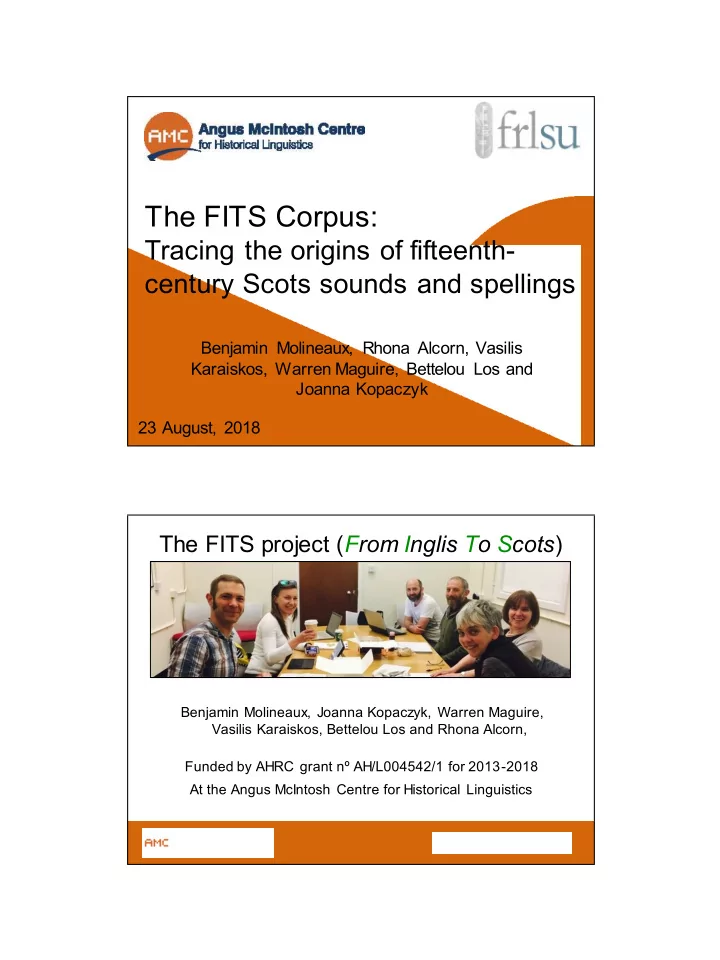
The FITS project (From Inglis To Scots)

Benjamin Molineaux, Joanna Kopaczyk, Warren Maguire, Vasilis Karaiskos, Bettelou Los and Rhona Alcorn, Funded by AHRC grant nº AH/L004542/1 for 2013-2018 At the Angus McIntosh Centre for Historical Linguistics

slide-2
SLIDE 2

๏ Research Questions ๏ How can we account for the diversity of spelling attested in pre-16C Scots? ๏ What can we learn about Scots phonology on the basis

  • f those spellings?

๏ Data: c.1,250 ‘local documents’ (c.400k words) written in Scots 1380-1500. From A Linguistic Atlas of Older Scots (‘LAOS’; Williamson 2008) ๏ Output: A freely available, fully searchable, richly annotated corpus of triads

OSc spelling unit OSc sound value Pre-Scots sound value

4

OSc <y> OSc [ɪ] OSc <k> OE [g] OE [i] OSc [k]

The FITS corpus of triads e.g. fysch ‘fish’ e.g. thynk ‘thing’

slide-3
SLIDE 3

5

OSc <y> OSc [ɪ] OSc <k> OE [g] OE [i] OSc [k]

The FITS corpus of changes e.g. fysch ‘fish’ e.g. thynk ‘thing’ SVL FD Short vowel lowering Final devoicing

How do we reconstruct OSc sound values?

Triangulate:

[?] [?]

Spelling Evidence Data from earlier and later stages Typology

  • f sound

change Phonological theory Scholarly literature

slide-4
SLIDE 4
  • Resolves word forms into units of spelling, e.g.
  • <wyir> = <w> | <y> | <i> | <r>
  • Assign likely sound values

Grapho-phonological parsing

(Kopaczyk et al. 2018)

Linguistic context w ord class,adjacent units Extralinguistic info date, location, text Linguistic context w ord class,adjacent units Extralinguistic info date, location, text

OSc spelling units OSc sound units

  • The database allows us to search for sounds and spellings

by a number of linguistic and extra-linguistic parameters

  • all morpheme-internal consonantal uses of <y>

Grapho-phonological parsing

(Kopaczyk et al. 2018)

slide-5
SLIDE 5

Grapho-phonological parsing

(Kopaczyk et al. 2018)

  • all morpheme-internal consonantal uses of <th>

Grapho-phonological parsing

(Kopaczyk et al. 2018)

slide-6
SLIDE 6

Grapho-phonological parsing

(Kopaczyk et al. 2018)

“Northern system”:

Jordan 1934, Benskin 1977, 1982, Stenroos 2004, Jensen 2012, Adamczy k 2016

bath > think > brother > there

Sound-spelling mapping: Older Scots <þ, y, th>

Function thence, there, thither, though, thus… Content thatch, thing, think, thorn, threat… N= 1872

FITS Data FITS Data

Word-medially: <y> and <th> = /ð/ other, brother /ð/

they them there

/θ/

think through thousand

<th> = <þ/y> = Word-initially: Word-finally: <th>= /θ/: booth, north

This is claimed to be the result of gradual entry of <th> into the spelling system (Benskin 1977: fn 9).

slide-7
SLIDE 7

brother, either, further, gather, other, rather, smithy, etc

N=1881

FITS Data FITS Data

  • Medial fricatives are

etymologically voiced

  • In early data we find

far more <th> spellings

  • By the end of the 15c,

when our data is most abundant, <y> predominates

  • <y> is growing as a

marker of /ð/

density of attestations across the corpus period

Sound-spelling mapping: Older Scots <þ, y, th>

๏ Older Scots displays an emerging norm that continues to

develop throughout the period, at least for initial and medial position:

๏ <y> is used for voiced contexts (initial function + medial) ๏ <th> is used for voiceless contexts (initial content + final)

๏ The <y>-for-voiced convention appears to spread from initial

to medial position, possibly a result of the initial spelling distinction between function and content words.

Sound-spelling mapping: Older Scots <þ, y, th>

slide-8
SLIDE 8

Spelling and sound substitution sets: Medusa

Overlapping spelling substitution sets for [θ] and [ð] Overlapping spelling substitution sets for [θ] and [ð]

Spelling and sound substitution sets

Overlapping sound substitution sets for <y>, <yh> and <ȝ> Overlapping sound substitution sets for <y>, <yh> and <ȝ>

๏ The use of <y> as a representation of the dental fricative has

consequences for the system as a whole, with the <yh> variant developing to represent /j/ in words like ‘year’ (alongside <y> and <ʒ>)

slide-9
SLIDE 9

Diachrony in the corpus

๏ In order to discover the changes that shaped the sound-system of Older Scots, we propose an etymological source for each item in the corpus. ๏ Each source segment (represented as a sound) is mapped on to a 15c Scots sound (where available) and a change mapping the one on to the other is proposed.

  • r

Old Northumbrian, Anglian, Old Norse, Middle Dutch

Initial Fricative Voicing

OSc sound OE sound

change

OSc graph

Diachrony in the corpus: IFV

๏ Sound changes are stored in a Corpus of Changes, ๏ It gives a narrative for each change ๏ Links to all proposed instances of the change ๏ The origins of spelling conventions are also accounted for in a corpus of spellings ๏ It provides an account of the origins of a particular sound-spelling match in the history of the language

slide-10
SLIDE 10

What will the FITS corpus do?

๏ How to account for the diversity of spelling in pre-16C Scots?

  • Grapho-phonological parsing: to link OSc spellings and sound
  • Etymological layer: to distinguish orthographic developments from

phonological ones ๏What can we learn about Scots phonology from these spellings?

  • Our corpus of triads identifies and quantifies:
  • relationships between OSc spellings and OSc sounds
  • relationships between OSc sounds & their etymological sources
  • the distribution of these relationships over time & space and within the

linguistic system

  • Our Corpus of Sound Changes & Corpus of Spelling Changes narrate

diachronic developments

Thanks!

More at www.amc.lel.ed.ac.uk/fits/

23 August, 2018

slide-11
SLIDE 11

Sound-spelling mapping: Older Scots <þ, y, th>

/θ/ /θ/ + <th>

=

Spellings Sounds <ð> <þ> ~<y> = /θ/ > /ð/ [θ]

betw een voiced segments: [oðer] elsew here: [θiŋg, θere] betw een voiced segments: /oðer/ w ord initially in function w ords: /ðere/

Older Scots

Benskin (1982)

<þ, ð> Old English

interchangeable interchangeable?

(phonemisation)

/ð/

think, thigh, bath there, they, brother

→ [ð] /θ/

elsew here: /θiŋg/

=

Diachrony in the corpus

๏ In order to discover the changes that shaped the sound-system of Older Scots, we propose an etymological source for each item in the corpus. ๏ Each source segment (represented as a sound) is mapped on to a 15c Scots sound (where available) and a change mapping the one on to the other is proposed.

  • r

Old Northumbrian, Anglian, Old Norse, Middle Dutch

Weak Vow el Neutralisation Weak Vow el Raising Northern Fronting

Spelling Sounds Old English Source

slide-12
SLIDE 12

Diachrony in the corpus: Northern Fronting

๏ Old English [o:] maps on to a number of spellings in OSc:

๏ OSc <o> makes up about half of the attestations, but there are numerous other options ๏ We know from later reflexes and the literature, that [o:] normally fronted [ø:] (and raised [y:]) ๏ There is no obvious spelling for [ø:] using the Roman alphabet

Diachrony in the corpus: Northern Fronting

๏ Following the literature, we postulate a change from [o:] > [ø:]: ’Northern Fronting’ ๏ The change, doesn’t only affect OE [o:], but also other OE elements that later join this category, such as stressed [u] in open syllables, such as in OE duru ‘door’

OE sounds 15c sounds CHANGES

Open Syllable Lengthening Northern Fronting Short Vowel Lowering

slide-13
SLIDE 13

Diachrony in the corpus: Northern Fronting

๏ Sound changes are stored in a Corpus of Changes, ๏ It gives a narrative for each change ๏ Links to all proposed instances of the change ๏ The origins of spelling conventions are also accounted for in a corpus of spellings ๏ It provides an account of the origins of a particular sound-spelling match in the history of the language

THIS WILL BE THE ENTRY FOR NORTHERN FRONTING