The Federal Circuit month at M ont h at a Glance TWO TUBES OR NOT - - PDF document

the federal circuit
SMART_READER_LITE
LIVE PREVIEW

The Federal Circuit month at M ont h at a Glance TWO TUBES OR NOT - - PDF document

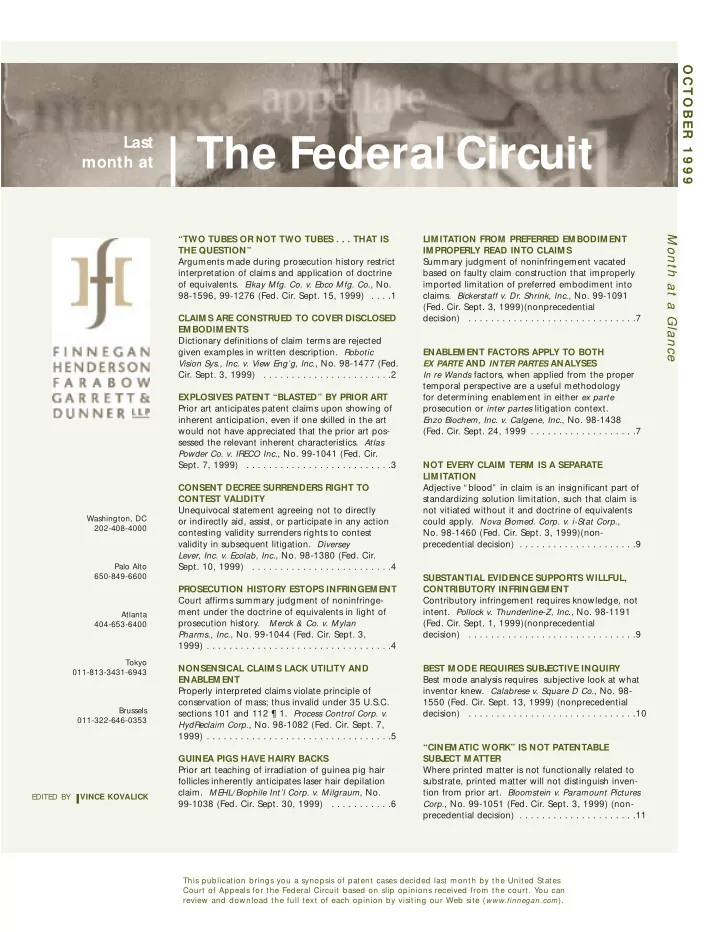
O CT O BER 1 9 9 9 Last The Federal Circuit month at M ont h at a Glance TWO TUBES OR NOT TWO TUBES . . . THAT IS LIM ITATION FROM PREFERRED EM BODIM ENT THE QUESTION IM PROPERLY READ INTO CLAIM S Arguments made during prosecution


slide-1
SLIDE 1

EDITED BY VINCE KOVALICK This publication brings you a synopsis of patent cases decided last month by the United States Court of Appeals for the Federal Circuit based on slip opinions received from the court. You can review and download the full text of each opinion by visiting our Web site (www.finnegan.com). Washington, DC 202-408-4000 Palo Alto 650-849-6600 Atlanta 404-653-6400 Tokyo 011-813-3431-6943 Brussels 011-322-646-0353

“TWO TUBES OR NOT TWO TUBES . . . THAT IS THE QUESTION” Arguments made during prosecution history restrict interpretation of claims and application of doctrine

  • f equivalents. E

lkay Mfg. Co. v. E bco Mfg. Co., No. 98-1596, 99-1276 (Fed. Cir. Sept. 15, 1999) . . . .1

CLAIM S ARE CONSTRUED TO COVER DISCLOSED EM BODIM ENTS Dictionary definitions of claim terms are rejected given examples in written description. Robotic

Vision Sys., Inc. v. View E ng’g, Inc., No. 98-1477 (Fed.

  • Cir. Sept. 3, 1999) . . . . . . . . . . . . . . . . . . . . . . .2

EXPLOSIVES PATENT “BLASTED” BY PRIOR ART Prior art anticipates patent claims upon showing of inherent anticipation, even if one skilled in the art would not have appreciated that the prior art pos- sessed the relevant inherent characteristics. Atlas

Powder Co. v. IRE CO Inc., No. 99-1041 (Fed. Cir.

  • Sept. 7, 1999) . . . . . . . . . . . . . . . . . . . . . . . . . .3

CONSENT DECREE SURRENDERS RIGHT TO CONTEST VALIDITY Unequivocal statement agreeing not to directly

  • r indirectly aid, assist, or participate in any action

contesting validity surrenders rights to contest validity in subsequent litigation. Diversey Lever, Inc. v. E colab, Inc., No. 98-1380 (Fed. Cir.

  • Sept. 10, 1999) . . . . . . . . . . . . . . . . . . . . . . . . .4

PROSECUTION HISTORY ESTOPS INFRINGEM ENT Court affirms summary judgment of noninfringe- ment under the doctrine of equivalents in light of prosecution history. Merck & Co. v. Mylan

Pharms., Inc., No. 99-1044 (Fed. Cir. Sept. 3, 1999) . . . . . . . . . . . . . . . . . . . . . . . . . . . . . . . . .4

NONSENSICAL CLAIM S LACK UTILITY AND ENABLEM ENT Properly interpreted claims violate principle of conservation of mass; thus invalid under 35 U.S.C. sections 101 and 112 ¶ 1. Process Control Corp. v.

HydReclaim Corp., No. 98-1082 (Fed. Cir. Sept. 7, 1999) . . . . . . . . . . . . . . . . . . . . . . . . . . . . . . . . .5

GUINEA PIGS HAVE HAIRY BACKS Prior art teaching of irradiation of guinea pig hair follicles inherently anticipates laser hair depilation

  • claim. ME

HL/ Biophile Int’l Corp. v. Milgraum, No. 99-1038 (Fed. Cir. Sept. 30, 1999) . . . . . . . . . . .6

LIM ITATION FROM PREFERRED EM BODIM ENT IM PROPERLY READ INTO CLAIM S Summary judgment of noninfringement vacated based on faulty claim construction that improperly imported limitation of preferred embodiment into

  • claims. Bickerstaff v. Dr. Shrink, Inc., No. 99-1091

(Fed. Cir. Sept. 3, 1999)(nonprecedential decision) . . . . . . . . . . . . . . . . . . . . . . . . . . . . . .7 ENABLEM ENT FACTORS APPLY TO BOTH EX PARTE AND INTER PARTES ANALYSES In re Wands factors, when applied from the proper temporal perspective are a useful methodology for determining enablement in either ex parte prosecution or inter partes litigation context. E nzo Biochem, Inc. v. Calgene, Inc., No. 98-1438 (Fed. Cir. Sept. 24, 1999 . . . . . . . . . . . . . . . . . . .7 NOT EVERY CLAIM TERM IS A SEPARATE LIM ITATION Adjective “ blood” in claim is an insignificant part of standardizing solution limitation, such that claim is not vitiated without it and doctrine of equivalents could apply. Nova Biomed. Corp. v. i-Stat Corp.,

  • No. 98-1460 (Fed. Cir. Sept. 3, 1999)(non-

precedential decision) . . . . . . . . . . . . . . . . . . . . .9 SUBSTANTIAL EVIDENCE SUPPORTS WILLFUL, CONTRIBUTORY INFRINGEM ENT Contributory infringement requires knowledge, not

  • intent. Pollock v. Thunderline-Z, Inc., No. 98-1191

(Fed. Cir. Sept. 1, 1999)(nonprecedential decision) . . . . . . . . . . . . . . . . . . . . . . . . . . . . . .9 BEST M ODE REQUIRES SUBJ ECTIVE INQUIRY Best mode analysis requires subjective look at what inventor knew. Calabrese v. Square D Co., No. 98- 1550 (Fed. Cir. Sept. 13, 1999) (nonprecedential decision) . . . . . . . . . . . . . . . . . . . . . . . . . . . . . .10 “CINEM ATIC WORK” IS NOT PATENTABLE SUBJ ECT M ATTER Where printed matter is not functionally related to substrate, printed matter will not distinguish inven- tion from prior art. Bloomstein v. Paramount Pictures Corp., No. 99-1051 (Fed. Cir. Sept. 3, 1999) (non- precedential decision) . . . . . . . . . . . . . . . . . . . . .11

O CT O BER 1 9 9 9

The Federal Circuit

Last month at

M ont h at a Glance

slide-2
SLIDE 2

“Two Tubes or Not Two Tubes . . . That Is the Question”

J acqueline D. Wright

[J udges: Gajarsa (author), Rich, and Plager] In E

lkay Manufacturing Co. v. E bco Manufacturing Co., No. 98-1596 (Fed. Cir. Sept.

15, 1999), the Federal Circuit reversed the dis- trict court’s holding that U.S. Patent No. 5,222,531 (“ the ‘531 patent” ) and 5,289,855 (“ the ‘855 patent” ) owned by Elkay Manufacturing Company (“ Elkay” ) are valid and infringed by Ebco Manufacturing Company and Ebtech Corporation (“ Ebco” ). Based on a proper claim construction, the Federal Circuit concluded that Ebco’s accused devices did not infringe the asserted claims of the patents either literally or under the doctrine of equivalents (“ DOE” ), and the Court consequently vacated the associated damages award. The ‘531 and ‘855 patents claim “ no-spill” adapters for bottled water coolers that permit bottles of water to be inserted into coolers with the cap still on the bottle, thereby eliminating problems of spillage or contamination. The accused devices, Ebco’s WaterGuard I, II, and III no-spill adapters, comprise two concentric tubes constructed so that water flows down the inner tube from the bottle into the cooler and air flows up into the bottle through the annular region formed by the two tubes. The claim construction at issue centers on the claim limitations of “ an upstanding feed tube . . . to provide a hygienic flow path for delivering liquid from . . . and for admitting air . . . into said container” in claims 1 and 7 of the ‘531 patent and claim 1 of the ‘855 patent. When interpreting these limitations, the district court had stated that the article “ an” does not pre- clude a separation of the air and water flow (i.e., two tubes) or otherwise require the intermin- gling of air and water within the feed tube (i.e.,

  • ne tube).

On appeal, Ebco argued that the normal, accepted meaning of the use of the articles “ a” and “ an” requires that the limitations be con- strued as describing one feed tube with a single path for both air and water. The Federal Circuit stated, however, that while “ a” and “ an” may suggest “ one,” these articles can actually mean either “ one” or “ more than one,” depending on the context in which the article is used. In addi- tion, although the use of “ a” and “ an,” when referring to “ feed tube” and “ flow path,” as well as other language in the claims, suggest a single feed tube with a single flow path for liquid and air, the asserted claims also use the open term “ comprising” in their transition phrases. Thus, the Federal Circuit ruled that the plain meaning

  • f the above-mentioned claim limitations is not

necessarily limited to a single feed tube with a single flow path for both liquid and air. Ebco also asserted that the written descrip- tion confirms that the feed tube must be a single flow path for air and water, since numerous ref- erences appear in the specification to “ a feed tube” and “ the feed tube” and that the figures show a single feed tube with a single flow path for liquid and air. The Court noted, however, that the written description describes a preferred

  • embodiment. Since claims of a patent are not

limited to a preferred embodiment, unless by their own language, the Court determined that the written description does not conclusively establish that the meaning of the claim limita- tions is limited to a single feed tube with a single flow path. The Federal Circuit found, however, that the prosecution history of the patents showed that Elkay gave up a construction of the feed tube/probe limitation that could include an apparatus with separate flow paths for liquid and

  • air. Specifically, during prosecution, the

Examiner had rejected claims pursuant to 35 U.S.C. section 103, based on two patents. Importantly, one of those patents (“ Krug” ) described a beer dispensing apparatus with two separate feed tubes, one for pressurized air and

  • ne for beer.

Elkay responded to the Examiner’s rejection by distinguishing Krug on the ground that Elkay claimed a flow path for delivering liquid and air. In addition, Elkay did not respond to the Examiner’s Statement of Reasons for Allowance, where the Examiner wrote that he had allowed claim 7 in the ‘531 patent because he under- stood the claim to describe a single feed tube with a single flow path for both liquid and air. Therefore, the Federal Circuit concluded that Elkay had disavowed a potential interpretation of the feed tube limitations that would have includ- ed separate feed tubes or flow paths. Accord- ingly, the Court held that the relevant claim limi-

page 01 L A ST M O N T H A T

T H E F E D E R A L C I R C U I T

FI N N EG A N H EN D ERSO N FA RA B O W G A RRET T D U N N ER L L P.

slide-3
SLIDE 3

1 9 9 9 O C T O B ER

02 page

FI N N EG A N H EN D ERSO N FA RA B O W G A RRET T D U N N ER L L P.

tations in the ‘531 patent refer to a single feed tube with a single flow path for both liquid and air. The Court applied the same interpretation to the asserted claims of the ‘855 patent, which resulted from a later filed continuation applica- tion from the ‘531 patent application. Based on a proper claim construction, the Federal Circuit concluded that no reasonable fact finder could determine that the accused devices meet every limitation of the properly construed claims of the ‘531 and the ‘855 patents. Hence, the Court found no literal infringement. Furthermore, as stated by the Federal Circuit, prosecution history estoppel prevents the opera- tion of the DOE from expanding claim limita- tions to include subject matter surrendered dur- ing prosecution. Therefore, prosecution history estoppel, based on the prosecution history of the ‘531 patent, was applied to prevent the opera- tion of the DOE to extend the coverage of the claims to include a separate feed tube or flow path for liquid and air. Moreover, the Court held that Elkay’s surrender of coverage of a separate feed tube or flow path also applied to the claim

  • f the ‘855 patent based on that claim’s connec-

tion to the relevant claims of the ‘531 patent. Thus, the Federal Circuit determined that no rea- sonable fact finder could find that the feed tube/probe limitation in these claims was met equivalently in the accused devices. Consequently, the Court reversed the district court’s decision, and held that the accused WaterGuard I, II, and III no-spill adapters did not infringe the asserted claims of the ‘531 and ‘855 patents, either literally or under the DOE. [Darrel Karl and Don Dunner of our firm suc- cessfully represented Ebco on this appeal.]

Claims Are Construed to Cover Disclosed Embodiments

Charles W. Chesney

[J udges: Gajarsa (author), Clevenger, and Bryson] In Robotic Vision Systems, Inc. v. View

E ngineering, Inc., No. 98-1477 (Fed. Cir. Sept. 3,

1999), the Federal Circuit affirmed a district court decision that View Engineering, Inc. (“ View” ) infringed certain claims of U.S. Patent

  • No. 5,465,152 (“ the ‘152 patent” ), a patent

directed to techniques for inspection of integrat- ed circuits, and affirmed a decision that the patent is not invalid for obviousness. Robotic Vision Systems, Inc. (“ RVSI” ) brought suit against View alleging that it had infringed the method claims of the ‘152 patent. The ‘152 patent is directed to a method for coplanarity inspection of package or substrate warpage for ball grid arrays (“ BGA” ), column arrays, and similar structures. BGAs are integrat- ed circuit devices that have an array of solder balls on one face. RVSI alleged that the View Model 880 inspection machine, which measures BGA coplanarity, infringes the ‘152 patent. Claim 1 of the ‘152 patent recites, in part, a method comprising the steps of: providing

  • paque fiducials as index pads, where the

heights of said index pads are correlated with signal pad heights, disposing said index pads in a prearranged pattern, restricting said index pads to a predetermined range of heights, and meas- uring the heights of at least three of said index pads. Before the district court, View moved for summary judgment of noninfringement, arguing that when properly interpreted, the terms “ pro- viding,” “ correlating,” “ disposing,” and “ restrict- ing” require the manufacture or fabrication of the index pads along with their measurement. The district court rejected this argument and ruled that these terms did not require separate manufacture of the index pads, but encom- passed the selection of preexisting signal pads. Following a bench trial, the district court reiterat- ed its claim construction and found that the View Model 880 device had infringed. On appeal, View again argued that the above terms require separate manufacture, and that the Model 880 does not perform these steps because it simply selects device signal pads as measurement targets. View contended that the district court had ignored the ordinary and cus- tomary meanings of these terms, and instead had looked to examples provided in the written specification of the ‘152 patent. Following its precedent, the Federal Circuit looked to the writ- ten specification to resolve the ambiguity of the above terms, and found that the written descrip- tion clearly discloses embodiments in which

slide-4
SLIDE 4

index pads are unused signal pads. Further, the Federal Circuit looked to the other claims of the patent, including dependent claim 12, which, the Court found, clearly shows that independent claim 1 does not require separate fabrication of the index pads. Accordingly, the Federal Circuit affirmed the district court’s interpretation of the ‘152 patent, construing claim 1 to encompass a measurement method in which index pads can be either sepa- rately manufactured or simply selected from existing signal pads. The Federal Circuit also rejected View’s argu- ment that if the claims are construed as broadly as the district court’s interpretation, then the claimed invention would have been obvious in light of the prior art because the prior art, as reflected in the record, did not disclose using sig- nal pads for coplanarity measurements, or sug- gestion substituting signal pads for ball-top coplanarity measurements. With regard to View’s invalidity position, the Federal Circuit held that the party seeking a holding of invalidity based on a combination of two or more prior art teachings must show some motivation or suggestion to combine the teach- ings.

Explosives Patent “Blasted” by Prior Art

Steven J . Scott

[J udges: Rader (author), M ayer, and M ichel] In Atlas Powder Co. v. IRE

CO Inc., No. 99-

1041 (Fed. Cir. Sept. 7, 1999), the Federal Circuit affirmed a district court’s finding that

  • riginal U.S. Patent No. 4,111,727 and Reissue

Patent No. RE 33,788 (collectively “ the Clay patents” ) were invalid as being inherently antici- pated by the prior art. The Clay patents claim explosive-blasting compositions containing specific percentages of a particulate solid oxidizer and a water-in-oil

  • emulsion. The water-in-oil emulsion also con-

tains a solid oxidizer, and all solid oxidizers of the composition comprise ammonium nitrate. The claims also recite that “ sufficient aeration is entrapped” in the compositions “ to enhance sensitivity to a substantial degree.” The “ suffi- cient aeration” provides small air bubbles in the compositions that compress and heat up upon detonation of the composition, thereby sensitiz- ing the fuel in the composition to ignition and furthering the explosion. IRECO Inc. (“ IRECO” ) argued that the Clay patents had been anticipated by prior art patents to Egly and Butterworth, which both disclose blasting compositions containing ammonium nitrate and water-in-oil emulsions in percentages that overlap those claimed in the Clay patents. Neither prior art patent expressly taught the limi- tation of “ sufficient aeration . . . entrapped to enhance sensitivity to a substantial degree,” but IRECO argued that the property would inherently flow from the specific percentages of ammonium nitrate and water-in-oil emulsions disclosed in the prior art patents. Although the U.S. Patent and Trademark Office (“ PTO” ) had allowed the Clay reissue patent over the Egly and Butterworth references, both the district court and Federal Circuit con- cluded that IRECO presented sufficient additional testimonial and documentary evidence, which had not been considered by the PTO, to over- come the presumption of validity of the Clay patents. Because the Egly and Butterworth patents disclosed composition ingredients identical to those of the Clay patents, the only remaining issue was whether the “ sufficient aeration” limi- tation was inherently present in the Egly and Butterworth explosives. Expert testimony estab- lished that “ sufficient aeration” in a blasting composition is a function of the ratio of solid oxi- dizer to water-in-oil emulsion. Thus, because the prior art references had disclosed ranges of solid

  • xidizer and water-in-oil emulsions identical to

those in the Clay patents, the prior art composi- tions inherently possessed the “ sufficient aera- tion” limitation. IRECO also presented results of experiments performed on blasting compositions disclosed in the prior art patents. Those tests indicated that the compositions of the prior art had contained the “ sufficient aeration” required by the Clay patents. According to the Court, even though the prior art references had not recognized the key aspect of the Clay invention, i.e., “ sufficient aera- tion,” the evidence provided by IRECO was suffi- cient to show that the prior art had anticipated the Clay patents. The Federal Circuit therefore

page 03 L A ST M O N T H A T

T H E F E D E R A L C I R C U I T

FI N N EG A N H EN D ERSO N FA RA B O W G A RRET T D U N N ER L L P.

slide-5
SLIDE 5

1 9 9 9 O C T O B ER

04 page

FI N N EG A N H EN D ERSO N FA RA B O W G A RRET T D U N N ER L L P.

affirmed the district court’s finding that the Clay patents were invalid as being anticipated by the prior art.

Consent Decree Surrenders Right to Contest Validity

Laural S. Boone

[J udges: M ayer (author), Newman, and Schall] In Diversey Lever, Inc. v. E

colab, Inc., No. 98-

1380 (Fed. Cir. Sept. 10, 1999), the Federal Circuit affirmed a summary judgment (“ SJ ” ) that Ecolab, Inc. (“ Ecolab” ) had infringed U.S. Patent

  • Nos. 5,009,801 (“ the ‘801 patent” ) and

5,073,280 (“ the ‘280 patent” ). The ‘801 and ‘280 patents cover conveyer belt lubricants to inhibit stress cracking of bever- age bottles made of polyethylene terphthalate (“ PET” ). In 1991, Diversey Lever, Inc.’s predeces- sors (collectively “ Diversey” ) brought a patent infringement suit against Ecolab, alleging that the latter’s PET GUARD lubricant infringed the ‘801 and ‘280 patents. A 1993 settlement had resulted, in a consent decree stating that Diversey’s ‘801 and ‘280 patents were valid and enforceable and that Ecolab “ will not directly or indirectly aid, assist or participate in any action contesting the validity of either the ‘801 or ‘280 patents.” The decree also had defined two spe- cific compositions and defined a scope of prod- ucts that Ecolab was prohibited from making or selling. Diversey had brought the present suit in 1996, alleging that Ecolab’s new PET GUARD IIB and PET*STAR infringed the ‘801 and ‘280

  • patents. Ecolab argued that the patents are

invalid, and, alternatively, that because the prod- ucts at issue are outside the defined products clause of the consent decree, the consent decree tacitly granted Ecolab permission to infringe. The district court granted Diversey partial SJ motion, holding that by the consent decree Ecolab had expressly waived an invalidity defense, and that Diversey could enforce its patents against Ecolab’s products that are out- side the defined products clause. On appeal, the Federal Circuit agreed that Ecolab had indeed waived its right to contest the validity of the patents. The Court agreed that Ecolab, by its own unequivocal statement agree- ing not to directly or indirectly aid, assist, or par- ticipate in any action contesting the validity of the patents, had surrendered its right to chal- lenge the validity of the patents in any context.

Prosecution History Estops Infringement

Gregory A. Chopskie

[J udges: Newman (author), Lourie, and Clevenger] In Merck & Co. v. Mylan Pharmaceuticals, Inc.,

  • No. 99-1044 (Fed. Cir. Sept. 3, 1999), the

Federal Circuit affirmed a district court’s ruling of noninfringement of two patents owned by Merck & Company, Inc. (“ Merck” ), finding that prosecution history estopped infringement under the doctrine of equivalents (“ DOE” ). Merck brought suit against Mylan Pharmaceuticals, Inc. (“ Mylan” ) for infringement under the DOE of U.S. Patent Nos. 4,832,957 (“ the ‘957 patent” ) and 4,900,755 (“ the ‘755 patent” ). The district court had granted summa- ry judgment in favor of Mylan on the grounds that the prosecution history of the patents-in-suit and the prior art precluded a finding of equiva- lency. The relevant claims of the ‘957 and ‘755 patents concern a controlled release formulation

  • f carbidopa and levodopa for use in the treat-

ment of Parkinson’s disease. In both the ‘957 and ‘755 patents, the claimed vehicle comprised a water-soluble hydroxypropyl cellulose (“ HPC” ) polymer and a less water-soluble polyvinyl acetate-crotonic acid (“ PVACA” ) copolymer (“ HPC/PVACA” ). Mylan’s accused formulation comprised an HPC and hydroxypropyl methylcel- lulose (“ HPMC” ) combination (“ HPC/HPMC” ). Thus, to capture Mylan’s formulation under the DOE, Merck contended that Mylan’s use of HPMC was equivalent to the claimed PVACA. Mylan argued that Merck surrendered the HPC/HPMC combination during the prosecution

slide-6
SLIDE 6
  • f the patents and that the prior art prevented

application of the DOE to encompass Mylan’s formulation. In each of the patents-in-suit Merck attempt- ed to claim a polymer vehicle comprising, among other combinations, the HPC/HPMC

  • vehicle. Both applications were rejected as obvi-
  • us under 35 U.S.C. section 103 in light of,

among other references, U.S. Patent Nos. 4,424,235 (“ Sheth” ) and 4,389,393 (“ Schor” ), each of which describes a HPC/HPMC polymer

  • vehicle. The Examiner also required Merck to

make an election of species pursuant to 35 U.S.C. section 121. Ultimately, Merck narrowed its claims to include only the HPC/PVACA combi- nation and did not pursue the HPC/HPMC drug- delivery vehicle, or any other combinations, in another application. Before the district court and on appeal, Merck claimed that it had narrowed the scope of the polymer vehicle in response to the Examiner’s restriction requirement and not because the claims were unpatentable under sec- tion 103. Accordingly, no prosecution history estoppel arose. The Federal Circuit disagreed. Noting that Merck’s failure to pursue the broader polymer claims suggested that its amendments were, in fact, pursuant to the obviousness rejec- tion, the Federal Circuit held that a prosecution history estoppel arose. As to the scope of the estoppel, the Federal Circuit held that since the Examiner had rejected Merck’s claims in light of references that disclosed a HPC/HPMC polymer vehicle, it was estopped as to that vehicle and could not recapture it under the DOE.

Nonsensical Claims Lack Utility and Enablement

Barry D. Biddle

[J udges: Gajarsa (author), Bryson, and Friedman] In Process Control Corp. v. HydReclaim Corp.,

  • No. 98-1082 (Fed. Cir. Sept. 7, 1999), the

Federal Circuit reversed a district court’s determi- nation that U.S. Patent No. 5,148,943 (“ the ‘943 patent” ) was not invalid and vacated the district court’s finding of infringement. The Federal Circuit held that the district court’s determina- tion of validity had been based on an improper claim construction. HydReclaim Corporation’s (“ HydReclaim” ) ‘943 patent is directed to continuous gravimetric blenders that are used in the plastics industry to mix multiple solid ingredients in appropriate pro- portions, based on weight, and feed the mixture to a weighed common hopper. The claimed invention controls the discharge rate of the blender by measuring the weight of the material in the common hopper and maintaining that weight. The issue of validity turned on the proper construction of the phrase “ discharge rates” as used in two separate limitations in the asserted

  • claims. Process Control Corporation (“ Process

Control” ) argued that the phrase should be given the same meaning throughout the claim,

i.e., the rate at which the material is discharged

to the processing machine. HydReclaim argued that based on the written description, the sec-

  • nd occurrence of “ discharge rates” denoted the

“ change in weight of the common hopper.” The district court adopted HydReclaim’s construction, holding that the patentee had specifically defined the second occurrence of “ discharge rates” in the written description to denote “ change in weight.” On appeal, Process Control argued that adoption of the district court’s claim construc- tion: (1) resulted in the second occurrence of “ discharge rate” having no antecedent basis; (2) redefined the second occurrence of the term, contrary to the explicit definition of that term in the claim itself; and (3) resulted in the use of a different term for the same limitation in a single claim for those claims requiring a “ second weighing means . . . for detecting a change in weight of the ingredients” in the common hop-

  • per. HydReclaim countered that the district

court’s claim construction was proper because claims should be construed to preserve their validity and to secure the patentee his actual

  • invention. HydReclaim admitted that if the

Court adopted Process Control’s construction, the claims would be invalid as they would not make sense. The Federal Circuit agreed with HydReclaim that claims generally should be construed to pre- serve their validity, but only when the claim lan- guage is reasonably susceptible to two construc-

page 05 L A ST M O N T H A T

T H E F E D E R A L C I R C U I T

FI N N EG A N H EN D ERSO N FA RA B O W G A RRET T D U N N ER L L P.

slide-7
SLIDE 7

1 9 9 9 O C T O B ER

06 page

FI N N EG A N H EN D ERSO N FA RA B O W G A RRET T D U N N ER L L P.

tions, and not merely as a means to cure a draft- ing error. The Court found that the “ discharge rate” in each limitation was referring to the same rate, as each phrase was associated with the clause “ from the common hopper to the materi- al processing machine,” and pointed out that this conclusion avoids any lack of antecedent basis. In addition, while noting that a patentee can act as his own lexicographer, the Court found that the written description did not clearly rede- fine the “ discharge rate,” as used in the second

  • ccurrence, so as to put a reasonable competitor
  • r one reasonably skilled in the art on notice that

the patentee had intended to so redefine the

  • claim. Thus, the Court ruled that the claim was

susceptible to only one reasonable construction, and that the claims must be construed as the patentee had drafted it. Having determined the claims to be suscep- tible to only one reasonable interpretation, thus resulting in a nonsensical construction of the claim, the Federal Circuit considered under what theory to find the claims invalid—lack of enable- ment or absence of utility. The Court stated that the two theories are closely related. The enable- ment requirement requires that the specification adequately disclose to one skilled in the relevant art how to carry out a process, while the utility requirement requires that the patentable inven- tion be useful and that the subject matter of the claim be operable. Accordingly, if a patent fails to meet the utility requirement because it is not

  • perable, then it also fails to meet the how-to-

use element of the enablement requirement. Thus, the Court held that the correctly construed claims were invalid because they were inopera- tive and, therefore, failed to comply with both the utility and enablement requirements.

Guinea Pigs Have Hairy Backs

Lawrence F . Galvin

[J udges: Rader (author), M ayer, and M ichel] In ME

HL/ Biophile International Corp. v. Milgraum, No. 99-1038 (Fed. Cir. Sept. 30,

1999), the Federal Circuit affirmed a district court’s grant of a motion for summary judgment (“ SJ ” ) of patent invalidity. The Court based its decision on the inherent teachings of a prior art reference that anticipate the asserted patent claims. Hair strands grow out of tubular apertures in the skin known as hair follicles. At the base of each follicle is the papilla, a collection of germ cells from which individual hair strands actually

  • grow. Sufficient damage to a papilla prevents

regrowth of its associated hair strand. U.S. Patent No. 5,059,192 (“ the ’192 patent” ) issued to Dr. Nardo Zaias claims a method of hair depletion using a laser beam to damage a papilla. Claim 1 requires the step of aligning a laser beam “ substantially vertically

  • ver a hair follicle opening.”
  • Dr. Zaias and his licensees (collectively

“ MEHL/Biophile” ) sued Palomar Medical Technologies, Inc.; its wholly owned subsidiary Spectrum Medical Technologies, Inc.; and Sandy Milgraum, M.D. (collectively “ Milgraum” ), alleg- ing infringement of all claims of the ’192 patent. Milgraum moved for SJ

  • f invalidity based
  • n 35 U.S.C. section 102, arguing inherency

based on two references: the RD-1200 instruc- tion manual, which teaches laser methods to remove tattoos, and a 1989 journal article by

  • Dr. Luigi Polla and others (“ the Polla article” ).

The Polla article documented studies of pigment- ed cell injury in guinea pigs exposed to Q- switched ruby laser energy. After considering both references, the district court granted SJ based on the RD-1200 instruction manual. On appeal, the Federal Circuit found that the RD-1200 instruction manual does not discuss hair follicles and does not inherently teach the limitations because the record does not disclose a relationship between the location of a tatoo and the location of a hair follicle. Unlike the instruction manual, the Polla arti- cle explicitly discusses the application of laser energy to a guinea pig’s hair follicle and the resulting damage to the follicle’s associated

  • papilla. According to the Court, “ [n]o one dis-

putes that guinea pigs have hairy backs.”

ME HL/ Biophile, slip op. at 4. Further, the Polla

article teaches holding the laser in contact with a guinea pig’s skin, thus inherently teaching the “ substantially vertically over a hair follicle open- ing” claim limitation. Accordingly, the Federal Circuit affirmed the grant of SJ

  • f invalidity with

respect to the claims of the ’192 patent.

slide-8
SLIDE 8

Limitation from Preferred Embodiment Improperly Read into Claims

William Z. Nakhleh

[J udges: Schall (author), M ayer, and Bryson] In Bickerstaff v. Dr. Shrink, Inc., No. 99-1091 (Fed. Cir. Sept. 3, 1999) (nonprecedential deci- sion), the Federal Circuit vacated a district court’s grant of summary judgment (“ SJ ” ) of nonin- fringement in favor of Dr. Shrink, Inc. (“ Dr. Shrink” ), finding fault with the district court’s claim construction. In addition, the Federal Circuit found no error in the district court’s denial of SJ where ambiguity in a settlement agreement directed to another, similar patent created a genuine issue of material fact. Othell Bickerstaff’s (“ Bickerstaff” ) patent, U.S. Patent No. 5,081,911 (“ the ‘911 patent” ), enti- tled “ Vent for Shrink Film Packaging,” is directed to a vent for shrinkwrap typically used to protect boats and aircraft from environmental condi-

  • tions. The ‘911 patent claims a vent, containing

an array of holes with covers, known as “ cowls,” with “ each cowl for shielding one of the holes.” The “ shielding” limitation was added to claim 1 by amendment after the application had been rejected. Bickerstaff sued Dr. Shrink in the district court for infringement of the ‘911 patent.

  • Dr. Shrink manufactures a vent for shrinkwrap.
  • Dr. Shrink’s vent also includes an array of holes,

but includes only one cowl per row of holes to shield each hole in the row. The district court interpreted the term “ cowl” to mean “ a hood of any shape” and the phrase “ each cowl for shield- ing one hole” to mean that “ each hole must have a separate cowl.” After construing the claims, the district court granted SJ

  • f noninfringement in favor of
  • Dr. Shrink, concluding that no reasonable jury

could have concluded that the common cowls for each row of holes in Dr. Shrink’s vent were separate and that prosecution history estoppel had barred a finding of equivalence. The Federal Circuit disagreed with the district court’s deter- mination that there must be a separate cowl for each hole. Although in a preferred embodiment a separate cowl for each hole was required, the Court observed the word “ separate” did not find its way into the claims. Without the requirement

  • f a separate cowl for each hole in the claims,

the Court concluded, a reasonable jury could find infringement, as Dr. Shrink’s vent includes a common cowl for each row of holes. Because the claims did not require a separate cowl for each hole, the district court had erred in making findings on such a nonexistent limitation. On a related issue, the Federal Circuit found no error in the district court’s refusal to grant SJ in favor of Dr. Shrink pursuant to a settlement agreement (“ Agreement” ) of U.S. Patent No. 4,247,509 (“ the ‘509 patent” ). The ‘509 patent is directed to a method for weatherizing boats by shrinkwrapping them. This patent describes the use of vents to avoid moisture condensation, but it did not disclose the vent claimed in the ‘911 patent. The Agreement had released all present and future claims regarding the ‘509

  • patent. In the district court, Dr. Shrink had con-

tended that the present lawsuit was within the scope of the Agreement, and therefore should be

  • dismissed. The district court had denied
  • Dr. Shrink’s motion for SJ

, because the Agreement was ambiguous as to whether the parties had intended it to cover the ‘911 patent. Because the ‘911 patent’s vent is used together with the shrinkwrapping method of the ‘509 patent, the Agreement could be interpreted either as precluding or permitting lawsuits based

  • n the ‘911 patent. The Federal Circuit agreed,

finding no error with the district court’s conclu- sion that the Agreement could be interpreted two ways.

Enablement Factors Apply to Both Ex Parte and Inter Partes Analyses

Steven P . O’Connor

[J udges: Lourie (author), Smith, and Schall] In E

nzo Biochem, Inc. v. Calgene, Inc., No. 98-

1438 (Fed. Cir. Sept. 24, 1999), the Federal Circuit affirmed the district court’s judgment of invalidity for lack of enablement of the asserted claims in two patents, U.S. Patent Nos. 5,190,931 (“ the ‘931 patent” ) and 5,208,149 (“ the ‘149 patent” ). The Federal Circuit also

page 07 L A ST M O N T H A T

T H E F E D E R A L C I R C U I T

FI N N EG A N H EN D ERSO N FA RA B O W G A RRET T D U N N ER L L P.

slide-9
SLIDE 9

1 9 9 9 O C T O B ER

08 page

FI N N EG A N H EN D ERSO N FA RA B O W G A RRET T D U N N ER L L P.

affirmed the district court’s judgment of validity

  • f claims in related U.S. Patent No. 5,272,065

(“ the ‘065 patent” ), upheld the district court’s refusal to open the record to new evidence, and vacated the district court’s judgment not to award attorney fees. Enzo Biochem, Inc. (“ Enzo” ) sued Calgene,

  • Inc. (“ Calgene” ), asserting that Calgene’s Flavr

Savr tomato infringed certain claims of the ‘931 and ‘149 patents. Calgene filed a counterclaim seeking a declaratory judgment that the ‘931, ‘149, and ‘065 patents were invalid, unenforce- able for inequitable conduct, and not infringed. Both parties sought attorney fees under 35 U.S.C. section 285. The three patents-in-suit, which have nearly identical written descriptions, disclose and claim antisense technology. Antisense is a method of controlling the expression of a particular gene. The patents teach the application of antisense technology to regulate three genes in the prokaryote E

scherichia coli (“ E . coli” ). The claims

  • f the ‘931, ‘149, and ‘065 patents, however,

were broadly directed to the practice of anti- sense technology in all prokaryotic and eukaryot- ic cells, tomato cells being eukaryotic. At the conclusion of a bench trial, the district court determined that Calgene’s recombinant tomato did not infringe any of the asserted claims in the ‘931 and ‘149 patents, and that the claims were invalid under U.S.C. section 112 ¶ 1, because the specification only enabled the prac- tice of antisense technology in E

. coli cells. The

‘065 patent claims were found not invalid. The court did not decide the inequitable conduct issue, and it denied the parties’ requests for attorney fees because the case was not excep- tional. On appeal, Enzo argued that the district court had erred in holding that the asserted claims of the ‘931 and ‘149 patents were not

  • enabled. It urged that by applying the enable-

ment factors set forth in In re Wands, 858 F .2d 731 (Fed. Cir. 1988), the district court had used the wrong analytical framework in assessing enablement because the Wands factors only apply to ex parte prosecution. The Federal Circuit rejected this argument, agreeing with Calgene that the Wands factors also apply to

inter partes litigation. Having determined that

the Wands factors apply, the Court then consid- ered the district court’s enablement analysis. The Court agreed that the district court, with one exception, had not erred in concluding that the asserted claims encompassed the prac- tice of antisense in all cells, both prokaryotic and

  • eukaryotic. Furthermore, the Federal Circuit

found ample support in the record for the dis- trict court’s determination that antisense was a highly unpredictable technology. Relying on the patentee’s failed attempts to use antisense tech- nology to regulate genes in prokaryotes other than E

. coli or in eukaryotes, the Court found

that the amount of experimentation needed to practice antisense in cells other than E

. coli was

quite high. The Court next considered the amount of direction presented by the specification, includ- ing the working examples. The district court had characterized the working examples as very

  • narrow. Other than three regulated E

. coli genes,

the patents provided no guidance, direction, or working examples for practicing the invention in eukaryotes, or even prokaryotes other than

E . coli. The Court characterized these teachings

as providing a “ plan” or “ invitation” for those of skill in the art to practice antisense in eukaryotes, but they failed to provide sufficient guidance or specificity as to how one could execute the plan. While the Court agreed with Enzo that the patents teach a basic blueprint for practicing antisense in eukaryotes, it also agreed with Calgene that the patents provide only a “ germ

  • f the idea” for exploiting antisense in these
  • cells. What was missing from the patents,

according to the Court, was disclosure of any direction or examples of how to practice anti- sense in any cell other than E

. coli.

The Court also rejected Enzo’s additional arguments in support of enablement, which included determinations by the U.S. Patent and Trademark Office and European Patent Office of enablement and examples of postfiling successes

  • f antisense in other types of cells. In sum, the

Court found that the district court had not clear- ly erred in its fact findings and affirmed the dis- trict court’s holding that the claims were invalid for lack of enablement. The Court also affirmed the district court’s holding that the ‘065 patent claims were not

  • invalid. The Federal Circuit was not persuaded

by Calgene’s argument that it satisfied its eviden- tiary burden for these claims because it had pre- sented clear and convincing evidence of nonen-

slide-10
SLIDE 10

ablement with respect to the claims of the ‘931 and ‘149 patents, which applies with equal force to the ‘065 patent since all three patents share a common specification. Instead, the Court agreed with Enzo, concluding that “ a party may not avoid its burden of proof by making a blan- ket statement that its proofs with respect to one patent apply to another and not provide a for- mal analysis as to why that is true.” E

nzo, slip

  • p. at 29. Had Calgene made such a formal

analysis, the Court noted, it might have obtained the same result as it did with the ‘931 and ‘149 patent claims, given their similar scope. The Federal Circuit also found that it was not an abuse of the district court’s discretion that it had refused to open the record to enter new evi- dence that Enzo considered crucial in responding to Calgene’s defenses. Finally, the Court held that it was error for the district court to have concluded that the case was not an exceptional one within the meaning

  • f 35 U.S.C. section 285. Noting that

inequitable conduct is a substantive patent issue that must be considered under section 285, and that the district court did not do so, the Federal Circuit vacated the district court’s conclusion on this issue and remanded the case for further pro- ceedings.

Not Every Claim Term Is a Separate Limitation

Salvatore J . Arrigo

[J udges: M ayer, Schall, and Gajarsa (per curiam)] In Nova Biomedical Corp. v. i-Stat Corp., No. 98- 1460 (Fed. Cir. Sept. 3, 1999)(nonprecedential decision), the Federal Circuit affirmed a district court’s claim construction and summary judg- ment (“ SJ ” ) of no literal infringement of Nova Biomedical Corporation’s (“ Nova” ) U.S. Patent

  • No. 4,686,479, but reversed the district court’s

SJ

  • f no infringement under the doctrine of

equivalents (“ DOE” ) and remanded. At issue on appeal was the district court’s construction of the limitation: “ standardizing solution . . . having a known concentration of [a particular] ion species and having a conductiv- ity indicative of a known equivalent hematocrit value.” The phrase “ equivalent hematocrit value” was defined in the specification as being the hematocrit level of a blood sample (the “ blood” limitation). The district court had noted that hematocrit values of real blood are measured on a percentage scale of 0 to 100 (0 representing no blood cells and 100 representing

  • nly red blood cells). Therefore, the district

court construed that the standardization solution was limited to solutions having an equivalent hematocrit value of between 0 and 100 and did not include solutions with negative equivalent hematocrit values. Nova argued for a broader interpretation that would include negative values because i-Stat Corporation’s (“ i-Stat” ) device used a negative equivalent hematocrit value. The Federal Circuit, however, agreed with the district court’s claim construction and affirmed the SJ

  • f no literal

infringement. As to equivalents, i-Stat argued that to find its standardization solution equivalent to the claimed standardization solution would vitiate the “ blood” limitation from the claim. The Federal Circuit found, however, that discounting the word “ blood” did not entirely vitiate the claim limitation since not every word in a claim is a separate limitation. The Court further noted that the specification did not teach that the stan- dardization solution required an equivalent hematocrit value of greater than or equal to zero, and the prosecution history revealed that the inclusion of the “ blood” limitation was not required for patentability. The Court concluded that the adjective “ blood” was an insignificant part of the stan- dardization solution limitation, and reversed the district court’s SJ

  • f no infringement under the

DOE because reasonable minds could disagree as to whether there are substantial differences between i-Stat’s and the claimed invention’s standardizing solutions.

Substantial Evidence Supports Willful, Contributory Infringement

Rachel H. Townsend

[J udges: M ayer, Rich (heard oral argument), and Plager (per curiam)] In Pollock v. Thunderline-Z, Inc., No. 98-1191 (Fed. Cir. Sept. 1, 1999)(nonprecedential deci- sion), the Federal Circuit affirmed a district court denial of judgment as a matter of law to over- turn a jury verdict, which found that

page 09 L A ST M O N T H A T

T H E F E D E R A L C I R C U I T

FI N N EG A N H EN D ERSO N FA RA B O W G A RRET T D U N N ER L L P.

slide-11
SLIDE 11

1 9 9 9 O C T O B ER

10 page

FI N N EG A N H EN D ERSO N FA RA B O W G A RRET T D U N N ER L L P.

Thunderline-Z, Inc. (“ Thunderline” ) willfully, con- tributorily infringed claims 9 and 10 of J

  • hn A.

Pollock’s (“ Pollock” ) U.S. Patent No. 4,841,101 (“ the ‘101 patent” ). The ‘101 patent is directed to a hermetically sealed electrical feedthrough connection in an enclosure bulkhead of a high expansion metal. The feedthrough connection includes a ferrule having specific characteristics, a connector pin, a glasslike insulator, a feedthrough port with spe- cific characteristics, and solder. Claim 9 includes as a limitation that the feedthrough port has “ a diameter over most of its length which will accept said [ferrule] rim with minimal clearance.” Claim 10 recites that “ the height of said rim is in the order of 0.005 inch.” Mr. Pollock alleged that Thunderline had infringed the ‘101 patent by selling a feedthrough that enables a customer to install a ferrule in that feedthrough in the manner protected by his patent. The jury agreed. Thunderline attacked the jury verdict in four

  • ways. First, it disputed the district court’s claim
  • construction. Second, it argued that, even if the

construction was correct, its feedthrough is a sta- ple article. Third, it attacked the validity of the ‘101 patent based on a best mode violation. Fourth, Thunderline attacked the enforceability

  • f the ‘101 patent based on inequitable conduct

and patent misuse. Regarding the claim construction, Thunderline contended that infringement could not be based on a flange tolerance of 0.001 inch because the claims of the patent do not recite that tolerance and the specification does not describe that tolerance. The Federal Circuit con- cluded, however, that while tolerances per se, are not discussed, the written description does disclose minimal clearances. Furthermore, testi- mony from Pollock and a Thunderline witness supported the Court’s conclusion that a jury could have found that to have minimal clearance as claimed, the feedthrough must have a toler- ance of 0.001 inches. Next, Thunderline argued that, even con- ceding the claim construction issue, it does not contributorily infringe. First, Thunderline point- ed out that it tells its customers that use of its feedthroughs may be governed by Pollock’s

  • patent. The Federal Circuit found this argument

wanting because contributory infringement only requires knowledge of infringement, not intent. Thunderline also argued that its flanged feedthrough is capable of many noninfringing

  • uses. The Federal Circuit ruled that substantial

evidence supported the jury’s conclusion other- wise, particularly in view of the fact that Thunderline’s actual sales were few and were for the purpose of using the feedthrough in an infringing manner. The Federal Circuit was not persuaded by Thunderline’s validity and enforceability attacks. Thunderline alleged invalidity for failure to dis- close a certain soft solder. The evidence, howev- er, showed that the inventor had not envisioned any particular solder. As to inequitable conduct, the Court con- cluded that although Pollock had not submitted certain information, there was substantial evi- dence for the jury to find that Pollock did not have the requisite intent. Moreover, the Federal Circuit concluded that Thunderline had waived any claim for patent misuse.

Best Mode Requires Subjective Inquiry

Alan Wright

[J udges: M ayer, Rich, and Plager (per curiam)] In Calabrese v. Square D Co., No. 98-1550 (Fed. Cir. Sept. 13, 1999) (nonprecedential deci- sion), the Federal Circuit vacated a district court’s grant of summary judgment (“ SJ ” ) of invalidity for violation of the best mode requirement. Frank A. Calabrese (“ Calabrese” ) holds two patents directed to a data relay system: U.S. Patent Nos. 4,322,849 (“ the ‘849 patent” ) and 5,703,451 (“ the ‘451 patent” ). The applications that ultimately matured into these two patents were filed on the same day and both disclosed the same data relay system, with the exception that the ‘451 patent also disclosed a specific “ amplifying circuit” used in a preferred embodi- ment of the relay system. Calabrese brought suit against Square D Company (“ Square D” ) accusing it of infringing the ‘849 patent. Square D moved for SJ that the ‘849 patent was invalid for failure to disclose the best mode of practicing the invention—namely,

slide-12
SLIDE 12

failing to disclose the amplifying circuit found in the ‘451 patent. Following a Special Master’s rec-

  • mmendation, the district court granted Square

D’s motion. The Federal Circuit vacated the grant of SJ because a genuine issue of material fact existed as to whether the amplifying circuit disclosed in the ‘451 patent comprised the best mode for practicing the ‘849 patent. Calabrese had testi- fied that he did not consider inclusion of the amplifying circuit to be the best mode for prac- ticing the ‘849 patent, but the trial court disre- garded the testimony, stating that the subjective thoughts of Calabrese were irrelevant. The Federal Circuit disagreed, noting that the first step in determining compliance with the best mode requirement is wholly subjective and involves determining whether at the time the inventor filed his patent application, he knew a mode of practicing the claimed invention that he had considered better than any other. The Court held that the inventor’s state of mind is therefore relevant in resolving the question of whether the best mode was disclosed, and remanded the case for further proceedings.

“Cinematic Work” Is Not Patentable Subject Matter

Alan Wright

[J udges: M ayer, Schall, and Bryson (per

curiam)]

In Bloomstein v. Paramount Pictures Corp., No. 99-1051 (Fed. Cir. Sept. 3, 1999) (nonpreceden- tial decision), the Federal Circuit affirmed a dis- trict court’s grant of summary judgment (“ SJ ” ) that the claims of U.S. Patent No. 4,827,532 (“ the ‘532 patent” ) were invalid under 35 U.S.C. section 101. The ‘532 patent claims a “ cinematic work” where animation is used to conform a character’s lip movements to dubbed-in dialog. The trial court had applied the printed matter doctrine and held the claimed cinematic work unpatentable under section 101. On appeal, Bloomstein argued that a cine- matic work was different from other works deemed unpatentable as printed matter. The Federal Circuit disagreed, reiterating the test set forth in In re Gulack, 703 F .2d 1381, 1385 (Fed.

  • Cir. 1983), “ where the printed matter is not

functionally related to the substrate, the printed matter will not distinguish the invention from the prior art in terms of patentability.” As such, the Federal Circuit affirmed the district court on this issue. Bloomstein also challenged the trial court’s claim construction and grant of SJ with respect to the term “ languages” as used in claim 1. In particular, looking to the patent specification, the trial court had held that the term “ languages” referred to dubbed-in foreign languages, and that the alteration of a character’s lip movements to conform to dialog in the same language as used in the original footage was not within the literal scope of claim 1. Further, the Federal Circuit ruled that the animation method used by the Defendants to achieve their desired lip move- ments was substantially different than those of the ‘532 patent, and as such, infringement under the DOE also failed.

page 11 FI N N EG A N H EN D ERSO N FA RA B O W G A RRET T D U N N ER L L P.

DISCLAIMER:

The case summaries reflect the understanding

  • f the authors only and are not meant to con-

vey legal opinions or advice of any kind. The firm disclaims any liability for any errors or

  • missions in these summaries. This promotion-

al newsletter does not establish any form of attorney-client relationship with our firm or with any of our attorneys.