The Familys Responsibility Toward Reducing Environmental Pollution - - PDF document

the family s responsibility toward reducing environmental
SMART_READER_LITE
LIVE PREVIEW

The Familys Responsibility Toward Reducing Environmental Pollution - - PDF document

The following environmental presentation was developed by BYU graduate students Kelly Goodale and Lauri Oldroyd. It is being used with their permission. PRESENTATION OUTLINE The Familys Responsibility Toward Reducing Environmental Pollution


slide-1
SLIDE 1

23

The following environmental presentation was developed by BYU graduate students Kelly Goodale and Lauri Oldroyd. It is being used with their permission.

PRESENTATION OUTLINE

The Family’s Responsibility Toward Reducing Environmental Pollution

By Kelly Goodale

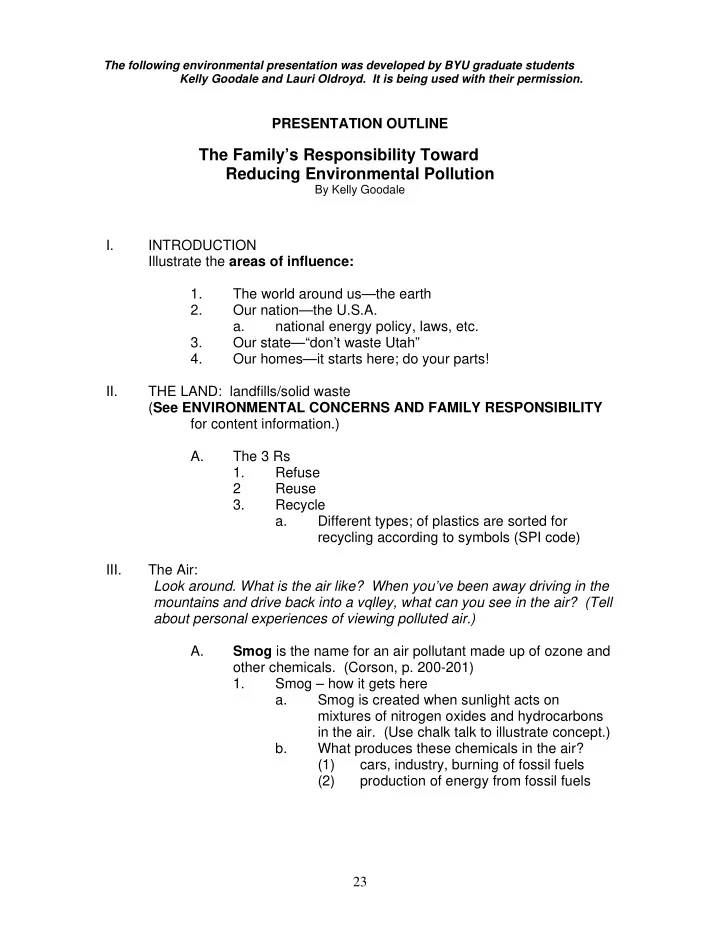
I. INTRODUCTION Illustrate the areas of influence: 1. The world around us—the earth 2. Our nation—the U.S.A. a. national energy policy, laws, etc. 3. Our state—“don’t waste Utah” 4. Our homes—it starts here; do your parts! II. THE LAND: landfills/solid waste (See ENVIRONMENTAL CONCERNS AND FAMILY RESPONSIBILITY for content information.) A. The 3 Rs 1. Refuse 2 Reuse 3. Recycle a. Different types; of plastics are sorted for recycling according to symbols (SPI code) III. The Air: Look around. What is the air like? When you’ve been away driving in the mountains and drive back into a vqlley, what can you see in the air? (Tell about personal experiences of viewing polluted air.) A. Smog is the name for an air pollutant made up of ozone and

  • ther chemicals. (Corson, p. 200-201)

1. Smog – how it gets here a. Smog is created when sunlight acts on mixtures of nitrogen oxides and hydrocarbons in the air. (Use chalk talk to illustrate concept.) b. What produces these chemicals in the air? (1) cars, industry, burning of fossil fuels (2) production of energy from fossil fuels

slide-2
SLIDE 2

24 How does breathing smog affect your health? 2. Ozone and other chemicals irritate the lungs of people and animals. Have you ever noticed the plants or trees near a busy road or highway? Do they look very healthy? 3. Cause plant cells to break down—damage crops and forests. 4. What can we do about the smog? a. drive less/walk more b. conserve energy (burn less fossil fuels) c. Use alternative fuels and energy sources B. GREENHOUSE EFFECT – In addition to chemicals in the air producing harmful smog, some scientists know that excess buildup of carbon dioxide is causing global warming/greenhouse. (Corson p. 200-201) 1. This is controversial. 2. If this is what is actually happening, this is how it is happening: scientists claim that since the industrial revolution, carbon dioxide levels have risen by 24%. Carbon dioxide molecules allow the sun’s rays to pass through the atmosphere but prevent some of the reflected heat from returning to space. a. fossil fuel burning released 5.5 billion tons of carbon into the atmosphere in 1988. b. deforestation released 0.4 – 2.5 billion tons of carbon stored in the trees and soil. 3. The possible effect on the planet: a. average temperatures are rising 1.5 – 4.5 degrees Celsius by mid-next century b. a change in rainfall patterns will (1) threaten agriculture (2) cost to adjust irrigation systems c. polar ice caps will melt – oceans will become warmer (1)

  • ceans will expand and sea levels will

rise (a) beaches and cities will flood; salt pollutes fresh water and farmlands C. INDOOR AIR POLLUTION – Household chemicals in an

slide-3
SLIDE 3

25 enclosed environment: (Yeaple, p. 80-82) (National Wildlife,

  • p. 32-32)

CASE STUDIES After Sue and Ed Mashoak moved into their new house in western Pennsylvania, Sue developed a nagging cough. Ed complained of headaches and sleeplessness. Even their two children seemed to be irritable and depressed. A few years passed before the Mashoaks learned that their symptoms were caused by formaldehyde and other toxins that had been released in the air from building materials and were then bottled up inside their tightly constructed house. The Environmental Protection Agency's Washington, D.C. headquarters (known as the EPA) became “sick” two years ago after a new carpet was installed and began to release toxic chemicals. A few workers became violently ill, and one of them had to be taken to the hospital. Administrators in one Michigan state agency office found to their surprise that after the ventilation system in their building was cleaned out, workers stopped their peculiar habits of falling asleep at their desks. 1. “SICK HOUSE SYNDROME” – a collection of symptoms caused by polluted air or a contaminated building

  • itself. Any indoor air is susceptible to contamination and the

symptoms can be difficult to pin down. a. Symptoms: burning eyes, rashes, dizziness, difficulty breathing, headaches, nausea,

  • verwhelming drowsiness, abdominal pains

and coughing. b. If symptoms coincide with a move to a new home/office be all the more suspicious. c. Energy measures: sealing air d. Pesticide spraying e. Remodeling: new furniture, drapes, or carpet 2. Sources of indoor air pollution: a. Radon – a colorless, odorless gas produced by the decay of uranium in soil and rock (1) sources – it surfaces through cracks in the earth and seeps into houses through foundation walls and floors (2) effects – lung cancer – 20,000 cases a year in the U.S. – 1 in 10 houses have elevated levels of radon; expert professionals can test the levels in

slide-4
SLIDE 4

26 your home and advise on the best way to get rid of it b. Formaldehyde (1) sources – particle board, underneath veneers in furniture and cabinets (2) effects – releases an invisible gas called

  • utgassing that can cause a number of

problems – minor eye, nose, and throat irritations; shortness of breath, headaches and nausea; replace furniture or seal with urethane, varnish, shellac, etc. c. Mold, bacteria (1) sources (2) effects d. Pesticides – can linger for many years e. Combustion compounds f. Aerosol sprays – avoid if possible. The small particles that surround you can enter your lungs. g. Household chemicals (1) sources (2) effects – vapors and fumes can hang around for days; chemicals can cause respiratory ailments, dizziness, sluggishness, confusion, depression, and headaches. DANGER: for young children Cleaning product experiment: Students will compare the effectiveness of commercial cleaning products to homemade ones. (Recipes: Embracing the Earth, Mark Harris, permission to use is granted) WHICH PRODUCT WORKED BETTER? SMELLED BETTER? WHICH ONE WOULD YOU USE? Glass Cleaner 2 Tbsp. Cornstarch ½ cup white vinegar 1 gallon water Note: The regular stuff (commercial product) is TOXIC. It contains ammonia and methane; store away from children and pets. Furniture Polish 1 part lemon juice 2 parts vegetable oil Note: The regular stuff (commercial product) is TOXIC. It can cause injury or death upon ingestion or inhalation; it is flammable – can be ignited under almost all temperature conditions.

slide-5
SLIDE 5

27 Tub, Tile, Sink Cleaner ¼ cup baking soda 1 tsp. Liquid soap 1 gallon water NOTE: The regular stuff (commercial product) is TOXIC. Who knows? (each brand varies). Air Fresheners Simmer cinnamon, orange peel, or cloves in a sauce pan Put vinegar in a dish to absorb odors Pop some popcorn NOTE: The regular stuff (commercial product) contains alkyl phenoxyplyethoxy ethanol, isobutene, and propane; they are flammable and an irritant (can cause soreness or inflammation of the skin, eyes, mucous membranes, or the respiratory system.) They coat the mucous membranes in the nasal passage and interfere with your natural sense of smell. Store them away from children and pets. Oven Cleaner Toxic, corrosive (capable of destroying animal or other organic tissue) 3. Ventilation is the key to good health indoors. Indoor air pollution has intensified during the rush to seal homes and as prompted by the energy crisis in the 1970s. 4. Sources to contact: a. American Lung Association b. National Institute for Occupational Safety (NIOSH) IV. THE VOYAGE THROUGH THE SEA A. Water Pollution 1. Pesticides and acid rain 2. Litter and garbage on the beaches a. pop cans b. plastic rings (snip these with scissors to prevent strangling waterfowl 3. Old water pipes contaminate drinking water with lead 4. Sewage 5. Global warming/factories warming water B. Water Conservation – water is a precious resource How much water do you use to start your day/ (worksheet)

slide-6
SLIDE 6

28 1. Is it wasting water? a. Don’t feel guilty; we do have to life; there are things that can be done. 2. Water – a most precious resource; we can’t take it for granted a. drought b. water pollution 3. How can we conserve? 4. Brainstorm ways to conserve water a. turn off water when you brush your teeth b. install a low-flow shower head c. fill the dishwasher before using d. install a faucet aerator; restrict the water flow e. repair leaky faucets f. take a quick shower instead of a bath (1) use half the water (2) plug up tub while in shower to see how much water is used g. put water displacer in toilet tank h. install low-flush toilet i. don’t leave water on when washing the car j. sweep instead of hosing off the driveway and sidewalk k. water plans and lawn in the evening V. SUMMARY – A FISHIE IN THE WATER Put a goldfish in a clear container of water. Have a supply of scrap paper handy. This fish is swimming around in his little environment. He seems pretty comfortable and happy. Crumple up pieces of paper and start putting them in the water as you name each pollutant found in water and in the environment in general: fertilizers, acid rain, solid waste, chemical waste, and sewage. Humans put these into his (the fish’s) environment. Continue putting in crumpled paper wads until the fish can no longer swim

  • around. Make sure the fish is where the students can see him.

Just as we’ve put paper in this fish’s environment and restricted his movement and happiness, we can continue to pollute our environment and eventually restrict our movement and happiness. A. CONCLUSION: Summarize the concepts learned. Interact with the students by asking questions.

slide-7
SLIDE 7

29 HOW MUCH WATER DO YOU USE TO START YOUR DAY? Name _______________________________ Period _________ Guess how many gallons of water you used this morning during each of the following activities: 1. A long, hot shower ______________________ ? 2. Brushing your teeth _____________________ ? 3. Using the toilet _________________________ ? 4. Breakfast: making orange juice, rinsing off your dishes and wiping

  • ff the counter __________________________

? 5. Using the toilet one more time ________________ ? So! You’re off for the day1 What’s your total amount? _________ ? WHERE ARE YOU WASTING WATER? WHERE ARE YOU GOING TO SAVE WATER?

Source of Information: Embracing the Earth by Mark Harris, p.38. The Noble Press, Inc., Chicago, IL. ANSWERS: 1. 80 gal.. Rest of the day: 70 gallons 2. 6 gal. Week: 1,197 gallons 3. 6 gal. Month: 4,788 gallons 4. 3 gal. Year: 57,456 gallons 5. 6 gal. (10 more if you share) Multiply by the millions of people across the country

slide-8
SLIDE 8

30 REFERENCES:

Permission to use was granted by the following authors and publishers.

Corson, Walter. Global Ecology Handbook: What You Can Do About the Environment Crisis. Boston: Beacon Press, 1990. Harris, Mark. Embracing the Earth: Choices for Environmentally Sound

  • Living. Chicago: The Noble Press, 1990.

Yeaple, Judith Anne. “Houses that Breathe.” Popular Science, Mar 1991.

  • Vol. 238, p. 80-82.

“How to Protect Yourself from your Environment.” Nat’l Wildlife, Aug/Sept

  • 1990. Vol. 28, p.30-42.
slide-9
SLIDE 9

31

ENVIRONMENTAL CONCERNS AND FAMILY RESPONSIBILITY

BY Laurie Oldroyd SOLID WASTES The earth is approximately 4.5 billion years old, and life has existed on our planet for more than 3.5 billion years. Humans have lived in coexistence with other life forms on earth for about 2 to 3 million years. Within the last 200 years people have begun to affect the global environment. Only in the last 40 years or so has this impact become serious in a negative way (Corson, 1990). Humans have always depended on nature and continue to do so, but, for the first time, humans have the ability to alter the natural world and are doing so on a global scale. Recently citizens, families and leaders of nations have begun to realize and understand the importance of the actions of humans on the environment. There is a need for urgent action. Many have stated that we are in the midst of what could be called a global

  • awakening. There are still many long-term consequences that are being

classified as certain to alter societies and the people who live therein. Increasing concerns about the present and future of our environment have motivated families and other groups to take more responsibility to protect the world. Corson writes that “all life is dependent on the planet’s land, water, and air, and the quality of the environment influences virtually all aspects of human activity” (1990, p.2). Environmental concerns deal with the necessities of life and ways in which we as humans will be able to maintain our resources. The management of solid waste is one of the biggest concerns facing the

  • environment. Each year the United States generates nearly 1 billion

metric tons of non-agricultural solid waste. Solid waste is the environmental term for garbage, trash, scrap, junk, and sewage. On the average, a United States citizen discards about 3.5 pounds of solid waste every day. In 1978 the United States had about 20,000 landfills because eighty percent of all solid waste is dumped in landfills. In the past five years, 3,ooo dumps have been closed and by 1993, 2,000 more will be filled and closed (Corson, 1990). The Wall Street Journal and the Washington Post have called the garbage situation in America a “crisis”. Americans are now becoming known as the “throwaway society” because

  • f waste disposal per capita which is twice that of any other country.

About two-thirds of U.S. solid waste is non-hazardous industrial waste. Almost all industrial waste is disposed of by means of private facilities

slide-10
SLIDE 10

32 rather than municipal landfills. Approximately 20 percent of industrial solid waste is associated with the production and use of oil and gas, while another 12 percent comes from mining. Municipal waste makes up about

  • ne percent of the total. It may seem to be such a minute part of the

whole, but this “minute part” comprises approximately 140 million metric tons each year. An interesting fact worldwide, is that solid waste tends to increase with the level of economic development (Corson, 1990). Large cities in low- 0income countries, such as Calcutta, produce 1.1 to 1.3 pounds of waste per person each day. Cities in middle-income countries, such as Manila and Singapore, produce 1.1 to 1.9 pounds. Large cities in industrial countries, such as New York, produce 3.0 to 4.0 pounds per day. This supports the suggestion that the U.S. has become an increasingly wasteful society. Solid waste is one of the environmental concerns that is receiving the most attention by the public. Later in this paper various solutions and actions people are taking to combat this problem will be discussed. Methods for managing waste have definite environmental impact. The pollution of ground water and surface water is caused by waste disposal in

  • landfills. As organic waste decays, methane is produced and creates the

potential for explosions. When waste is incinerated, effluent gases may contain hazardous air pollutants. It is unwise to assume that controlling the management of solid waste would rid us of environmental concerns. Issues and concerns about the environment are many. It is difficult to single out one area or overriding

  • problem. The challenges seem overwhelming at times, but the need to

solve them is real. GLOBAL WARMING Another issue reaching the minds of many is that of global warming. Several environmentalists are asking the question: “Is the world really getting hotter?” The so-called greenhouse effect is possibly threatening the future of the world’s climate. There is still speculation on whether or not this is a real environmental concern. Bowermaster and Steger, (1990) write: “Global warming, and the greenhouse effect’s role in it, promises to be one of the most controversial, and potentially most disastrous environmental problems the world faces in the century to come” (1990, p.3). The theory behind global warming is the build-up of carbon dioxide, as well as a number of other gases, causing the earth to warm. Other gasses involved in global warming are methane, chlorofluorocarbons,

slide-11
SLIDE 11

33 nitrous oxide, ozone, etc. As the atmosphere grows hotter, it could change the world and disrupt every natural ecosystem that humans depend upon for life. Some of the predicted wide-range effects are that it would alter crop yields and water supplies, seas would rise, floods would swamp cities and wetlands, plant and wildlife would shift, pests would proliferate, and disease would spread. Some have even compared the disruptions to the aftermath of a nuclear war (Bowermaster 7 Steger, 1990). There are numerous causes of global warming. But the one cause viewed as most responsible, is the number of people now on the earth. The growing population, which is not just over 5 billion people, is expected to double in the next 60 years. This fact alone is linked to a number of environmental concerns. Because there are so many gases involved in global warming, it may turn

  • ut to be “the most difficult to cure of all the world’s environmental ills”

(Bowermaster & Steger, 1990, p.5). It seems overwhelming to delete all the contributors of a global warming. Bowermaster and Steger explain a startling drama of how our everyday lives contribute to global warming. Just getting up in the morning starts the cycle: when you turn on the bathroom light is probably uses electricity generated by the burning of fossil fuels, which pumps carbon dioxide into the air. The refrigerator that keeps our orange juice cold is lined with another contributor to the greenhouse shield –

  • chlorofluorocarbons. Driving to work burns gasoline,

which sends millions of particles of carbon dioxide into the atmosphere. The mahogany desk that you work at may have come from a tree in the rain forests, and the tree once helped absorb carbon dioxide from the atmosphere. Even the rice on your plate at lunch time contributed, by giving off methane gas when it was grown (1990, p. 5). The magnitude of a global warming could be enormous. OZONE DEPLETION Ozone depletion has also been given m ore study and research and has been emphasized as an environmental concern. In this context, ozone is a “naturally produced, life-protecting shield 15 miles above the Earth’s surface” (Bowermaster & Steger, 1990, p 27). Ozone filters the sun’s

slide-12
SLIDE 12

34 most dangerous ultraviolet rays from the earth. By doing so, humans are protected from various potentially disastrous ills. One simple chemical compound is the primary cause of ozone depletion: CFC (chlorofluorocarbons). CFCs were first developed in the 1930s. They were used to cool refrigerators and air conditions and clean

  • electronics. They were also used in the manufacturing of plastic foam,

home insulation, and throwaway food containers. They are probably best known for their use in propelled aerosols, such as hair spray, until such use was banned in 1978 (Bowermaster & Steger, 1990). We have already lost about two percent of the ozone layer over Antarctica and although this may seem to be a small amount, the problem is a global

  • ne. Ozone loss increases the amount of one form of ultraviolet light:

UV-B. Each one percent drop of ozone allows 2 percent more UV-B to reach the earth and, subsequently humans. This alone increases the potential for skin cancer by 3 to 6 percent. A diminishing ozone layer could make people more susceptible to a variety of infectious diseases, including malaria. In addition, it will disrupt the life cycle of plants and billions of dollars’ worth of crops will be

  • destroyed. The effects on the ocean could be even worse. Microscopic
  • rganisms that are necessary to maintain marine life could be destroyed.

Scientists have found that increased UV-B has hurt photosynthesis and metabolism of the plants in the ocean, caused some mutations in some marine organisms, and harmed eggs of other organisms. The Earth’s climate will also be disrupted with the ozone depletion. Shifting winds created by the depletion will change the weather in ways that cannot be predicted. Deserts and forests will be in jeopardy, and also the atmosphere will heat up, adding to the problem of global warming. This paper has expounded on just three of the main environmental concerns with their causes and effects. The situation looks a bit grim. Who is responsible to find solutions to these problems, and who is responsible to act on these solutions? It wasn’t until recently that these questions began to be thought through and answered. Scientists, government, and more recently, citizens have taken an active role in combating these environmental stressors. Freudenberg states: Identification and control of environmental health hazards have depended primarily on two strategies: scientific research and government regulation. In the last decade, a third strategy for environmental control has emerged. In communities across the country, concerned citizens have banded together to attempt to force government and industry to reduce or eliminate a suspected hazard in their neighborhood.

slide-13
SLIDE 13

35 (1984 p. 444) CONCERNS OF THE FAMILY GROUP Concerned citizens are made up of environmentally aware groups and many of those concerned are family groups. Moms, dad, and even children are voicing their concerns for the environment and actively participating in programs and solutions to some of the most devastating problems ever. Why should there be increased family involvement in these concerns? One scientist at the Environmental Defense Fund explains, “The future remains by and large in our own hands, . . . the choices we make today will have dramatic effect on the way we live, and on the state of our world, tomorrow” (Begley, 1990, p. 76). Meryl Streep, famous actress and mother of three, tells her reasons for organizing her neighbors to fight against pesticides, “I was concerned about the future for my children” (Cook & O’Malley, 189, p.14). Her personal family reward and responsibility is very clear from her words and actions. Freudenberg comments “{an individual’s} day-to-day contact with the air, water, and soil in their environment and their perceptions of changes in family or community health can be early warning signs

  • f potential danger” (1984, p. 447). Once again the health of family

life motivates citizens to become involved in environmental issues. Freudenberg’s survey suggests that “health concerns are the dominant motivation for citizen action to protect the environment” (1984, p. 447). There are still those who insist that it is the government’s or industry’s responsibility to lean up the environment. Hutchings has a quick reply to that thought, “but if we (citizens) can’t take responsibility for the planet, who will?” (1990, p.11). The awareness of family and individual responsibility is increasing. Family involvement and concern increases as their understanding

  • f environmental issues increases. Arcury (1990) states,

“promoters of increased environmental awareness assume that increased information leads to increased knowledge about the environment (and that) increased knowledge is a precondition for changing attitudes. Both knowledge and attitudes are assumed to be important for changing human actions toward the environment” (1990, p 300). Therefore, the public needs to be educated on the concerns about the planet.

slide-14
SLIDE 14

36 EDUCATING AND ACTING The educative measures in society are innumerable: books, games, toys, T-shirts, TV programs, classes, etc. Everywhere you look it seems that there is something about the environment. This is a step in the right direction since “young, better educated, urban, liberal individuals tend to be more concerned about the environment and have more positive attitudes toward the environmental movement” (Arcury, 1990 p.301). The most commonly talked about, written about and acted upon environmental act is that of recycling. Industry has caught on to the feelings and attitudes of their consumers and are changing their products to become more environmentally safe. Consumer and individuals are coming up with their own methods to best save the

  • earth. School rooms are promoting and educating even the

youngest of children about what they can do to help the environment. Lauren Manning, a third grader from Westport, Connecticut,showed what an environmentally educated child can do to help. She was distressed by the use of polystyrene products in her school’s

  • lunchroom. After writing a letter to her principal requesting the

discontinuation of these products, her voice was not only heard by him but the district office as well. Since writing her letter, the district has hired a company to remove and recycle polystyrene from school lunchrooms in Westport (Loomis, 1990). Children are standing up for the environment. The realities of solid waste disposal in the eighties and nineties have brought about renewed interest in recycling. For local governments, recycling is helping to decrease landfill disposal

  • costs. “Communities commonly paying $100/ton or more to

dispose of trash and solid waste disposal makes up the third largest percentage of a local community’s budget” (Burn, 1991, p.611-12). Then not all the support for recycling is solely ethically minded. There are also economical reasons. Families have taken on remarkable responsibility to take care of the

  • environment. In the process, they realize that it’s “not so bad after

all”. Families are receiving personal benefits in addition to a cleaner, safer environment. Children are understanding and feeling what it is like to be a part of something on a different level. (Coward (1990, p.41) has studied the influence of recycling with children and has found that “there is an important sense in which children are being encouraged to feel effective within their immediate environment. Most significantly they are being

slide-15
SLIDE 15

37 encouraged to be knowledgeable”. Lockyear, a retired nurseryman, organized tree plantings for groups

  • f children. After years of environmental services, he commented,

“I always feel so great after working with children. They learn what it means to do something for the world and not just for themselves. I think that lesson carries over to the rest of their lives” (1990, p.79). The benefits of being concerned about the environment extend far beyond the trash that is recycled. In a small way, we could thank

  • ur environment for helping strengthen family dedication and

responsibility to a worthy cause. The Maceman family has found that “environmental chores” can be turned into games and create fun for the whole family (Jackson, 1991, p.172). Deborah Heiligman (1991, p.66) concludes that “recycling actually has become fun at our house. My son Aaron . . . helps by carrying the jars and cans to the recycling buckets. He knows that glass goes in

  • ne, aluminum in the other, and he’s proud to be helping”.

The environmental concerns plaguing the earth seem very

  • verwhelming at times. But thanks to individual families and other

groups, the responsibility for cleaning up the earth is receiving

  • attention. As families become more educated about what they can

do, and realize their responsibilities, they will not only have some of the old environment back, but some new habits. One of the most important places to cultivate those new habits is in the area related to food preparation.