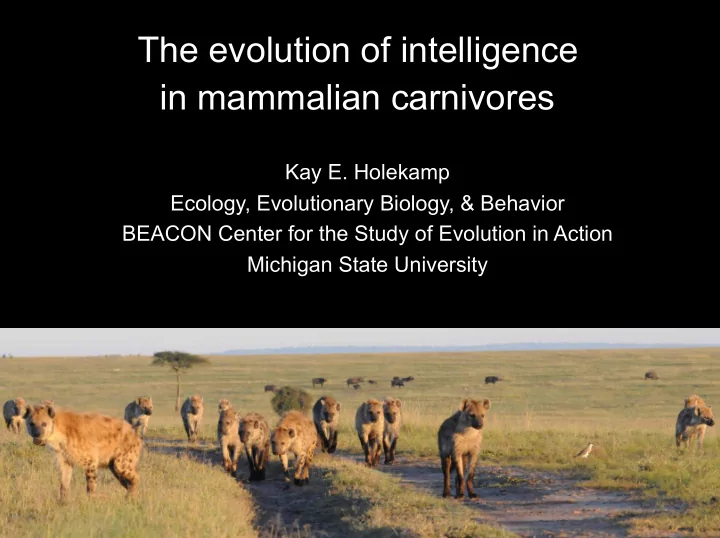
SLIDE 1
The evolution of intelligence in mammalian carnivores
Kay E. Holekamp Ecology, Evolutionary Biology, & Behavior BEACON Center for the Study of Evolution in Action Michigan State University
SLIDE 2 “Intelligence” broadly defined:
“Those processes by which organisms
- btain & retain information about their
environments, & use that information to make behavioral decisions” (Kamil 1987)
These processes are mediated by nervous systems that vary greatly in size & complexity
SLIDE 3
Despite the huge metabolic costs of neural tissue, mammals have relatively large brain:body ratios
SLIDE 4
Relative to other animals, including most other mammals, primates have relatively large brains, enlarged cortex, & sophisticated cognition. Why?
SLIDE 5
H1: Big brains & great intelligence evolved to cope with complexity in the physical environment
SLIDE 6
H2: The ‘social complexity’ hypothesis: large brains evolved to cope with complexity in the social environment
SLIDE 7
H3: The ‘cognitive buffer’ hypothesis: large brains evolved to allow animals to cope with novel socio- ecological challenges & thus reduce mortality in changing environments
SLIDE 8
If the big brains found in primates were favored by social complexity,… …then non-primates living in primate-like
societies should exhibit cognitive abilities & brain features convergent with those in primates.
Eg: spotted hyenas
Where we began: Testing the social complexity hypothesis
SLIDE 9
Spotted hyenas live in large, stable social groups called ‘clans,’ containing < 130 individuals
SLIDE 10
SLIDE 11 Striking convergence: hyena clans & baboon troops are large, complex groups containing both kin & non-kin
- Mean within-group relatedness is low
- Multiple overlapping generations
- Multiple adults of both sexes
- Male dispersal & female philopatry
- Matrilineal kin sub-groups
- Hierarchical rank relationships
Group size, composition & structure have evolved convergently
SLIDE 12
Primates & carnivores last shared a common ancestor 90-100 MYA
SLIDE 13 Study of multiple clans in Kenya since 1988: clans contain 40 -130 hyenas
Masai Mara National Reserve
Managed by the Mara Conservancy Managed by the Narok County Government
!2008%! !2008%! !2008%! !2001%2013! !2007%! !1988%!
SLIDE 14
Individual recognition of hyenas Daily observation from vehicles
SLIDE 15
A typical (low intensity) fight
SLIDE 16 MRPH SEIN WHO MP NAV BAIL MIG BP BOS MRPH -- 24 14 13 28 11 14 21 4 SEIN
13 17 15 18 11 9 WHO
31 10 15 17 11 MP 1
27 12 15 14 NAV 2
29 13 17 BAIL
21 12 MIG
5 BP
BOS
- Clans are structured by linear dominance hierarchies
Loser Winner Breeding females Immigrant males
Both individuals and matrilines have ranks
SLIDE 17
Hyena Life history
Natal den Communal den Puberty Reproduction (females) Dispersal (males) Immigration & reproduction (males) Weaning Max lifespan in nature is ~ 26 yrs
SLIDE 18 Conducted repeated bone tests. Monitored fights among cubs when no adults present.
(Holekamp & Smale 1993)
As in primates, hyena social rank is learned early in life
SLIDE 19 Test results for a cohort containing 13 cubs
After 1-2 month at the communal den After 5-6 months at the communal den
(Holekamp & Smale 1993)
Rank acquisition complete by ~18 mo of age
SLIDE 20 Patterns of resource competition: as in primates,
- utcomes are determined by social rank
SLIDE 21 As in many primates, all adult female hyenas breed, but their reproductive success varies with social rank…. .…and this has profound long-term fitness consequences.
(Holekamp et al. 1996, J. Reprod. Fert.)
High Low
(Holekamp et al. 2012, Molec. Ecol.)
SLIDE 22 As in despotic primate societies, females’ fitness varies with social rank
(Holekamp et al. 2012)
SLIDE 23 After controlling for rank, gregariousness affects fitness in hyenas, as it does in baboons
(Holekamp et al. 2015)
p=0.011
Generalized linear model: t31 = 2.695, P = 0.011
SLIDE 24 Spotted hyenas & cercopithecine primates have much in common
- Group size, composition & structure
- Life history patterns & social development
- Rank determines priority of resource access
- Fitness consequences of social rank & gregariousness
Are there also similarities in social cognition between these taxa?
SLIDE 25 Hyenas & cercopithecine primates: social cognitive abilities & adaptive decision-making
- Individual recognition using multiple
sensory modalities (Kruuk 1972; Holekamp et
- al. 1999; Benson-Amram et al. 2011)
- Reconcile after fights to repair social
bonds (Wahaj et al. 2001)
- Kin-biased associations & nepotistic
behavior (Holekamp et al. 1997; Smith et al. 2007)
- Recognize paternal as well as
maternal kin (Van Horn et al. 2004; Wahaj et al.
2004)
SLIDE 26 Playback experiments with hyenas
100 m
SLIDE 27 Eg., Responses to cub distress calls vary with relatedness
(Holekamp et al. 1999, Anim. Behav.)
SLIDE 28 Hyenas & cercopithecine primates: social cognitive abilities & adaptive decision-making
- Join forces to accomplish social
goals (Engh et al. 2000, 2005; Smith et al. 2010)
- Recognize third-party relationships
based on both rank & kinship (Engh et
- al. 2005)
- Track a great deal of information
about their environments & use it to make adaptive social decisions (Smith
et al. 2010)
- Recognize that social partners vary
in their relative value, & choose accordingly (Szykman et al. 2001; Smith et al.
2007; Smith et al. 2011)
SLIDE 29 Eg., Adaptive use by males of knowledge about female social rank
Cubs of higher-ranking females survive better Males initiate M-F associations & prefer higher-ranking females
(Szykman et al. 2001, Behav. Ecol. Sociobiol.) (Watts et al. 2009, Proc. Roy. Soc. B)
Maternal rank: High Middle Low High Low
SLIDE 30
Summary: We find striking similarities in social cognition between spotted hyenas & cercopithecine primates
But what about the brain?
Behavioral data support the social complexity hypothesis
SLIDE 31 The ‘social brain’ hypothesis predicts convergent evolution between hyenas & primates regarding expansion of neural tissues mediating social behavior
Cruciate sulcus Post-cruciate dimple Central sulcus
SLIDE 32 Comparative analysis of gross brain morphology based on “virtual brain” endocasts from CT scans
- Compare brains & brain regions
among Hyaenid species (Sakai et al. 2011)
SLIDE 33
Comparison of spotted hyenas with less gregarious Hyaenid species
SLIDE 34 Cerebral hemispheres of 4 carnivores
Raccoon Cat Dog Spotted hyena Yellow box indicates approximate area of frontal cortex (cortex rostral to the cruciate sulcus) If social brain hypothesis is correct, then frontal cortex volume in Hyaenids should decrease as: spotted hyena brown hyena striped hyena aardwolf
(Sakai et al. 2011 Brain, Behav, Evol)
SLIDE 35 Spotted hyenas have the largest relative brain and frontal cortex volumes
(Sakai et al. 2011, Brain, Behav Evol )
Frontal cortex volume Brain volume Brain volume Anterior cerebrum volume
SLIDE 36 Anterior cerebrum is proportionately larger in adult male
(N=12) than female (N=18) spotted hyenas
(Arsznov et al. 2010 Brain, Behav. Evol.)
*
ns
SLIDE 37
- Whole brain and frontal cortex both larger in spotted
hyenas than less gregarious Hyaenids
- Frontal cortex larger in male than female spotted
hyenas Behavioral and morphological data support the social complexity hypothesis
Comparative brain analysis
SLIDE 38 Caveats: The social complexity hypothesis can’t explain:
- 1. Grade shifts in relative brain size & relative
cortex size
- 2. Species with high socio-cognitive abilities also
excel in general intelligence
Primates vs. carnivores
(Bush & Allman 2004)
SLIDE 39 Brain size varies more within & among primate than carnivore families; variability affects evolvability. This may contribute to grade shifts.
(Holekamp et al. 2013)
SLIDE 40 The problem of general intelligence
Phylogenetic analysis of brain & brain region volumes in carnivores Used brain size as a proxy for general intelligence
(Swanson et al. 2012, PLoS1)
SLIDE 41 36 species Multiple specimens per species Measures of endocranial volume plus:
multiple brain areas from CT scans
- Social complexity
- Diet
- Life history data
- Specimen sex
Multivariate phylogenetic analysis of mammalian carnivores
(Swanson et al. 2012, PLoS1)
SLIDE 42 (Swanson et al. 2012, PLoS1)
Phylogeny Matters
SLIDE 43 (Swanson et al. 2012, PLoS1)
Diet matters
But sociality doesn’t predict brain size
SLIDE 44
Social problem-solving is remarkably similar in hyenas & baboons, yet general behavioral plasticity appears much greater in baboons Plasticity is a hallmark of intelligence…. ..but social complexity can’t account for this difference How does general intelligence evolve?
SLIDE 45 Can social selection pressures shape the evolution of general intelligence as well as social cognition? How well do hyenas solve non-social problems? Puzzle box tests with wild hyenas
354 trials on 59 individuals from 3 study clans
SLIDE 46 Innovation, persistence, & neophilia predict success in field puzzle box experiments
But only 9 of 59 wild subjects
(Benson-Amram & Holekamp 2012, Proc. Roy. Soc. B)
SLIDE 47
SLIDE 48
Zoo study of problem-solving in carnivores: 9 zoos
SLIDE 49
Experimental set-up
Box size: scaled to body size Bait: favorite food Test location: home enclosure
SLIDE 50
Experimental set-up
SLIDE 51 Video analysis & modeling
assessed in relation to
– Performance measures
- Work time
- Number of different
behaviors used
– Sociality – Body size – Manual dexterity – Neuroanatomy
SLIDE 52
Problem-solving in captive carnivores
Bayesian phylogenetic generalized linear mixed-effects models used to investigate predictors of success in opening the puzzle box
SLIDE 53 Carnivore brain volume varies with body mass
(Benson-Amram et al. 2016, PNAS)
SLIDE 54 Carnivores with larger brains were better at solving the problem.
But social species performed no better than solitary ones.
(Benson-Amram et al. 2016, PNAS)
SLIDE 55 Social complexity appears to promote convergent evolution in carnivores of
- social problem-solving
- size of specific brain regions (?)
But social complexity does not predict either brain size or ability to solve non-social problems
The evolution of general intelligence remains unexplained
SLIDE 56
What shapes the evolution of general intelligence?
The cognitive buffer hypothesis (Allman,
Sol, Reader & colleagues):
large brains evolved to allow animals to cope with novel socio-ecological challenges & thus reduce mortality in changing environments
SLIDE 57 Where we’re headed:
Testing predictions of the Cognitive Buffer hypothesis in the context of urbanization
- Cities are evolutionarily novel environments
- Cognitive testing across an urbanization gradient
SLIDE 58 Masai Mara National Reserve
Managed by the Mara Conservancy Managed by the Narok County Government
2008- 2008- 2008- 2001-2013 2007- 1988-
SLIDE 59
Talek town 2009 Rapid urbanization in progress
SLIDE 60
Talek town 2013 Rapid urbanization in progress
SLIDE 61
Urban hyenas in Mekelle, Ethiopia: city- dwelling for > 500 years
SLIDE 62
Compare performance among ancestral, rapidly urbanizing & fully urbanized populations
Serena: Stable ancestral environment Talek: Rapidly urbanizing environment Mekelle: Stable urban environment
SLIDE 63
Administer battery of 7 tasks:
Learning, memory behavioral flexibility & executive function Calculate ‘g’ using a psychometric factor-analytical approach, & calculate selection gradient on ‘g’ in each habitat
SLIDE 64 Many thanks to:
The following awesome graduate students: Sarah Benson-Amram, Erin Boydston, Leslie Curren, Ben Dantzer, Stephanie Dloniak, Anne Engh, Andy Flies, David Green, Julia Greenberg, Lily Johnson- Ulrich, Sarah Jones, Joe Kolowski, Zach Laubach, Kenna Lehmann, Nora Lewin, Kevin McCormick, Tracy Montgomery, Jenn Smith, Eli Strauss, Eli Swanson, Micaela Szykman, Jaime Tanner, Kevin Theis, Russ Van Horn, Page Van Meter, Sofi Wahaj, Heather Watts, Kate Yoshida Post-docs: Susan Cooper, Isla Graham, Keith Nelson, Agathe Laurence Many fabulous field assistants! Technical support staff: P. Bills, H. Couraud For cooperation: NACOSTI, KWS, Narok County Government, Warden of the MMNR For funding: NSF & NIH For pretty much everything: Laura Smale The Mara hyenas