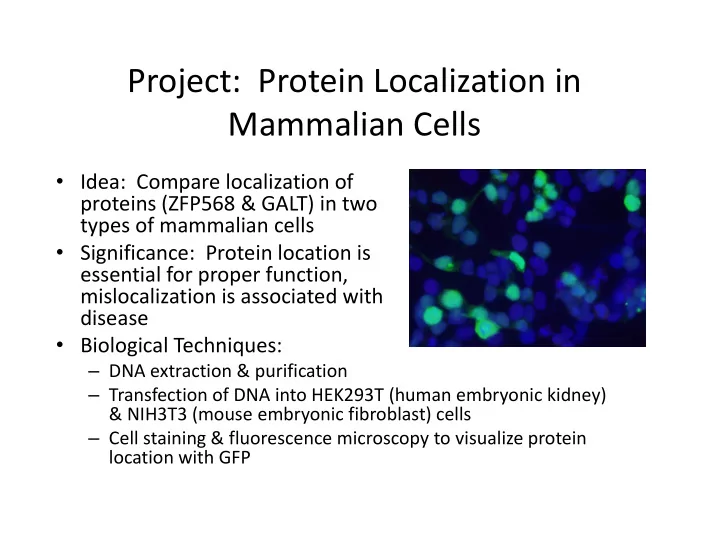
SLIDE 1 Project: Protein Localization in Mammalian Cells
Idea: Compare localization of proteins (ZFP568 & GALT) in two types of mammalian cells Significance: Protein location is essential for proper function, essential for proper function, mislocalization is associated with disease Biological Techniques:
DNA extraction & purification Transfection of DNA into HEK293T (human embryonic kidney) & NIH3T3 (mouse embryonic fibroblast) cells Cell staining & fluorescence microscopy to visualize protein location with GFP
SLIDE 2
Protein Synthesis in the Cell
SLIDE 3
Diseases associated with defects in protein transport
Cystic fibrosis (CF) Familial hypercholesterolaemia hypercholesterolaemia (FH) Congenital sucrase- isomaltase deficiency (CSID)
SLIDE 4
Project Goal
Compare the localization of two proteins
(ZFP568 & GALT) in two types of mammalian cells
(human embryonic kidney cells & mouse embryonic fibroblasts)
We’ll do this by We’ll do this by
Making DNA that codes for our proteins (DNA
extraction & purification)
Putting that DNA in mammalian cells (transfection) Determining where our proteins are within the cells (cell staining & fluorescent microscopy)
SLIDE 5
Our Project Plan
Miniprep to extract DNA from bacteria (Tues) Stain & look at our cells to see where the protein is (Thurs/Fri) Transfect to put our DNA in mammalian cells (Wed)
SLIDE 6
The Two Cell Types We’ll Use
HEK293T cells (human embryonic kidney) NIH 3T3 cells (mouse embryonic fibroblast) Look at the cell morphology of each: How are they different? they different? Which cell type would you want to use for our project?
SLIDE 7 The First Protein We’ll Look At
GFP-ZFP568 (Zinc finger protein 568)
Binds to DNA and recruits transcriptional repressor TRIM28 Mutation (“chato”) causes embryonic arrest Mutation (“chato”) causes embryonic arrest
Garcia-Garcia, M.J., Shibata, M., and Anderson, K.V. (2008). Development 135, 3053-3062.
SLIDE 8
The Second Protein We’ll Look At
GFP-GALT (Galactose-1-phosphate uridylyltransferase)
Enzyme important in sugar metabolism: Converts galactose to glucose Converts galactose to glucose Mutation in GALT causes galactosemia
autosomal recessive mode of inheritance
SLIDE 9 GFP vector – a plasmid
DNA coding for ZFP568
inserted here
SLIDE 10 Restriction Enzymes
XhoI and HindIII
Used to cut (digest) DNA coding for ZFP568 so it could be glued (ligated) into GFP-vector
Digest with these enzymes and DNA coding for ZFP568 should be “cut” from its vector ZFP568 should be “cut” from its vector
Resulting fragments of DNA will be analyzed using gel electrophoresis What will this gel look like? How will digested GFP-ZFP568 look different from GFP-alone?
XhoI HindIII
SLIDE 11
DNA extraction & purification
GFP-ZFP568, GFP-GALT, and GFP-alone DNA was transformed into bacterial cells cells were cultured to make more DNA now DNA can be extracted can be extracted Qiagen MiniPrep Kit
SLIDE 12
Transfection
Purified DNA can be transfected into HEK293T and NIH3T3 cells using Lipofectamine 2000 Mix DNA in media with the Lipofectamine reagent and then add it to your cells’ dish Cells will take up DNA and express the Cells will take up DNA and express the proteins (GFP-ZFP568, GFP-GALT, or GFP- alone) within 24hrs Why do we transfect the GFP-alone construct?
SLIDE 13 Cell Staining
Phalloidin (red)
Marks actin filaments, concentrated beneath cell membrane to keep cell shape Actin is part of cytoskeleton
DAPI (blue) DAPI (blue)
Marks the nuclei of cells
GFP (green)
Tagged to ZFP568 and GALT
Can take pictures of each using fluorescence microscope and then merge using Photoshop Why do we stain with DAPI and Phalloidin? Why don’t we have to stain to see ZFP568 or GALT?
http://migration.wordpress.com/2007/07/11/basics-the-cytoskeleton/
SLIDE 14
Final Questions
Where is GFP-GALT and GFP-ZFP568 located within the cell? Why? What does GFP-alone look like? Why? Is protein location different in HEK293T or Is protein location different in HEK293T or NIH3T3 cells? Why are cells useful for scientists?