The ESOP Student Scholarships Limited number of scholarships (3 - - PowerPoint PPT Presentation

the esop student scholarships
SMART_READER_LITE
LIVE PREVIEW

The ESOP Student Scholarships Limited number of scholarships (3 - - PowerPoint PPT Presentation

The ESOP Student Scholarships Limited number of scholarships (3 categories Thesis must be relevant to ESOPs research areas Deadline for writing thesis in spring or fall of 2013 is October 20, 2012 Should have at least one supervisor from


slide-1
SLIDE 1

The ESOP Student Scholarships

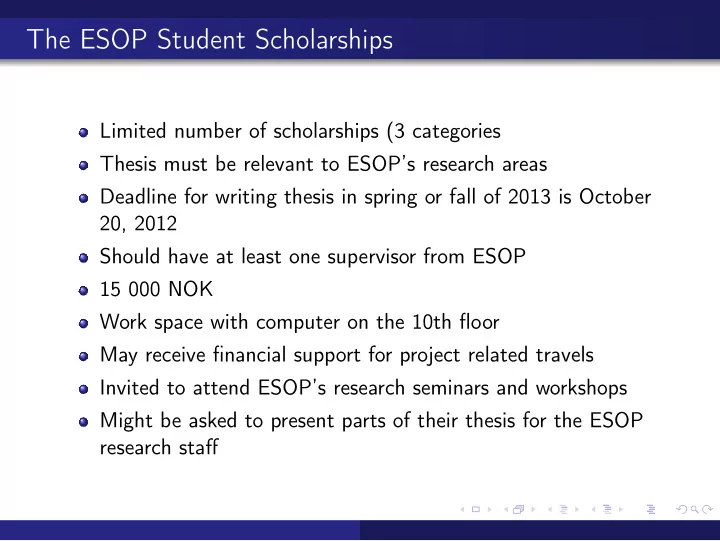
Limited number of scholarships (3 categories Thesis must be relevant to ESOP’s research areas Deadline for writing thesis in spring or fall of 2013 is October 20, 2012 Should have at least one supervisor from ESOP 15 000 NOK Work space with computer on the 10th floor May receive financial support for project related travels Invited to attend ESOP’s research seminars and workshops Might be asked to present parts of their thesis for the ESOP research staff

slide-2
SLIDE 2

The Scholarships

1 The ESOP Scholarship - open application 2 The ESOP Scholarship in Gender and Economics - focus on

gender related topics

3 The ESOP Scholarship - Funding announcement practices in

the Norwegian research council (Tore Nilssen) What you should do:

1 Read about the ESOP scholarships, ESOP’s research areas, see

examples of theses written by former recipients and find out what ESOP researchers are working on: http://www.sv.uio.no/esop/english/

2 Find an adviser from ESOP, and remember to let them know

you want to apply for a scholarship

3 Use your research proposal in your application for the

scholarship

slide-3
SLIDE 3

PhD Candidate Ingrid Kr¨ uger ESOP & the Gulf Research Unit – University of Oslo

slide-4
SLIDE 4

PhD Candidate Ingrid Kr¨ uger ESOP & the Gulf Research Unit – University of Oslo

the Gulf Region:

Saudi Arabia, Kuwait, Bahrain, Qatar, the United Arab Emirates, and Oman

slide-5
SLIDE 5

PhD Candidate Ingrid Kr¨ uger ESOP & the Gulf Research Unit – University of Oslo

the Gulf Region:

Saudi Arabia, Kuwait, Bahrain, Qatar, the United Arab Emirates, and Oman

Key facts:

  • 20% of the world’s crude
  • il production
slide-6
SLIDE 6

PhD Candidate Ingrid Kr¨ uger ESOP & the Gulf Research Unit – University of Oslo

the Gulf Region:

Saudi Arabia, Kuwait, Bahrain, Qatar, the United Arab Emirates, and Oman

Key facts:

  • 20% of the world’s crude
  • il production
  • Net fuel exports:

50% of GDP on average → “rentier states”

slide-7
SLIDE 7

PhD Candidate Ingrid Kr¨ uger ESOP & the Gulf Research Unit – University of Oslo

the Gulf Region:

Saudi Arabia, Kuwait, Bahrain, Qatar, the United Arab Emirates, and Oman

Key facts:

  • 20% of the world’s crude
  • il production
  • Net fuel exports:

50% of GDP on average → “rentier states”

  • Non-democratic regimes
slide-8
SLIDE 8

PhD Candidate Ingrid Kr¨ uger ESOP & the Gulf Research Unit – University of Oslo

the Gulf Region:

Saudi Arabia, Kuwait, Bahrain, Qatar, the United Arab Emirates, and Oman

Key facts:

  • 20% of the world’s crude
  • il production
  • Net fuel exports:

50% of GDP on average → “rentier states”

  • Non-democratic regimes

Does Oil Hinder Democratization?

slide-9
SLIDE 9

PhD Candidate Ingrid Kr¨ uger ESOP & the Gulf Research Unit – University of Oslo

the Gulf Region:

Saudi Arabia, Kuwait, Bahrain, Qatar, the United Arab Emirates, and Oman

Key facts:

  • 20% of the world’s crude
  • il production
  • Net fuel exports:

50% of GDP on average → “rentier states”

  • Non-democratic regimes

Does Oil Hinder Democratization? How?

slide-10
SLIDE 10

PhD Candidate Ingrid Kr¨ uger ESOP & the Gulf Research Unit – University of Oslo

the Gulf Region:

Saudi Arabia, Kuwait, Bahrain, Qatar, the United Arab Emirates, and Oman

Key facts:

  • 20% of the world’s crude
  • il production
  • Net fuel exports:

50% of GDP on average → “rentier states”

  • Non-democratic regimes

Does Oil Hinder Democratization? How?

  • Restricted civil liberties
slide-11
SLIDE 11

PhD Candidate Ingrid Kr¨ uger ESOP & the Gulf Research Unit – University of Oslo

the Gulf Region:

Saudi Arabia, Kuwait, Bahrain, Qatar, the United Arab Emirates, and Oman

Key facts:

  • 20% of the world’s crude
  • il production
  • Net fuel exports:

50% of GDP on average → “rentier states”

  • Non-democratic regimes

Does Oil Hinder Democratization? How?

  • Restricted civil liberties
  • Subsidized consumption
slide-12
SLIDE 12

PhD Candidate Ingrid Kr¨ uger ESOP & the Gulf Research Unit – University of Oslo

the Gulf Region:

Saudi Arabia, Kuwait, Bahrain, Qatar, the United Arab Emirates, and Oman

Key facts:

  • 20% of the world’s crude
  • il production
  • Net fuel exports:

50% of GDP on average → “rentier states”

  • Non-democratic regimes

Does Oil Hinder Democratization? How?

  • Restricted civil liberties
  • Subsidized consumption

Regression analyses, merging data from the World Bank etc.

slide-13
SLIDE 13

PhD thesis: the natural resource curse revisited

slide-14
SLIDE 14

PhD thesis: the natural resource curse revisited

Main supervisor: Halvor Mehlum Co-supervisor: Erik Biørn

slide-15
SLIDE 15

PhD thesis: the natural resource curse revisited

Main supervisor: Halvor Mehlum Co-supervisor: Erik Biørn

1 Natural Resources and Democracy: A Replication Study

slide-16
SLIDE 16

PhD thesis: the natural resource curse revisited

Main supervisor: Halvor Mehlum Co-supervisor: Erik Biørn

1 Natural Resources and Democracy: A Replication Study 2 The Interaction between Repression and Subsidies

slide-17
SLIDE 17

PhD thesis: the natural resource curse revisited

Main supervisor: Halvor Mehlum Co-supervisor: Erik Biørn

1 Natural Resources and Democracy: A Replication Study 2 The Interaction between Repression and Subsidies 3 The Domestic Gasoline Pricing Game in Kuwait

slide-18
SLIDE 18

Interested in studying the shadow economy?

(also called: underground economy, black economy, informal economy) In shadow markets , transactions are legal but hidden from the authorities to avoid taxes and regulations. Many aspects of such markets are still poorly understood, such as:

  • Why isn’t the shadow sector larger in high-tax

countries such as the Scandinavian?

  • What factors determines the size of the shadow

economy?

  • How does shadow markets affect efficiency?
  • To what extent do regular firms participate in

shadow activities? If you are interested in studying problems related to the shadow economy, contact: Tone Ognedal, tone.ognedal@econ.uio.no

slide-19
SLIDE 19

Tollfri importkvote for ost fra EU - vurdering av ulike fordelingsmetoder - Statens landbruksforvaltning (SLF) https://www.slf.dep.no/...organisasjon/for-studenter/undersider/Tollfri+ importkvote+ for+ ost+ fra+ EU+ + -+ vurdering+ av+ ulike+ fordelingsmetoder.16681.cms[08.02.2012 15:09:52]

Orga nisa sjon

Tollfri im p ortkv ote for ost fra EU - v urd ering a v ulike ford elingsm etod er

Forslag til studentoppgave på bachelor- eller masternivå i SLF. Bakgrunn for oppgaven Norge og EU har inngått en ny avtale om handel med landbruksvarer innenfor rammen av Artikkel 19 til EØS-avtalen. I denne avtalen er EU gitt en ny kvote for tollfri eksport av ost til Norge på 2700 tonn. Denne kvoten fordeles per auksjon. I tillegg har EU fra tidligere en kvote på 4500 tonn med ost. Denne fordeles etter søknadstidspunkt og etter historiske kriterier. I henhold til avtalen med EU skal denne fordelingsmetoden avvikles og erstattes med et annet system, som ikke er auksjon. SLF ønsker derfor en vurdering av ulike fordelingsmetoder og fordelingsmetodenes konsekvenser for det norske ostemarkedet. Problemstilling Norge har gitt EU en tollfri eksportkvote på 4500 tonn ost. Denne fordeles p.t. etter søknadstidspunkt og etter historiske

  • kriterier. Denne fordelingsmetoden skal fra 1. januar 2014 erstattes av et nytt fordelingssystem, som ikke skal være auksjon.

Hvordan skal et slikt fordelingssystem utformes, gitt at man ønsker en balanse mellom minimering av risiko for markedsforstyrrelser i det norske ostemarkedet, et forutsigbart system for importørene og et system som minimerer den administrative belastningen? Relevant studieretning Denne oppgaven passer for deg som studerer samfunnsøkonomi, men også andre studieretninger kan være relevant under forutsetning om at man har mikroøkonomi i fagkretsen. Ønsket resultat Statens landbruksforvaltning (SLF) ønsker en beskrivelse av det norske ostemarkedet, og en evaluering av ulike fordelingsmetoder og deres påvirkning på det norske ostemarkedet. SLF ønsker en anbefaling til fordelingsmetode som i størst mulig grad tilfredsstiller de kriterier som er gitt under problemstillingen. Hva SLF kan bidra med i prosjektperioden? SLF vil være en samtalepartner og en veileder, og tilbyr også å stille relevant informasjon til rådighet i den grad denne er

  • tilgjengelig. SLF kan bidra med å sette opp møter med relevante myndigheter/næringsliv i den grad det er ønskelig og
  • etterspurt. I den grad det er behov for ytterligere bidrag fra SLF sin side, vil dette bli stilt til rådighet innenfor hensiktsmessige

rammer. Kostnadsdekking Skriving av oppgaver lønnes ikke. Eventuelle utlegg som studenten har i forbindelse med prosjektsamarbeidet, for eksempel gjelde reise- og oppholdsutgifter knyttet til å komme til møter i SLF, kan dekkes etter avtale. Kontorplass SLF stiller ikke med egen kontorplass i prosjektperioden, men kan tilby møtefasiliteter.

Organisasjonskart Kontakt oss Ansatte Ledige stillingar For studenter

15.12.2011

Logg inn saksbehandler | Sidekart | English Høykontrast | A A A

Eiendom og skog Miljø og økologisk Produksjon og marked Internasjonal handel Erstatning Om SLF
slide-20
SLIDE 20

Tollfri importkvote for ost fra EU - vurdering av ulike fordelingsmetoder - Statens landbruksforvaltning (SLF) https://www.slf.dep.no/...organisasjon/for-studenter/undersider/Tollfri+ importkvote+ for+ ost+ fra+ EU+ + -+ vurdering+ av+ ulike+ fordelingsmetoder.16681.cms[08.02.2012 15:09:52] Eventuell konfidensialitet Det er ingen begrensinger knyttet til konfidensialitet. Dersom konfidensielt materiale blir stilt til rådighet, vil dette bli spesifisert. Kontaktinformasjon Harald Moksnes Weie Seksjon import Harald.moksnes.weie@slf.dep.no

  • Tlf. 24 13 12 13 / 992 30 407

Søknader, generelle og praktiske spørsmål kan også rettes til: Inger Abrahamsen Avdeling administrasjon Inger.abrahamsen@slf.dep.no

  • Tlf. 23 13 10 58

Postadresse Postboks 8140 Dep 0033 Oslo, Besøksadresse

  • Stortingsgt. 28

0161 Oslo Kontakt Telefon: 24 13 10 00 Telefaks: 24 13 10 05 postmottak@slf.dep.no Webredaktør Mette Risbråthe Tekniske problemer? Support

Statens landbruksforvaltning (SLF)