The (Emerging) Reality of Corynespora cassiicola : Insights from a - - PowerPoint PPT Presentation

the emerging reality of corynespora cassiicola insights
SMART_READER_LITE
LIVE PREVIEW

The (Emerging) Reality of Corynespora cassiicola : Insights from a - - PowerPoint PPT Presentation

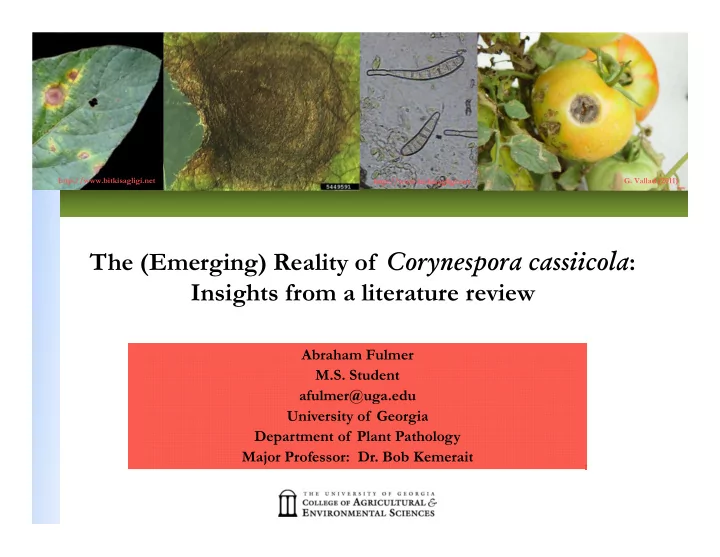
http://www.bitkisagligi.net G. Vallad (2011) http://www.bitkisagligi.net The (Emerging) Reality of Corynespora cassiicola : Insights from a literature review Abraham Fulmer M.S. Student afulmer@uga.edu University of Georgia Department of


slide-1
SLIDE 1

The (Emerging) Reality of Corynespora cassiicola: Insights from a literature review

Abraham Fulmer M.S. Student afulmer@uga.edu University of Georgia Department of Plant Pathology Major Professor: Dr. Bob Kemerait

http://www.bitkisagligi.net http://www.bitkisagligi.net

  • G. Vallad (2011)
slide-2
SLIDE 2

The Course of this Talk

Introduction to the Fungal Pathogen The Rise of Corynespora cassiicola Life Cycle: What’s known (or not) Fungicide Resistance

slide-3
SLIDE 3

An Introduction ~ Nomenclature ~

 First described by Berk. & M.A. Curtis 1868 as Helminthosporium cassiicola

 Corynespora cassiicola (Berk. & M.A. Curtis) C.T. Wei 1950

 Kingdom: Fungi

Phylum: Ascomycota

Subphylum: Pezizomycotina Class: Dothideomycetes Order: Pleosporales Family: Corynesporascaceae

 Common name of disease:

  • Corynespora leaf spot
  • Target spot

http://www.mycobank.org/MycoTaxo.aspx?Link=T&Rec=296024

Systematic Mycology and Microbiology Laboratory (USDA) http://nt.ars-grin.gov/fungaldatabases

slide-4
SLIDE 4

Pathogen Morphology

 Colony Morphology

  • Grey, Black, Dark brown, Green,
  • Concentric rings

 Conidiophores

  • Simple, erect, intermittently

branching and septate

  • Enteroblastic conidiogenous cells

produce subhyaline conidia singly or in chains.

 Conidia

  • Variable in size and shape
  • 4-17 pseudosepta
  • Range from 40-220 µm in length and

to 8-22 µm in width, straight to curved with rounded apex and truncate base

  • Conspicuous thickened hilum

http://www.padil.gov.au

Ellis, M. B., and Holiday, P. 1971. Corynespora cassiicola (Berk. & Curt.) Wei. Commonwealth Mycological Institute Descriptions of Fungi and Bacteria No. 31, Sheet 303.

www.invasive.org Qi, Y. X et al. 2009.

Olive L.S., Bain D.C., and Lefevbre C.L. 1945. A leaf spot of cowpea and soybean caused by an undescribed species of Helminthosporium. Phytopathology 50, 263–6.

slide-5
SLIDE 5

Host Range

 C. cassiicola has wide host range

  • from tropical and subtropical

countries

  • 530 plant species from 380

genera, including monocots, dicots, ferns, and one cycad

  • Includes saprotrophic and

endotrophic isolates

 Reported on diverse substrates:

  • plant leaves
  • stems
  • roots
  • nematode cysts
  • human skin

1. Dixon, L. J., Schlub, R. L., Pernezny, K., and Datnoff, L. E. 2009. Host specialization and phylogenetic diversity of Corynespora cassiicola. Phytopathology 99:1015-1027. 2. Huang, H.-K., Liu, C.-E., Liou, J.-H., Hsiue, H.-C., Hsiao, C.-H., and Hsueh, P.-R. 2010. Subcutaneous infection caused by Corynespora cassiicola, a plant pathogen. Journal of Infection 60 (2):188-190. Dixon, L. J. 2008. Dissertation. University Of Florida Huang, H.-K . et al. - Taiwan

slide-6
SLIDE 6

Major Diseases Caused by Corynespora cassiicola

 Rubber (Hevea brasiliensis)

  • Corynespora Leaf Fall Disease
  • First epidemic to gain notoriety
  • Sri Lanka - 4600 ha of rubber clone

(RRIC 103) destroyed since 1987

  • Malaysia, Indonesia and Thailand

1. Silva, W. P. K., Karunanayake, E. H., Wijesundera, R. L. C., and Priyanka, U. M. S. 2003. Genetic variation in Corynespora cassiicola : a possible relationship between host origin and virulence. Mycological Research 107 (5):567-571. 2. Fernando, T.H.P.S., Jayasinghe, C.K., Wijesundera, R.L.C. and Siriwardana, D. 2010. Screening of fungicides against Corynespora leaf fall disease of rubber under nursery conditions. Journal of Plant Diseases and Protection, 117 (3), 117–121 http://mvmtechnologies.info/main/index.php?id=164 Nghia et al., 2008.

slide-7
SLIDE 7

Other Epidemics of Note ≈ 30 years

 Cucumber (Cucumis sativus)

  • Recently, corynespora leaf spot

has become one of the most important diseases of cucumber.

  • 7- to 10-day intervals during

the 4-5 month growing season

 Tomato (Lycopersicon esculentum)

  • Serious pathogen on winter

grown tomatoes

  • Losses in marketable yield of

11 800 kg/ha

1. Miyamoto, T., Ishii, H., Stammler, G., Koch, A., Ogawara, T., Tomita, Y., Fountaine, J. M., Ushio, S., Seko, T., and Kobori, S. 2010. Distribution and molecular characterization of Corynespora cassiicola isolates resistant to boscalid. Plant Pathology 59 (5):873-881. 2. Pernezny K., Stoffella P., Collins, J., Carroll A., Beaney A. (2003): Control of target spot of tomato with fungicides, systemic acquired resistance activators, and a biocontrol agent. Plant Protect. Sci., 38: 81–88. www.invasive.org

Gary Vallad . UF, Gulf Coast REC
slide-8
SLIDE 8

The Rise of Corynespora cassiicola

 Increasing awareness?  Or  Increasing aggressiveness / dissemination of virulent isolates?  All of the above?  72 documented first reports from 1957 – 2013

  • Google Scholar, APS

Journals, Australasian Plant Disease Notes

1. Miyamoto, T., Ishii, H., Stammler, G., Koch, A., Ogawara, T., Tomita, Y., Fountaine, J. M., Ushio, S., Seko, T., and Kobori, S. 2010. Distribution and molecular characterization of Corynespora cassiicola isolates resistant to boscalid. Plant Pathology 59 (5):873-881.

2 4 6 8 10 12 14 16

# of Publications Year of Publication

First Reports for Corynespora cassiicola 2012= 5 2013 = 7

slide-9
SLIDE 9

Increasing First Reports1

1. Shimomoto, Y., Sato, T., Hojo, H., Morita, Y., Takeuchi, S., Mizumoto, H., Kiba, A., and Hikichi, Y. 2011. Pathogenic and genetic variation among isolates of Corynespora cassiicola in Japan. Plant Pathology 60 (2):253-260. 2. http://apsjournals.apsnet.org 3. http://www.publish.csiro.au/index.cfm

Documented since 2005

slide-10
SLIDE 10

2011 - Proof of Target Spot Koch’s Postulates

100% of inoculated plants showed symptoms No symptoms found on non-inoculated plants Fungus was re-isolated, cultured, and confirmed by morphological characteristics and PCR Symptoms associated with this disease

slide-11
SLIDE 11

Life Cycle of Corynespora cassiicola The Evolution of An Educated Guess

slide-12
SLIDE 12

A Typical Life Cycle Scenario Prediction: Anticipating the Behavior

slide-13
SLIDE 13

Development of Disease? Factors involved in Predicting Disease Severity

How does it overwinter? How long can it survive?

What’s the effect of tillage and crop rotation?

When does the pathogen emerge/start sporulating?

Secondary inoculum?

What is the relationship between environment and infection, etc? When does infection begin?

Based on phenology, weather, planting date, etc? All of the above?

slide-14
SLIDE 14

Epidemiology Optimum Environment

Host Temperature Leaf Wetness Tomato 20-28ºC (68-82.4) > 16 hours necessary Cucumber 25-30ºC (77-86ºF)

  • Tobacco

27.5-30ºC (81.5-86ºF)

  • Rubber

25-30ºC (77-86ºF) Greatest at 90% Cotton ? ? Mild Temperatures Prolonged Leaf Wetness

  • But to what extent?
slide-15
SLIDE 15

A Hopeful Demise? Suppression with Fungicides

Fungicide Dependence

  • Cucumbers
  • Tomatoes
  • Papaya
  • Rubber –

Resistance is a major concern

  • Strobilurins (QoI)
  • Boscalid (SDHI)

Rubber Institute of Sri Lanka

slide-16
SLIDE 16

Cucumber Fungicide Trial Japan

Corynespora leaf spot

  • Now 3rd most important disease in cucumber
  • Increasing severity in greenhouse production

Fungicide resistance

  • Already high frequency of resistance to:
  • Benzimidazoles
  • Strobilurin (QoI) ~ 6 years

– Miyamoto et al. (2009) – DNA analysis suggests that resistant isolates were present before the introduction of QoI fungicides

  • Boscalid - succinate dehydrogenase inhibitor (SDHI)
  • Japan: Registered in 2006 (very effective control)
  • Wide spread Resistance reported in 2009

Miyamoto, T., Ishii, H., Seko, T., Kobori, S., and Tomita, Y. 2009. Occurrence of Corynespora cassiicola isolates resistant to boscalid on cucumber in Ibaraki Prefecture, Japan. Plant Pathology 58 (6):1144-1151.

www.forestryimages.org www.forestryimages.org

slide-17
SLIDE 17

Target Spot of Tomato Florida

Target Spot

  • Most serious disease of

winter grown crop

  • Historically controlled with

Bravo

Fungicide resistance

  • QoI – First documented in

2001

Miyamoto, T., Ishii, H., Seko, T., Kobori, S., and Tomita, Y. 2009. Occurrence of Corynespora cassiicola isolates resistant to boscalid on cucumber in Ibaraki Prefecture, Japan. Plant Pathology 58 (6):1144-1151.

Gary Vallad . UF, Gulf Coast REC

slide-18
SLIDE 18
slide-19
SLIDE 19

Gary Vallad. 2011. Initial Characterization of Corynespora cassiicola Affecting Florida Tomatoes. University of Florida, Gulf Coast REC.

Hypervirulence

slide-20
SLIDE 20

Fungicides Labeled in Cotton

Currently – strobilurin chemistries are primary MOA labeled for cotton:

  • Headline
  • Quadris
  • Twinline
  • Metconazole

Photo: Courtesy Dr. Bob Kemerait & J. Brock

All Strobilurins

slide-21
SLIDE 21

The Path Ahead

 Emergence

  • Awareness or Aggressiveness

 Epidemiology

  • Knowledge gap
  • Inability to accurately predict

development

  • How can we better predict the

behavior of target spot based on the life cycle?

 Fungicide Resistance

  • High Risk pathogen
  • 3-6 years of use for QoI and SDHI

Or

Target Spot

  • f Cotton
slide-22
SLIDE 22

Questions?

afulmer@uga.edu

“It is hoped that this research will aid others in unraveling the many complexities that remain to be discovered with respect to C. cassiicola and its associated diseases.” Dixon et al., 2009