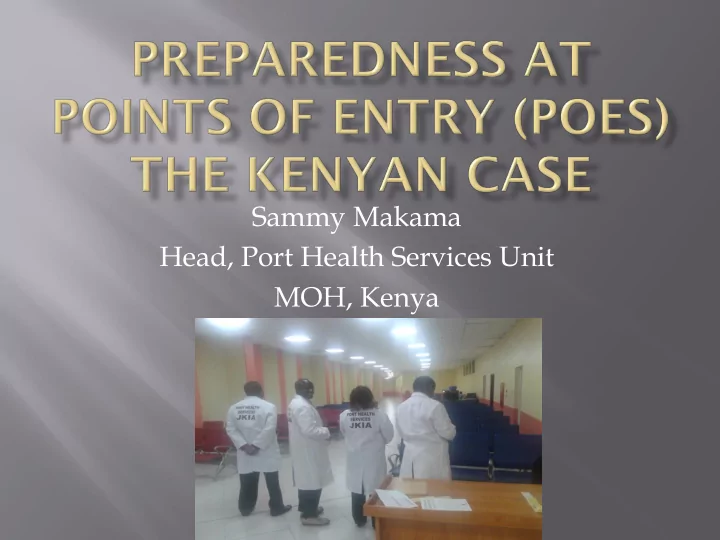
Sammy Makama Head, Port Health Services Unit MOH, Kenya POEs in - - PowerPoint PPT Presentation
Sammy Makama Head, Port Health Services Unit MOH, Kenya POEs in Kenya (Int. Airports) 1. Objectives of Port Health Services at POEs 2. Key PHS functions 3. Core capacity requirements 4. Preparedness at POEs 5. Use of information
1.
POEs in Kenya (Int. Airports)
2.
Objectives of Port Health Services at POEs
3.
Key PHS functions
4.
Core capacity requirements
5.
Preparedness at POEs
6.
Use of information generated at POEs
7.
Challenges
8.
Achievements
1.
Part IV ; Points of Entry
2.
Part V: General Provisions
a)
Article 23: Health measures on arrival and departure
b)
Article 31: Health measures relating to entry of travellers
3.
Annex 1 (B): Core capacity requirements at POEs
Prevention/control of spread of PHEICs through: -
1.
Provision of basic health services for travellers
2.
Control of disease causing vectors and vermins
3.
Inspection and certification of exports/imports
4.
Surveillance: communicable diseases and conditions
5.
Ensure coordinated rapid response to any PHEICs
CONTROLING PUBLIC HEALTH RISKS At PORTS, AIRPORTS GROUND CROSSING RESPONDING TO EMERGENCIES DETECTING PUBLIC HEALTH EVENTS OF INTERNATIONAL CONCERN (PHEICs)
INSPECTION - SCREENING CONTINGENCY PLANS
Airports, ports and ground: -
1.
Permanent Capacities (Available at all times)
2.
Capacity to respond to PHEIC
(During emergencies)
(a) Health service, staff & equipment (b) Equipment & personnel for transport (c) Trained personnel for inspection of conveyances (d) ensure save environment, water, catering facilities, wash rooms, disposal services & inspection programmes (e) Trained staff and programme for vector control
Permanent Capacities
Capacity requirements at all times (routine)
a
Emergency resp. plan, coordinator, contact points for relevant PoE, PH &
- ther agencies
Provide PH assessment & care for affected travellers, animals, goods by establishing arrangements with medical, veterinary facilities for isolation, treatment & other services
b c
Provide space, separate from
- ther travellers
to interview suspect or affected persons
d
Provide for assessment, quarantine of suspect or affected travellers
e
To apply recommended measures, disinsect, disinfect, decontaminate, baggage, cargo, containers, conveyances, goods, postal parcels etc
e
To apply entry/exit control for departing & arriving passengers
f
Provide access to required equipment, personnel with protection gear for transfer of travellers with infection/ contamination
Capacity requirements for responding to PHEIC (emergency)
Capacity to respond to PHEIC
1.
Staff deployment/re-deployment
2.
Contingency planning
3.
Development of protocols
4.
Supplies
5.
Training/Sensitization
6.
Surveillance
7.
Designated referral facilities for POEs
POEs requirements
included in the MOH Contingency Plan
Public health
emergency plan part
- f Kenya Aviation
Pandemic Preparedness Plan
Entry screening protocol – finalised Protocol for handling suspected cases at POEs -
finalised
Exit screening protocol - Draft Safe burial protocol – Draft
PPEs Surveillance/Entry
screening forms
Disinfectants /
Sanitizers
IEC materials Waste management
supplies
95 TOTs on EVD Over 500 sensitized
- n EVD
50 trained on use
- f thermo-cameras
Every major POE has
a designated HF for referral of suspected cases
Kenyatta National
Hospital is designated for JKIA
1.
Travelers arriving from unaffected countries
a)
Temperature taking
2.
Travelers arriving from EVD affected countries
a)
Fill surveillance forms
b)
Temperature taking
3.
Travelers transiting from EVD affected countries
a)
Fill surveillance forms
b)
Temperature taking
50,000 100,000 150,000 200,000 250,000 JKIA Mombasa Airport Kilindini Port Busia Malaba Namanga Lwakhakha Taveta Isebania Lungalunga Lokichogio Kisumu Port Kiunga Eldoret Airport 247,962 71,718 18,102 110,226 99,516 64,614 74,562 85,266 18,000 48,000 30,000 726 960 282
Revision of plans Resource allocation Follow up of travelers Further risk assessment
Liberia, 49 Guinea, 14 S/Leone, 37
Outcome of follow up: - 15 are health workers: nurses, doctors,
clinicians and epidemiologists
Completed 21dys, 34%
Left the country, 43% Still on f/up, 23%
Travellers screened at Busia (Kenya/Uganda Border)
S/sudan DRC Rwanda Burundi Tanzania
- thers