Host range, pathogenicity, and genetic diversity of Corynespora - - PowerPoint PPT Presentation

host range pathogenicity and genetic diversity of
SMART_READER_LITE
LIVE PREVIEW

Host range, pathogenicity, and genetic diversity of Corynespora - - PowerPoint PPT Presentation

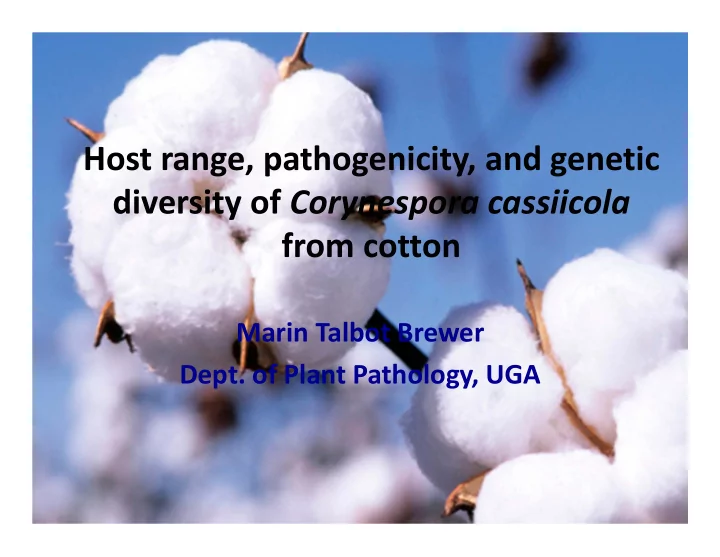
Host range, pathogenicity, and genetic diversity of Corynespora cassiicola from cotton Marin Talbot Brewer Dept. of Plant Pathology, UGA Corynespora cassiicola is causing numerous emerging diseases, including target spot of cotton A disease is


slide-1
SLIDE 1

Host range, pathogenicity, and genetic diversity of Corynespora cassiicola from cotton

Marin Talbot Brewer

  • Dept. of Plant Pathology, UGA
slide-2
SLIDE 2

Corynespora cassiicola is causing numerous emerging diseases, including target spot of cotton

A disease is emerging if – increase in host range, geographic range, or incidence is

  • bserved, or

– new strains evolve

slide-3
SLIDE 3

Causes of disease emergence include…

  • Pathogen adaptation
  • Pathogen introduction
  • Host susceptibility
  • Environmental change

Target spot on cotton (photo: Nick McGhee)

Which of these explain emergence of target spot on cotton?

slide-4
SLIDE 4

Corynespora cassiicola has a very wide host range

Pathogen of crop plants, ornamentals, and weeds

– rubber tree, hydrangea, mandevilla, cassava, lantana, balsam pear, basil, highbush blueberry, papaya, eggplant, azalea, cocoa, sweet potato – cotton, soybean, tomato, cucumber, cowpea, pepper, bean

Cassiicolin ‐ host selective plant toxin Endophyte Saprophyte Subcutaneous skin infections, corneal infections

slide-5
SLIDE 5

Population biology of C. cassiicola

  • Few studies addressing population biology
  • Dixon et al. (2009) most comprehensive study to date
  • Sequenced 4 genes from 143 isolates from different

hosts and geographic locations

  • 50 isolates on 8 economically important hosts

– Basil, bean, papaya, tomato, cowpea, cucumber, soybean, sweet potato

slide-6
SLIDE 6

Dixon et. al (2009) Phytopathology

Host range and phylogenetic diversity

  • Phylogenetic lineages

– wide geographic range – wide host range

  • Some host specialization
  • No cotton isolates, 2 soybean

isolates

slide-7
SLIDE 7

Research Objectives

1. Determine the host range of C. cassiicola isolates from cotton and pathogenicity of isolates from other hosts in the southeastern USA to cotton 2. Determine the phylogenetic relationship of isolates of C. cassiicola from cotton with isolates from other hosts 3. Characterize the genetic diversity of C. cassiicola isolates from cotton

slide-8
SLIDE 8

Why is this important?

  • Host range

– Identify alternative hosts of cotton isolates – Identify sources of inoculum – Determine if different populations exist in SE

  • Phylogenetic relationships

– Determine where it came from – Identify other potential hosts – Identify if specialization exists

  • Diversity of cotton isolates

– Determine if there are differences in aggressiveness, host range, fungicide resistance – Develop a panel for resistance assays, breeding – Identify mechanisms of dispersal – Understand why it emerged

slide-9
SLIDE 9

Research approach

  • Isolate collection

– Diverse hosts in southeast – Diverse geographic locations (SE and worldwide) – Focus on cotton and soybean isolates

slide-10
SLIDE 10

Host range

  • Inoculate cotton seedlings with diverse isolates

– Resistant and sensitive cotton cultivars

  • Inoculate diverse hosts with cotton isolates

– Soybean, cowpea, cucumber, tomato seedlings

  • 40 isolates, 10 each from cotton and soybean
  • Evaluate for symptoms
slide-11
SLIDE 11

Phylogenetic relationships

  • Cotton isolates (100)

– Diverse varieties – Diverse geographic regions

  • Soybean isolates
  • Other isolates from southeastern US
  • 150 total isolates
  • Sequence 4+ genes
  • Construct phylogenetic trees
  • Lineages to which cotton, soybean and other hosts

belong

  • Clustering?
slide-12
SLIDE 12

Genetic diversity

  • Sequence 6 genes for numerous cotton

isolates throughout southeastern US

  • Also from other countries where C. cassiicola
  • n cotton found
slide-13
SLIDE 13

Summary

  • Corynespora cassiicola is an emerging disease
  • Wide host range with some specialization
  • Research on cotton and soybean populations is

needed

  • Research will provide insight into where it came from,

why it is emerging, and diversity of cotton populations

  • Knowledge will improve disease management
  • Alternative hosts
  • Sources of inoculum
  • Resistance