The Double Helix April 1953 Francis Crick James Watson Rosalind - - PDF document

the double helix april 1953
SMART_READER_LITE
LIVE PREVIEW

The Double Helix April 1953 Francis Crick James Watson Rosalind - - PDF document

Can be syndromic or non-syndromic Majority of cases are non-syndromic with no other features to assist in diagnosis Environmental and Genetic Factors Pre and perinatal factors, infections, family histories, parental age,


slide-1
SLIDE 1

 Can be syndromic or non-syndromic  Majority of cases are non-syndromic with no other

features to assist in diagnosis

 Environmental and Genetic Factors  Pre and perinatal factors, infections, family histories,

parental age, pesticides, drugs and chemicals

 Observed in all ethnic groups  More than 600 genes described in literature  Most have not be replicated  Many individuals with autism are still unresolved –

more genes/loci?

 Genetic testing is recommended for all children with ASD

 ~25-30% have an identified genetic syndrome or variant  This means that ~70% have no mechanism identified as yet

 Comorbidity with ID, epilepsy, motor impairment, certain

dysmorphic features supports a likely underlying genetic etiology

 Future Goal: genetic characterization of etiology will

facilitate targeted treatments based on the underlying mechanism of the disease

Pediatr Clin N Am 2015;62:607-18 Nature 2012;485:242-5 Nature 2012;485:246-50

 Concordance in monozygotic twins

approaches 70%

 Recurrence rates in siblings of children with

ASD range from 5% to 20%

 Recurrence rate increases to 33% if a family

has 2 children with ASD

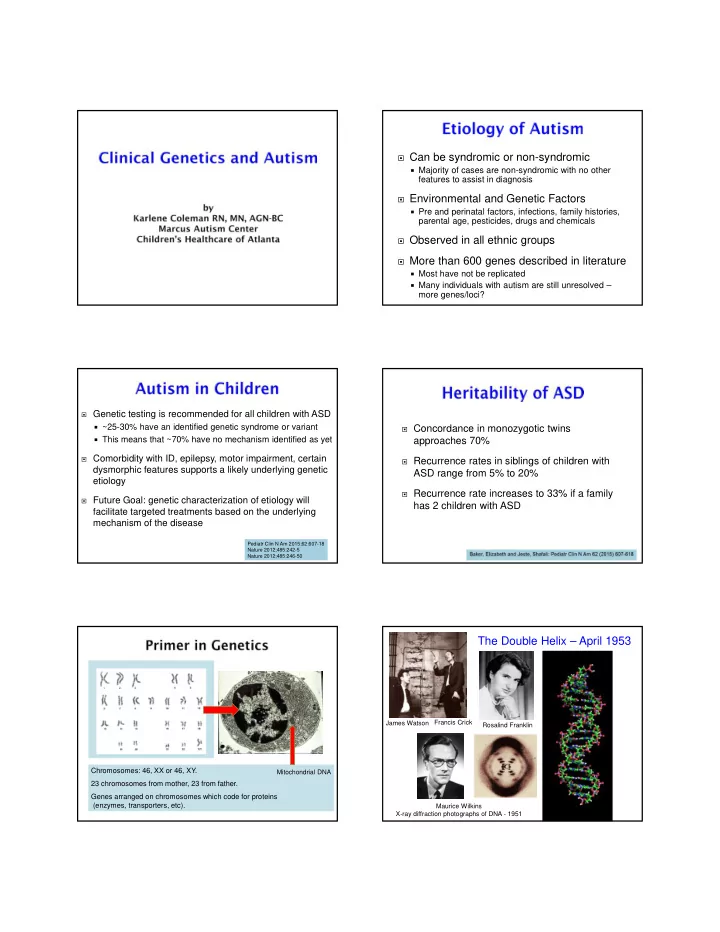
Chromosomes: 46, XX or 46, XY. 23 chromosomes from mother, 23 from father. Genes arranged on chromosomes which code for proteins (enzymes, transporters, etc).

Mitochondrial DNA Maurice Wilkins X-ray diffraction photographs of DNA - 1951 Rosalind Franklin James Watson Francis Crick

The Double Helix – April 1953

Rosalind Franklin

slide-2
SLIDE 2
  • 50 years later

I t took 1 3 years and 3 billion dollars

2007

  • J. Craig Venter

Decoded a full diploid genome – his and James Watson’s

It took 3 months and $300,000 each Goal is under $1000 for genome sequencing Currently it takes ~3 months and $5,000 to $7,000

Chromosome Technology Progress

Technology Resolution Sample Diagnosis Karyotype Whole Down syndrome (1970’s) Chromosome Large Deletions or duplications (> 4 Mb) Fluorescence in situ ~ 100 kb 22q11.2 syndrome Hybridization (FISH) VCFS (1990’s) Tests a single locus at a time Need Prior knowledge of region Array CGH Flexible, only Submicroscopic (2000’s) limited by probe deletions/duplications spacing (> 1 kb) anywhere in the genome Can test whole-genome simultaneously

Slide courtesy of Jennifer Mulle PhD

Fluorescent In Situ Hybridization

  • FISH

Looks for small specific sections of DNA (30-50 genes) that would be missed by routine chromosome analysis Detects microdeletion syndromes like:

22q11.2 deletion 7q11 del Williams

22q11.2 Region and FISH

Fish for Williams syndrome 7q11.23 deletion Incidence 1:10 to 15,000

Normal Deleted

slide-3
SLIDE 3

What is array CGH Comparative Genomic Hybridization? (aka - Chromosomal Microarray) What can it tell me?

Patient DNA Control DNA

Genomic Clones

Array-based Comparative Genomic Hybridization

Pinkel et al., Nat Genet (1998), 20(2):207-11 Slide courtesy of Christa Martin, PhD

Only detects unbalanced rearrangements NORMAL Patient DNA Control DNA

Genomic Clones

Loss: ratio < 0.8 Gain: ratio > 1.2

Array-based CGH

Normal: ratio 0.8 - 1.2

Normal (46,XX) Turner synd. (45,X) 47,XXX

FISH probe (~100 kb) used for testing only covers this gene 3 Mb DGS region

  • ligo probe

coverage on EmArray

Diagnostic Yield for ID, ASD, DD and MCA:

Conventional Karyotype - 5% Microarray – 20% positive for CNVs Recommendation: order a microarrays a first tier test for

  • 1. Intellectual Disability
  • 2. Multiple Congenital Anomalies
  • 3. Developmental Delays
  • 4. Autism Spectrum Disorders

Yield for ASD alone – 10% positive for CNVs

American Journal of Human Genetics 86, 749-764, May 13, 2010 Genetics in Medicine 15 (7) July 2013

slide-4
SLIDE 4

DNA Testing

Transcription

mRNA (messenger) tRNA (transfer) rRNA (ribosomal)

Translation Protein Production

DNA Primer

Gene – String of A’s, T’s C’s and G’s

ATG GGG TTT TCT CCA CAC TAC CCC AAA AGA GGT GTG

mRNA (U instead of T Single Stranded)

AUG GGG UUU UCU CCA CAC

Codons

Met Gly Phe Ser Pro His

Enzyme Transporter etc. Met Gly Phe Ser Pro His

Room for Normal Variation

Altered Biological Function = Disease Autosomal Dominant – TSC1 and TSC2 Tuberous Sclerosis Autosomal Recessive – BCKDK - Branched Chain Ketoacid Dehydrogenase Kinase X-Linked – Fragile X syndrome

Known Genes with Autism as a feature:

Single base variants

Silent mutation: codes for same amino acid (AA) Conservative missense: codes for similar AA – protein works Nonconservative missense: codes for different AA – protein may lose function Nonsense: STOP codon reduced or no protein made Frame Shift: insertion or deletion shifts reading frame

slide-5
SLIDE 5

Other Mechanisms:

  • Small Deletions
  • Whole Gene Deletions
  • Splice Mutations
  • Chromosomal deletions
  • Rearrangements
  • Epigenetic changes
  • Single base variants

Benefits:

  • All nucleotides interrogated in a specific gene
  • Analyst reviews quality at every basepair
  • Gold standard

Limitations:

  • Large deletions or duplications cannot be detected
  • Relatively high cost, labor intensive
  • Low through put
  • Limited automation in data review
  • Potentially complicated interpretation and reporting

First Generation (Sanger Sequencing): Second Generation (NextGeneration Sequencing):

Benefits:

  • Sophisticated bioinformatics
  • Highly automated
  • Large amount of sequence

Limitations:

  • High cost for infrastructure
  • Sophisticated bioinformatics
  • Reagent cost
  • Complicated interpretation

and reporting

Next Generation Sequencing -

New sequencing Techniques

Utility of Panels: autism; cardiomyopathy; seizures etc Cost wise: panels are frequently close to the same cost

as sequencing one single gene

Gene Panels

Sometime we know what gene to sequence Autism and Macrocephaly – sequence the PTEN

tumor suppressor gene on chromosome 10q

Cardiomyopathy Panel

  • 63-gene cardiomyopathy NGS panel

Emory Autism Panel

  • 62 genes:
  • ADSL, AFF2, AP1S2, ARX, ATRX, BCKDK, BRAF, CACNA1C,

CASK, CDKL5, CHD7, CHD8, CNTNAP2, CREBBP, CYP27A1, DHCR7, DMD, EHMT1, FGD1, FMR1, FOLR1, FOXG1, FOXP1, FOXP2, HPRT1, KDM5C, L1CAM, MAGEL2, MBD5, MECP2, MED12, MEF2C, MID1, NHS, NIPBL, NLGN3, NLGN4X, NR1I3, NRXN1, NSD1, OPHN1, PAFAH1B1, PCDH19, PHF6, PNKP, PQBP1, PTCHD1, PTEN, PTPN11, RAB39B, RAI1, RELN, SCN1A, SLC2A1, SLC9A6, SMARCB1, SMC1A, TCF4, UBE2A, UBE3A, VPS13B, ZEB2

  • all except 3 of these genes are associated with

known genetic syndromes or intellectual disability

slide-6
SLIDE 6

Venn diagram of the overlap of genes affected by hot zone de novo mutations across four neuropsychiatric disorders

Slide courtesy of: David B. Goldstein, Institute for Genomic Medicine, Columbia University Baker, Elizabeth and Jeste, Shafali: Pediatr Clin N Am 62 (2015) 607-618

The Next Test?

WES – Whole Exome Sequencing WGS – Whole Genome Sequencing

Exome sequencing

Panels vs Exome

Panel Exome

Cost $2,500-$3,200 $6,700 trios Turn-around time 8-12 weeks 16 weeks Analytical sensitivity 99%; All coding exons of all genes on panel are analyzed; Del/Dup included 92%; all exons of all genes are not covered; no del/dup Clinical sensitivity All genes are associated with specific phenotype of panel No specific phenotype needed; not all exons/genes covered Gene coverage Only genes included on panel are analyzed Captures exomes indiscriminately Parental testing Not required; parental follow up may be useful Recommended; can help with interpretation and classification Potential Results Mutations and VOUS identified in genes associated with specific phenotype Mutations, VUS, and carrier status can be identified in any gene, including adult onset, cancer and non-medically actionable genes

Next Generation Sequencing Genome vs. Exome

intron exon