Cytogenetic Oncogenesis Abnormalities in Hematologic Disorders - - PDF document

cytogenetic
SMART_READER_LITE
LIVE PREVIEW

Cytogenetic Oncogenesis Abnormalities in Hematologic Disorders - - PDF document

Cytogenetic Oncogenesis Abnormalities in Hematologic Disorders Siddhartha Ganguly, MD, FACP Director, Lymphoma & Myeloma Program Blood and Marrow Transplantation Professor of Medicine Increased Growth and University of Kansas Medical


slide-1
SLIDE 1

1

Cytogenetic Abnormalities in Hematologic Disorders

Siddhartha Ganguly, MD, FACP Director, Lymphoma & Myeloma Program Blood and Marrow Transplantation Professor of Medicine University of Kansas Medical Center Kansas City, Kansas

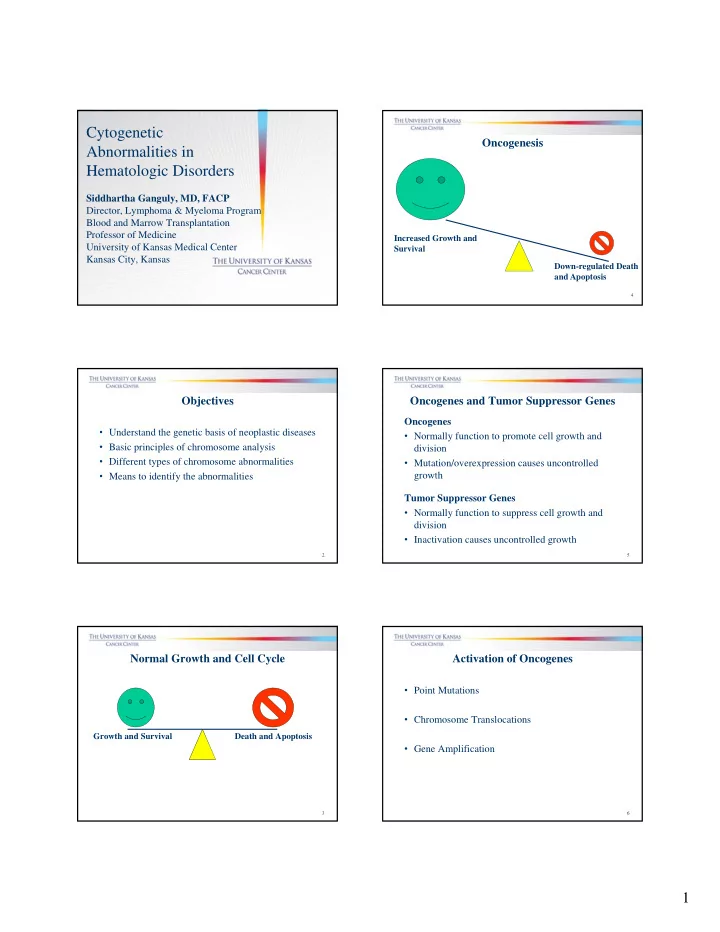
Objectives

  • Understand the genetic basis of neoplastic diseases
  • Basic principles of chromosome analysis
  • Different types of chromosome abnormalities
  • Means to identify the abnormalities

2 3

Growth and Survival Death and Apoptosis

Normal Growth and Cell Cycle

4

Increased Growth and Survival Down-regulated Death and Apoptosis

Oncogenesis Oncogenes and Tumor Suppressor Genes

Oncogenes

  • Normally function to promote cell growth and

division

  • Mutation/overexpression causes uncontrolled

growth Tumor Suppressor Genes

  • Normally function to suppress cell growth and

division

  • Inactivation causes uncontrolled growth

5

Activation of Oncogenes

  • Point Mutations
  • Chromosome Translocations
  • Gene Amplification

6

slide-2
SLIDE 2

2

Methods to Identify Genetic basis of Diseases

  • Chromosome analysis (Karyotyping)
  • FISH
  • PCR
  • mRNA and micro RNA
  • Proteomics

7

Human Chromosomes

8 9

Normal metaphase Normal male karyogram 46, XY

Normal metaphase vs. Normal male karyogram Philadelphia Chromosome of CML

10

The abnormality seen by Nowell & Hungerford

  • n chromosome 22. Now know as the

Philadelphia Chromosome.

11

p arm q arm centromere region p1 region q2 region q1

Nomenclature

22q11.2

12

slide-3
SLIDE 3

3

Chromosome Disorders

  • Conditions associated with visible changes in

chromosomes – Limited to fairly large gains, losses or rearrangements of chromosomal material

13

Clinical Cytogenetics

  • Acquired Abnormalities

– Leukemia and lymphoma

  • Constitutional Abnormalities

– Prenatal diagnosis – Newborns/children with multiple congenital abnormalities – Adults with infertility

14

Types of chromosome abnormalities

  • Numeric abnormalities

– Diploid, haploid, aneuploid, tetraploid, monosomy, trisomy

  • Structural abnormalities

– Translocations, deletions, duplications, inversions, rings

15

Trisomy 21

16

Consequences of Chromosome Abnormalities in Cancer

  • Translocations

– Fusion proteins – Overexpression of normal proteins

  • Deletions

– Loss of tumor suppressor genes

  • Amplifications of genes

– Oncogene overexpression

17

Mechanisms by which chromosome translocations active oncogenes

18

Fusion protein- bcr/abl in chronic myelogenous leukemia increased tyrosine kinase activity

slide-4
SLIDE 4

4

Inversion 16 (p13:q22)

19

Florescence in Situ Hybridization

20

Probe Mbcr/abl In Cells With A t(9;22)(q34;q11.2)

21

Normal Cell & ABL/BCR fusion

22

Normal Cell ABL/BCR fusion

Let us Read a Report!

  • 70 year old male admitted with acute leukemia add 16

(p2.1); del 3q13; t(8:14)(q24:q32); der 16p32/44-46 XY; FISH was positive for t(8:14)(c-myc:IgH)(q24:q32)

  • Flow cytometry was suggestive of pre-B ALL
  • Treated with Hyper CVAD
  • After 2 cycles: 46, XY
  • After 4th cycle relapsed with: add 16 (p2.1); del 3q13; -7;

t(8:14)(q24:q32); der 16p32/44-46 XY

  • Clonal evolution and planning for cord blood

transplantation

23

What we learned!

  • Understood the genetic basis of neoplastic

diseases

  • Basic principles of chromosome analysis
  • Different types of chromosome abnormalities
  • Means to identify the abnormalities by

Karyotyping and FISH

  • How to read a report

24