The Disability Conundrum How To Deal With Difficult Accommodation - - PDF document

the disability conundrum
SMART_READER_LITE
LIVE PREVIEW

The Disability Conundrum How To Deal With Difficult Accommodation - - PDF document

The Disability Conundrum How To Deal With Difficult Accommodation Issues MT SHRM Sumner County October 4, 2018 Presented by Fred J. Bissinger Background Information 2 Total Number of Charges Filed 100,000 Total Number of Charges Filed


slide-1
SLIDE 1

1 The Disability Conundrum – How To Deal With Difficult Accommodation Issues

MT SHRM Sumner County

October 4, 2018 Presented by Fred J. Bissinger

Background Information

2

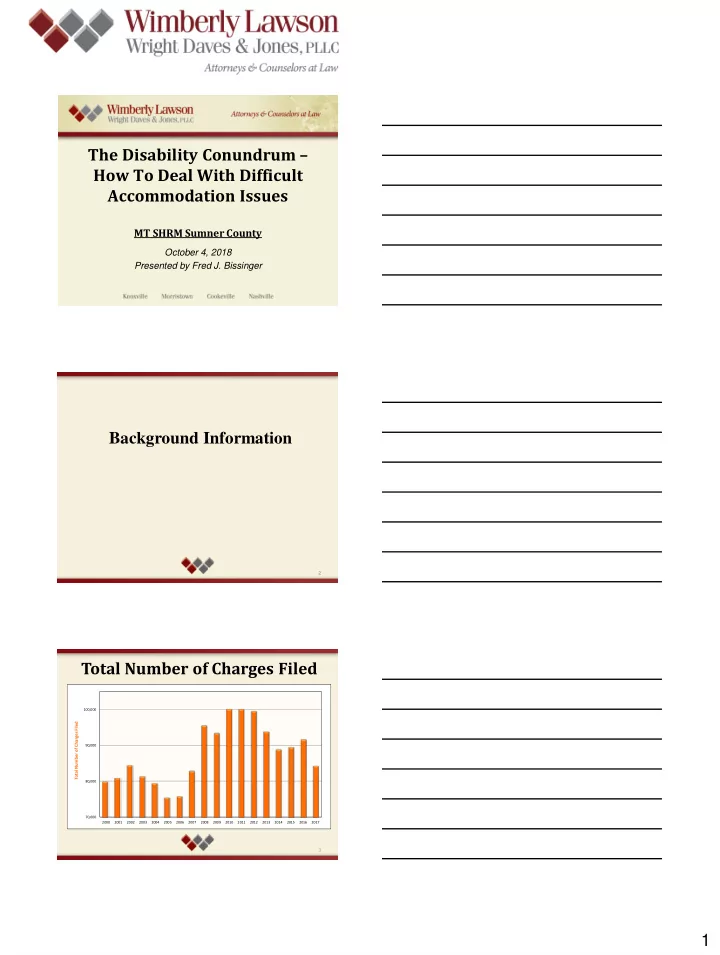
Total Number of Charges Filed

3

70,000 80,000 90,000 100,000 2000 2001 2002 2003 2004 2005 2006 2007 2008 2009 2010 2011 2012 2013 2014 2015 2016 2017

Total Number of Charges Filed

slide-2
SLIDE 2

2 Disability Discrimination

4

10,000 20,000 30,000 2000 2001 2002 2003 2004 2005 2006 2007 2008 2009 2010 2011 2012 2013 2014 2015 2016 2017

Number of Disability Discrimination Charges

Real Life Examples

  • EE comments regarding building
  • EE asleep onsite during break period
  • EE request to intermittently miss work due

to use of narcotic medications

5 6

ADAAA – Definition

  • A physical or mental impairment that

substantially limits one or more major life activities;

  • A record of such an impairment; or
  • Being

regarded as having such an impairment

slide-3
SLIDE 3

3 Disability – Prima Facie Case

  • Disabled within the meaning of ADA;
  • Qualified,

with

  • r

without reasonable accommodation, to perform the essential functions of the position held or desired;

  • Skills, training, education, certifications, etc.
  • Can EE perform essential functions – with or

without RA; and

  • Has suffered an adverse action because of

his/her disability

7

Defenses

  • **Not Qualified
  • Undue Hardship
  • Direct Threat

8

EEOC Enforcement

  • Generally not interested in arguments over

whether EE is disabled;

  • Instead,

EEOC’s focus is on whether ER engaged EE in Interactive Process

  • And,

basis for ER’s decision regarding Reasonable Accommodation

9

slide-4
SLIDE 4

4 ADAAA Check-Down List

  • Job Description
  • Essential Functions
  • Regular and predictable attendance
  • Ability to work in a cooperative manner with
  • thers

10

ADAAA Check-Down List

  • RA in current position
  • RA in open position / same level
  • RA in open position / lower level
  • LOA **** (ADA and FMLA)

**Individual Assessment

11

Case Where ER Won

  • Huwe v. Brennan (D. Minn. 2018)
  • Christine

Huwe developed depression &

  • anxiety. She asked for a new supervisor as a

reasonable accommodation under the ADA, but was turned down.

12

slide-5
SLIDE 5

5 Case Where ER Won

  • She sued, alleging failure to accommodate

under the ADA.

  • The court dismissed the suit, explaining

that a different supervisor is not a reasonable accommodation. Other courts agree.

13

Case Where ER Won

  • An employee may claim that the stress of

having a difficult boss creates a mental disability such as major depression. She can ask for another supervisor as a reasonable accommodation—but employers don’t have to grant it. Courts don’t view such a change as a reasonable accommodation.

14

Case where ER Won:

  • In 2015, the U.S. 6th Circuit Court of Appeal

(which includes Tennessee), held in Yarberry v. Gregg Appliances, Inc. that an employer could terminate the employment

  • f

an employee who engaged in misconduct even if it was caused by a disability.

15

slide-6
SLIDE 6

6 Case where ER Won

  • In that case, the employer terminated the

plaintiff’s employment after he exhibited bizarre behavior over the course of two days…

16

Case where ER Won:

  • …The plaintiff had an argument with a co-

worker and engaged in other disruptive and bizarre behavior. After experiencing a mental breakdown, plaintiff was admitted to a psychiatric hospital.

17

Case where ER Won:

  • After the employer terminated plaintiff’s

employment, his doctor submitted a letter stating that plaintiff had experienced a manic episode stemming from his bipolar disorder.

18

slide-7
SLIDE 7

7 Case Where ER Won:

  • The

Sixth Circuit affirmed the district court’s granting summary judgment to the employer on the plaintiff’s ADA claim.

19

Case Where ER Won

  • The Sixth Circuit found that “Employers

not only have latitude to discipline employees for threats of violence, stealing, or destruction of property, but also may prohibit inappropriate behavior between co-workers”.

20

Case where ER Won:

  • Walz v. Ameriprise Fin., Inc., 779 F.3d 842,

31 A.D. Cas. 573 (8th Cir. 2015)

  • Plaintiff fired for spate of erratic and

disrespectful actions

21

slide-8
SLIDE 8

8 Case where ER Won:

  • No disability claim since bipolar disorder

wasn’t apparent to employer and plaintiff failed to inform the company of her condition or the work limitations it caused her

  • Ability

to work well with

  • thers was

essential job function.

22

Case where ER Won:

  • Stevens v. Rite Aid Corp., 851 F.3d 224, 33

A.D. Cas. 557 (2d Cir. 2017), pet. for cert. docketed by ___ U.S. ___ (Aug. 11, 2017)

  • Award
  • f

$2.6 million to terminated pharmacist who had a phobia that prevented him from giving injections reversed

  • Giving injections was an essential function
  • f job

23

Case where ER Won:

  • …plaintiff

suggested that a reasonable accommodation would be de-sensitization therapy – employers are not obliged to

  • ffer medical treatment as a reasonable

accommodation –

24

slide-9
SLIDE 9

9 Case Where ER Won

  • Plaintiff suggested that other employees

could give the injections – a reasonable accommodation “can never involve the elimination of an essential function,” 851 F.3d at 230.

25

Case where ER Won:

  • Stern v. St. Anthony’s Health Ctr., 788 F.3d

276, 31 A.D. Cas. 1149 (7th Cir. 2015) - Terminated chief psychologist unfit for position-subordinates noted cognitive problems similar to Alzheimer’s – independent third party concluded that plaintiff “definitely had cognitive issues” typical of early Alzheimer’s – …

26

Case where ER Won:

  • …court bothered by termination without

interactive process –

  • However, plaintiff did not demonstrate

how disabilities could be accommodated

27

slide-10
SLIDE 10

10 Case where ER Won:

  • Not

sufficient to suggest delegating essential job functions – summary judgment affirmed.

28

Case Where ER Did Not Win

  • Hostettler v. College of Wooster (6th Cir.

2018)

  • Plaintiff, an HR Generalist at Wooster College,

alleged that the college discriminated against her based on her pregnancy under the ADA.

29

Case Where ER Did Not Win

  • College terminated her employment when

she asked to extend her part-time work schedule due to postpartum depression and separation anxiety.

  • College explained that it terminated Plaintiff

because a full-time presence at work was an essential function of her position.

30

slide-11
SLIDE 11

11 Case Where ER Did Not Win

  • The 6th Circuit Court of Appeals found that the

case should go to trial.

  • There was a dispute about whether working

full-time was really an essential function of Plaintiff’s position, and whether the college engaged in an interactive process on this issue after Plaintiff raised it.

31

Case Where ER Did Not Win

  • The court stated, “[F]ull-time presence at

work is not an essential function of a job solely because an employer says that it is .... An employer cannot deny a modified work schedule as unreasonable unless the employer can show why the employee is needed on a full-time schedule.”

32

Case Where ER Did Not Win

  • Lesson:

Although some jobs, by their nature, do require full-time work, not every job does. This requires job-by-job analysis.

33

slide-12
SLIDE 12

12 Bottom Line

  • 1) Unless you know or should know

about an employee’s disability, you don’t have to treat the employee any differently with respect to discipline.

34

Bottom Line

  • You should, however, document when you

first learned of the disability and, in some instances, request an explanation from the employee if you reasonably suspect performance issues are caused by a disability.

35

Bottom Line

  • 2) You should engage in an interactive

process with all employees, including disciplined employees, to identify reasonable accommodations that could prevent future misconduct.

36

slide-13
SLIDE 13

13 Bottom Line

  • 3)

If you later become aware that misconduct was caused by a disability, you don’t have to retract an otherwise proper disciplinary action.

37

Bottom Line

  • You still may move forward with discipline if

the misconduct violates a job-related rule that applies to all employees, such as requirements that employees deal appropriately with customers

  • r

work cooperatively with others.

38

Bottom Line

  • 4) Document all stages of the process.

39

slide-14
SLIDE 14

14 Opioid/Heroin Addiction Epidemic

40

Total U.S. Drug Deaths* - More than 64,000 Americans died from drug

  • verdoses in 2016, including illicit drugs and prescription opioids--nearly

double in a decade. Source: CDC WONDER * Provisional counts for 2016 are based on data available for analysis as

  • f 8/2017. Counts through 2015 are based on final annual data.

41

National Statistics

42

slide-15
SLIDE 15

15 TENNESSEE STATISTICS

** The Tennessee Department of Health data shows 1,776 Tennesseans died from drug overdoses in 2017, the highest annual number of such deaths since reporting began.

43

VA’s Change of Direction Regarding Opioids

44

Drug Addiction and the ADA/FMLA

  • ADA:
  • Disability does not include illegal drug

use

  • Current use v. someone who is sober
  • FMLA: Need for LOA for treatment

45

slide-16
SLIDE 16

16 Drug Addiction and the ADA/FMLA

29 CFR 1630.16(b) Regulation

  • f alcohol and drugs. A covered Entity:
  • (1) May prohibit the illegal use of drugs and

the use of alcohol at the workplace by all employees;

  • (2) May require that the employees not be

under the influence

  • f

alcohol

  • r

be engaging in the illegal use of drugs at the workplace; and

46

Drug Addiction and the ADA/FMLA

29 CFR1630.16(b) Regulation of alcohol and drugs. A covered Entity:

  • (May hold an employee who engages in the

illegal use of drugs or who is an alcoholic to the same qualification standards for employment

  • r

job performance and behavior to which the entity holds its other employees, even if any unsatisfactory performance or behavior is related to the employee’s drug use or alcoholism. 4)

47

Drug Addiction and the ADA/FMLA

29 CFR 1630.16(c) Drug Testing

  • (1) General Policy - For purposes of this

part, a test to determine the illegal use of drugs is not considered a medical examination.

48

slide-17
SLIDE 17

17 Drug Addiction and the ADA/FMLA

29 CFR 1630.16(c) Drug Testing

  • However, this part does not encourage,

prohibit, or authorize a covered entity to conduct drug tests of job applicants or employees to determine the illegal use of drugs or to make employment decisions based on such test results.

49

Conclusion

50

Fred J. Bissinger, Esq. Wimberly Lawson Wright Daves & Jones, PLLC 214 2nd Ave. North, Suite 3 Nashville, TN 37201 Phone: 615-727-1000 fbissinger@wimberlylawson.com