trial of pralsetinib (BLU-667) in patients with advanced RET - - PowerPoint PPT Presentation

trial of pralsetinib blu 667 in patients with
SMART_READER_LITE
LIVE PREVIEW

trial of pralsetinib (BLU-667) in patients with advanced RET - - PowerPoint PPT Presentation

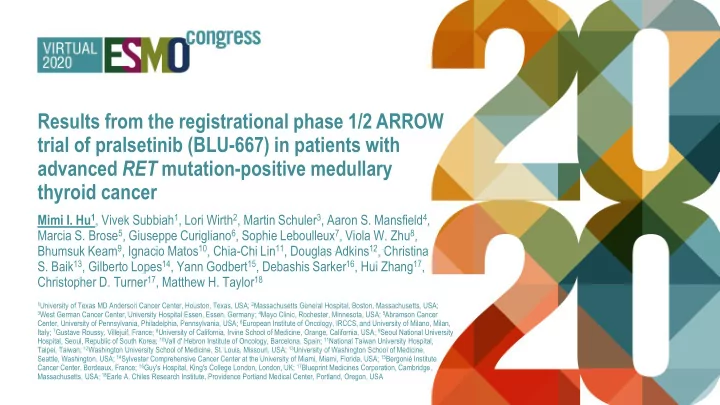
Results from the registrational phase 1/2 ARROW trial of pralsetinib (BLU-667) in patients with advanced RET mutation-positive medullary thyroid cancer Mimi I. Hu 1 , Vivek Subbiah 1 , Lori Wirth 2 , Martin Schuler 3 , Aaron S. Mansfield 4 ,


slide-1
SLIDE 1

Results from the registrational phase 1/2 ARROW trial of pralsetinib (BLU-667) in patients with advanced RET mutation-positive medullary thyroid cancer

1University of Texas MD Anderson Cancer Center, Houston, Texas, USA; 2Massachusetts General Hospital, Boston, Massachusetts, USA; 3West German Cancer Center, University Hospital Essen, Essen, Germany; 4Mayo Clinic, Rochester, Minnesota, USA; 5Abramson Cancer

Center, University of Pennsylvania, Philadelphia, Pennsylvania, USA; 6European Institute of Oncology, IRCCS, and University of Milano, Milan, Italy; 7Gustave Roussy, Villejuif, France; 8University of California, Irvine School of Medicine, Orange, California, USA; 9Seoul National University Hospital, Seoul, Republic of South Korea; 10Vall d' Hebron Institute of Oncology, Barcelona. Spain; 11National Taiwan University Hospital, Taipei, Taiwan; 12Washington University School of Medicine, St. Louis, Missouri, USA; 13University of Washington School of Medicine, Seattle, Washington, USA; 14Sylvester Comprehensive Cancer Center at the University of Miami, Miami, Florida, USA; 15Bergonié Institute Cancer Center, Bordeaux, France; 16Guy's Hospital, King's College London, London, UK; 17Blueprint Medicines Corporation, Cambridge, Massachusetts, USA; 18Earle A. Chiles Research Institute, Providence Portland Medical Center, Portland, Oregon, USA

Mimi I. Hu1, Vivek Subbiah1, Lori Wirth2, Martin Schuler3, Aaron S. Mansfield4, Marcia S. Brose5, Giuseppe Curigliano6, Sophie Leboulleux7, Viola W. Zhu8, Bhumsuk Keam9, Ignacio Matos10, Chia-Chi Lin11, Douglas Adkins12, Christina

  • S. Baik13, Gilberto Lopes14, Yann Godbert15, Debashis Sarker16, Hui Zhang17,

Christopher D. Turner17, Matthew H. Taylor18

slide-2
SLIDE 2

Disclosures

Mimi Hu has participated in advisory boards for Blueprint Medicines Corporation, Eli Lilly and Company, and Loxo Oncology, and has served as a consultant for Veracyte. Pralsetinib is approved by the U.S. Food and Drug Administration (FDA) for the treatment of adults with metastatic RET fusion-positive NSCLC. Pralsetinib has not been approved for the treatment of any other indication in the USA by the FDA or for any indication in any other jurisdiction by any other health authority.

2

slide-3
SLIDE 3

RET mutations are oncogenic drivers in MTC

  • MTC accounts for 1‒5% of all thyroid cancers1
  • RET mutations are present in 50‒90% of sporadic MTC and nearly 100% of germline

MTC cases as part of MEN2 syndrome1,2

  • The MKIs cabozantinib and vandetanib are approved treatment options for advanced

MTC, but have high rates of dose reductions and treatment discontinuations due to AEs3,4

  • Pralsetinib is highly potent and selective inhibitor of wild-type RET and RET with
  • ncogenic alterations, including V804M/L gatekeeper mutations5
  • 1. Wells SA et al. Thyroid. 2015;25:567-610. 2. Subbiah V et al. Cancer Discov. 2020;38:1209‒1221. 3. Elisei R et al. J Clin Oncol. 2013;31:3639-3646. 4. Wells SA, Jr. et al. J Clin Oncol.

2012;30:134-141. 5. Subbiah V, et al. Cancer Discov. 2018;8:836‒849. MEN2, multiple endocrine neoplasia type 2; MTC, medullary thyroid cancer; RET, rearranged during transfection.

3

slide-4
SLIDE 4

Registrational phase 1/2 study of pralsetinib in patients with solid tumors (ARROW)

ARROW (NCT03037385) is an ongoing, international multicenter phase 1/2 study across 84 sites in 11 countries

*Until protocol amended in July 2019 to allow enrollment of treatment-naïve, standard therapy-eligible patients. Data cutoff February 13, 2020. ECOG PS, Eastern Cooperative Oncology Group performance score; DOR, duration of response; NSCLC, non-small cell lung cancer; ORR, overall response; PO, orally; QD, once daily; RECIST v1.1, Response Evaluation Criteria in Solid Tumors version 1.1.

Key endpoints

  • Blinded, independent central review

ORR and DOR per RECIST v1.1

  • Safety

Pralsetinib dosing 400 mg PO QD N=438

  • Advanced solid tumors
  • RET-altered (local testing)
  • No other driver mutations
  • ECOG PS 0–1
  • Prior receipt of or not candidates

for standard therapy* RET-mutant MTC with prior systemic treatment other than cabozantinib and vandetanib n=10 RET-mutant MTC with prior cabozantinib and/or vandetanib n=67 Other RET-altered tumors n=319 RET-mutant MTC with no prior systemic treatment n=42

4

slide-5
SLIDE 5

Baseline demographics and disease characteristics in RET-mutant MTC population

aIncludes patients enrolled by July 11, 2019, data cutoff February 13, 2020. Patients enrolled by this date either received standard therapy or were not candidates for standard therapy; 9 patients

received prior systemic therapy other than cabozantinib or vandetanib. bECOG PS of 2 was allowed prior to a protocol amendment. cThree patients classified with M918T as the primary mutation also had a V804L or V804M mutation. dCysteine rich domain includes: C609, C611, C618, C620, C630 and/or C634. eOther includes: D898_E901del (1), L790F (1), A883F (2), K666E (1) and R844W (1). CNS, central nervous system; ECOG PS, Eastern Cooperative Oncology Group performance score.

Characteristic All 400 mg pralsetinib (N=92)a Prior cabozantinib and/or vandetanib treatment (n=61) No prior systemic treatment (n=22) Median age (range), years 59 (19–83) 58 (25–83) 60 (19–81) Male, n (%) 63 (68) 41 (67) 16 (73) ECOG PS, n (%) 37 (40) 17 (28) 15 (68) 1–2b 55 (60) 44 (72) 7 (32) History of CNS/brain metastases, n (%) 9 (10) 5 (8) 3 (14) RET mutation 92 (100) 61 (100) 22 (100) M918T 56 (61) 41 (67)c 8 (36) Cysteine rich domaind 27 (29) 14 (23) 11 (50) V804M/L 3 (3) 2 (3) 1 (5) Othere 6 (7) 4 (7) 2 (9)

5

slide-6
SLIDE 6

Clinical response to pralsetinib in patients with prior cabozantinib and/or vandetanib treatment

aBlinded independent central review of tumor response; response-evaluable patients enrolled by July 11, 2019, as of a data cut-off February 13, 2020. Six patients without measurable disease

at baseline on central review, and 2 patients without a post-baseline tumor response assessment were not response evaluable. b1 PR pending confirmation. C/V, cabozantinib and/or vandetanib; CI, confidence interval; CR, complete response; DCR, disease control rate; ORR, overall response rate; PD, progressive disease; PR, partial response; SD, stable disease.

6

Efficacy in response-evaluable patients with prior C/V treatment (N=53)a

ORR (95% CI) 60% (46–74) CR 2% PRb 58% SD 36% PD 4% DCR (95% CI) 96% (87–100)

20

  • 20
  • 40
  • 60
  • 80
  • 100

PD SD PR Cysteine rich domain M918T V804M/L M918T/V804M/L Maximum percentage reduction from baseline in target lesion diameter CR Other

slide-7
SLIDE 7

DOR and PFS with pralsetinib in patients with prior cabozantinib and/or vandetanib treatment

Blinded independent central review of tumor response; Patients enrolled by July 11, 2019, as of a data cut-off February 13, 2020. DOR presented for response-evaluable population and includes confirmed responses only; PFS presented for efficacy population. DOR, duration of response; NR, not reached; PFS, progression-free survival.

Median DOR not reached (95% CI NR–NR) 94% of patients with responses remained on treatment Only 2 responding patients had PD

Numbers at risk 2 8 11 22 36 43 53 61 Months from first dose

7

100 90 80 70 60 50 40 30 20 10 PFS (%) 3 6 9 12 15 18 21 24

PFS

Median PFS not reached (95% CI NR–NR) 75% of patients remained on treatment

1 2 7 17 20 28 31 Months from first documented response (CR/PR) 3 100 90 80 70 60 50 40 30 20 10 DOR (%) 3 6 9 12 18 21 24 15

DOR

Numbers at risk

slide-8
SLIDE 8

CR 20

  • 20
  • 40
  • 60
  • 80
  • 100

PD SD PR

Clinical response to pralsetinib in patients with no prior systemic treatment

aBlinded independent central review of tumor response; response-evaluable patients enrolled by July 11, 2019, as of a data cut-off February 13, 2020. Two patients without measurable disease

at baseline on central review and 1 patient who experienced major protocol violation were not response evaluable.

8

Maximum percentage reduction from baseline in target lesion diameter Efficacy in response-evaluable patients with no prior systemic treatment (N=19)a

ORR (95% CI) 74% (49–91) CR 5% PR 68% SD 26% PD 0% DCR (95% CI) 100% (82–100)

Cysteine rich domain M918T V804M/L Other

slide-9
SLIDE 9

DOR and PFS with pralsetinib in patients with no prior systemic treatment

Blinded independent central review of tumor response; Patients enrolled by July 11, 2019, as of a data cut-off February 13, 2020. DOR presented for response-evaluable population; PFS presented for efficacy population.

9

PFS DOR

Numbers at risk Months from first dose Numbers at risk Months from first documented response (CR/PR) 100 90 80 70 60 50 40 30 20 10 PFS (%) 100 90 80 70 60 50 40 30 20 10 DOR (%) 1 6 7 10 14 20 22 22 3 6 9 12 15 18 21 24 3 4 8 12 14 3 6 9 12 18 21 24 15

Median DOR not reached (95% CI 7.4–NR) 93% of patients with responses remained on treatment Only 2 responding patients had PD Median PFS not reached (95% CI NR–NR) 82% of patients remained on treatment

slide-10
SLIDE 10

Pralsetinib safety profile (all tumor types)

  • Pralsetinib was well tolerated
  • TRAEs were primarily Grade 1–2 and

reversible

  • 4% of patients discontinued due to TRAEs
  • Median dose intensity was 92%

(range 18–100)

TRAEs in ≥15% of patients Pralsetinib 400 mg QD (N=438) All grades Grade ≥3 Aspartate aminotransferase increased 34% 2% Anemia 24% 8% Alanine aminotransferase increased 23% 2% Constipation 23% 1% Hypertension 22% 11% White blood cell count decreased 18% 3% Neutropenia 18% 10% Neutrophil count decreased 16% 6% Hyperphosphatemia 15% 1%

Data cut-off February 13, 2020. TRAE, treatment-related adverse event.

10

slide-11
SLIDE 11

Summary

  • Pralsetinib demonstrated potent and durable clinical activity in RET-mutant advanced MTC

regardless of line of therapy

‒ 60% ORR and 96% DCR in patients with prior C/V treatment ‒ 74% ORR and 100% DCR in systemic treatment-naïve patients who were not candidates for standard therapies

  • Responses were observed regardless of RET mutation genotype, including 5 of 6 (83%)

patients with V804X gatekeeper mutation

  • Pralsetinib was well tolerated at 400 mg QD; only 4% of patients discontinued due to TRAEs
  • US NDA under review

NDA, new drug application.

11

slide-12
SLIDE 12

Acknowledgments

  • Participating patients and families
  • Pralsetinib investigators and research coordinators
  • Colleagues at Blueprint Medicines Corporation

12