The Diagram of Flow: Its Departure from Software Engineering and its - - PowerPoint PPT Presentation

the diagram of flow its departure from software
SMART_READER_LITE
LIVE PREVIEW

The Diagram of Flow: Its Departure from Software Engineering and its - - PowerPoint PPT Presentation

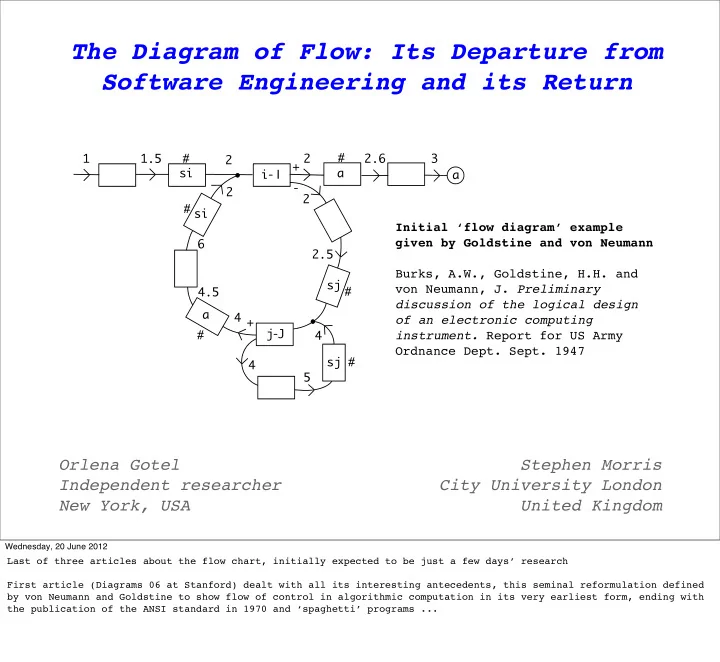
The Diagram of Flow: Its Departure from Software Engineering and its Return # 1 1.5 # + 2 2.6 3 2 si a i - I a - 2 2 # si Initial flow diagram example 6 given by Goldstine and von Neumann 2.5 Burks, A.W., Goldstine, H.H.


slide-1
SLIDE 1

The Diagram of Flow: Its Departure from Software Engineering and its Return

Stephen Morris City University London United Kingdom Orlena Gotel Independent researcher New York, USA

1 1.5 2 i- I + 2 2.6 3 si # # a 2 6 4.5 2 2.5 4 4 4 5 j-J a # # si a # # sj + sj

  • Initial ‘flow diagram’ example

given by Goldstine and von Neumann Burks, A.W., Goldstine, H.H. and von Neumann, J. Preliminary discussion of the logical design

  • f an electronic computing
  • instrument. Report for US Army

Ordnance Dept. Sept. 1947

Wednesday, 20 June 2012

Last of three articles about the flow chart, initially expected to be just a few days’ research First article (Diagrams 06 at Stanford) dealt with all its interesting antecedents, this seminal reformulation defined by von Neumann and Goldstine to show flow of control in algorithmic computation in its very earliest form, ending with the publication of the ANSI standard in 1970 and ‘spaghetti’ programs ...

slide-2
SLIDE 2

Higher level program flow chart by Mike Woodger, 1958 N9 File : Simplified programming systems for ACE. M. Woodger work

  • 1959. Incl. complete DEUCE prog.

for shockwave boundary layer interaction, Ma4532, 1957-59

Complex algorithms Simple data

Wednesday, 20 June 2012

Second article (Bulletin of the BSHM) showed the importance of flow charts when automated computation was having a radical effect on applied mathematics Used some of the few surviving examples of programme documentation from US and UK to show essential role of flow charts in complex algorithm representation and program structuring. This third article takes up story with the appearance of many forms of what was known as ‘structured programming’ ...

slide-3
SLIDE 3

Why structure the unstructured ?

  • Ability to write increasingly complex programs using

higher level languages

  • Introduction of operating system programs to remove

much of the effort from machine management

  • Availability of mass storage devices
  • Shift in commercial domains towards mass data

transformations and manipulations

  • General lack of experience in dealing with the

problems of scaling

  • Craft nature of programming
  • Rapidly expanding demand for machines and programming

Wednesday, 20 June 2012

Not only such practical motivation but also theoretical opposition on grounds of need for formality In his book “The Science of Programming”(1981) David Gries used a phrase which he(?) had coined much earlier, "the flaw chart”, for “a two-dimensional representation that exhibited the program structure or flow of control”. For him, when using structured programming techniques, “good indentation obviates the need for a flaw chart." Mike Woodger certainly stopped using them completely as approaches to programming altered radically to face issues of complexity and size ...

slide-4
SLIDE 4

Hierarchical tree structure for program structure and control Knuth, D.E. The art of computer programming - fundamental

  • algorithms. Reading, Mass.:

Addison Wesley, 1968

Q N O M L K J F G H I E D C A P Parsing of functions or functional decomposition following Knuth

Wednesday, 20 June 2012

Decomposition to solve problems of complexity and size Not simple division of functions because hierarchy of control maintaned (not A C J P A but A C J P J A) This notion of hierarchy effects even flow charts ...

slide-5
SLIDE 5

Flowchart with left-to-right levels of nesting by Dill et al.,1975 Dill, J.M., Hopson, R.W. and Dixon, D.F. Design and documentation

  • standards. Providence, Rhode Island,

Brown University, 1975.

T F

Ai+1 Ai

Newswaps Newswaps + 1

Repeat : Nswaps . 0 i . 0 DO :

i i+1 Ai+1 Ai& Interchange

Until Nswaps =0

Loop exit

T F

While i n.1

Loop exit

Alterations to accommodate some indication of hierarchy

Wednesday, 20 June 2012

Representation of nested loops used to implement an exchange sort algorithm for repositioning numbers in ascending order Left to right hierarchy of loops reminiscent, graphically, of swim lanes Other attempts to continue using a flow-based conception ...

slide-6
SLIDE 6

Internally nested representation of loops in a Chapin chart Nassi, I. and Shneiderman, B. Flowchart techniques for structured

  • programming. SIGPLAN Notices,

Volume 8, Issue 8, August 1973

Repeat until nswaps = 0 Nswaps Repeat for i = 1 to n.1 T >Ai+1 Ai F Ai+1 Ai& Interchange Newswaps Newswaps + 1

Radically different representation of nested structures by Chapin

Wednesday, 20 June 2012

Representation of same algorithm in a Chapin chart Ingenious use of 2D space but not one that obviously or easily solved problem of complexity or size More radical approach in same year ...

slide-7
SLIDE 7

Data structure and Data-centric program structure in JSD notation Jackson, M.A. Data structures as a basis for program design. In Structured Programming. Infotech State of the Art Report. Maidenhead: Infotech International Limited, 1976.

F G H I E D C A

*

  • Process

le Process group * Start group Process group data End group Process record *

Completely data-centric view initiated by Jackson

Wednesday, 20 June 2012

In collection of articles by members of IFIP WG2.3 (Programming Methodology), chaired by Woodger 69-76 and set up to examine "problems of construction and control of reliable programs", 6th meeting in Oct 73 was, according to MW (p4) "memorable for M.A.Jackson’s account of commercial programming and his technique of matching program structure to file structure." Within 5 years being used by major companies such as ICI Also reflects concern with possible use at highest level ...

slide-8
SLIDE 8

Hierarchy of components, Inputs and Outputs in a HIPO process P HIPO - A Design Aid and Documentation Tool. Poughkeepsie, NY, IBM Corporation, Form SR20 - 9413, 1973

P

  • P1

P2

C D E

P

A B

Combination of hierarchical and data approaches in system descriptions of HIPO

Wednesday, 20 June 2012

High level descriptions for whole system combining process decomposition (upper) and data input, output and processing Flow chart has disappeared from standard set of diagrammatic tools Still heavily used in many other fields Another even bigger explosion of diagrammatic forms with database formalisations, multiple approaches to development and OO ...

slide-9
SLIDE 9

Earliest version of the UML activity diagram, 1996 Booch, G., Jacobson, I. and Rumbaugh, J. The Unified Modeling Language for Object- Oriented Development. Documentation Set Version 0.91

  • Addendum. Santa Clara CA:

Rational Software Corporation, September 1996

[no coffee] [found coffee] [no tea] [found tea] coffeePot.turnOn light goes on 1 .. 4 1 .. 4

Person::Prepare Beverage

Get Water Make Tea Drink Pour Coffee Find Beverage Add Water to Reservoir Turn on Machine Brew coffee Get Cup Put Coffee in Filter Put Filter in Machine

“a special kind of state machine that describes the implementation of an

  • peration in terms of

its sub-operations.”

Wednesday, 20 June 2012

Satisfies need “to show work involved in performing an operation by an object” ‘activity’ involves invocation and execution of operation [guards] and complex condition expressed as chain by dummy intermediate node “a small round(sic) circle” Standard ‘state’ notation for ‘Brew coffee’ No specific role for flow although control mentioned Many twist and turns in the develoment of UML ...

slide-10
SLIDE 10

Example of an activity diagram from UML Version 2.4 Object Management Group. OMG Unified Modeling Languagege (OMG UML), Version 2.4. [Figure 12.35

  • f the Superstructure

Specification] January 2011.

[order rejected] Ship Order Close Order Fill Order Receive Order Send Invoice Make Payment Accept Payment [order accepted] Invoice

Explicit modelling

  • f control flow and
  • bject flow

Wednesday, 20 June 2012

By V1.4.2 diamond symbol back, plus action and sub-activity states but still ‘stereotyped’ form of state diagram By V2.4 reformulation using Petri net semantics Reintroduction of old diamond symbol (squashed) ‘actions’ as steps in ‘activities’ with own ‘nodes’ ‘object nodes’ from and to which object values may flow Now OO based diagrams as pervasive, and unquestioned, as once were ‘structured programming’ techniques’ and before them flow charts ...

slide-11
SLIDE 11

Navigation order in car-sharing application Stahl, T., Volter, M., Bettin, J., Haase,

  • A. and Helsen, S. Model-driven software

development : technology, engineering,

  • management. Chichester : John Wiley, c2006

[Fig.36 Change in navigation order]

Edit Reservation Reservation Confirmation Show Reservation Select Car Category User Registration Member Identification [OK] [OK] [Show reservation] [Create reservation] [Cancel] [Cancel] [Cancel] [Cancel] [End] [OK] [OK]

Contemporary use in MDSD and agile design

Wednesday, 20 June 2012

Place even in most ‘up-to-date’ techniques Role in new field of ecommerce because of importance of interface and navigation. However ...

slide-12
SLIDE 12

Edit Reservation Reservation Confirmation Show Reservation Select Car Category User Registration Member Identification [OK] [OK] [Show reservation] [Create reservation] [Cancel] [Cancel] [Cancel] [Cancel] [End] [OK] [OK]

Mais plus ça change ...

Member Identification Reservation Confirmation Edit Reservation Show Reservation Select Car Category User Registration cancel ID

  • k

END reg

  • k

T F F T F T

cancel

F T

START

Wednesday, 20 June 2012

Figure on right is ‘Flow Chart Classic’ a redrawn version of figure on left, suggesting mutability of representation but not of fundamental abstraction So what conclusions ? ...

slide-13
SLIDE 13

Conclusions Longevity of concepts, not representations Flow as an essential high level abstraction in software engineering

  • control
  • data
  • navigation

Value of studying diagram development and use Other concepts and their histories ?

Wednesday, 20 June 2012