SLIDE 1 Takashi Iba
Ph.D. in Media and Governance Associate Professor, Faculty of Policy Management, Keio University iba@sfc.keio.ac.jp
Autopoietic Systems Diagram for Describing Creative Processes
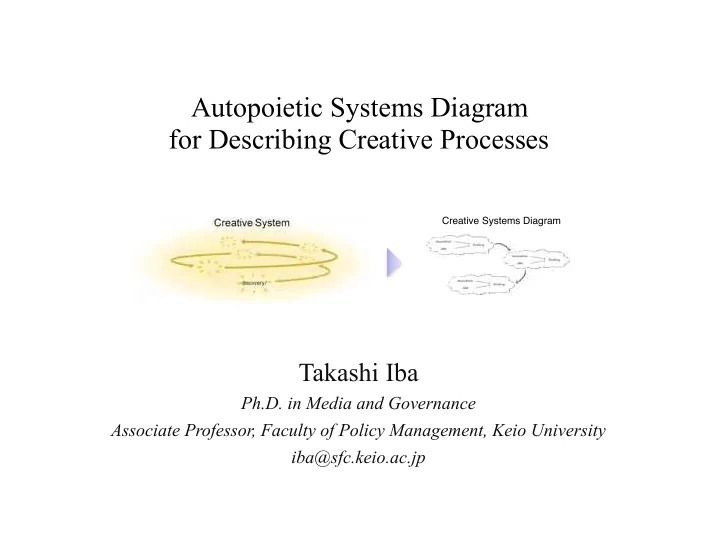
Creative Systems Diagram
SLIDE 2 Autopoietic Systems Diagram for Describing Creative Processes
Creative Systems Diagram
A diagram to describe a creative process, which I name “Creative Systems Diagram.” Creative Systems Theory (Iba, 2009)
SLIDE 3 Revised version of “An Autopoietic Systems Theory for Creativity” (T. Iba, COINs2009, 2009)
- 1. Overview of Creative Systems Theory
- 2. Creative Systems Diagram (CSD)
- 3. Case: The origin of “Footprint of Chaos”
Our Project combining philosophy, art, and science. (K. Shimonishi, J. Hirose, and T. Iba, since 2007)
Autopoietic Systems Diagram for Describing Creative Processes
SLIDE 4
Creative Systems Theory
based on the autopoietic systems theory A creative process is defined as an autopoietic system whose elements are discoveries. Creative process is a (re-) production network of discoveries. Each discovery is emerged only when a synthesis of the following three selection occurs: idea, association, and finding.
Iba, T. (2009) “An Autopoietic Systems Theory for Creativity”, COINs2009.
SLIDE 5 Production Network of Discoveries in Creation
Iba, T. (2009) “An Autopoietic Systems Theory for Creativity”, COINs2009.
Each discovery is produced based on previous discovery, associating to
What is most important is successive production of discoveries. Discovery, in this context, does not imply it is novel, true, and useful.
SLIDE 6 Creation-Centered Viewpoint
What is most important is successive production of discoveries. It doesn’t matter where and how discoveries come from.
- Maybe from deliberation, spark, or merely by accident.
- Maybe by somebody alone or collaboration by more than one person.
Iba, T. (2009) “An Autopoietic Systems Theory for Creativity”, COINs2009.
Both of human and source of ideas are located in the environment of the creative system!
SLIDE 7
Emergence of Momentary Elements
Discovery is emerged from a synthesis of following three selections: idea, association, and finding. Discovery happens only when a finding is obtained as a result of that an idea is associated to on-going creation.
Iba, T. (2009) “An Autopoietic Systems Theory for Creativity”, COINs2009.
self-reference alter-reference
SLIDE 8 Discovery Media
There are intrinsically uncertainties for realization of discovery.
- Association of idea.
- Far-reaching finding from association of idea.
- Success of the discovery
Media is evolutionary achievements for overcoming these uncertainties
- Media for description
- Media for thinking
- Media for success
SLIDE 9 Revised version of “An Autopoietic Systems Theory for Creativity” (T. Iba, COINs2009, 2009)
- 1. Overview of Creative Systems Theory
- 2. Creative Systems Diagram (CSD)
- 3. Case: The origin of “Footprint of Chaos”
Our Project combining philosophy, art, and science. (K. Shimonishi, J. Hirose, and T. Iba, since 2007)
Autopoietic Systems Diagram for Describing Creative Processes
SLIDE 10
SLIDE 11
discovery (system element) A discovery is to obtain a finding as a result of that an idea is associated to on-going creation.
SLIDE 12
production network of discoveries (system formation) Creative process is a production network of discoveries.
SLIDE 13
For convenience of understanding, discoveries are grouped into some processes.
Elements View
Creative Systems Diagram
SLIDE 14
Processes View
Creative Systems Diagram
SLIDE 15
Elements View
Creative Systems Diagram
SLIDE 16
Environments View
Creative Systems Diagram
SLIDE 17
Environments View
Creative Systems Diagram
Elements View
Creative Systems Diagram
Processes View
Creative Systems Diagram
abstract
Creative Systems Diagram
SLIDE 18 Revised version of “An Autopoietic Systems Theory for Creativity” (T. Iba, COINs2009, 2009)
- 1. Overview of Creative Systems Theory
- 2. Creative Systems Diagram (CSD)
- 3. Case: The origin of “Footprint of Chaos”
Our Project combining philosophy, art, and science. (K. Shimonishi, J. Hirose, and T. Iba, since 2007)
Autopoietic Systems Diagram for Describing Creative Processes
SLIDE 19 Kazeto Shimonishi Junya Hirose
- K. Shimonishi & T. Iba, "Visualizing Footprints of Chaos", 3rd
International Nonlinear Sciences Conference (INSC2008), 2008
- T. Iba & K. Shimonishi, "Exploring Patterns on Footprints of Chaos", 3rd
International Nonlinear Sciences Conference (INSC2008), 2008
- K. Shimonishi, J. Hirose & T, Iba, "Understanding Dynamics on Network
Structure: Applying New Visualization Method to Coupled Chaotic Systems", International Workshop and Conference on Network Science '08 (NetSci'08), 2008
- K. Shimonishi, J. Hirose & T. Iba, "The Footprints of Chaos: A Novel
Method and Demonstration for Generating Various Patterns from Chaos", SIGGRAPH2008, 2008
Informal Project for “Footprint of Chaos” Takashi Iba
SLIDE 20
xn+1 = a xn ( 1 - xn ) Logistic Map θn = 2πxn
SLIDE 21
SLIDE 22
Processes View
Creative Systems Diagram
SLIDE 23
Elements View
Creative Systems Diagram
SLIDE 24
Association
(self-reference)
Idea
(alter-reference)
finding
discovery
SLIDE 25
SLIDE 26
SLIDE 27
SLIDE 28
SLIDE 29
SLIDE 30
SLIDE 31
SLIDE 32
SLIDE 33
SLIDE 34
SLIDE 35
SLIDE 36
SLIDE 37
SLIDE 38
SLIDE 39
SLIDE 40
SLIDE 41
Elements View
Creative Systems Diagram
association (self-reference) idea (alter-reference)
SLIDE 42
Environments View
Creative Systems Diagram
SLIDE 43 Revised version of “An Autopoietic Systems Theory for Creativity” (T. Iba, COINs2009, 2009)
- 1. Overview of Creative Systems Theory
- 2. Creative Systems Diagram (CSD)
- 3. Case: The origin of “Footprint of Chaos”
Our Project combining philosophy, art, and science. (K. Shimonishi, J. Hirose, and T. Iba, since 2007)
Autopoietic Systems Diagram for Describing Creative Processes
SLIDE 44 Creative Systems Diagram
based on the creative systems theory Describing a creative process as a production network of discoveries. Each discovery is described with specifying idea, association, and finding. Three types of view: Processes View, Elements View, Environments View.
Environments View Elements View Processes View abstract
Takashi Iba
Faculty of Policy Management, Keio University iba@sfc.keio.ac.jp
“Autopoietic Systems Diagram for Describing Creative Processes”
COINs2010