The Colton Coalmine to 1956 I was very familiar with the Wallum - - PowerPoint PPT Presentation

the colton coalmine
SMART_READER_LITE
LIVE PREVIEW

The Colton Coalmine to 1956 I was very familiar with the Wallum - - PowerPoint PPT Presentation

25/9/17 As a Maryborough Boy Scout from 1946 The Colton Coalmine to 1956 I was very familiar with the Wallum surrounding the Aldershot scout camp just three kilometres from the Colton Mine From a personal perspec2ve of the environmental


slide-1
SLIDE 1

25/9/17 1

The Colton Coalmine

From a personal perspec2ve of the environmental impacts on and off the site By John Sinclair AO

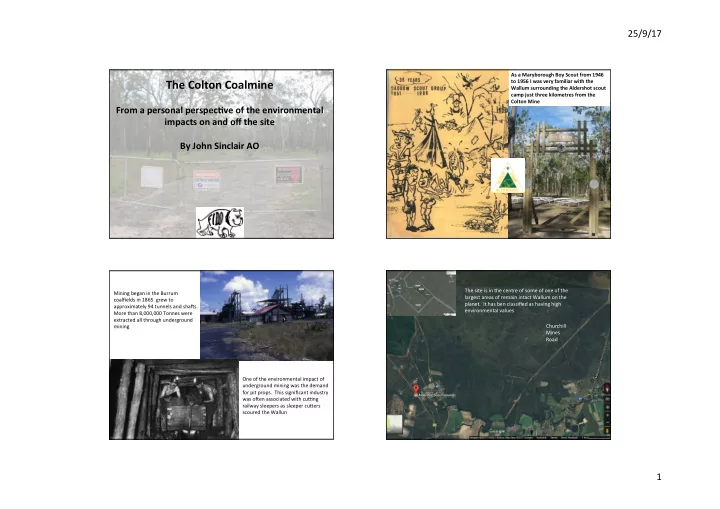
As a Maryborough Boy Scout from 1946 to 1956 I was very familiar with the Wallum surrounding the Aldershot scout camp just three kilometres from the Colton Mine Mining began in the Burrum coalfields in 1865 grew to approximately 94 tunnels and shaBs. More than 8,000,000 Tonnes were extracted all through underground mining One of the environmental impact of underground mining was the demand for pit props. This significant industry was oBen associated with cuJng railway sleepers as sleeper cuKers scoured the Wallun Churchill Mines Road The site is in the centre of some of one of the largest areas of remain intact Wallum on the

  • planet. It has ben classified as having high

environmental values

slide-2
SLIDE 2

25/9/17 2

Vegeta2on paLerns along Churchill Mines Road Because the mine will be open cut working in a deep pit cuNng through layers of groundwater aquifers the environmental impacts will be felt far beyond the mine site.

pH: Once the coal seam is exposed to air the sulphur in the

Pyrites begins an endless chain reac2on genera2ng sulphuric

  • acid. This poses a huge environmental threat to the natural

integrity of Great Sandy Strait arises. Most aqua2c life is extremely sensi2ve to any changes in pH and water quality.

Heavy Metals: Exposure causes heavy metals

(Aluminium, Arsenic, Boron, Cadmium, Chromium, Cobalt, Copper, Lead, Manganese, Nickel and Zinc) to be released as a result of the mining process. These will be in the cocktail being flushed into the Mary River. Heavy metals don’t breakdown like other pollutants do and they will con2nue to accumulate in the sediment and poten2ally in the water for year a_er year while the mine is in opera2on. While they may plateau when the mine ceases opera2on they will persist in the sediment and con2nue entering the food chain long a_er.

The most obvious impact arises from the water that will seep con2nually into the deep open cut pit cuNng though various aquifers. This will have two impacts:

  • 1. It will change the hydrology of land

surrounding the mine making it more drought sensi2ve; and

  • 2. Water contaminated by acid (sulphur

exposure) and heavy metals will be discharged into the Mary River to allow mining to proceed without the pit flooding. Polluted ground water from Colton Mine is proposed to will be pumped out of the pit and discharged into Mary River at the Devil’s Elbow, Dundathu just 8 kilometres up from the Great Sandy Strait Ramsar site.

slide-3
SLIDE 3

25/9/17 3

It is the environmental impacts on Great Sandy Strait that arise from that discharged water that most worries FIDO

  • The mine will need to discharge 946 megalitres of

untreated mine water annually.

  • Translated this means that 200 litres per second

(equivalent of 10 x 20 litre containers) will be discharged directly into the Mary River every second (600 jerry cans per minute). Just imaging people flushing that volume of contaminated undrinkable water into the estuary and what it can do to life in the river.

  • Put another way that is 5.8% of the average daily

Mary River flow But what happens when the Mary River flow over the 2dal barrage ceases?

The proponents admit that there is the poten2al for the dams to overflow during flood events discharging the toxic contents into the Susan River The threats from water from the mine aren’t limited exclusively to the Mary River. The mine is wholly within the catchment of the Susan River. Major flood events can carry the most toxic water from the mine site and disperse dangerous pollutants downstream. The natural flow of the Mary River discharge is through Great Sandy Strait. For most of its history the the geological syncline that is represented by Woody Island has blocked the Mary River from flowing into Hervey Bay. Un2l the sea levels rose sufficiently, the river was turned south and headed down Great Sandy Strait discharging into the Pacific somewhere east of Double Island Point. Even now most of the river’s flow is to the south as evidenced by the 2dal delta south of River Heads

slide-4
SLIDE 4

25/9/17 4

Great Sandy Strait is a Wetland of Interna2onal Significance. It was inscribed as Ramsar site 992 in 1999. Its 93,160 ha includes marine, estuarine and inter2dal wetlands and salt pans. The inter2dal wetland habitats consist of:

  • 15,500 ha of mangrove forests,
  • 12,300 ha of inter2dal and sub2dal seagrass beds,
  • 2,800 ha of saltmarshes, unvegetated mud, sand and salt flats, and estuarine

and channel waters of varying depth and width. It is a very special place deserving the highest level of protec2on.

The main freshwater wetland types are Melaleuca swamp forest and

  • ther palustrine wetlands.

Extracts from "Eye of the Storm" Patrick White describing Great Sandy Strait and Fraser Island (K’gari)

Beneath them the straits burnished silver by the heat; ahead of them the solid island trembling percep@bly with the mo@on of their flight. ... On one side was the strait flat and listless through the fringe of mean looking mangroves; on the other, beyond the pickets of eucalypts rose the dark mass

  • f the more obscure esoteric rainforest

which obscured, presumably the ocean.

Great Sandy Strait is a narrow shallow protected Heritage waterway separa2ng Fraser Island from the mainland has a rich historical and cultural heritage which has been under-recognized

slide-5
SLIDE 5

25/9/17 5

Great Sandy Strait is a mecca for small boa2ng enthusiasts

The nutrient rich double ended estuary of Great Sandy Strait supports an excep2onally rich array of fauna The 2dal delta makes a perfect habitat for trans-equatorial waders

Waders use the expansive 2dal flats intensively, especially near the seagrass beds.

  • Eighteen of the 24 migratory

shorebird species listed under JAMBA and CAMBA use these wetlands.

  • The area is recognized as among the

most important roos2ng sites for migratory trans-equatorial shorebirds in Australia.

  • Counts of up to 40,000 shorebirds

have been recorded.

  • It provides one of the most

important roos2ng areas for migratory, trans-equatorial shorebirds in Australia.

slide-6
SLIDE 6

25/9/17 6

Great Sandy Strait is the most important of thirteen areas for the Eastern Curlews, containing 14.3% of the known Australian popula2on. Only a handful of sites on the eastern seaboard hold a majority of the popula2on. This popula2on becomes even more endangered if we fail to protect this

very significant part of their Australian habitat from pollu2on

All six species of marine turtles found in Queensland inhabit the strait. — green, hawksbill, flatback, Pacific Ridley, loggerhead and leatherback turtles. The Great Sandy Strait is an important feeding ground for juvenile turtles. Turtles are reliant on sea grass. What happens when the seagrass of Great Sandy Strait has an unnatural uptake of heavy metals — Cadmium, Cobalt and Manganese?

Great Sandy Strait is a recognized “hot spot” for the endangered dugong with high densi2es of these marine mammals dependent on the sea grass there.

.

Three species of dolphins, the common dolphin, boKle-nosed dolphin and the Indo- Pacific, humpback dolphin, are resident in the area.

All of this rich biodiversity is at risk of being slowly poised by the heavy metals discharged into this special waterway or by the changes in the pH

slide-7
SLIDE 7

25/9/17 7

Mangroves: The mangrove communi\es represent a transi\on between temperate and tropical

  • regions. Ten species of mangrove

have been iden\fied. Aegiali@s annulata and Xylocarpus granatum reach their southernmost limit here. Seagrass: The seagrass beds contain six species. These areas act as nursery and feeding grounds for prawns and fish, and the feeding grounds for dugong and turtles. Rare BuLerflies: Old stands of grey mangrove support popula\ons of the endangered Illidge's ant-blue buKerfly. Fish and crabs: The area is extremely important for the protec\on of, and as a source of food for, juvenile and adult fish and crustaceans.

So far there has been no Environmental Impact Statement for the Colton Coal mine because the size of the deposit was understated and that enabled the whole enlarged scheme to slip through without scru\ny of the impact that it will have on the Great Sandy Strait Ramsar site and he public need answers to some very cri\cal ques\ons.

  • Why have the plans for the hazardous materials dams been scaled back to

increase the poten\al for severe environmental impacts on the Susan River Catchment?

  • What is the an\cipated pH of the water being discharged into the Mary River?
  • What are the volumes and projected impacts of the heavy minerals in the

sediments and how long will these persist?

  • What is going to be the impact on the fauna that has un\l now made Great

Sandy Strait its home? Since there has not yet been an Environmental Impact Statement and because Ramsar and World Heritage sites are triggers for the EPBC Act Federal Environment Minister Josh Frydenberg is determining whether it should have been considered a controlled ac2on and assessed under Federal environment

  • laws. The public certainly needs to get some clear answers to these cri2cal

environmental issues.