
SLIDE 1
01‐08‐2016 1
INDIC TEXT SEGMENTATION
Presented by : Swaran Lata Senior Director & HoD (TDIL Programme) Department of Electronics and Information Technology (DeitY) E-mail: slata@deity.gov.in
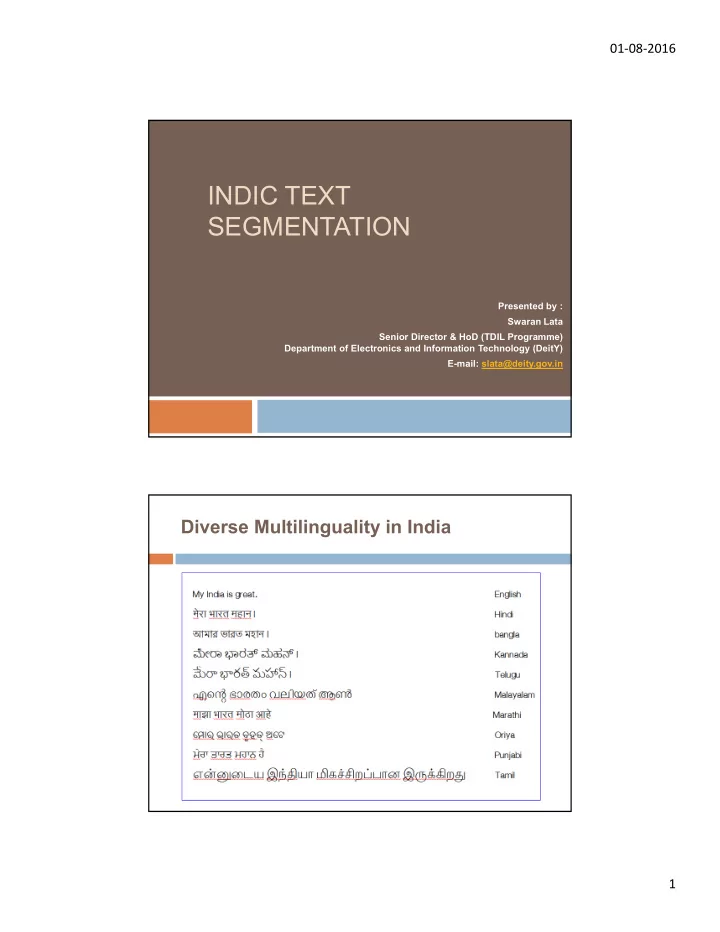
INDIC TEXT SEGMENTATION Presented by : Swaran Lata Senior - - PDF document
01 08 2016 INDIC TEXT SEGMENTATION Presented by : Swaran Lata Senior Director & HoD (TDIL Programme) Department of Electronics and Information Technology (DeitY) E-mail: slata@deity.gov.in Diverse Multilinguality in India 1 01
Presented by : Swaran Lata Senior Director & HoD (TDIL Programme) Department of Electronics and Information Technology (DeitY) E-mail: slata@deity.gov.in
Brahmi Script (Ashokan) Indus Script (proto Brahmi Scripts)
?
Unknown Ancient Scripts
Northern Scripts (Gupta Scripts) Sharda Landa Gurmukhi
Kutil
Nagari Gaur Oriya Bangla Assamese Maithali Devanagari Jain Nagari Gauri Kaithi Gujarati Tibetan Central Asian Southern Scripts Kole hat Vettashut Kannadda Telugu South‐eastern Asian‐ Burmese, Thai, Cambodian, Indonesian, Malasiyan, vietbames, Philipines etc Sinhali Brahmi Cental Sinhali Pallava Granth Malayalam Southern Sinhalese Grantha Tamil Brahmi Script Nepali (Newari) Kharoshthi Script 400 BC‐300 BC 2000 BC 400 BC 3rd BC 7th century 8th Century 10th Century Ol‐Chiki 8th Century 12th Century 13th Century
3 Meetei
Speaking region covers 40% of India.
Localization effort Hindi is treated as test- bed.
for
Indian languages using language specific requirements for Indic languages
India has large linguistic diversity with 22
The mapping between languages and scripts
Each language and script is unique in nature
Indic text layout requireme nts Initial Letter styling on web & Digital publishing Letter spacing Proper Indic n Proper Indic text segmentatio n Horizontal and vertical arrangements
Line breaking
Correct representation
Spacing Change shape
कायरॎ
आकषरॎण िवज्टापन
Vertical arrangements of characters
legacy grapheme cluster :
Extended grapheme cluster
Tailored Grapheme cluster
Due to high complexities of Indian languages , it is
Indian languages Orthographic syllable should be based
Rules for wrapping of Indian languages characters and
An Orthographic syllable includes Independent vowel or a
Consonant/s and consonant + virama sequences vowel signs Modifiers
Examples of Indic Orthographic syllable based
(क)DEVANAGARI LETTER KA 094D (◌्) DEVANAGARI SIGN VIRAMA 092F (य)DEVANAGARI LETTER SSA 093E (◌ा)DEVANAGARI SIGN AA
Devanagari kya
0938 (स)DEVANAGARI LETTER SA 094D (◌्)DEVANAGARI SIGN VIRAMA 0925 (थ)DEVANAGARI LETTER THA 091C (ि◌)DEVANAGARI LETTER I Devanagari sthi
0938 (स) DEVANAGARI LETTER SA 0924 (त) DEVANAGARI LETTER TA 0903 (◌ः) DEVANAGARI Sign Visarga Devana gari sth
कॎल
0924 (त) DEVANAGARI LETTER TA 094D (◌्) DEVANAGARI SIGN VIRAMA 0915 (क) DEVANAGARI LETTER KA 094D (◌्) DEVANAGARI SIGN VIRAMA 0932 (ल) DEVANAGARI LETTER LA Devana gari tkl
ABNF
Augmented Backus–Naur Form (ABNF) is a meta-
The linguistic definition of Indic orthographic
Rule 1 : V[m] Rule 2 : {CH}C[v][m] Rule 3 : CH (This rule is applicable only at the end of the word)
V(upper case) is independent vowel m is modifier(Anusvara/Visarga/Chandrabindu) C is a consonant which may or may not include a single nukta v (lower case) is any dependent vowel or vowel sign [Vvs has
been used as symbol in Unicode for dependent vowel of full vowel V e.g AAvs]
H is Virama/ halant | is a rule separator [ ] - The enclosed items is optional under this bracket {} - The enclosed item/items occurs zero or repeated multiple
times
Rul Rules Do not
break betwe etween
V[m] Independent vowel and Modifier {CH}C[v][m]
more consonant(N) + virama sequences and Consonant zero
more consonant(N) + virama sequences , Consonant and dependent vowel sign zero
more consonant(N) + virama sequences , Consonant and modifier zero
more consonant(N) + virama sequences, Consonant ,dependent vowel sign and modifier CH Consonant(N) with virama (applicable only for those Indian languages where pure consonant appears at the end of the word)
Note : Consonant may or may not include Nukta(N)
In Indic writing system , it is preferred that line breaks at word
boundaries ,if required following principle may be adhered : New line cannot begin with following symbols/Punctuation marks. Also these should be retain with the associated text :
Symbols Cha haracter name name Uni Unicode co code-poi
। DEVANAGARI DANDA U + 0964 ॥ DEVANAGARI DOUBLE DANDA U + 0965 ) RIGHT PARENTHESIS U + 0029 + PLUS SIGN U + 002B * ASTERISK U + 002A
HYPHENATION-SOFT HYPHEN U + 2027 U+ 00AD / SOLIDUS U + 002F , COMMA U + 002C . FULL STOP U + 002E : COLON U + 003A ; SEMICOLON U + 003B = EQUALS SIGN U + 003D > GREATER-THAN SIGN U + 003E ] RIGHT SQUARE BRACKET U + 005D _ LOW LINE U + 005F | VERTICAL LINE U + 007C } RIGHT CURLY BRACKET U + 007D ~ TILDE U + 007E % PERCENT SIGN U + 0025
The definition of Indic orthographic syllable may be used to break
the line and a hyphen should be at the breaking point so that word can be read intuitively.
However the language specific morpho-phonemic rules and industry
practices (from media, publishing and grammar books) could be used for hyphenation. U+ 00AD (soft hyphen) is used in some languages such as Tamil and Malayalam.
The hyphenated words can be broken at the hyphenation point (U +
2027) e.g.: नर-नारी should be treated as: नर- on the first line and नारी on the next line
Hindi Punjabi
Malayalam
Additional information
Indic
syllable boundaries based on tailored grapheme cluster define in UAX#29
ABNF valid segmentation definition to define Indian languages orthographic syllable
No break rules for determination of Indic syllable boundary
Information for identification of boundaries of first letter styling, Guiding principles of line breaking at syllable level for Indian languages.
Detailed report at L2/16-161