The CO-H 2 Conversion Factor in Galaxies Desika Narayanan Bart J - - PowerPoint PPT Presentation

the co h 2 conversion factor in galaxies
SMART_READER_LITE
LIVE PREVIEW

The CO-H 2 Conversion Factor in Galaxies Desika Narayanan Bart J - - PowerPoint PPT Presentation

The CO-H 2 Conversion Factor in Galaxies Desika Narayanan Bart J Bok Fellow University of Arizona (With: Mark Krumholz, Eve Ostriker, Lars Hernquist) H 2 CI CI CI H 2 H 2 CO H 2 H 2 H 2 CO CI CO H 2 H 2 CO H 2 H 2 H 2 H 2 CI H 2 CI


slide-1
SLIDE 1

The CO-H2 Conversion Factor in Galaxies

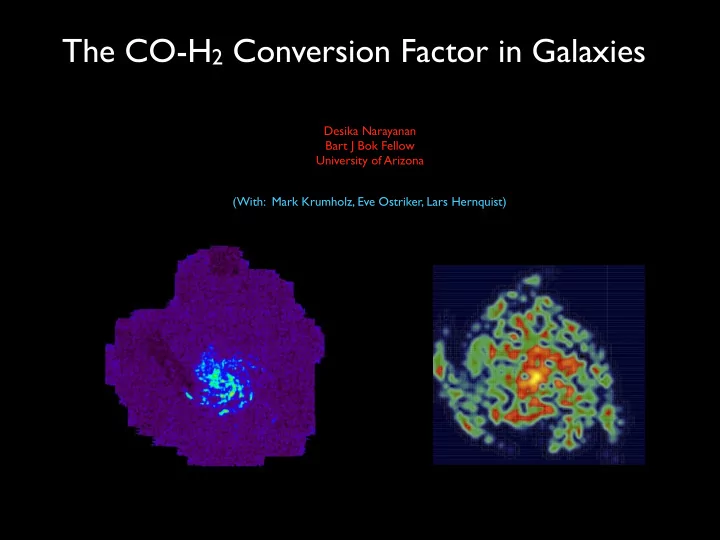
Desika Narayanan Bart J Bok Fellow University of Arizona (With: Mark Krumholz, Eve Ostriker, Lars Hernquist)
slide-2
SLIDE 2

H2 H2 H2 H2 CO CO CO CO H2 H2 H2 H2 H2 CI CI CI CI CI H2 H2 H2

slide-3
SLIDE 3

H2 H2 H2 H2 CO CO CO CO H2 H2 H2 H2 H2 CI CI CI CI CI H2 H2 H2

  • 1. Assume GMC is viralized and use CO

line width as mass measurement

slide-4
SLIDE 4

H2 H2 H2 H2 CO CO CO CO H2 H2 H2 H2 H2 CI CI CI CI CI H2 H2 H2

  • 1. Assume GMC is viralized and use CO

line width as mass measurement

  • II. Assume a DTG ratio and get dust

masses

slide-5
SLIDE 5

H2 H2 H2 H2 CO CO CO CO H2 H2 H2 H2 H2 CI CI CI CI CI H2 H2 H2

  • 1. Assume GMC is viralized and use CO

line width as mass measurement

  • II. Assume a DTG ratio and get dust

masses

  • III. CR + H2 --> γ-ray
slide-6
SLIDE 6

H2 H2 H2 H2 CO CO CO CO H2 H2 H2 H2 H2 CI CI CI CI CI H2 H2 H2

  • 1. Assume GMC is viralized and use CO

line width as mass measurement

  • II. Assume a DTG ratio and get dust

masses

  • III. CR + H2 --> γ-ray

Xco = NH2/Ico= 2-4 x 1020 cm-2/K-km s-1

slide-7
SLIDE 7

Blitz et al., PPV Review Article, 2006

Xco is Similar for Local Group

slide-8
SLIDE 8

Desika Narayanan

Tacconi et al. 2008

Xco = NH2/ICO Depends on Galactic Environment

“MW Xco”

slide-9
SLIDE 9

Desika Narayanan

Tacconi et al. 2008

Xco = NH2/ICO Depends on Galactic Environment: High Surface Densities

“MW Xco” “ULIRG Xco”

slide-10
SLIDE 10

Xco = NH2/ICO Depends on Galactic Environment: Low Metallicities

Leroy et al. 2011 (local galaxies) Genzel et al. 2011 (z~1)

CI

slide-11
SLIDE 11

Desika Narayanan

KS Relations and Star Formation Efficiencies Molecular to Atomic Gas Mass Ratios Saintonge et al. 2011

Genzel et al. 2010 Daddi et al. 2010 Leroy et al. 2009 Saintonge et al. 2011 Lagos et al. 2011 Lagos et al. 2011 Obreschkow & Rawlings 2009 Keres, Yun & Young 2003

CO Luminosity Functions and ΩH2(z)

What’s at Stake

slide-12
SLIDE 12

Gadget: to get model discs and mergers at z=0,2 Springel et al. 2003-2005 Jonsson et al. 2006, 2009 Jonsson & Primack 2010 Sunrise: to get dust temperatures

slide-13
SLIDE 13

Desika Narayanan

What do the molecules look like?

CO CI H2

HI

  • H2-HI balance calculated by balancing growth of H2 on grains with LW band

photodissociation (Krumholz, McKee, Tumlinson 2010)

  • CO-CI balance function of ISRF, Z (Wolfire et al. 2010)
  • Temp calculated by balancing PE, CR heating, line cooling and thermal exchange

with dust (Krumholz, Leroy, McKee 2011; Juvela 2011)

  • GMCs isothermal, constant density spheres with floor surface density of ~1022

cm-3

  • Monte Carlo code: Calculates full statistical equilibrium of level populations in a

3D velocity, temp, density field within GMCs and galaxies (DN+2008, Krumholz & Thompson 2007, DN+2011)

slide-14
SLIDE 14

Desika Narayanan

Xco in Discs and Mergers

Narayanan, Krumholz, Ostriker & Hernquist 2011

slide-15
SLIDE 15

Desika Narayanan

Xco = NH2/ICO ~ NH2/(T*σ) I ~Tb~Tk velocity

σ

Tb

slide-16
SLIDE 16

Xco = NH2/ICO ~ NH2/(T*σ)

Narayanan, Krumholz, Ostriker & Hernquist 2011

1022 cm-3

slide-17
SLIDE 17

Xco = NH2/ICO ~ NH2/(T*σ)

Narayanan, Krumholz, Ostriker & Hernquist 2011

1022 cm-3 5 km/s

slide-18
SLIDE 18

Xco = NH2/ICO ~ NH2/(T*σ)

Narayanan, Krumholz, Ostriker & Hernquist 2011

1022 cm-3 1022 cm-3 5 km/s 10-20 K Xco (MW) = few x 1020 cm-2/K-km/s

slide-19
SLIDE 19

Xco = NH2/ICO ~ NH2/(T*σ)

Narayanan, Krumholz, Ostriker & Hernquist 2011

1022 cm-3 1023 cm-3

slide-20
SLIDE 20

Xco = NH2/ICO ~ NH2/(T*σ)

Narayanan, Krumholz, Ostriker & Hernquist 2011

1022 cm-3 1023 cm-3 50 km/s

slide-21
SLIDE 21

Xco = NH2/ICO ~ NH2/(T*σ)

Narayanan, Krumholz, Ostriker & Hernquist 2011

1022 cm-3 1023 cm-3 50 km/s 50 K Xco (MW) = few x 1019 cm-2/K-km/s

slide-22
SLIDE 22

Xco decreases with increasing ∑H2

slide-23
SLIDE 23

Xco increases with decreasing Z

H2 H2 H2 H2 H2 H2 H2 H2 H2 H2 H2 CO CO CO CI CI CI CI CI CI

slide-24
SLIDE 24

Xco ~ ΣH2 -0.2 e-Z/Z❂ A General Prediction for Xco

slide-25
SLIDE 25

Xco ~ ΣH2 -0.2 e-Z/Z❂ A General Prediction for Xco

slide-26
SLIDE 26

Desika Narayanan

Conclusions Xco a continuous function dependent on metallicity and thermal and dynamical state of galaxies

  • In starburst galaxies hotter and high velocity dispersion gas

causes Xco (on average) to be lower than Galactic mean

  • In low metallicity galaxies, lack of dust shielding increases

mass of CO-dark clouds, and drives Xco to larger values than Galactic mean