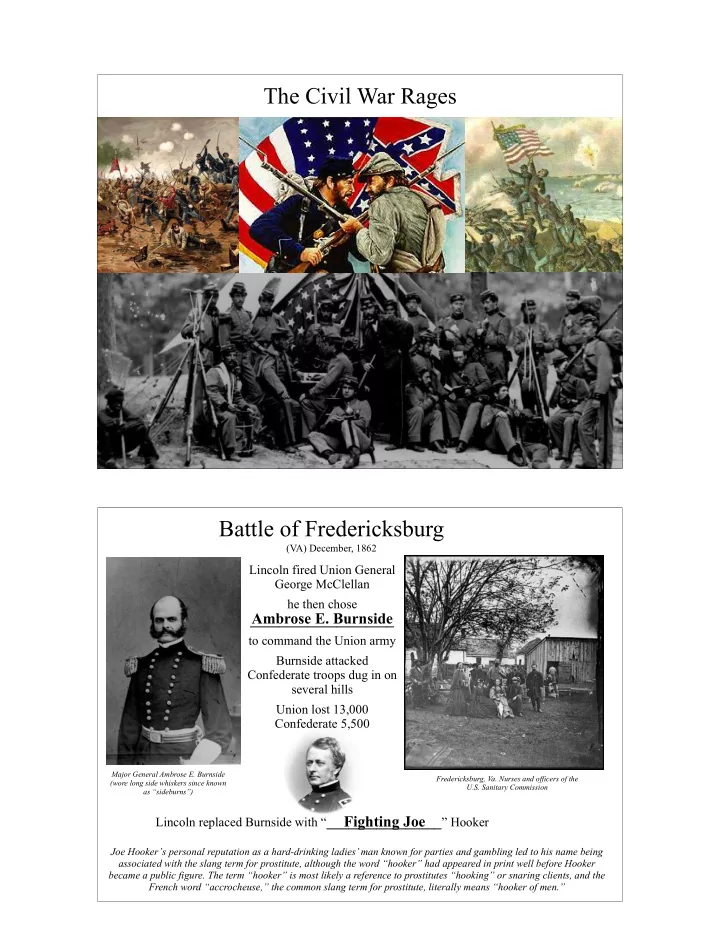
The Civil War Rages Battle of Fredericksburg (VA) December, 1862 - - PDF document

the civil war rages battle of fredericksburg
SMART_READER_LITE
LIVE PREVIEW

The Civil War Rages Battle of Fredericksburg (VA) December, 1862 - - PDF document

The Civil War Rages Battle of Fredericksburg (VA) December, 1862 Lincoln fired Union General George McClellan ! he then chose Ambrose E. Burnside ____________________ ! to command the Union army ! Burnside attacked Confederate troops


slide-1
SLIDE 1

The Civil War Rages Battle of Fredericksburg

(VA) December, 1862

! Major General Ambrose E. Burnside (wore long side whiskers since known as “sideburns”) ! Fredericksburg, Va. Nurses and officers of the U.S. Sanitary Commission

Joe Hooker’s personal reputation as a hard-drinking ladies’ man known for parties and gambling led to his name being associated with the slang term for prostitute, although the word “hooker” had appeared in print well before Hooker became a public figure. The term “hooker” is most likely a reference to prostitutes “hooking” or snaring clients, and the French word “accrocheuse,” the common slang term for prostitute, literally means “hooker of men.”

Lincoln replaced Burnside with “________________” Hooker Lincoln fired Union General George McClellan ! he then chose

____________________

! to command the Union army ! Burnside attacked Confederate troops dug in on several hills ! Union lost 13,000 Confederate 5,500

Ambrose E. Burnside Fighting Joe

slide-2
SLIDE 2

Abolition

an __________________ calls for the immediate, unconditional, and total abolition of slavery ! a ____________________________ calls for the gradual freeing of slaves ! During the 1820s and 1830s the ___________________________________ promoting the action of moving black people from the US to places as Canada or Africa. founded the American Anti-Slavery Society ! editor of the abolitionist newspaper The Liberator

Many slaveholders’ argued that slaves did not have the intellectual capacity to function as independent American

  • citizens. Douglass stood as a living counter-example to that argument and was such a great speaker that many found it

hard to believe that he had once been a slave. Douglass wrote several autobiographies, eloquently describing his experiences in slavery in his 1845 autobiography, Narrative of the Life of Frederick Douglass, an American Slave, which became influential in its support for abolition.

abolitionist gradual emancipationist American Colonization Society

African-American abolitionist ! great speeches and antislavery writings ! editor of the abolitionist newspaper The North Star

________________________ ________________________

William Lloyd Garrison Frederick Douglass

“______________” escaping slaves; also called “cargo,” or “goods” ! “______________” places along the escape route ! ! “______________” helped passengers get from one station to the next; sometimes traveled with escaping slaves from the South to the North, sometimes traveled only a short distance and then handed the fugitives to another helper

The Underground Railroad

a secret organization that helped men, women, and children escape slavery, providing hiding places, food, and transportation for the fugitive slaves “______________” hid slaves from people who were trying to catch them and return them to slavery; helped fugitives with food, shelter, and sometimes jobs ! various other people also provided directions along the way for the safest routes along the RR

passengers conductors engineers stations

slide-3
SLIDE 3

born a slave named Araminta Harriet Ross ! escaped slavery ! also known as “____________________ ” because she rescued more than 300 slaves using the Underground Railroad ! helped John Brown recruit men for his raid on Harpers Ferry ! worked as a Union spy during the Civil War

Famous Female Abolitionists

! author of the best-selling novel ________________________ emphasized the horrors of slavery !

  • utraged the North

enraged Southern slave owners ! swayed British public opinion against the South

Harriet Tubman Harriet Beecher Stowe Uncle Tom’s Cabin

______________________ ___________________ ___________________

Sojourner Truth

African-American abolitionist and women's rights activist ! escaped with her infant daughter to freedom in 1826 ! named herself Sojourner Truth ! gave a famous speech on gender inequalities entitled “Ain’t I a Woman?” ! helped recruit black troops for the Union Army

Evangelical abolitionists founded Bates College in Waterville, Maine in 1855.

______________

Black Moses

Emancipation Proclamation

January 1, 1963

!

as the war continued, Northerns grew tired of the gruesome fighting and the death of so many Union soldiers ! made them want to ______________ the South ! the best way to hurt the South would be to take away their slaves ! slavery was helping the South’s ______________: slaves built military fortifications, produced food for Confederate troops, etc. the North thought abolishing slavery might make the ______________ want to support them ! Lincoln had not been in favor of _____________ _____________,

  • nly of preventing its spread to other states and territories

! when the war began he said it was being fought to _____________ the Union, NOT to end slavery ! as the war continued he changed his mind became very opposed to slavery realized that _________________ (freeing the slaves) would make his own beliefs law and help the Union war effort

British punish war effort abolishing slavery preserve emancipation

slide-4
SLIDE 4

the Emancipation Proclamation

  • nly freed slaves in

______________ territories

(areas where it couldn’t be enforced!)

! didn’t apply to slave states loyal to Union or in Union occupied Confederate territories didn’t really free any slaves !

slavery was not legally abolished in the US until the adoption of the

__________________ in 1865

FYI: about 300,000 blacks served in the Union army - 16 black soldiers received the Medal of Honor in the navy, 1 out of every 4 sailors were black; 4 received Medals of Honor

Effects of the Emancipation Proclamation: ! some Northerners now see war as a moral crusade

  • thers feared freed slaves would take their jobs

Confederate 13th Amendment

the British opposed slavery, so now they supported the Union encouraged the recruitment of black soldiers into the Union army

although they weren’t treated the same as white soldiers paid less than white soldiers Union army on Cemetery Ridge, Lee on Seminary Ridge, large open field between them

!

On the first day of the battle, Confederate General

______________ led a charge through the center of the

Union line, temporarily breaking through but eventually being pushed back. This was the first time General Lee was defeated in battle; the newly-appointed Union Gen. Meade could have gone in for the kill, but like cautious Gen. McClellan before him, he chose not to.

Gettysburg

(PA) July, 1863 (3-day battle) Robert E. Lee decided upon a second invasion of the North (the first was the unsuccessful Maryland Campaign which ended in the bloody Battle of Antietam).

!

Confederate soldiers looking for __________ stumbled upon a Union camp

!

Union army on Cemetery Ridge, Lee on Seminary Ridge,

shoes Pickett
slide-5
SLIDE 5

____________________________ and the ______________

were sent to defend a precarious hold on an an important hill called

________________________________, at the far left end of

the entire Union line. The men from Maine waited until Confederates charged up the hill, attacking the 20th time and time

  • again. With many casualties and ammunition running low, Col.

Chamberlain ordered his men to fix bayonets, and they charged down the hill and captured over 100 Confederates, successfully saving the hill.

Gettysburg

Joshua Chamberlain

On the second day of the battle, Union forces were recovering from setbacks and regrouping into defensive positions on hills south of the town. The Confederates sensed the the Union’s momentary vulnerability and began an attack. Chamberlain sustained two wounds in the battle. ! He was awarded the Medal of Honor for his “daring heroism and great tenacity in holding his position on the Little Round Top against repeated assaults, and carrying the advance position on the Great Round Top.” ! He earned the name the “______________ of Round Top”

Joshua Chamberlain 20th Maine Little Round Top Lion

Union casualties were > 23,000 (3,000 killed, 14,000 wounded, 5,000 captured or missing). ! Confederate casualties > 23,000 (4,000 killed, 12,000 wounded, 5,000 captured or missing).

Gettysburg

Casualties

(The stench from dead bodies and over 3,000 horse carcasses lying in the hot summer sun caused townsfolk to became violently ill.)

Considered the

______________

! in the war Lee never went on the

______________

again ! from then on the South was steadily defeated

turning point

  • ffensive
slide-6
SLIDE 6

The Gettysburg Address

A national cemetery was established on the battlefield at Gettysburg on November 19, 1863. At the cemetery’s dedication, President Abraham Lincoln rose to deliver “a few appropriate remarks,” now known as the Gettysburg Address. His ______-minute speech served as a reminder of the sacrifices of war and the necessity of holding the Union together.

Gettysburg Address

“Four score and seven years ago our fathers brought forth on this continent a new nation, conceived in liberty and dedicated to the proposition that all men are created equal. Now we are engaged in a great civil war, testing whether that nation or any nation so conceived and so dedicated can long endure. We are met on a great battlefield of that war. We have come to dedicate a portion of that field as a final resting-place for those who here gave their lives that that nation might live. It is altogether fitting and proper that we should do this. But in a larger sense, we cannot dedicate, we cannot consecrate, we cannot hallow this ground. The brave men, living and dead who struggled here have consecrated it far above our poor power to add or detract. The world will little note nor long remember what we say here, but it can never forget what they did here. It is for us the living rather to be dedicated here to the unfinished work which they who fought here have thus far so nobly advanced. It is rather for us to be here dedicated to the great task remaining before us--that from these honored dead we take increased devotion to that cause for which they gave the last full measure of devotion--that we here highly resolve that these dead shall not have died in vain, that this nation under God shall have a new birth of freedom, and that government of the people, by the people, for the people shall not perish from the earth.”

two