ANSWER KEY Key Civil War Battles Graphic Organizer Directions : - - PowerPoint PPT Presentation

answer key key civil war battles graphic organizer
SMART_READER_LITE
LIVE PREVIEW

ANSWER KEY Key Civil War Battles Graphic Organizer Directions : - - PowerPoint PPT Presentation

ANSWER KEY Key Civil War Battles Graphic Organizer Directions : Your classmates will present information about the following Civil War battles. For each battle, complete the information shared in the graphic organizer below. Battle Location


slide-1
SLIDE 1

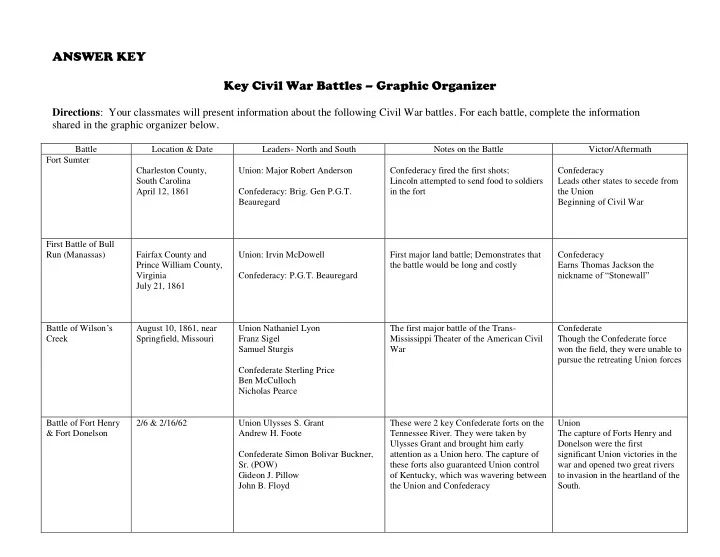
ANSWER KEY Key Civil War Battles – Graphic Organizer

Directions: Your classmates will present information about the following Civil War battles. For each battle, complete the information shared in the graphic organizer below.

Battle Location & Date Leaders- North and South Notes on the Battle Victor/Aftermath Fort Sumter Charleston County, South Carolina April 12, 1861 Union: Major Robert Anderson Confederacy: Brig. Gen P.G.T. Beauregard Confederacy fired the first shots; Lincoln attempted to send food to soldiers in the fort Confederacy Leads other states to secede from the Union Beginning of Civil War First Battle of Bull Run (Manassas) Fairfax County and Prince William County, Virginia July 21, 1861 Union: Irvin McDowell Confederacy: P.G.T. Beauregard First major land battle; Demonstrates that the battle would be long and costly Confederacy Earns Thomas Jackson the nickname of “Stonewall” Battle of Wilson’s Creek August 10, 1861, near Springfield, Missouri Union Nathaniel Lyon Franz Sigel Samuel Sturgis Confederate Sterling Price Ben McCulloch Nicholas Pearce The first major battle of the Trans- Mississippi Theater of the American Civil War Confederate Though the Confederate force won the field, they were unable to pursue the retreating Union forces Battle of Fort Henry & Fort Donelson 2/6 & 2/16/62 Union Ulysses S. Grant Andrew H. Foote Confederate Simon Bolivar Buckner,

  • Sr. (POW)

Gideon J. Pillow John B. Floyd These were 2 key Confederate forts on the Tennessee River. They were taken by Ulysses Grant and brought him early attention as a Union hero. The capture of these forts also guaranteed Union control

  • f Kentucky, which was wavering between

the Union and Confederacy Union The capture of Forts Henry and Donelson were the first significant Union victories in the war and opened two great rivers to invasion in the heartland of the South.

slide-2
SLIDE 2

Battle Location & Date Leaders- North and South Notes on the Battle Victor/Aftermath Battle Hampton Roads – Monitor v. Merrimack Hampton Roads/Chesapeake Bay, Virginia March 8, 1862 Union: Lt. John Worden Confederacy: Capt. Franklin Buchanan and Lt. Catesby R. Jones Monitor= Union Merrimack/Virginia= Confederacy 433 deaths Unknown First battle of iron-sided ship - no more wooden ones! Battle of Shiloh Hardin County, Tennessee April 6-7, 1862 Union: Maj. Gen. Ulysses S. Grant and Maj. Gen. Don Carlos Buell Confederacy: Gen. Albert Sidney Johnston and Gen. P.G.T. Beauregard Series of attacks and counterattacks to capture the ‘Hornet’s Nest’ 23,746 More casualties than in all previous American wars combined Union victory helps to make Grant famous Battle of Forts Jackson & St. Philip April 18, 1862 – April 28, 1862 Location Plaquemines Parish, Louisiana Union David G. Farragut Confederate Johnson K. Duncan John K. Mitchell John A. Stephenson The Union fleet faced only token

  • pposition at Chalmette, and thereafter had

clear sailing to New Orleans. Union victory The fall of New Orleans as a consequence of the battle may also have swayed European powers, primarily Great Britain and France, not to recognize the Confederacy diplomatically. Jackson’s Shenandoah Valley Campaign March-June 1862 Union Nathaniel P. Banks John C. Frémont Irvin McDowell Confederate “Stonewall” Jackson Stonewall Jackson at his best. Using speed and superior tactics Jackson is able to defeat several larger Union armies by never allowing them to combine and constantly moving faster than his

  • pponents expect. This campaign cements

his reputation as one of the South’s best generals, Confed. Jackson followed up his successful campaign by forced marches to join Gen. Robert E. Lee for the Seven Days Battles

  • utside Richmond.

The Seven Days Battle Near Richmond, VA 6/25-7/1/62 Union George B. McClellan Confederate Robert E. Lee Fought outside Richmond, this series of battles was Robert E. Lee’s first big victory over the North. During the course of the week Lee, even though outnumbered, attacked the Union general, George McLellan, so furiously that the Union army was forced to retreat back to Washington.

  • Confed. The Seven Days ended

with McClellan's army in relative safety next to the James River, having suffered almost 16,000 casualties during the retreat. Lee's army, which had been on the

  • ffensive during the Seven Days,

lost over 20,000. As Lee became convinced that McClellan would not resume his threat against Richmond, he moved north.

slide-3
SLIDE 3

Battle Location & Date Leaders- North and South Notes on the Battle Victor/Aftermath Battle of Malvern Hill July 1, 1862 Location Henrico County, Virginia Union George B. McClellan Fitz John Porter Confederate Robert E. Lee The battle occurred in stages: an initial exchange of artillery fire, a minor charge by Confederate Brig. Gen. Lewis Armistead, and three successive waves of Confederate infantry charges triggered by unclear orders from Lee and the actions of

  • Maj. Gens. Magruder and D. H. Hill,
  • respectively. In each phase, the

effectiveness of the Federal artillery was the deciding factor, repulsing attack after attack, resulting in a tactical Union victory. Tactical Union victory Despite the defeat on Malvern Hill, the Seven Days Battles accomplished the original Confederate goal of removing any direct threat to Richmond from the Union Army. Second Battle of Bull Run Manassas, VA 8/29-30/62 Union John Pope Confederate Robert E. Lee Fought on almost the same field as the first battle of Bull Run, this was a complete victory for the South. Robert E. Lee further cemented his reputation as a great general. The Union commander, John Pope, was completely defeated. Confed Success in this battle emboldened Lee to initiate the ensuing Maryland Campaign Battle of Antietam Washington County, Maryland

  • Sept. 17, 1862

Union: Maj. Gen. George McClellan Confederacy: Gen. Robert E. Lee McClellan loses command of Union forces after failure to defeat Lee 23,000 Union Single bloodiest day of war Prompts Lincoln to issue Eman. Proc. Battle of Perryville October 8, 1862 Location Near Perryville, Kentucky Union Don Carlos Buell Confederate Braxton Bragg Confederate General Braxton Bragg lead his army into Kentucky in an attempt to regain control of eastern Tennessee and possibly bring Kentucky into the

  • Confederacy. Fought to a draw by the

Union army Bragg was forced to withdraw and Confederate hopes for Kentucky were dashed. Union Considering the casualties relative to the engaged strengths of the armies, the Battle of Perryville was one of the bloodiest battles of the Civil War. It was the largest battle fought in the state of Kentucky. Battle of Fredericksburg Fredericksburg, VA 12/13/62 Union Ambrose E. Burnside Confederate Robert E. Lee Thomas J. Jackson Union general Ambrose Burnside learned the folly of attacking an entrenched enemy with a frontal assault. Robert E. Lee was dug in at the top of a hill called Marye’s Heights and he was able to repel 14 Union

  • assaults. The screams of wounded Union

soldiers could be heard from the base of the heights, but the soldiers were unable to help their fallen comrades. Confed. On December 15, Burnside withdrew his army, ending another failed Union campaign in the Eastern Theater.

slide-4
SLIDE 4

Battle Location & Date Leaders- North and South Notes on the Battle Victor/Aftermath Battle of Stone’s River (2nd Battle of Murfreesboro) Murfreesboro, TN Dates: Dec 31, 1862 – Jan 2, 1863 Union William Rosecrans Confederate Braxton Bragg The Battle of Stones River was a battle fought from December 31, 1862, to January 2, 1863, in Middle Tennessee, as the culmination of the Stones River Campaign in the Western Theater of the American Civil War. Of the major battles

  • f the war, Stones River had the highest

percentage of casualties on both sides. Union victory The battle was tactically

  • inconclusive. Bragg received

almost universal scorn from his Confederate military colleagues;

  • nly the support of Joseph E.

Johnston and President Jefferson Davis's inability to find a suitable replacement saved his command. Battle of Chancellorsville Spotsylvania County, Virginia May 1863 Union: Maj. Gen. Joseph Hooker Confederacy: Gen. Robert E. Lee and ‘Stonewall’ Jackson 24,000 casualties Jackson killed by own men Considered Lee’s greatest victory “Jackson lost his left arm, but I have lost my right arm.” ~ Lee Battle of Gettysburg Adams County, Pennsylvania July 1-3, 1863 Union: Maj. Gen. George S. Meade Confederacy: Gen. Robert E. Lee Back and forth between two sides Bloodiest battle of the Civil War 51,000 deaths Union victory Gettysburg Address issued months later Battle of Vicksburg Warren County, Mississippi July 4, 1863 Union: Maj. Gen. Ulysses S. Grant Confederacy: Lt. Gen. John C. Pemberton 35,285 deaths 2nd part of Anaconda Plan Union victory - Grant is appointed General-in-Chief Battle of Chickamauga Chickamauga, GA 8/19-20/63 Union William Rosecrans Confederate Braxton Bragg A huge victory for the Confederate forces. One of the few times they were on the

  • attack. A large Union army was routed by

Braxton Bragg and James Longstreet. The

  • nly person that avoided total

disaster for the Union was Gen. George Thomas, who earned the nickname the “Rock of Chickamauga” for the way in which he held his troops together. Confed. Chickamauga was the first major Confederate effort to use the "interior lines of the nation" to transport troops between theaters with the aim of achieving a period

  • f numerical superiority and

taking the initiative in the hope of gaining decisive results in the West.

slide-5
SLIDE 5

Battle Location & Date Leaders- North and South Notes on the Battle Victor/Aftermath Battle of Chattanooga Chattanooga, Tenn. 11/23-25/63 Union Ulysses S. Grant Confederate Braxton Bragg Ulysses Grant defeated the confederates of Braxton Bragg and opened the way for a full scale attack on Atlanta by General

  • Sherman. This battle was won when Union

troops without orders stormed up Missionary ridge and swept the Confederates from their positions. Union The Union now held undisputed control of the state of Tennessee, including Chattanooga, the "Gateway to the Lower South." The city became the supply and logistics base for Sherman's 1864 Atlanta Campaign, as well as for the Army of the Cumberland, and Grant had won his final battle in the West prior to receiving command of all Union armies in March 1864. Battle of the Wilderness The Wilderness, VA 5/5-6/64 Union Ulysses S. Grant George G. Meade Confederate Robert E. Lee Ulysses Grant’s first confrontation with Robert E. Lee. Although Lee

  • utmaneuvered Grant and won the battle

he was unable to halt Grant’s army from advancing towards Richmond. This battle, in thick woods and brush, saw some of the most horrific fighting of the war. Draw Although the Wilderness is usually described as a draw, it could be called a tactical Confederate victory, but a strategic victory for the Union army. Battle of Spotsylvania Spotsylvania, VA 5/8-5/19/64 Union Ulysses S. Grant George G. Meade Confederate Robert E. Lee Grant continued his drive towards

  • Richmond. Although Grant’s casualties

were higher, he could afford to lose the troops while Lee could not. Grant knew this and used it to his advantage. Draw Lee had stopped Grant, but had not turned him back, and Grant had not destroyed Lee's army. Battle of Cold Harbor Cold Harbor, VA 6/3/64 Union Ulysses S. Grant George G. Meade Confederate Robert E. Lee 7000 die in 20 mins. Grant’s biggest defeat by Lee. Forced to attack an entrenched Confederate army, Grant showed why frontal assaults would no longer work. His army was repeatedly repelled by the Confederates with minimal Southern losses. Confed. It was an impressive defensive victory for Lee, but it was his last in the war. In the final stage, he alternated between digging into the trenches at Petersburg and fleeing westward across Virginia. Siege of Atlanta Fulton County, Georgia July 22, 1864 Union: Maj. Gen. William T. Sherman Confederacy: Gen. John Bell Hood 12,140 casualties Miscalculation on Hood’s part led to defeat Union victory Began Sherman’s ‘total war’ initiative

slide-6
SLIDE 6

Battle Location & Date Leaders- North and South Notes on the Battle Victor/Aftermath Sherman’s March to the Sea July 23 – Sept. 2, 1864 Union William T. Sherman Confederate William J. Hardee Joseph Wheeler After the siege of Atlanta by Gen. Sherman ended with the burning of the city by Union troops. This battle was immortalized in “Gone With the Wind.” After burning the city Sherman began his famous march to the sea during which his troops looted and plundered their way across Georgia, destroying nearly everything in their path. Union Sherman telegraphed to President Lincoln, "I beg to present you as a Christmas gift the City of Savannah, with one hundred and fifty guns and plenty of ammunition, also about twenty- five thousand bales of cotton. Battle of Petersburg Petersburg, VA 6/20/64-4/2/65 Union Ulysses S. Grant George Meade Benjamin Butler Confederate Robert E. Lee

  • P. G. T. Beauregard

The fourth and final battle between Lee and Grant in 2 months. The siege of Petersburg spelled the end of the

  • Confederacy. Lee finally halted Grant’s

drive toward Richmond but could not defeat him. The eventual waiting game would be won by the North. Both sides dug elaborate trenches in a preview of WW I 50 years

  • later. Richmond finally fell on April 2,

1865. Union The Siege of Petersburg foreshadowed the trench warfare that was common in World War I, earning it a prominent position in military history. It also featured the war's largest concentration of African American troops, who suffered heavy casualties at such engagements as the Battle of the Crater and Chaffin's Farm. Battle of Sailor’s Creek Farmville, Virginia April 6, 1865 Union Ulysses S. Grant, Philip H. Sheridan Confederate Robert E. Lee, Richard S. Ewell (POW), John B. Gordon The Battle of Sailor's Creek was fought on April 6, 1865, near Farmville, Virginia, as part of the Appomattox Campaign, near the end of the American Civil War. Union victory Confederate General Robert E. Lee would surrender to Union General Ulysses S. Grant 3 days later ending the Civil War Appomattox Campaign Appomattox County, VA April 9, 1865 Union: Ulysses S. Grant Confederacy: Robert E. Lee Lee had given up attempting to protect Richmond and sought to rejoin with other forces. Lee was forced to surrender when he realized Grant’s forces outnumbered his. Surrender happened three days later at the Appomattox Courthouse.