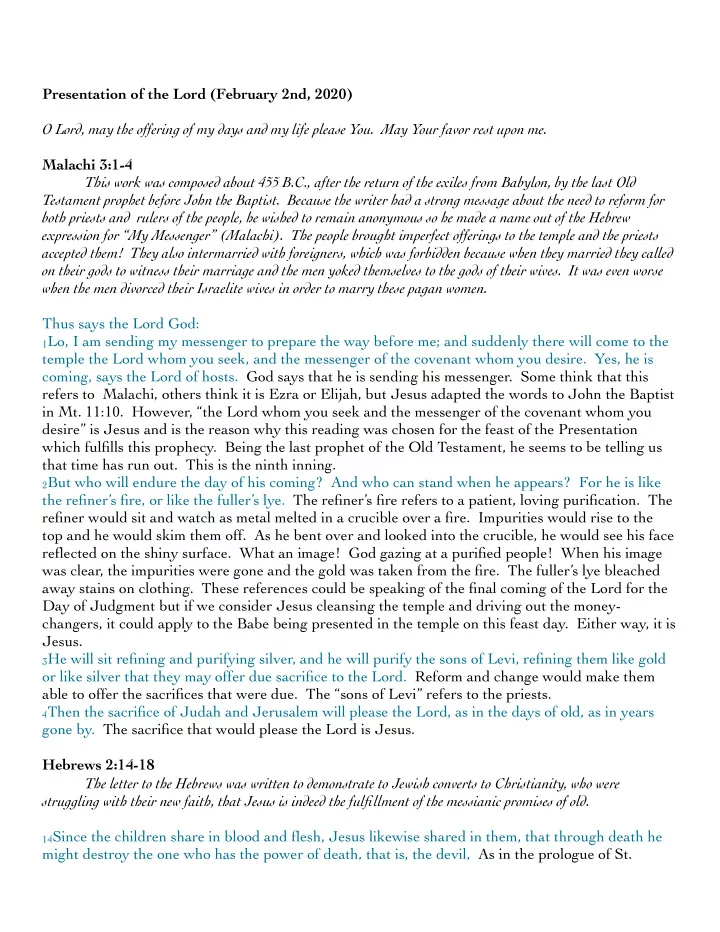
Presentation of the Lord (February 2nd, 2020) O Lord, may the - - PDF document

presentation of the lord february 2nd 2020 o lord may the
SMART_READER_LITE
LIVE PREVIEW

Presentation of the Lord (February 2nd, 2020) O Lord, may the - - PDF document

Presentation of the Lord (February 2nd, 2020) O Lord, may the offering of my days and my life please You. May Your favor rest upon me. Malachi 3:1-4 This work was composed about 455 B.C., after the return of the exiles from Babylon, by the last


slide-1
SLIDE 1

Presentation of the Lord (February 2nd, 2020) O Lord, may the offering of my days and my life please You. May Your favor rest upon me. Malachi 3:1-4 This work was composed about 455 B.C., after the return of the exiles from Babylon, by the last Old Testament prophet before John the Baptist. Because the writer had a strong message about the need to reform for both priests and rulers of the people, he wished to remain anonymous so he made a name out of the Hebrew expression for “My Messenger” (Malachi). The people brought imperfect offerings to the temple and the priests accepted them! They also intermarried with foreigners, which was forbidden because when they married they called

  • n their gods to witness their marriage and the men yoked themselves to the gods of their wives. It was even worse

when the men divorced their Israelite wives in order to marry these pagan women. Thus says the Lord God:

1Lo, I am sending my messenger to prepare the way before me; and suddenly there will come to the

temple the Lord whom you seek, and the messenger of the covenant whom you desire. Yes, he is coming, says the Lord of hosts. God says that he is sending his messenger. Some think that this refers to Malachi, others think it is Ezra or Elijah, but Jesus adapted the words to John the Baptist in Mt. 11:10. However, “the Lord whom you seek and the messenger of the covenant whom you desire” is Jesus and is the reason why this reading was chosen for the feast of the Presentation which fulfills this prophecy. Being the last prophet of the Old Testament, he seems to be telling us that time has run out. This is the ninth inning.

2But who will endure the day of his coming? And who can stand when he appears? For he is like

the refiner’s fire, or like the fuller’s lye. The refiner’s fire refers to a patient, loving purification. The refiner would sit and watch as metal melted in a crucible over a fire. Impurities would rise to the top and he would skim them off. As he bent over and looked into the crucible, he would see his face reflected on the shiny surface. What an image! God gazing at a purified people! When his image was clear, the impurities were gone and the gold was taken from the fire. The fuller’s lye bleached away stains on clothing. These references could be speaking of the final coming of the Lord for the Day of Judgment but if we consider Jesus cleansing the temple and driving out the money- changers, it could apply to the Babe being presented in the temple on this feast day. Either way, it is Jesus.

3He will sit refining and purifying silver, and he will purify the sons of Levi, refining them like gold

  • r like silver that they may offer due sacrifice to the Lord. Reform and change would make them

able to offer the sacrifices that were due. The “sons of Levi” refers to the priests.

4Then the sacrifice of Judah and Jerusalem will please the Lord, as in the days of old, as in years

gone by. The sacrifice that would please the Lord is Jesus. Hebrews 2:14-18 The letter to the Hebrews was written to demonstrate to Jewish converts to Christianity, who were struggling with their new faith, that Jesus is indeed the fulfillment of the messianic promises of old.

14Since the children share in blood and flesh, Jesus likewise shared in them, that through death he

might destroy the one who has the power of death, that is, the devil, As in the prologue of St.

slide-2
SLIDE 2

John’s Gospel, “flesh and blood” apply to human nature in its weakened condition. Jesus assumed man’s nature: he took it on without sin but with all its capacity to suffer pain and death. Christ chose to submit to death, which is a consequence of (Original) sin, in order to destroy death and the power of the devil. The death of Christ, the only one who could atone for man’s sin, wipes out sin and makes death a WAY to God. The victory of the Cross is that Jesus, by dying, obtained Life for us through that death.

15and free those who through fear of death had been subject to slavery all their life. Christ has freed

men not from physical but from spiritual death and therefore from fear of death, because he has given us certainty of future resurrection. Blessed J. Escriva wrote: “Don’t be afraid of death. Accept it from now on, generously… when God wills it, where God will it, as God will it. It will come in the moment, in the place and in the way that are best: sent by your Father-God.

16Surely he did not help angels but rather the descendants of Abraham; Christ took to himself a

human nature, not an angelic nature. Angels are pure spirits. They do not learn nor become nor

  • change. They made their choice of who they would serve once and for all. “We were very far from

God and were almost without God in the world” (Eph. 2:12). Then Jesus came in pursuit of us and seized us for himself. He is now bone of our bone and flesh of our flesh, a privilege not given to angels.

17therefore, he had to become like his brothers and sisters in every way, that he might be a merciful

and faithful high priest before God to expiate the sins of the people. This is the central theme of the epistle: the priesthood of Christ. Because he is God and man, Jesus is the only Mediator between God and men, who have lost God’s friendship and divine life on account of sin. He exercises this mediation as High Priest. He saves men by bridging the abyss, which separates the sinful stock of Adam from God whom we have outraged. Jesus is both the high priest who offers the sacrifice and the sacrifice itself.

18Because he himself was tested through what he suffered, he is able to help those who are being

  • tested. Christ’s main purpose in undergoing his passion was the Redemption of mankind, but he

also suffered in order to STRENGTHEN us and give us an EXAMPLE. As St. Alphonsus explained: “On the night before his passion, by choosing to suffer fear, anguish and sorrow in the garden of Gethsemane he won for us strength to resist harassment by those who seek our downfall; he obtained for us strength to overcome the fatigue we experience in prayer, in mortification and in

  • ther acts of devotion, and, finally, the fortitude to bear adversity with peace and joy.”

Luke 2:22-40

22When the days were completed for their purification according to the law of Moses, Mary and

Joseph took Jesus up to Jerusalem to present him to the Lord, The events in this reading show the Holy Family as good, observant Jews for Mary and Joseph brought Jesus to the temple and as the ritual prescribed, they made two offerings to God: a sacrifice of thanksgiving for the birth of their son and a sacrifice of purification for his mother. The birth of a male child disqualifies an Israelite woman from touching any holy object or approaching the Temple for 40 days, after which time she must offer sacrifice in Jerusalem (Lev 12:1-8). Strictly speaking, these offerings cleanse women of legal impurity and have no connection with moral failures or guilt. Mary here gives the sacrifice of the poor: two “turtledoves”, or two “pigeons.” Several Church Fathers hold that Mary had no legal impurity to atone for. She nevertheless conformed herself to the Mosaic Law to avoid scandalizing

slide-3
SLIDE 3
  • thers. Her submission was similar to that of Jesus, who was sinless yet received John’s baptism of

repentance.

23just as it is written in the law of the Lord, every male that opens the womb shall be consecrated to

the Lord The command to offer the first-born to God and then to redeem them came in Exodus 13 and is meant to recall the Passover in Egypt when God passed over the first-born of the Israelites and took the first-born of the Egyptians, who actually worshipped their first born sons. As an antidote, the Jews gave their first born sons to God in a rite of redemption. Jesus’ presentation parallels the OT dedication of Samuel, who was also taken by devout parents to the Temple. Since Samuel was offered to God to become a priest, Luke may imply the same of Jesus’ dedication.

24and to offer the sacrifice of a pair of turtledoves or two young pigeons, in accordance with the

dictate in the law of the Lord. One bird was for a holocaust of adoration, the other for a sin

  • ffering.

25Now there was a man in Jerusalem whose name was Simeon. This man was righteous and

devout, awaiting the consolation of Israel and the Holy Spirit was upon him. awaiting “the consolation of Israel” According to the rabbis, these were the final, unrecorded words that passed between Elijah and Elisha and that would be made known when Elijah reappeared. Simeon, whose very name means “God has heard” and Anna, in their great age suggest the long wait for the Lamb

  • f God. “The Holy Spirit was upon him” means that he had the Spirit of Prophecy.

26It had been revealed to him by the Holy Spirit that he should not see death before he had seen the

Christ of the Lord.

27He came in the Spirit into the temple; and when the parents brought in the child Jesus to perform

the custom of the law in regard to him,

28he took him into his arms and blessed God, saying: 29”Now, Master, you may let your servant go in peace, according to your word The shepherds

adored, the magi adored and Anna and Simeon adored. Simeon is credited with the first hymn in the life of Christ done by a human.

30for my eyes have seen your salvation, 31which you prepared in sight of all the peoples, 32a light for revelation to the Gentiles, and glory for your people Israel.” 30 and 32 show Jesus as

the fulfillment of prophecies in Isaiah: he is God’s salvation and a light shining to the Gentiles.

33The child’s father and mother were amazed at what was said about him; 34and Simeon blessed them and said to Mary his mother, “Behold, this child is destined for the fall

and rise of many in Israel, and to be a sign that will be contradicted “Behold, this child is destined for the fall and rise of many in Israel, and to be a sign that will be contradicted.” Simeon is saying that Jesus is the Messiah who will draw a line in the sand of Israel, causing the nation to divide itself by taking a stand for or against him. Those who reject him stand self-condemned, while those who embrace him will be blessed. Fulton J. Sheen called Jesus, “the Divine Disturber.”

35and you yourself a sword will pierce—so that the thoughts of many hearts may be revealed.” “and

you yourself a sword will pierce” Simeon is giving a glimpse of Calvary to Mary for the rejection of Jesus by sinners will bear heavily on her. Attached to her vocation is a grim expectation of maternal

  • suffering. This is a prophecy of Mary’s role as Coredemptrix, which does not mean equal to the role

played by Christ (whose redemptive sacrifice was completed on Calvary), but rather, that she participates (as we all do, by carrying our crosses) in the work of redemption which is referred to by Paul in Col. 1:24: “In my flesh I complete what is lacking in Christ’s

slide-4
SLIDE 4

afflictions for the sake of his body, that is the Church.” Mary has a greater role than the rest of us because of being the Mother of Christ and because of her aversion to sin and the fact that her love

  • f God is far greater than that of any other human person. People around the world are petitioning

Rome to name Mary as “Coredemptrix, Mediatrix and Advocate at the rate of a million and a half a year and over 500 Bishops and Cardinals have added their names to the list. Before the proclamation of Mary’s Immaculate Conception, people petitioned Rome to define that dogma at the rate of 10,000 a year. “so that the thoughts of many hearts may be revealed” means that she will be able to read people’s hearts.

36There was also a prophetess, Anna, the daughter of Phanuel, of the tribe of Asher. She was

advanced in years, having lived seven years with her husband after her marriage Rabbinical literature recognized seven prophetesses: Sarah, Miriam, Deborah, Hannah, Abigail, Huldah, and Esther and the bible also mentions the wife of Isaiah. Like these women in the OT, Anna is a recognized interpreter of God’s will for Israel.

37and then as a widow until she was eighty-four. She never left the temple, but worshiped night and

day with fasting and prayer.

38And coming forward at that very time, she gave thanks to God and spoke about the child to all

who were awaiting the redemption of Jerusalem. Anna, like Simeon, awaits God’s deliverance for

  • Israel. She did two things: First, she gave thanks to God and second, she became the first evangelist

by talking about the child to all who were awaiting the redemption of Jerusalem (synonymous with Israel.)

39When they had fulfilled all the prescriptions of the law of the Lord, they returned to Galilee to

their own town of Nazareth.

40The child grew and became strong, filled with wisdom; and the favor of God was upon him. Very

simply, the Gospel points out the necessity of Jesus’ hidden life at Nazareth, that he might grow strong in the full experience of a human nature.

Some of the material for this commentary was taken from “Notes On The Minor Prophets” by H.A. Ironside, “The Jerome Biblical Commentary,” “Saint Joseph Edition of The New American Bible,” the commentary notes of Tim Grey, “Workbook for lectors and gospel readers: 2003” by Aelred R. Rosser, “Ignatius Catholic Study Bible: The Gospel of Luke,” “The Navarre Bible: Hebrews,” and “The Truth About Mary: A Scriptural Introduction to the Mother of Jesus for Bible-Believing Christians” by Robert Payesko. In loving memory of Peg Schneller, who compiled these commentaries.