
SLIDE 1
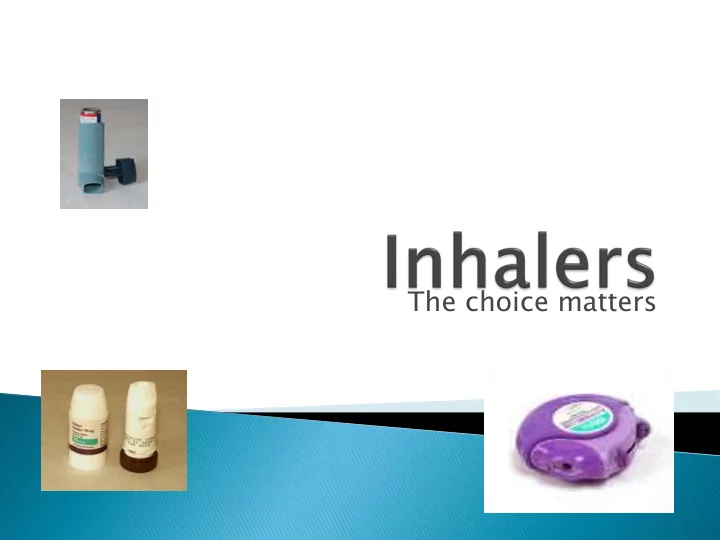
The choice matters Aim is for asthma control: no daytime symptoms - - PowerPoint PPT Presentation
The choice matters Aim is for asthma control: no daytime symptoms no night time awakening due to asthma no need for rescue medication no exacerbations no limitations on activity including exercise normal lung function
Aim is for asthma control:
Before moving up to the next step:
We have effective medication We have trained staff
To be effective the medication has to reach
Patients have to understand the importance
Correct treatment and correct inhaler
Metered dose inhalers Dry powder inhalers
Can mean only 5% of the medication reaches
More side effects as more medication is
Increased doses required
The drug is mixed with the propellant by
The aerosol mixture comes out at high speed Smaller particles will be able to reach smaller
NEEDS TO BE INHALED GENTLY TO BE
Co-ordination difficulties are prevented as the
Reduce the amount of particles hitting the
Aerochambers have no valves Volumatics have valves Even Spacer can be used wrongly!
Important to breathe out gently before
Inhale appropriately for the device Spacers need to be used correctly Hold breath for 5-10 seconds after
An empty inhaler will continue to spray!! Not possible to determine when the inhaler is
Even when the medication is gone, propellant can
Check on the prescribing screen when the inhaler
Ask questions in a non threatening way
Need to be meaningful and individual Management plans ---with patient’s
Don’t step up before looking at
People with asthma are given specific training and
People with asthma need to be able to use their
Training and assessment need to take place before
Patients without a personal asthma action
Inequalities exist nationally – The Asthma
Source: Adams, R. J., et al. "Factors associated with hospital admissions and repeat emergency department visits for adults with asthma." Thorax. 55.7 (2000): 566-73.