
University of Tokyo, October 2010
Engineering the Pharmacology & Toxicology of Nanomaterials
The Case of Carbon Nanotubes
Professor Kostas Kostarelos
Nanomedicine Lab Centre for Drug Delivery Research The School of Pharmacy, University of London
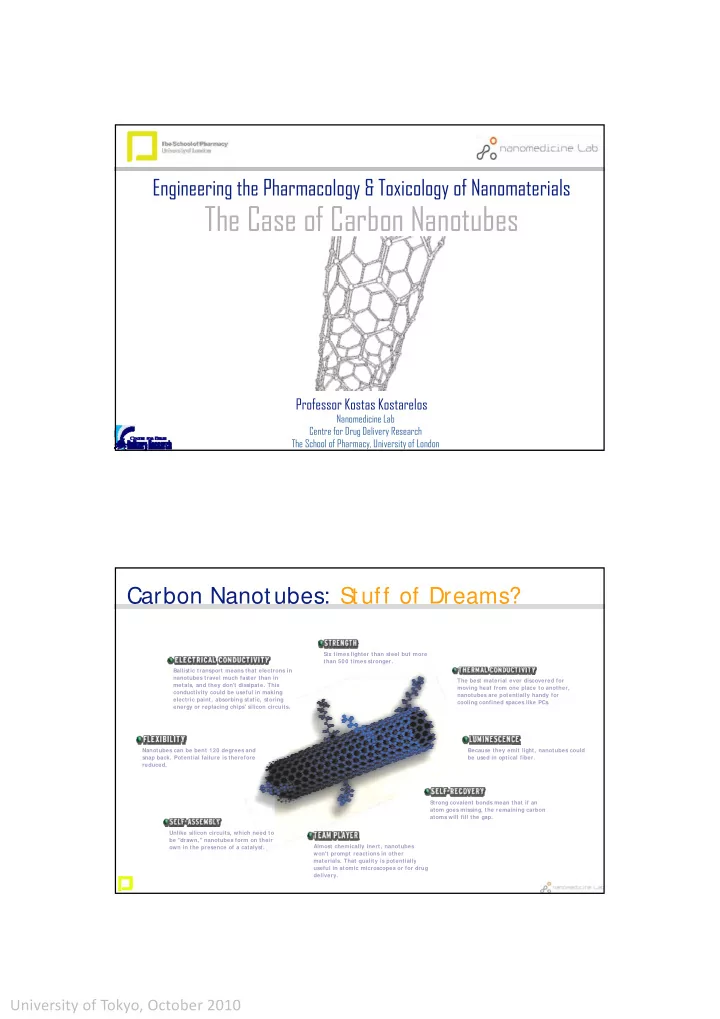
Ballistic transport means that electrons in t b t l h f t th i Six times lighter than steel but more than 500 times stronger.
Carbon Nanotubes: S tuff of Dreams?
nanotubes travel much faster than in metals, and they don't dissipate. This conductivity could be useful in making electric paint, absorbing static, storing energy or replacing chips' silicon circuits. The best material ever discovered for moving heat from one place to another, nanotubes are potentially handy for cooling confined spaces like PCs. Because they emit light, nanotubes could be used in optical fiber. Nanotubes can be bent 120 degrees and snap back. Potential failure is therefore reduced. Strong covalent bonds mean that if an atom goes missing, the remaining carbon atoms will fill the gap. Unlike silicon circuits, which need to be "drawn," nanotubes form on their
- wn in the presence of a catalyst.
Almost chemically inert, nanotubes won't prompt reactions in other
- materials. That quality is potentially
useful in atomic microscopes or for drug delivery.