SLIDE 3 DNS of Multiphase Flows
Code
See sample matlab code CodeC1.m
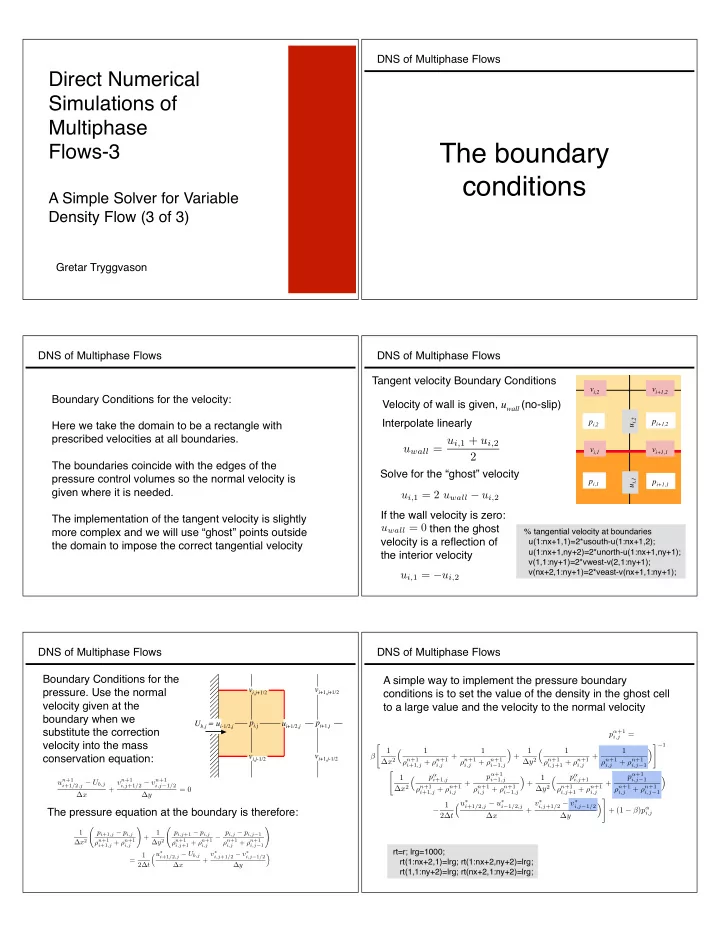
%=================================================================== % A very simple Navier-Stokes solver for a drop falling in a rectangular % domain. The viscosity is taken to be a constant and a forward in time, % and a conservative centered in space discretization is used. The density % is advected by solving a simple advection-diffusion equation. %===================================================================
DNS of Multiphase Flows
for i=2:nx+1,for j=2:ny % TEMPORARY v-velocity vt(i,j)=(2.0/(r(i,j+1)+r(i,j)))*( 0.5*(ro(i,j+1)+ro(i,j))*v(i,j)+ dt* ( ...
- (0.0625/dx)*( (ro(i,j)+ro(i+1,j)+ro(i+1,j+1)+ro(i,j+1))*...
(u(i,j)+u(i,j+1))*(v(i,j)+v(i+1,j)) ...
- (ro(i,j)+ro(i,j+1)+ro(i-1,j+1)+ro(i-1,j))*...
(u(i-1,j+1)+u(i-1,j))*(v(i,j)+v(i-1,j)) ) ...
- (0.25/dy)*(ro(i,j+1)*(v(i,j+1)+v(i,j))^2-ro(i,j)*(v(i,j)+v(i,j-1))^2 ) ...
+ 0.5*(ro(i,j+1)+ro(i,j))*gy ... +m0*((v(i+1,j)-2*v(i,j)+v(i-1,j))/dx^2+(v(i,j+1)-2*v(i,j)+v(i,j-1))/dy^2)) ); end,end %======================================================================== % Compute source term and the coefficient for p(i,j) rt=r; lrg=1000; rt(1:nx+2,1)=lrg;rt(1:nx+2,ny+2)=lrg; rt(1,1:ny+2)=lrg;rt(nx+2,1:ny+2)=lrg; for i=2:nx+1,for j=2:ny+1 tmp1(i,j)= (0.5/dt)*( (ut(i,j)-ut(i-1,j))/dx+(vt(i,j)-vt(i,j-1))/dy ); tmp2(i,j)=1.0/( (1./dx)*( 1./(dx*(rt(i+1,j)+rt(i,j)))+... 1./(dx*(rt(i-1,j)+rt(i,j))) )+... (1./dy)*(1./(dy*(rt(i,j+1)+rt(i,j)))+... 1./(dy*(rt(i,j-1)+rt(i,j))) ) ); end,end for it=1:maxit % SOLVE FOR PRESSURE
for i=2:nx+1,for j=2:ny+1 p(i,j)=(1.0-beta)*p(i,j)+beta* tmp2(i,j)*(... (1./dx)*( p(i+1,j)/(dx*(rt(i+1,j)+rt(i,j)))+... p(i-1,j)/(dx*(rt(i-1,j)+rt(i,j))) )+... (1./dy)*( p(i,j+1)/(dy*(rt(i,j+1)+rt(i,j)))+... p(i,j-1)/(dy*(rt(i,j-1)+rt(i,j))) ) - tmp1(i,j)); end,end if max(max(abs(oldArray-p))) <maxError, break,end end for i=2:nx, for j=2:ny+1 % CORRECT THE u-velocity u(i,j)=ut(i,j)-(dt*2.0/(r(i+1,j)+r(i,j)))*(p(i+1,j)-p(i,j))/dx; end, end for i=2:nx+1, for j=2:ny % CORRECT THE v-velocity v(i,j)=vt(i,j)-(dt*2.0/(r(i,j+1)+r(i,j)))*(p(i,j+1)-p(i,j))/dy; end, end %======================================================================== time=time+dt % plot the results uu(1:nx+1,1:ny+1)=0.5*(u(1:nx+1,2:ny+2)+u(1:nx+1,1:ny+1)); vv(1:nx+1,1:ny+1)=0.5*(v(2:nx+2,1:ny+1)+v(1:nx+1,1:ny+1)); for i=1:nx+1,xh(i)=dx*(i-1);end; for j=1:ny+1,yh(j)=dy*(j-1);end hold off,contour(x,y,flipud(rot90(r))),axis equal,axis([0 Lx 0 Ly]); hold on;quiver(xh,yh,flipud(rot90(uu)),flipud(rot90(vv)),'r'); pause(0.01) end %======================================================================== % CodeC1.m % A very simple Navier-Stokes solver for a drop falling in a rectangular % domain. The viscosity is taken to be a constant and a forward in time, % and a conservative centered in space discretization is used. The density % is advected by solving a simple advection-diffusion equation. %======================================================================== %domain size and physical variables Lx=1.0;Ly=1.0;gx=0.0;gy=-100.0; rho1=1.0; rho2=2.0; m0=0.01; unorth=0;usouth=0;veast=0;vwest=0;time=0.0; rad=0.15;xc=0.5;yc=0.7; % Initial drop size and location % Numerical variables nx=32;ny=32;dt=0.00125;nstep=100; maxit=200;maxError=0.001;beta=1.2; % Zero various arrys u=zeros(nx+1,ny+2); v=zeros(nx+2,ny+1); p=zeros(nx+2,ny+2); ut=zeros(nx+1,ny+2); vt=zeros(nx+2,ny+1); tmp1=zeros(nx+2,ny+2); uu=zeros(nx+1,ny+1); vv=zeros(nx+1,ny+1); tmp2=zeros(nx+2,ny+2); % Set the grid dx=Lx/nx;dy=Ly/ny; for i=1:nx+2; x(i)=dx*(i-1.5);end; for j=1:ny+2; y(j)=dy*(j-1.5);end; % Set density in the domain and the drop r=zeros(nx+2,ny+2)+rho1; for i=2:nx+1,for j=2:ny+1; if ( (x(i)-xc)^2+(y(j)-yc)^2 < rad^2), r(i,j)=rho2;end, end,end %================== START TIME LOOP====================================== for is=1:nstep,is % tangential velocity at boundaries u(1:nx+1,1)=2*usouth-u(1:nx+1,2);u(1:nx+1,ny+2)=2*unorth-u(1:nx+1,ny+1); v(1,1:ny+1)=2*vwest-v(2,1:ny+1);v(nx+2,1:ny+1)=2*veast-v(nx+1,1:ny+1); %=======ADVECT DENSITY using centered difference plus diffusion ========== ro=r; for i=2:nx+1,for j=2:ny+1 r(i,j)=ro(i,j)-(0.5*dt/dx)*(u(i,j)*(ro(i+1,j)... +ro(i,j))-u(i-1,j)*(ro(i-1,j)+ro(i,j)))-(0.5* dt/dy)*(v(i,j)*(ro(i,j+1)... +ro(i,j))-v(i,j-1)*(ro(i,j-1)+ro(i,j)) )... +(m0*dt/dx/dx)*(ro(i+1,j)-2.0*ro(i,j)+ro(i-1,j))... +(m0*dt/dy/dy)*(ro(i,j+1)-2.0*ro(i,j)+ro(i,j-1)); end,end %===== Find temporary velocities ======================================== for i=2:nx,for j=2:ny+1 % TEMPORARY u-velocity ut(i,j)=(2.0/(r(i+1,j)+r(i,j)))* ( 0.5*(ro(i+1,j)+ro(i,j))*u(i,j)+ dt* (...
- (0.25/dx)*(ro(i+1,j)*(u(i+1,j)+u(i,j))^2-ro(i,j)*(u(i,j)+u(i-1,j))^2) ...
- (0.0625/dy)*( (ro(i,j)+ro(i+1,j)+ro(i,j+1)+ro(i+1,j+1))*...
(u(i,j+1)+u(i,j))*(v(i+1,j)+v(i,j)) ...
- (ro(i,j)+ro(i+1,j)+ro(i+1,j-1)+ro(i,j-1))*(u(i,j)...
+u(i,j-1))*(v(i+1,j-1)+v(i,j-1))) ... + 0.5*(ro(i+1,j)+ro(i,j))*gx ... +m0*((u(i+1,j)-2*u(i,j)+u(i-1,j))/dx^2+ (u(i,j+1)-2*u(i,j)+u(i,j-1))/dy^2)) ); end,end
DNS of Multiphase Flows Limitations on the time step where The time step needs to be small enough so that the code is
- stable. For the explicit method used here we need to use:
h = max(∆x, ∆y)
µ∆t ρh2 1 4 (u · u)max ρ∆t µ 2 DNS of Multiphase Flows
Problem specification: Lx=1.0; Ly=1.0; gx=0.0; gy=-100.0; rho1=1.0; rho2=2.0; m0=0.01; Tangential velocities: unorth=0;usouth=0; veast=0;vwest=0; Initial drop size and location rad=0.15; xc=0.5; yc=0.7; Numerical variables nx=32; ny=32; dt=0.00125; nstep=100; Pressure solver maxit=200; beta=1.2; maxError=0.001;
0.2 0.4 0.6 0.8 1 0.2 0.4 0.6 0.8 1 0.8 1 1.2 1.4 1.6 1.8 2 2.2
Example: An initially stationary droplet in a square box that falls down due to gravity. Here we ignore surface tension, take the viscosity to be the same as the ambient fluid and advect density by solving the advection-diffusion equation
DNS of Multiphase Flows
0.1 0.2 0.3 0.4 0.5 0.6 0.7 0.8 0.9 1 0.1 0.2 0.3 0.4 0.5 0.6 0.7 0.8 0.9 1 0.1 0.2 0.3 0.4 0.5 0.6 0.7 0.8 0.9 1 0.1 0.2 0.3 0.4 0.5 0.6 0.7 0.8 0.9 1
time=0.00125 time=0.125
5 10 15 20 25 30 35 10 20 30 40 0.8 1 1.2 1.4 1.6 1.8 2
“Exact” solution
5 10 15 20 25 30 35 10 20 30 40 0.8 1 1.2 1.4 1.6 1.8 2 2.2
Density at final time Numerical results for a falling drop on a 32 by 32 grid