SLIDE 1
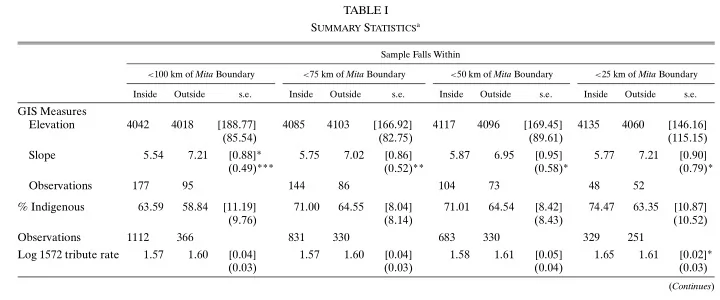
TABLE I SUMMARY STATISTICSa
Sample Falls Within <100 km of Mita Boundary <75 km of Mita Boundary <50 km of Mita Boundary <25 km of Mita Boundary Inside Outside s.e. Inside Outside s.e. Inside Outside s.e. Inside Outside s.e.
GIS Measures Elevation 4042 4018 [18877] 4085 4103 [16692] 4117 4096 [16945] 4135 4060 [14616] (8554) (8275) (8961) (11515) Slope 554 721 [088]* 575 702 [086] 587 695 [095] 577 721 [090] (049)*** (052)** (058)* (079)* Observations 177 95 144 86 104 73 48 52 % Indigenous 6359 5884 [1119] 7100 6455 [804] 7101 6454 [842] 7447 6335 [1087] (976) (814) (843) (1052) Observations 1112 366 831 330 683 330 329 251 Log 1572 tribute rate 157 160 [004] 157 160 [004] 158 161 [005] 165 161 [002]* (003) (003) (004) (003)
(Continues)
SLIDE 2
TABLE I—Continued
Sample Falls Within <100 km of Mita Boundary <75 km of Mita Boundary <50 km of Mita Boundary <25 km of Mita Boundary Inside Outside s.e. Inside Outside s.e. Inside Outside s.e. Inside Outside s.e.
% 1572 tribute to Spanish Nobility 5980 6382 [139]*** 5998 6369 [156]** 6201 6307 [112] 6101 6317 [158] (136)*** (153)** (134) (221) Spanish Priests 2105 1910 [090]** 2190 1945 [102]** 2059 1993 [076] 2145 1998 [101] (094)** (102)** (092) (133) Spanish Justices 1336 1258 [053] 1331 1246 [065] 1281 1248 [043] 1306 1237 [056] (048)* (060) (055) (079) Indigenous Mayors 567 440 [078] 455 429 [026] 442 447 [034] 448 442 [029] (085) (029) (033) (039) Observations 63 41 47 37 35 30 18 24
aThe unit of observation is 20 × 20 km grid cells for the geospatial measures, the household for % indigenous, and the district for the 1572 tribute data. Conley standard errors
for the difference in means between mita and non-mita observations are in brackets. Robust standard errors for the difference in means are in parentheses. For % indigenous, the robust standard errors are corrected for clustering at the district level. The geospatial measures are calculated using elevation data at 30 arc second (1 km) resolution (SRTM (2000)). The unit of measure for elevation is 1000 meters and for slope is degrees. A household is indigenous if its members primarily speak an indigenous language in the home (ENAHO (2001)). The tribute data are taken from Miranda (1583). In the first three columns, the sample includes only observations located less than 100 km from the mita boundary, and this threshold is reduced to 75, 50, and finally 25 km in the succeeding columns. Coefficients that are significantly different from zero are denoted by the following system: *10%, **5%, and ***1%.
SLIDE 3
FIGURE 2.—Plots of various outcomes against longitude and latitude. See the text for a de- tailed description.
SLIDE 4 TABLE III SPECIFICATION TESTSa
Dependent Variable Log Equiv. Hausehold Consumption (2001) Stunted Growth, Children 6–9 (2005) Sample Within: <100 km <75 km <50 km <100 km <75 km <50 km Border
- f Bound.
- f Bound.
- f Bound.
- f Bound.
- f Bound.
- f Bound.
District (1) (2) (3) (4) (5) (6) (7)
Alternative Functional Forms for RD Polynomial: Baseline I Linear polynomial in latitude and longitude Mita −0294*** −0199 −0143 0064*** 0054** 0062** 0068** (0092) (0126) (0128) (0021) (0022) (0026) (0031) Quadratic polynomial in latitude and longitude Mita −0151 −0247 −0361 0073* 0091** 0106** 0087** (0189) (0209) (0216) (0040) (0043) (0047) (0041) Quartic polynomial in latitude and longitude Mita −0392* −0324 −0342 0073 0072 0057 0104** (0225) (0231) (0260) (0056) (0050) (0048) (0042) Alternative Functional Forms for RD Polynomial: Baseline II Linear polynomial in distance to Potosí Mita −0297*** −0273*** −0220** 0050** 0048** 0049** 0071** (0079) (0093) (0092) (0022) (0022) (0024) (0031) Quadratic polynomial in distance to Potosí Mita −0345*** −0262*** −0309*** 0072*** 0064*** 0072*** 0060* (0086) (0095) (0100) (0023) (0022) (0023) (0032) Quartic polynomial in distance to Potosí Mita −0331*** −0310*** −0330*** 0078*** 0075*** 0071*** 0053* (0086) (0100) (0097) (0021) (0020) (0021) (0031) Interacted linear polynomial in distance to Potosí Mita −0307*** −0280*** −0227** 0051** 0048** 0043* 0076*** (0092) (0094) (0095) (0022) (0021) (0022) (0029) Interacted quadratic polynomial in distance to Potosí Mita −0264*** −0177* −0285** 0033 0027 0039* 0036 (0087) (0096) (0111) (0024) (0023) (0023) (0024)
(Continues)
SLIDE 5 TABLE III—Continued
Dependent Variable Log Equiv. Hausehold Consumption (2001) Stunted Growth, Children 6–9 (2005) Sample Within: <100 km <75 km <50 km <100 km <75 km <50 km Border
- f Bound.
- f Bound.
- f Bound.
- f Bound.
- f Bound.
- f Bound.
District (1) (2) (3) (4) (5) (6) (7)
Alternative Functional Forms for RD Polynomial: Baseline III Linear polynomial in distance to mita boundary Mita −0299*** −0227** −0223** 0072*** 0060*** 0058** 0056* (0082) (0089) (0091) (0024) (0022) (0023) (0032) Quadratic polynomial in distance to mita boundary Mita −0277*** −0227** −0224** 0072*** 0060*** 0061*** 0056* (0078) (0089) (0092) (0023) (0022) (0023) (0030) Quartic polynomial in distance to mita boundary Mita −0251*** −0229** −0246*** 0073*** 0064*** 0063*** 0055* (0078) (0089) (0088) (0023) (0022) (0023) (0030) Interacted linear polynomial in distance to mita boundary Mita −0301* −0277 −0385* 0082 0087 0095 0132** (0174) (0190) (0210) (0054) (0055) (0065) (0053) Interacted quadratic polynomial in distance to mita boundary Mita −0351 −0505 −0295 0140* 0132 0136 0121* (0260) (0319) (0366) (0082) (0084) (0086) (0064) Ordinary Least Squares Mita −0294*** −0288*** −0227** 0057** 0048* 0049* 0055* (0083) (0089) (0090) (0025) (0024) (0026) (0031)
yes yes yes yes yes yes yes Boundary F.E.s yes yes yes yes yes yes yes Clusters 71 60 52 289 239 185 63 Observations 1478 1161 1013 158,848 115,761 100,446 37,421
aRobust standard errors, adjusted for clustering by district, are in parentheses. All regressions include geographic
controls and boundary segment fixed effects (F.E.s). Columns 1–3 include demographic controls for the number of in- fants, children, and adults in the household. Coefficients significantly different from zero are denoted by the following system: *10%, **5%, and ***1%.
SLIDE 6 TABLE II LIVING STANDARDSa
Dependent Variable Log Equiv. Hausehold Consumption (2001) Stunted Growth, Children 6–9 (2005) Sample Within: <100 km <75 km <50 km <100 km <75 km <50 km Border
- f Bound.
- f Bound.
- f Bound.
- f Bound.
- f Bound.
- f Bound.
District (1) (2) (3) (4) (5) (6) (7)
Panel A. Cubic Polynomial in Latitude and Longitude Mita −0284 −0216 −0331 0070 0084* 0087* 0114** (0198) (0207) (0219) (0043) (0046) (0048) (0049) R2 0060 0060 0069 0051 0020 0017 0050 Panel B. Cubic Polynomial in Distance to Potosí Mita −0337*** −0307*** −0329*** 0080*** 0078*** 0078*** 0063* (0087) (0101) (0096) (0021) (0022) (0024) (0032) R2 0046 0036 0047 0049 0017 0013 0047 Panel C. Cubic Polynomial in Distance to Mita Boundary Mita −0277*** −0230** −0224** 0073*** 0061*** 0064*** 0055* (0078) (0089) (0092) (0023) (0022) (0023) (0030) R2 0044 0042 0040 0040 0015 0013 0043
yes yes yes yes yes yes yes Boundary F.E.s yes yes yes yes yes yes yes Clusters 71 60 52 289 239 185 63 Observations 1478 1161 1013 158,848 115,761 100,446 37,421
aThe unit of observation is the household in columns 1–3 and the individual in columns 4–7. Robust standard errors, adjusted for clustering by district, are in parentheses. The dependent variable is log equivalent household consumption (ENAHO (2001)) in columns 1–3, and a dummy equal to 1 if the child has stunted growth and equal to 0 otherwise in columns 4–7 (Ministro de Educación (2005a)). Mita is an indicator equal to 1 if the household’s district contributed to the mita and equal to 0 otherwise (Saignes (1984), Amat y Juniet (1947, pp. 249, 284)). Panel A includes a cubic polynomial in the latitude and longitude of the observation’s district capital, panel B includes a cubic polynomial in Euclidean distance from the observation’s district capital to Potosí, and panel C includes a cubic polynomial in Euclidean distance to the nearest point on the mita boundary. All regressions include controls for elevation and slope, as well as boundary segment fixed effects (F.E.s). Columns 1–3 include demographic controls for the number of infants, children, and adults in the household. In columns 1 and 4, the sample includes observations whose district capitals are located within 100 km of the mita boundary, and this threshold is reduced to 75 and 50 km in the succeeding columns. Column 7 includes only observations whose districts border the mita boundary. 78% of the observations are in mita districts in column 1, 71% in column 2, 68% in column 3, 78% in column 4, 71% in column 5, 68% in column 6, and 58% in column 7. Coefficients that are significantly different from zero are denoted by the following system: *10%, **5%, and ***1%.
SLIDE 7
SLIDE 8 TABLE VI LAND TENURE AND LABOR SYSTEMSa
Dependent Variable Percent of Haciendas per Rural Tributary Percent of Rural 1000 District Population in Population in Haciendas per Residents Haciendas Haciendas Land Gini District in 1689 in 1689 in ca. 1845 in 1940 in 1994 (1) (2) (3) (4) (5)
Panel A. Cubic Polynomial in Latitude and Longitude Mita −12683*** −6453** −0127* −0066 0078 (3221) (2490) (0067) (0086) (0053) R2 0538 0582 0410 0421 0245 Panel B. Cubic Polynomial in Distance to Potosí Mita −10316*** −7570*** −0204** −0143*** 0107*** (2057) (1478) (0082) (0051) (0036) R2 0494 0514 0308 0346 0194 Panel C. Cubic Polynomial in Distance to Mita Boundary Mita −11336*** −8516*** −0212*** −0120*** 0124*** (2074) (1665) (0060) (0045) (0033) R2 0494 0497 0316 0336 0226
yes yes yes yes yes Boundary F.E.s yes yes yes yes yes Mean dep. var. 6.500 5.336 0.135 0.263 0.783 Observations 74 74 81 119 181
aThe unit of observation is the district. Robust standard errors are in parentheses. The dependent variable in col-
umn 1 is haciendas per district in 1689 and in column 2 is haciendas per 1000 district residents in 1689 (Villanueva Urteaga (1982)). In column 3 it is the percentage of the district’s tributary population residing in haciendas ca. 1845 (Peralta Ruiz (1991)), in column 4 it is the percentage of the district’s rural population residing in haciendas in 1940 (Dirección de Estadística del Perú (1944)), and in column 5 it is the district land gini (INEI (1994)). Panel A includes a cubic polynomial in the latitude and longitude of the observation’s district capital, panel B includes a cubic polyno- mial in Euclidean distance from the observation’s district capital to Potosí, and panel C includes a cubic polynomial in Euclidean distance to the nearest point on the mita boundary. All regressions include geographic controls and bound- ary segment fixed effects. The samples include districts whose capitals are less than 50 km from the mita boundary. Column 3 is weighted by the square root of the district’s rural tributary population and column 4 is weighted by the square root of the district’s rural population. 58% of the observations are in mita districts in columns 1 and 2, 59% in column 3, 62% in column 4, and 66% in column 5. Coefficients that are significantly different from zero are denoted by the following system: *10%, **5%, and ***1%.
SLIDE 9 TABLE VII EDUCATIONa
Dependent Variable Mean Years Mean Years Literacy
1876 1940 2001 (1) (2) (3)
Panel A. Cubic Polynomial in Latitude and Longitude Mita −0015 −0265 −1479* (0012) (0177) (0872) R2 0401 0280 0020 Panel B. Cubic Polynomial in Distance to Potosí Mita −0020*** −0181** −0341 (0007) (0078) (0451) R2 0345 0187 0007 Panel C. Cubic Polynomial in Distance to Mita Boundary Mita −0022*** −0209*** −0111 (0006) (0076) (0429) R2 0301 0234 0004
yes yes yes Boundary F.E.s yes yes yes Mean dep. var. 0.036 0.470 4.457 Clusters 95 118 52 Observations 95 118 4038
aThe unit of observation is the district in columns 1 and 2 and the individual in column 3. Robust standard errors,
adjusted for clustering by district, are in parentheses. The dependent variable is mean literacy in 1876 in column 1 (Dirección de Estadística del Perú (1878)), mean years of schooling in 1940 in column 2 (Dirección de Estadística del Perú (1944)), and individual years of schooling in 2001 in column 3 (ENAHO (2001)). Panel A includes a cubic polynomial in the latitude and longitude of the observation’s district capital, panel B includes a cubic polynomial in Euclidean distance from the observation’s district capital to Potosí, and panel C includes a cubic polynomial in Euclidean distance to the nearest point on the mita boundary. All regressions include geographic controls and bound- ary segment fixed effects. The samples include districts whose capitals are less than 50 km from the mita boundary. Columns 1 and 2 are weighted by the square root of the district’s population. 64% of the observations are in mita districts in column 1, 63% in column 2, and 67% in column 3. Coefficients that are significantly different from zero are denoted by the following system: *10%, **5%, and ***1%.
SLIDE 10
(A) (B)
FIGURE 1.—(A) Ethnic boundaries. (B) Ethnic pre-colonial institutions.
SLIDE 11
(A) (B)
FIGURE 3.—(A) Luminosity at the ethnic homeland. (B) Pixel-level luminosity.
SLIDE 12 TABLE I SUMMARY STATISTICSa
Variable Obs. Mean
p25 Median p75 Min Max
Panel A: All Observations Light Density 683 0368 1528 0000 0022 0150 0000 25140 ln(001 + Light Density) 683 −2946 1701 −4575 −3429 −1835 −4605 3225 Pixel-Level Light Density 66,570 0560 3422 0000 0000 0000 0000 62978 Lit Pixel 66,570 0167 0373 0000 0000 0000 0000 1000 Panel B: Stateless Ethnicities Light Density 176 0257 1914 0000 0018 0082 0000 25140 ln(001 + Light Density) 176 −3231 1433 −4605 −3585 −2381 −4605 3225 Pixel-Level Light Density 13,174 0172 1556 0000 0000 0000 0000 55634 Lit Pixel 13,174 0100 0301 0000 0000 0000 0000 1000 Panel C: Petty Chiefdoms Light Density 264 0281 1180 0000 0015 0089 0000 13086 ln(001 + Light Density) 264 −3187 1592 −4605 −3684 −2313 −4605 2572 Pixel-Level Light Density 20,259 0283 2084 0000 0000 0000 0000 60022 Lit Pixel 20,259 0129 0335 0000 0000 0000 0000 1000 Panel D: Paramount Chiefdoms Light Density 167 0315 0955 0002 0039 0203 0000 9976 ln(001 + Light Density) 167 −2748 1697 −4425 −3017 −1544 −4605 2301 Pixel-Level Light Density 20,972 0388 2201 0000 0000 0000 0000 58546 Lit Pixel 20,972 0169 0375 0000 0000 0000 0000 1000 Panel E: Pre-Colonial States Light Density 76 1046 2293 0012 0132 0851 0000 14142 ln(001 + Light Density) 76 −1886 2155 −3836 −1976 −0150 −4605 2650 Pixel-Level Light Density 12,165 1739 6644 0000 0000 0160 0000 62978 Lit Pixel 12,165 0302 0459 0000 0000 1000 0000 1000
aThe table reports descriptive statistics for the luminosity data that we use to proxy economic development at the
country-ethnic homeland level and at the pixel level. Panel A gives summary statistics for the full sample. Panel B reports summary statistics for ethnicities that lacked any form of political organization beyond the local level at the time of colonization. Panel C reports summary statistics for ethnicities organized in petty chiefdoms. Panel D reports summary statistics for ethnicities organized in large paramount chiefdoms. Panel E reports summary statistics for ethnicities organized in large centralized states. The classification follows Murdock (1967). The Data Appendix in the Supplemental Material (Michalopoulos and Papaioannou (2013)) gives detailed variable definitions and data sources.
SLIDE 13 TABLE II PRE-COLONIAL ETHNIC INSTITUTIONS AND REGIONAL DEVELOPMENT CROSS-SECTIONAL ESTIMATESa
(1) (2) (3) (4) (5) (6)
Jurisdictional Hierarchy 0.4106*** 0.3483** 0.3213*** 0.1852*** 0.1599*** 0.1966*** Double-clustered s.e. (0.1246) (0.1397) (0.1026) (0.0676) (0.0605) (0.0539) Conley’s s.e. [0.1294] [0.1288] [0.1014] [0.0646] [0.0599] [0.0545] Rule of Law (in 2007) 0.4809** Double-clustered s.e. (0.2213) Conley’s s.e. [0.1747] Log GDP p.c. (in 2007) 0.5522*** Double-clustered s.e. (0.1232) Conley’s s.e. [0.1021] Adjusted R-squared 0.056 0.246 0.361 0.47 0.488 0.536 Population Density No Yes Yes Yes Yes Yes Location Controls No No Yes Yes Yes Yes Geographic Controls No No No Yes Yes Yes Observations 683 683 683 683 680 680
aTable II reports OLS estimates associating regional development with pre-colonial ethnic institutions, as re-
flected in Murdock’s (1967) index of jurisdictional hierarchy beyond the local community. The dependent variable is log(001 + light density at night from satellite) at the ethnicity–country level. In column (5) we control for national institutions, augmenting the specification with the rule of law index (in 2007). In column (6) we control for the overall level of economic development, augmenting the specification with the log of per capita GDP (in 2007). In columns (2)–(6) we control for log(001 + population density). In columns (3)–(6) we control for location, augmenting the specification with distance of the centroid of each ethnicity–country area from the respective capital city, distance from the closest sea coast, and distance from the national border. The set of geographic controls in columns (4)–(6) includes log(1 + area under water(lakes, rivers, and other streams)), log(surface area), land suitability for agriculture, elevation, a malaria stability index, a diamond mine indicator, and an oil field indicator. The Data Appendix in the Supplemental Material gives detailed variable definitions and data sources. Below the estimates, we report in parentheses double-clustered standard errors at the country and ethnolinguistic family
- dimensions. We also report in brackets Conley’s (1999) standard errors that account for two-dimensional spatial auto-
- correlation. ***, **, and * indicate statistical significance, with the most conservative standard errors at the 1%, 5%,
and 10% level, respectively.
SLIDE 14
TABLE III PRE-COLONIAL ETHNIC INSTITUTIONS AND REGIONAL DEVELOPMENT WITHIN AFRICAN COUNTRIESa
(1) (2) (3) (4) (5) (6) (7) (8) (9) (10) (11) (12)
Panel A: Pre-Colonial Ethnic Institutions and Regional Development Within African Countries All Observations Jurisdictional 0.3260*** 0.2794*** 0.2105*** 0.1766*** Hierarchy (0.0851) (0.0852) (0.0553) (0.0501) Binary Political 0.5264*** 0.5049*** 0.3413*** 0.3086*** Centralization (0.1489) (0.1573) (0.0896) (0.0972) Petty Chiefdoms 0.1538 0.1442 0.1815 0.1361 (0.2105) (0.1736) (0.1540) (0.1216) Paramount Chiefdoms 0.4258* 0.4914* 0.3700** 0.3384** (0.2428) (0.2537) (0.1625) (0.1610) Pre-Colonial States 1.1443*** 0.8637*** 0.6809*** 0.5410*** (0.2757) (0.2441) (0.1638) (0.1484) Adjusted R-squared 0.409 0.540 0.400 0.537 0.597 0.661 0.593 0.659 0.413 0.541 0.597 0.661 Observations 682 682 682 682 682 682 682 682 682 682 682 682 Country Fixed Effects Yes Yes Yes Yes Yes Yes Yes Yes Yes Yes Yes Yes Location Controls No Yes No Yes No Yes No Yes No Yes No Yes Geographic Controls No Yes No Yes No Yes No Yes No Yes No Yes Population Density No No Yes Yes No No Yes Yes No No Yes Yes (Continues)
SLIDE 15 TABLE III—Continued
(1) (2) (3) (4) (5) (6) (7) (8) (9) (10) (11) (12)
Panel B: Pre-Colonial Ethnic Institutions and Regional Development Within African Countries Focusing on the Intensive Margin of Luminosity Jurisdictional 0.3279*** 0.3349*** 0.1651** 0.1493** Hierarchy (0.1238) (0.1118) (0.0703) (0.0728) Binary Political 0.4819** 0.6594*** 0.2649** 0.2949** Centralization (0.2381) (0.2085) (0.1232) (0.1391) Petty Chiefdoms 0.1065 0.1048 0.0987 0.0135 (0.2789) (0.2358) (0.1787) (0.1725) Paramount Chiefdoms 0.2816 0.6253* 0.2255 0.2374 (0.3683) (0.3367) (0.2258) (0.2388) Pre-Colonial States 1.2393*** 0.9617*** 0.5972*** 0.4660** (0.3382) (0.3209) (0.2207) (0.2198) Adjusted R-squared 0.424 0.562 0.416 0.562 0.638 0.671 0.636 0.671 0.431 0.564 0.639 0.672 Observations 517 517 517 517 517 517 517 517 517 517 517 517 Country Fixed Effects Yes Yes Yes Yes Yes Yes Yes Yes Yes Yes Yes Yes Location Controls No Yes No Yes No Yes No Yes No Yes No Yes Geographic Controls No Yes No Yes No Yes No Yes No Yes No Yes Population Density No No Yes Yes No No Yes Yes No No Yes Yes
aTable III reports within-country OLS estimates associating regional development with pre-colonial ethnic institutions. In Panel A the dependent variable is the log(001 +
light density at night from satellite) at the ethnicity-country level. In Panel B the dependent variable is the log(light density at night from satellite) at the ethnicity-country level; as such we exclude areas with zero luminosity. In columns (1)–(4) we measure pre-colonial ethnic institutions using Murdock’s (1967) jurisdictional hierarchy beyond the local community index. In columns (5)–(8) we use a binary political centralization index that is based on Murdock’s (1967) jurisdictional hierarchy beyond the local community
- variable. Following Gennaioli and Rainer (2007), this index takes on the value of zero for stateless societies and ethnic groups that were part of petty chiefdoms and 1 otherwise
(for ethnicities that were organized as paramount chiefdoms and ethnicities that were part of large states). In columns (9)–(12) we augment the specification with three dummy variables that identify petty chiefdoms, paramount chiefdoms, and large states. The omitted category consists of stateless ethnic groups before colonization. All specifications include a set of country fixed effects (constants not reported). In even-numbered columns we control for location and geography. The set of control variables includes the distance of the centroid of each ethnicity-country area from the respective capital city, the distance from the sea coast, the distance from the national border, log(1 + area under water (lakes, rivers, and other streams)), log(surface area), land suitability for agriculture, elevation, a malaria stability index, a diamond mine indicator, and an oil field indicator. The Data Appendix in the Supplemental Material gives detailed variable definitions and data sources. Below the estimates, we report in parentheses double-clustered standard errors at the country and the ethnolinguistic family dimensions. ***, **, and * indicate statistical significance at the 1%, 5%, and 10% level, respectively.
SLIDE 16
TABLE IV EXAMINING THE ROLE OF OTHER PRE-COLONIAL ETHNIC FEATURESa
Specification A Specification B Additional Variable Obs. Additional Variable Jurisdictional Hierarchy Obs. (1) (2) (3) (4) (5)
Gathering −0.1034 682 −0.0771 0.2082*** 682 (0.1892) (0.1842) (0.0550) Hunting −0.0436 682 −0.0167 0.2099*** 682 (0.1316) (0.1236) (0.0562) Fishing 0.2414* 682 0.2359* 0.2087*** 682 (0.1271) (0.1267) (0.0551) Animal Husbandry 0.0549 682 0.0351 0.2008*** 682 (0.0407) (0.0432) (0.0617) Milking 0.1888 680 0.0872 0.2016*** 680 (0.1463) (0.1443) (0.0581) Agriculture Dependence −0.1050** 682 −0.1032** 0.2078*** 682 (0.0468) (0.0454) (0.0558) Agriculture Type 0.0128 680 −0.0131 0.2092*** 680 (0.1043) (0.1021) (0.0549) Polygyny 0.0967 677 0.0796 0.2140*** 677 (0.1253) (0.1288) (0.0561) Polygyny Alternative −0.0276 682 0.0070 0.2106*** 682 (0.1560) (0.1479) (0.0543) Clan Communities −0.1053 567 −0.0079 0.2158*** 567 (0.1439) (0.1401) (0.0536) Settlement Pattern −0.0054 679 −0.0057 0.2103*** 679 (0.0361) (0.0377) (0.0571) Complex Settlements 0.2561 679 0.2154 0.1991*** 679 (0.1604) (0.1606) (0.0553) Hierarchy of Local 0.0224 680 −0.0009 0.2085*** 680 Community (0.0822) (0.0867) (0.0565) Patrilineal Descent −0.1968 671 −0.2011 0.1932*** 671 (0.1329) (0.1307) (0.0499) Class Stratification 0.1295** 570 0.0672 0.1556** 570 (0.0526) (0.0580) (0.0696) Class Stratification Indicator 0.4141** 570 0.2757 0.1441** 570 (0.1863) (0.1896) (0.0562) Elections 0.3210 500 0.2764 0.2217*** 500 (0.2682) (0.2577) (0.0581) (Continues)
SLIDE 17 TABLE IV—Continued
Specification A Specification B Additional Variable Obs. Additional Variable Jurisdictional Hierarchy Obs. (1) (2) (3) (4) (5)
Slavery 0.0191 610 −0.1192 0.2016*** 610 (0.1487) (0.1580) (0.0617) Inheritance Rules for −0.1186 529 −0.1788 0.2196*** 529 Property Rights (0.2127) (0.2283) (0.0690)
aTable
IV reports within-country OLS estimates associating regional development with pre-colonial ethnic features as reflected in Murdock’s (1967) Ethnographic Atlas. The dependent variable is the log(001 + light density at night from satellite) at the ethnicity-country level. All specifications include a set
country fixed effects (constants not reported). In all specifications we control for log(001 + population density at the ethnicity-country level). In specification A (in columns (1)–(2)) we regress log(001 + light density) on various ethnic traits from Murdock (1967). In specification B (columns (3)–(5)) we regress log(001+ light density) on each of Murdock’s additional variables and the jurisdictional hierarchy beyond the local community
- index. The Data Appendix in the Supplemental Material gives detailed variable definitions and data sources. Below
the estimates, we report in parentheses double-clustered standard errors at the country and the ethnolinguistic family
- dimensions. ***, **, and * indicate statistical significance at the 1%, 5%, and 10% level, respectively.
SLIDE 18
TABLE V PRE-COLONIAL ETHNIC INSTITUTIONS AND REGIONAL DEVELOPMENT: PIXEL-LEVEL ANAL
YSISa Lit/Unlit Pixels ln(001 + Luminosity) (1) (2) (3) (4) (5) (6) (7) (8) (9) (10)
Panel A: Jurisdictional Hierarchy Beyond the Local Community Level Jurisdictional Hierarchy 0.0673** 0.0447** 0.0280*** 0.0308*** 0.0265*** 0.3619** 0.2362** 0.1528*** 0.1757*** 0.1559*** Double-clustered s.e. (0.0314) (0.0176) (0.0081) (0.0074) (0.0071) (0.1837) (0.1035) (0.0542) (0.0506) (0.0483) Adjusted R-squared 0.034 0.272 0.358 0.375 0.379 0.045 0.320 0.418 0.448 0.456 Panel B: Pre-Colonial Institutional Arrangements Petty Chiefdoms 0.0285 0.0373 0.0228 0.0161 0.0125 0.1320 0.1520 0.0796 0.0642 0.0531 Double-clustered s.e. (0.0255) (0.0339) (0.0220) (0.0175) (0.0141) (0.1192) (0.1832) (0.1271) (0.0976) (0.0837) Paramount Chiefdoms 0.0685** 0.0773 0.0546* 0.0614** 0.0519*** 0.3103** 0.3528 0.2389 0.3054** 0.2802*** Double-clustered s.e. (0.0334) (0.0489) (0.0295) (0.0266) (0.0178) (0.1560) (0.2472) (0.1498) (0.1347) (0.0964) Pre-Colonial States 0.2013** 0.1310** 0.0765*** 0.0798*** 0.0688*** 1.0949** 0.6819** 0.4089*** 0.4544*** 0.3994*** Double-clustered s.e. (0.0956) (0.0519) (0.0240) (0.0216) (0.0235) (0.5488) (0.2881) (0.1432) (0.1430) (0.1493) Adjusted R-squared 0.033 0.271 0.357 0.375 0.379 0.046 0.319 0.417 0.448 0.456 Country Fixed Effects No Yes Yes Yes Yes No Yes Yes Yes Yes Population Density No No Yes Yes Yes No No Yes Yes Yes Controls at the Pixel Level No No No Yes Yes No No No Yes Yes Controls at the No No No No Yes No No No No Yes Ethnic-Country Level Observations 66,570 66,570 66,570 66,173 66,173 66,570 66,570 66,570 66,173 66,173
SLIDE 19
TABLE VII PRE-COLONIAL ETHNIC INSTITUTIONS AND REGIONAL DEVELOPMENT WITHIN CONTIGUOUS ETHNIC HOMELANDS IN THE SAME COUNTRYa
Difference in Jurisdictional Hierarchy One Ethnic Group was Part of a All Observations Index > |1| Pre-Colonial State (1) (2)
(3)
(4) (5) (6) (7) (8) (9)
Jurisdictional Hierarchy 0.0253* 0.0152** 0.0137** 0.0280* 0.0170** 0.0151** 0.0419** 0.0242** 0.0178*** Double-clustered s.e. (0.0134) (0.0073) (0.0065) (0.0159) (0.0079) (0.0072) (0.0213) (0.0096) (0.0069) Adjusted R-squared 0.329 0.391 0.399 0.338 0.416 0.423 0.424 0.501 0.512 Observations 78,139 78,139 77,833 34,180 34,180 34,030 16,570 16,570 16,474 Adjacent-Ethnic-Groups Fixed Effects Yes Yes Yes Yes Yes Yes Yes Yes Yes Population Density No Yes Yes No Yes Yes No Yes Yes Controls at the Pixel Level No No Yes No No Yes No No Yes
aTable VII reports adjacent-ethnicity (ethnic-pair-country) fixed effects OLS estimates associating regional development, as reflected in satellite light density at night with
pre-colonial ethnic institutions, as reflected in Murdock’s (1967) jurisdictional hierarchy beyond the local community index within pairs of adjacent ethnicities with a different degree of political centralization in the same country. The unit of analysis is a pixel of 0125×0125 decimal degrees (around 12×12 kilometers). Every pixel falls into the historical homeland of ethnicity i in country c that is adjacent to the homeland of another ethnicity j in country c, where the two ethnicities differ in the degree of political centralization. The dependent variable is a dummy variable that takes on the value of 1 if the pixel is lit and zero otherwise. In columns (4)–(6) we restrict estimation to adjacent ethnic groups with large differences in the 0–4 jurisdictional hierarchy beyond the local level index (greater than one point). In columns (7)–(9) we restrict estimation to adjacent ethnic groups in the same country where one of the two ethnicities was part of a large state before colonization (in this case the jurisdictional hierarchy beyond the local level index equals 3 or 4). In columns (2), (3), (5), (6), (8), and (9) we control for ln(pixel population density). In columns (3), (6), and (9) we control for a set of geographic and location variables at the pixel level. The set of controls includes the distance of the centroid of each pixel from the respective capital, its distance from the sea coast, its distance from the national border, an indicator for pixels that have water (lakes, rivers, and other streams), an indicator for pixels with diamond mines, an indicator for pixels with oil fields, the pixel’s land suitability for agriculture, pixel’s mean elevation, pixel’s average value of a malaria stability index, and the log of the pixel’s area. Below the estimates, we report in parentheses double-clustered standard errors at the country and the ethnolinguistic family dimensions. ***, **, and * indicate statistical significance at the 1%, 5%, and 10% level, respectively.
SLIDE 20
148
(A) (B)
FIGURE 5.—(A) Border thickness: 0 km. (B) Border thickness: 25 km.
SLIDE 21
PRE-COLONIAL INSTITUTIONS AND AFRICAN DEVELOPMENT
145
TABLE VIII PRE-COLONIAL ETHNIC INSTITUTIONS AND REGIONAL DEVELOPMENT WITHIN ADJACENT ETHNIC HOMELANDS IN THE SAME COUNTRY: CLOSE TO THE ETHNIC BORDERa
All Observations Difference in Jurisdictional Hierarchy One Ethnic Group Was Part of a Adjacent Ethnicities in the Same Country Index > |1| Pre-Colonial State < 100 km of < 150 km of < 200 km of < 100 km of < 150 km of < 200 km of < 100 km of < 150 km of < 200 km of ethnic border ethnic border ethnic border ethnic border ethnic border ethnic border ethnic border ethnic border ethnic border (1) (2) (3) (4) (5) (6) (7) (8) (9)
Panel A: Pre-Colonial Ethnic Institutions and Regional Development Within Contiguous Ethnic Homelands in the Same Country Pixel-Level Analysis in Areas Close to the Ethnic Border Panel 1: Border Thickness—Total 50 km (25 km from each side of the ethnic boundary) Jurisdictional Hierarchy 0.0194* 0.0230** 0.0231** 0.0269*** 0.0285*** 0.0280*** 0.0240*** 0.0297*** 0.0300*** Double-clustered s.e. (0.0102) (0.0106) (0.0102) (0.0092) (0.0088) (0.0084) (0.0090) (0.0067) (0.0069) Adjusted R-squared 0.463 0.439 0.429 0.421 0.430 0.434 0.485 0.500 0.501 Observations 6830 10,451 13,195 3700 5421 6853 2347 3497 4430 Panel 2: Border Thickness—Total 100 km (50 km from each side of the ethnic boundary) Jurisdictional Hierarchy 0.0227** 0.0278** 0.0274** 0.0318*** 0.0331*** 0.0312*** 0.0317*** 0.0367*** 0.0350*** Double-clustered s.e. (0.0114) (0.0117) (0.0108) (0.0094) (0.0083) (0.0076) (0.0092) (0.0057) (0.0068) Adjusted R-squared 0.467 0.433 0.423 0.458 0.451 0.452 0.525 0.526 0.521 Observations 4460 8081 10,825 2438 4159 5591 1538 2688 3621 (Continues)
SLIDE 22
PRE-COLONIAL INSTITUTIONS AND AFRICAN DEVELOPMENT
141
TABLE VI PRE-COLONIAL ETHNIC INSTITUTIONS AND GEOGRAPHIC CHARACTERISTICS WITHIN CONTIGUOUS ETHNIC HOMELANDS
IN THE SAME COUNTRYa Dependent variable is: Diamond Water Distance to Distance to Distance to Malaria Land Mean Indicator Oil Indicator Indicator the Capital the Sea the Border Stability Suitability Elevation (1) (2) (3) (4)
(5)
(6) (7) (8) (9)
Jurisdictional Hierarchy 0.0011 0.0063 −0.0058 −9.1375 9.4628 −3.7848 −0.001 −0.0059 21.3826 Double-clustered s.e. (0.0008) (0.0051) (0.0077) (20.1494) (6.3349) (10.0488) (0.0181) (0.0060) (19.5522) Adjusted R-squared 0.508 0.019 0.126 0.915 0.944 0.660 0.629 0.835 0.767 Mean of Dependent Variable 0.004 0.036 0.125 521.899 643.984 157.596 0.754 0.377 743.446 Observations 78,139 78,139 78,139 78,139 78,139 78,139 77,985 77,983 78,139 Adjacent-Ethnic-Groups Fixed Effects Yes Yes Yes Yes Yes Yes Yes Yes Yes
aTable VI reports OLS estimates associating various geographical, ecological, and other characteristics with pre-colonial ethnic institutions within pairs of adjacent ethnicities.
The unit of analysis is a pixel of 0125 × 0125 decimal degrees (around 12 × 12 kilometers). Every pixel falls into the historical homeland of ethnicity i in country c that is adjacent to the homeland of another ethnicity j in country c, where the two ethnicities differ in the degree of political centralization. The dependent variable in column (1) is a binary index that takes on the value of 1 if there is a diamond mine in the pixel; in column (2) a binary index that takes on the value of 1 if an oil/petroleum field is in the pixel; in column (3) a binary index that takes on the value of 1 if a water body falls in the pixel. In columns (4)–(6) the dependent variable is the distance of each pixel from the capital city, the sea coast, and the national border, respectively. In column (7) the dependent variable is the average value of a malaria stability index; in column (8) the dependent variable is land’s suitability for agriculture; in column (9) the dependent variable is elevation. The Data Appendix in the Supplemental Material gives detailed variable definitions and data sources. Below the estimates, we report in parentheses double-clustered standard errors at the country and the ethnolinguistic family dimensions. ***, **, and * indicate statistical significance at the 1%, 5%, and 10% level, respectively.