
SLIDE 1
Community Workshop
1
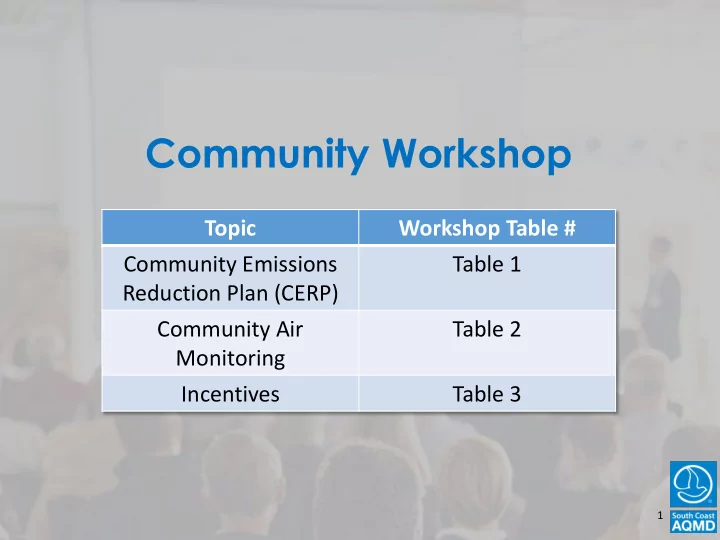
Topic Workshop Table # Community Emissions Reduction Plan (CERP) Table 1 Community Air Monitoring Table 2 Incentives Table 3
Community Workshop Topic Workshop Table # Community Emissions - - PowerPoint PPT Presentation
Community Workshop Topic Workshop Table # Community Emissions Table 1 Reduction Plan (CERP) Community Air Table 2 Monitoring Incentives Table 3 1 Community Air Initiatives San Bernardino, Muscoy Community Steering Committee Meeting #8
Community Workshop
1
Topic Workshop Table # Community Emissions Reduction Plan (CERP) Table 1 Community Air Monitoring Table 2 Incentives Table 3
Community Air Initiatives
San Bernardino, Muscoy Community Steering Committee Meeting #8
Thursday, July 18, 2019 San Bernardino, CA
2
Announcements
(TAG) meeting update
3
Please contact: Daniel Wong dwong@aqmd.gov (909) 396-3046
Meeting Objectives
Discussion Draft Community Emission Reduction Plan (CERP)
Actions
Monitoring
truck technologies
4
Community Reported Air Quality Concerns Community Boundary Discussion Air Quality Concern Prioritization Discussion Draft Community Emissions Reduction Plan Strategies and Proposed Actions for Reported Air Quality Concerns (Parts 1 and 2) 5 Draft Air Monitoring Plan Begin Monitoring, Committee Consideration Governing Board Hearing
August
July
June March February January November December
SBM Progress
September April
Stationary Source Committee
May
Draft of Air Monitoring Plan available for public input, submitted to CARB
6
California Air Resource Board Enforcement Actions
California Air Resources Board Enforcement Efforts in Your Community
July 2019 San Bernardino - Muscoy AB 617 Community Steering Committee Meeting
7
Off-Road Transport- ation Refrigera- tion Units Heavy-duty Vehicle Inspection P ro g ram Fuels
CARB Enforcement Programs
8
Drayage Vehicles Idling Trucks & Buses Statewide Trucks & Buses Cargo Handling
Equipment
Comm- ercial Harbor Craft Ocean Going Vessels
Shore Power
SmartWay Solid Waste Collection Vehicles Consumer Products
CARB Past Enforcement Actions in the San Bernardino - Muscoy Community
Over 1900 heavy-duty vehicles inspected from 2016 – 2018 Almost 90 heavy-duty vehicles cited/brought into compliance from 2016 -2018 Settlement Agreement (SA) Actions - Railroads CARB Supplemental Environmental Projects (SEPs) in SCAQMD
9
Map of Heavy – Duty Diesel Vehicle Enforcement Activities 2016 - 2018
10
San Bernardino - Muscoy Community
1066 total inspections at BNSF in 2018 5 emissions violations 27 non- emissions violations Highest mobile source priorities: Truck and bus traffic and idling, railyard, warehouses, Omnitrans
2016 – 2018
CARB Three-Year Enforcement History 2016 - 2018 for the San Bernardino - Muscoy Community
11
Year/Type Drayage HDVIP Idling Off- Road STB Smart Way TRU Total 2016 Field Inspections 552 3 16 9 1 581 2016 Non-compliant 32 2 1 8 43 2016 % Compliance 94% 33% 94% N/A 11% N/A 100% 93% 2017 Field Inspections 178 1 37 60 276 2017 Non-compliant 4 7 11 2018 % Compliance 98% N/A 100% 81% 100% N/A N/A 96% 2018 Field Inspections 769 246 43 4 4 1066 2018 Non-compliant 21 11 32 2018 % Compliance 97% 96% N/A N/A 100% 100% 100% 97% Total 2016 – 2018 Inspections 1499 249 17 37 112 4 5 1923 Total 2016 - 2018 Non-compliant 57 13 1 7 8 86 Total 2016 - 2018 % Compliance 96% 95% 94% 81% 93% 100% 100% 96%
HDVIP covers emissions control labels (ECL), smoking and tampering; see CARB Resource Slides for total listing
Enhanced Enforcement: Additional Fleet Audits (STEP – Streamlined Truck Enforcement Program)
In addition to roadside inspections we also conduct fleet audits. A total of 353 heavy-duty vehicles were audited.
Registration holds were placed on 198 of those vehicles and 17 were brought into compliance.
12
Between Jan 2018 to May 2019, 176 fleets were audited in SBM.
Upcoming and in Progress CARB Enforcement Actions in Your SBM Community
Focused roadside and idling enforcement in and around your community in June/July 2019 Settlement Agreement (SA) actions Supplemental Environmental Projects (SEPs) – Over $400k school air filters in SCAQMD
13
Focused enforcement in railyards for cargo handling equipment
14
Supplemental Environmental Projects (SEPs)
Improve public health Reduce pollution Increase environmental compliance Bring public awareness
SEPs are community- based projects funded from a portion of the penalties received during CARB settlement of enforcement actions.
Six funded SEPs in SCAQMD
15
Examples of Projects:
education internships
inform community about air pollution and resources
(e.g., air monitoring, truck traffic survey)
education programs and filtration systems
16
More SEPs are Possible in Your Community by Submitting a Project Proposal
Reduce direct/indirect air emissions
Relate to the violation Not benefit the violator Go above and beyond regulatory requirements If project meets requirements to right: Please submit a proposal by filling out a SEP Proposal Form (https://calepa.ca.gov /sep-proposal-form/)
*Higher consideration given to projects within, or that benefit, disadvantaged communities.*
Possible CARB Enforcement Actions for your Community
Truck Idling Sweeps Coordinated with SCAQMD Targeted Enforcement of our Regulations Outreach/MOUs/Educational Material Additional Consumer Products/Fuels Enforcement
17
Questions, Input, Brainstorming
What do you want to know more about? What efforts do you have input on? What creative enforcement/outreach solutions can we explore together to improve air quality here?
18
CARB Enforcement Contacts
19
CARB Community Outreach and Enforcement Section: COES@arb.ca.gov To report a violation to CARB: Call 1-800-END-SMOG (288-7664) or report online at: https://calepa.ca.gov/enforcement/complaints Visit the TruckStop for more detailed compliance info.: www.arb.ca.gov/truckstop or contact CARB’s diesel hotline at 866-6DIESEL (866-634-3735) or email: 8666diesel@arb.ca.gov.
California Air Resources Board
20
CARB Enforcement Role in San Bernardino - Muscoy CERP
21
Compile three-year enforcement and compliance history within the community corridor
Provide statistics CSC can use to establish compliance goals and identify enforcement-related strategies in the CERP
Create community-led joint district and CARB enforcement plan within the CERP Conduct enforcement actions within the CERP Monitor and reevaluate within five years
22
Protect public health from the harmful effects of air pollution and developing programs and actions to fight climate change. Implement and enforce local, state and federal air pollution control laws and regulations applicable to stationary sources.
CARB Responsibilities
SB 1: Registration Requirements
Starting in 2020, in order to register a truck or bus subject to CARB’s regulations with the California Department of Motor Vehicles (DMV), that vehicle needs to be in compliance according to the following schedule: Heavier Vehicles (>26,000 pounds gross vehicle weight) Vehicle Model Year DMV Begins Compliance Verification 2000 and older January 1, 2020 2001 – 2005 January 1, 2021 2006 – 2007 January 1, 2022 2008 – 2010 January 1, 2023
23
Lighter Vehicles (14,001 – 26,000 pounds gross vehicle weight) Vehicle Model Year DMV Begins Compliance Verification 2004 and older January 1, 2020 2005 – 2007 January 1, 2021 2008 – 2010 January 1, 2023
Truck and Bus Rule and Idling Restrictions Enforcement
weighing over 14,000 pounds must reduce exhaust emissions by upgrading to 2010 or newer engines by 2023. SB 1 will deny DMV registration to non-compliant vehicles. https://www.arb.ca.gov/msprog/onrdiesel/documents/tbfinalreg.pdf
regulatory truck and bus idling limits are not exceeded. Those limits are:
senior and child care facilities.
are low NOx emissions DPM filtered exhaust engines.
24
Ports and Railyards Enforcement Programs
We are in ports and railyards regularly enforcing these regulations:
port or intermodal facility are required to be certified to meet clean emission standards. https://www.arb.ca.gov/msprog/onroad/porttruck/finalregdrayage.pdf
located within 24 nautical miles of the California coast. The regulation includes requirements for new and in-use (existing) engines as well as monitoring, recordkeeping, and reporting requirements. https://ww2.arb.ca.gov/our-work/programs/commercial-harbor-craft
https://www.arb.ca.gov/ports/marinevess/ogv/ogvrules.htm
engines on container ships, passenger ships, and refrigerated-cargo ships while berthing at a California
handling equipment used at ports and intermodal rail yards. https://www.arb.ca.gov/ports/cargo/cargo.htm
25
Heavy-duty Vehicle Inspection Program (HDVIP)
We conduct regular roadside heavy-duty vehicle inspections for the following:
Reduction (SCR) all use a liquid urea solution as the reductant, known commonly as diesel exhaust fluid (DEF). This fluid is used in the SCR to reduce NOx emissions. https://www.arb.ca.gov/msprog/onrdiesel/regulation.htm
certify that engines meet clean emission standards. https://www.arb.ca.gov/enf/hdvip/bip/bip.htm
inspected for excessive smoke and tampering. https://www.arb.ca.gov/enf/hdvip/bip/finalreg.pdf
26
Other Vehicle Enforcement Programs
bulldozers, graders, and backhoes. These requirements are in place to help ensure that diesel soot filters are installed on off-road equipment. https://www.arb.ca.gov/msprog/ordiesel/documents/finalregorder-dec2011.pdf
dry van or refrigerated van trailers and the tractors that pull them on California highways to use certain equipment that the U.S. Environmental Protection Agency SmartWay program has verified or designated to meet their efficiency standards. https://arb.ca.gov/cc/hdghg/technologies.htm
labeling and clean air requirements. https://ww3.arb.ca.gov/diesel/tru/documents/fro_10-16-12.pdf
https://www.arb.ca.gov/msprog/swcv/swcv.htm
27
Other Enforcement Programs
fuels as well as storage of fuels from refineries through transportation to distribution at fuel service stations. https://www.arb.ca.gov/enf/fuels/fuels.htm
requirements for chemically formulated consumer products, fuel containers, and indoor air cleaning products that emit volatile organic compounds, toxic air contaminants and greenhouse gases, and include the following products: cleaning compounds; composite wood products, floor finishes; cosmetics; personal care products; home, lawn, and garden products; aerosol paints; and automotive specialty products. https://www.arb.ca.gov/consprod/consprod.htm; https://www.arb.ca.gov/enf/compwood.htm
28
Additional Enforcement Activities
We are working on compiling complete enforcement activity for the CERP from 2016 –
29
Fuels Consumer products Aftermarket parts
Fuels Enforcement Criteria
Fuels enforcement activity focuses on inspections of fuels and storage tanks
30
Diesel, gas and racing fuels inspections
Low Carbon Fuel Standard enforcement ensures reported emission reductions are real to promote a level playing for all fuel suppliers Fuels must meet formulation standards at production, transport, and dispensing facilities
Cargo tank vapor recovery
Ensures reduced VOC emissions from gasoline cargo tanks
Consumer Products Enforcement Criteria
Account for over ten percent of VOC emissions that contribute to smog formation statewide and can also emit carcinogenic toxic air contaminants.
31
Who needs to comply?
Manufacturers, marketers, distributors, wholesalers, retailers, and consumers
Specific examples of what is enforced
Enforces limits of formaldehyde, a carcinogenic toxic air contaminant, for composite wood products VOC emissions limits enforced for aerosol coatings Antiperspirants/deodorants must be free of toxic air contaminants and meet VOC emissions limits
Aftermarket Parts Enforcement Activities
We ensure new add-on and modified aftermarket parts demonstrate that they do not adversely affect emissions or emission control systems.
32
Examples of illegal aftermarket parts/tampering practices in California
Diesel particulate filter delete kits Engine control module tampering Selective catalytic reduction delete kits
Where enforced?
Part manufacturers, distributors, automobile dealers, general and automotive retailers, marine equipment stores, motorcycle shops, etc. at stores and online
Outcomes, remedies & penalties Opportunity to discuss Notify responsible party Evaluate information Identify and report a potential violation
33
Enforcement Process
All of these are Potential Violations
34
Reporting
35
Reporting potential violations of air quality requirements can provide important information for enforcement:
calepa.ca.gov/enforcement/complaints
36
Evaluating Information
Inspections: Site visits to learn about potential violations Determine compliance status and required actions Write inspection reports Issue compliance documents
37
Notice of Violation (NOV)/Citation
Process to notify responsible party for violations Based on excess emissions Listing facts, laws, and regulations Include CARB enforcement contact information
Opportunity to Discuss
38
Responsible party may provide further facts for consideration by CARB regarding NOV This discussion often becomes a negotiation between CARB and the responsible party
Outcomes/Remedies
39
Compliance
Appropriate pollution prevention actions Settlement Agreements / Case resolution
Penalties: Designed to remove any economic benefit from responsible party and deter future violations
Examples of Settlement Agreements in SCAQMD
40
Railyard drayage truck violations UP agreed to truck turn away program through 2020 and paid fines BSNF instituted truck compliance Rail Pass reporting system and helped fund a local SEP through fines
Refinery tank fuel sampling exceeded limits Paid fines Ocean- going vessels exceeded fuel sulfur emissions within coastal waters Paid fines
And many more… See CARB annual enforcement reports for statewide enforcement efforts https://www. arb.ca.gov/en f/reports/rep
41
Summary of SEPs in SCAQMD
Community teen paid internship conducting hands-on climate change teaching and research projects for visitors at the California Science Center
CFASE Survey of Freight Truck Transportation Corridors will gather data needed for community and government entities to develop future land use planning policy in Wilmington Kids Making Sense air monitoring/improving air quality grades 6 -12 education and empowerment program offered at local schools, including Dana Middle School in San Pedro to help students and community members improve air quality and reduce their exposure to air pollution School Air Filtration Systems SEP will install IQ Air filtration systems in schools throughout the South Coast Air Quality Management District in the second half of 2019
South LA Urban Greening and Community Forestry Project will plant and maintain 300 trees over five years in public parkways with the help of local volunteers raising awareness and restoring ecosystem functions Community Voices on Health and the Environment will hire three community members to write monthly articles identifying environmental health hazards and community member resources in Wilmington
Committee Presenters
Committee (CSC) members to present
Muscoy (SBM) community that could be part
Reduction Plan (CERP)
42
SBCTA Building the BRIDGE to Tomorrow’s Transportation
Otis Greer, Director of Legislative Affairs Josh Lee, Chief of Planning
Cities and Towns
Supervisorial Districts
Population
Who We Are
County Transportation Commission
Allocates and programs State and Federal funds for regional transportation projects throughout the county.
County Transportation Authority
Administers the voter-approved half-cent transportation sales tax and provides major transportation improvements within the county.
Congestion Management Agency
Implements the plan for addressing congestion and air quality related to transportation facilities throughout the county.
Service Authority for Freeway Emergencies
Manages the system of call boxes on major highways throughout the county.
Who We Are
Award Design/Build Contract Summer 2019 Demolition of the Bridge Early 2020 Anticipated Re-open to Traffic Mid to Late 2023
SB Express Lanes
Area Projects
INTERSTATE 215 WIDENING PROJECT $700 MILLION
Recently Completed Projects
SAN BERNARDINO TRANSIT CENTER $30 MILLION
Recently Completed Projects
METROLINK EXTENSION TO DOWNTOWN $140 MILLION
Recently Completed Projects
Next Generation of Transit
FROM
TO
Planning and Sustainability
Planning and Sustainability
Countywide Active Transportation Plan Countywide Comprehensive Sidewalk Inventory Points of Interest Pedestrian Plan Safe Routes School Plan (Countywide) Metrolink and RPRP Accessibility Plan and Program (First/Last Mile Plans) Grants, Project Delivery, Workshops, and Training Open Streets Events and Safety Events
Customer-Focused, Technology-Enabled Multi-Modal Action Plan Inland Empire Comprehensive Multimodal Corridor Plans Long Range Transit Plan Open Data Initiative Freeway Service Patrol (FSP)
Planning and Sustainability
RTP/SCS Socio-Economic Data Local Input Process SBTAM Modelling Efforts with Countywide Growth Forecast Assist with RHNA, AHSC, and Housing Elements
Advanced Regional Rail Integrated Vision – East (ARRIVE) Study with TOD Strategies Countywide VMT Reduction Study (SB 743) Complete Streets Strategies Public and Transportation Infrastructure Art
Planning and Sustainability
Regional Greenhouse Gas Reduction Plan and EIR (AB 32/SB 32) Zero-Emission Vehicle Readiness and Implementation Plan San Bernardino Regional Energy Partnership Regional Energy Network Partnerships on Clean Freight IE Commuter Rideshare and Vanpool Program Resilient IE – Regional Climate Adaptation Plan (Phase I & II)
Planning and Sustainability
Healthy Communities Program Coordination Health and Built-Environment Implementation Toolkit Safe Routes to School Program Summer Meals Program Coordination Community Transformation Plan Disadvantaged Communities and Equity Toolkit (SB 1000) Healthy Development Checklist
Regional Conservation Investment Strategy (RCIS) – Alternative Conservation Plan RCIS – Climate Adaptation Strategies on Focal Species
www.goSBCTA.com 909.884.8276 @goSBCTA
Discussion Draft of the Community Emissions Reductions Plan (CERP) Comments Received
62
Discussion Draft CERP Comments Received and Comment Process
63
http://onbase- pub.aqmd.gov/publicaccess/DatasourceTemplate Parameter.aspx?MyQueryID=257&OBKey__1409 _1=SBM
Committee
2019
Stationary Source Committee
Summary of Comment Response
Identify an emissions baseline and establish emission reduction targets in the CERP The Draft CERP will be available on July 19, 2019, including:
AB 617 funding levels), and
CERP should go above and beyond what is already required In anticipation of AB 617, staff prioritized specific rule development projects to address potential air quality concerns to ensure earlier implementation dates. CERP actions focus on prioritizing these Year 1 communities (e.g., targeted outreach, focused enforcement) Support ideas, goals, and actions
jurisdiction (e.g., land use agencies) that advocate for reducing air pollution The Discussion Draft CERP includes collaborations with land use agencies and other community based
community
Examples of General Comments Received for Discussion Draft CERP
64
Additional comments were received, and staff are working to address them in Draft CERP
Summary of Comment Response
Perform a community health assessment to measure the existing health standards baseline in
quantifiable goals and targets Our objective is to achieve air quality improvements to benefit public health. Staff is interested in partnering with health agencies and
actions to improve public health (e.g., asthma interventions). These actions will have greater direct benefits to public health than an assessment, which is costly and may not be able to show short-term health benefits. Staff will work to identify funding resources and partners for public health interventions that have a nexus to air quality improvements (e.g., Breathmobiles).
Examples of General Comments Received for Discussion Draft CERP (continued)
65
Additional comments were received, and staff are working to address them in Draft CERP Examples of asthma intervention programs (e.g., Akron Children’s Hospital, Regional Asthma Management & Prevention, and American Lung Association):
Summary of Comment Response
Discuss funds allocated to date, how investments will achieve quantifiable results and community benefits, and how groups can support sustained funding
South Coast AQMD staff is:
communities
Provide an effectiveness analysis for enforcement and
Coast AQMD staff updates at future CSC meetings on enforcement activities (e.g., truck idling)
County may also provide enforcement updates to the CSC Continue to support the accelerated adoption and prioritization of zero-emission technology and a robust, clean electric infrastructure The Draft CERP will include provisions that prioritize zero- emission technologies based on certain criteria such as availability, cost, etc. Incentive dollars can be used toward infrastructure projects
Examples of General Comments Received for Discussion Draft CERP (continued)
66
Additional comments were received, and staff are working to address them in Draft CERP
Summary of Comment Response
communities to direct existing resources more effectively
programs to accelerate implementation of cleaner vehicles
Automated License Plate Reader (ALPR) for targeted
Action 3) Approve and implement the Facility Based Measures and Indirect Source Rules (ISR) for warehouses and railyards
based mobile source measures for warehouses and
continue to reach out for CSC input
CSC's into the rule concepts brought to the Board for its decision. For example, staff will look to ensure that any rule concept will include measures to emphasize localized emission reductions around these facilities.
Examples of Comments Received for Chapter 5 of the Discussion Draft CERP
67
Additional comments were received, and staff are working to address them in Draft CERP
Payam Pakbin, PhD
Program Supervisor
Community Air Monitoring Updates
Fixed Monitoring Mobile Monitoring Flight-Based Measurements Community Air Monitoring Website Community Air Monitoring Data Display
Fixed Monitoring
Purpose: to provide information about general air quality conditions in this community and track progress
Continuous, real-time monitors:
(BC), ultrafine particles (UFP) 24 hr time-integrated samples (1 in 3 days):
24 hr time-integrated samples (1 in 6 days):
24 hr time-integrated samples (1 in 12 days):
(VOCs)
Baseline
San Bernardino San Bernardino Station
Fixed Monitoring
Source Monitoring
Purpose: to identify activities that may cause high levels of air pollution and to measure levels of pollutants near these sources
cement have the potential to emit PM containing hexavalent chromium from
fugitive dust
facilities and nearby communities to identify monitoring locations
𝜺 𝜹
Mobile Monitoring
“hotspots”
identify specific source(s) of air pollution
composition and variability of known emissions sources
robust monitoring, investigation activities, and enforcement actions
Mobile Monitoring: Platform 1 Example
Target Air Quality Priority:
Purpose:
corridors and idling spots
strategies Target Pollutants: Diesel exhaust NO2, CO, O3 Particulate Matter
Preliminary Results
Mobile Monitoring: Platform 2 Example
Target Pollutants: VOCs , particulate matter mass and composition Target Air Quality Priority:
Purpose:
and around OmniTrans Bus Yard with highly sensitive monitors
available soon
Flight-Based Air Toxics Measurements
Purpose:
sources
Target Pollutants: VOCs and other gaseous air pollutants
Community Air Monitoring Website
http://www.aqmd.gov/nav/about/initiatives/community-efforts/environmental-justice/ab617-134/ab-617-community-air-monitoring
Access to the Data Display tool Access to community pages for data summaries and reports
Data Display and Access
24-hr time- integrated data are available several days to weeks after sampling and can be accessed through “Historical Search” button All continuous air monitoring data are displayed in near real-time
Access to Data Reports and Summaries: Mobile monitoring results, special projects
http://xappprod.aqmd.gov/AB617CommunityAirMonitoring/Home/Index/SBM
New functions will be added to the Data Display tool over time
Would like CSC feedback
ppakbin@aqmd.gov
Questions & Discussion
Tru ruck Technologies: : Develop, , Demonstrate & Commercialize
Community Air Initiatives Community Steering Committee Meeting #8 July 18, 2019 Joseph Impullitti Technology Demonstration Manager South Coast AQMD
Technology Advancement Office
and Commercialize Clean Air Technologies
>100 on-going projects Contact: Joseph Impullitti (jimpullitti@aqmd.gov)
Clean Fuels Program
Vehicles registrations ($~13 million/year)
(~$400,000/year)
develop, demonstrate, and deploy (RDD&D) clean technologies
Vehicle Technologies Readiness & Challenges
Challenges
20X X Research Basic Research Lab Bench Proof-of- Concept Development 1st Gen Demos System/ Component Integration Proof-of- Technology Demonstration 2nd/3rd Gen Demos Durability Acceptance Proof-of- Product Deployment Pre- Commercial Demos Market Readiness Proof-of
Commercializ ation
Commercialization
Technology Readiness
Incentives
Regulation Technology Readiness Level 0 3 8 9
Commercial Availability Assessment – Ports CAAP
Research Basic Research Lab Bench Proof-of- Concept Development 1st Gen Demos System/ Component Integration Proof-of- Technology Demonstration 2nd/3rd Gen Demos Durability Acceptance Proof-of- Product Deployment Pre- Commercial Demos Market Readiness Proof-of
Commercializ ation
Commercialization
CNG Low Nox Engine Technology
Incentives
Regulation Technology Readiness Level 0 3 8 9
Key CNG Proje jects
In Production
2018 Department of Energy Solicitation through NREL
duty truck
In Incentives: Near Zero Engin ines/Vehic icles
En Encouragin ing the use use of
le Natu tural Gas Gas CWI L9N CWI ISX12N Agility’s 366NG 587 Vehicles
$15.2 MM 175 Vehicles
$32.4 MM 383 Vehicles $50 MM
Research Basic Research Lab Bench Proof-of- Concept Development 1st Gen Demos System/ Component Integration Proof-of- Technology Demonstration 2nd/3rd Gen Demos Durability Acceptance Proof-of- Product Deployment Pre- Commercial Demos Market Readiness Proof-of
Commercializ ation
Commercialization
Fuel Cell Electric Truck Technology
Incentives
Regulation Technology Readiness Level 0 3 8 9
Zero Emission Cargo Transport Fuel Cell Drayage Trucks Project
6 Fuel Cell & 1 CNG Hybrid
integration are complete – 4 trucks currently in demonstration
used
$10M from SCAQMD and Funding Partners, Total: $20M
12 Research Basic Research Lab Bench Proof-of- Concept Development 1st Gen Demos System/ Component Integration Proof-of- Technology Demonstration 2nd/3rd Gen Demos Durability Acceptance Proof-of- Product Deployment Pre- Commercial Demos Market Readiness Proof-of
Commercializ ation
Commercialization
Battery Electric & Hybrid Truck Technology
Incentives
Regulation Technology Readiness Level 0 3 8 9
Zero Emission Drayage Truck Project
near-zero emission drayage trucks
$10.4M State Air Districts, $6M In Kind – Total of $40.1M
Battery Electric Trucks and EV Infrastructure Project
the largest truck OEM in North America
heavy-duty Freightliner trucks
80,000 lbs)
infrastructure for heavy-duty trucks:
DTNA $15.7M – Total = $31.4M
Page 92 Volvo LIGHTS
Heavy Transport Solution)
integrating zero-emission equipment, renewable solar energy, and battery storage technologies into the freight mobility network
demo and 15 commercial & pre- commercial trucks
from SCAQMD $41.6M from Volvo & Partners – Total: $90.4M
Summary
commercial deployment in 2021-22 timeframe
Achieves 90% NOx and significant GHG reductions
in 2021
(http://learn.lightsproject.com/updates )
Likely agenda items for CSC Meeting #8:
Next steps and important reminders
Future meeting dates and locations:
San Bernardino Valley College
95
Is the CSC okay with these topics? Any additional topics?
Next steps and important reminders
96
Important Dates and Deadlines:
September 6, 2019
Upcoming meeting of interest:
Headquarters
https://www.aqmd.gov/home/news-events/webcast
Roster changes:
Vidaurre as a CCAEJ primary member
Thank you for the hard work!
More information on AB 617: www.aqmd.gov/AB617 Email: AB617@aqmd.gov Follow us @SouthCoastAQMD
97