The Bellows Theorem (Introduction) Giovanni Viglietta JAIST June - - PowerPoint PPT Presentation

the bellows theorem introduction
SMART_READER_LITE
LIVE PREVIEW

The Bellows Theorem (Introduction) Giovanni Viglietta JAIST June - - PowerPoint PPT Presentation

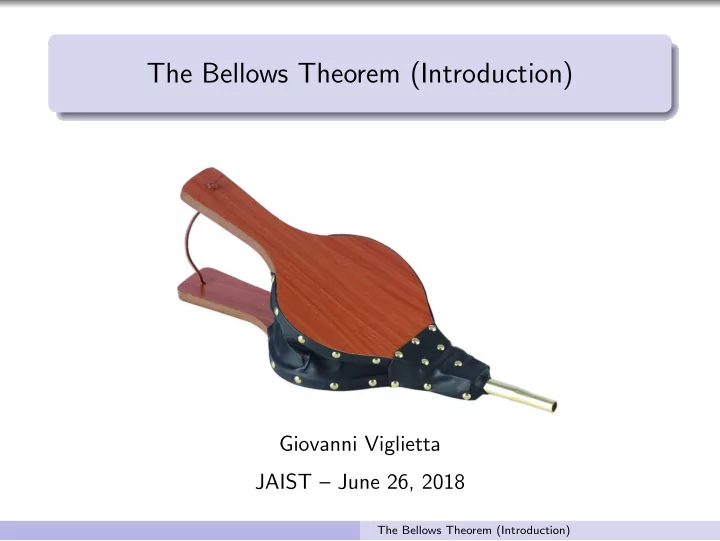
The Bellows Theorem (Introduction) Giovanni Viglietta JAIST June 26, 2018 The Bellows Theorem (Introduction) Real-life bellows The Bellows Theorem (Introduction) Real-life bellows Observation: All of them have elasticity or curved creases.


slide-1
SLIDE 1

The Bellows Theorem (Introduction)

Giovanni Viglietta JAIST – June 26, 2018

The Bellows Theorem (Introduction)
slide-2
SLIDE 2

Real-life bellows

The Bellows Theorem (Introduction)

slide-3
SLIDE 3

Real-life bellows

Observation: All of them have elasticity or curved creases. Why?

The Bellows Theorem (Introduction)

slide-4
SLIDE 4

Definition of bellows

Wiktionary: “A bellows is a container which is deformable in such a way as to alter its volume, which has an outlet where one wishes to blow air.”

The Bellows Theorem (Introduction)

slide-5
SLIDE 5

Definition of bellows

Wiktionary: “A bellows is a container which is deformable in such a way as to alter its volume, which has an outlet where one wishes to blow air.” Problem: Is it possible to construct a “geometric bellows” in some mathematical sense?

The Bellows Theorem (Introduction)

slide-6
SLIDE 6

Bellows in Flatland

/A triangular linkage (rigid bars and joints) cannot be a bellows./

The Bellows Theorem (Introduction)

slide-7
SLIDE 7

Bellows in Flatland a b c

16

4

c −

4

b −

4

a −

2

a

2

c +

2

c

2

b +2

2

b

2

a 2

=

2

A

/Heron’s formula gives its area as a function of the edge lengths./

The Bellows Theorem (Introduction)

slide-8
SLIDE 8

Bellows in Flatland

/However, all other closed polygonal linkages are flexible./

The Bellows Theorem (Introduction)

slide-9
SLIDE 9

Bellows in Flatland

/However, all other closed polygonal linkages are flexible./

The Bellows Theorem (Introduction)

slide-10
SLIDE 10

Bellows in Flatland

/However, all other closed polygonal linkages are flexible./

The Bellows Theorem (Introduction)

slide-11
SLIDE 11

Bellows in Flatland

/However, all other closed polygonal linkages are flexible./

The Bellows Theorem (Introduction)

slide-12
SLIDE 12

Bellows in Flatland

/However, all other closed polygonal linkages are flexible./

The Bellows Theorem (Introduction)

slide-13
SLIDE 13

Bellows in Flatland

/However, all other closed polygonal linkages are flexible./

The Bellows Theorem (Introduction)

slide-14
SLIDE 14

Bellows in Flatland

/However, all other closed polygonal linkages are flexible./

The Bellows Theorem (Introduction)

slide-15
SLIDE 15

Bellows in Flatland

/However, all other closed polygonal linkages are flexible./

The Bellows Theorem (Introduction)

slide-16
SLIDE 16

Bellows in Flatland

/However, all other closed polygonal linkages are flexible./

The Bellows Theorem (Introduction)

slide-17
SLIDE 17

Bellows in Flatland

/If the linkage has a small hole, it can “breathe” air as it flexes./

The Bellows Theorem (Introduction)

slide-18
SLIDE 18

Bellows in Flatland

/If the linkage has a small hole, it can “breathe” air as it flexes./

The Bellows Theorem (Introduction)

slide-19
SLIDE 19

Bellows in Flatland

/If the linkage has a small hole, it can “breathe” air as it flexes./

The Bellows Theorem (Introduction)

slide-20
SLIDE 20

Bellows in Flatland

/If the linkage has a small hole, it can “breathe” air as it flexes./

The Bellows Theorem (Introduction)

slide-21
SLIDE 21

Bellows in Flatland

/If the linkage has a small hole, it can “breathe” air as it flexes./

The Bellows Theorem (Introduction)

slide-22
SLIDE 22

Bellows in Flatland

/If the linkage has a small hole, it can “breathe” air as it flexes./

The Bellows Theorem (Introduction)

slide-23
SLIDE 23

Bellows in Flatland

/If the linkage has a small hole, it can “breathe” air as it flexes./

The Bellows Theorem (Introduction)

slide-24
SLIDE 24

Bellows in Flatland

/If the linkage has a small hole, it can “breathe” air as it flexes./

The Bellows Theorem (Introduction)

slide-25
SLIDE 25

Bellows in Flatland

/If the linkage has a small hole, it can “breathe” air as it flexes./

The Bellows Theorem (Introduction)

slide-26
SLIDE 26

Polyhedral model

To define a 3D model, let us generalize 2D linkages. Instead of rigid bars, we have rigid polygons. Instead of joints at vertices, we have hinges at edges.

The Bellows Theorem (Introduction)

slide-27
SLIDE 27

Polyhedral model

To define a 3D model, let us generalize 2D linkages. Instead of rigid bars, we have rigid polygons. Instead of joints at vertices, we have hinges at edges. Problem: Can such a polyhedron be a bellows? Can it even flex?

The Bellows Theorem (Introduction)

slide-28
SLIDE 28

Euclid’s “definition” of equal polyhedra

Euclid’s Elements, Book XI, Definition 10: Literal translation: Equal and similar solid figures are those contained by similar planes equal in multitude and in magnitude. Modern interpretation: Two polyhedra are equal if they have the same combinatorial structure and equal corresponding faces.

The Bellows Theorem (Introduction)

slide-29
SLIDE 29

Euclid’s “definition” of equal polyhedra

Euclid’s Elements, Book XI, Definition 10: Literal translation: Equal and similar solid figures are those contained by similar planes equal in multitude and in magnitude. Modern interpretation: Two polyhedra are equal if they have the same combinatorial structure and equal corresponding faces. = ⇒ Euclid seems to disallow the existence of flexible polyhedra!

The Bellows Theorem (Introduction)

slide-30
SLIDE 30

Simson’s critique to Euclid

Simson, 1756: Euclid’s statement cannot be a definition, but a theorem that ought to be proved. Also, the statement is not universally true:

The Bellows Theorem (Introduction)

slide-31
SLIDE 31

Simson’s critique to Euclid

Simson, 1756: Euclid’s statement cannot be a definition, but a theorem that ought to be proved. Also, the statement is not universally true: Heath, 1908: To be fair, Euclid only applies his definition to prove equality of convex polyhedra with trihedral vertices. For these polyhedra, Euclid’s statement is obviously true, because a trihedral vertex is rigid.

The Bellows Theorem (Introduction)

slide-32
SLIDE 32

Convex polyhedra are rigid

Cauchy’s arm lemma:

1

> α

2

> α

3

> α

4

> α > d d

1

α

2

α

3

α

4

α

Theorem (Legendre-Cauchy, 1813) Two convex polyhedra are equal if they have the same combinatorial structure and equal corresponding faces.

The Bellows Theorem (Introduction)

slide-33
SLIDE 33

Convex polyhedra are rigid

Cauchy’s arm lemma:

1

> α

2

> α

3

> α

4

> α > d d

1

α

2

α

3

α

4

α

Theorem (Legendre-Cauchy, 1813) Two convex polyhedra are equal if they have the same combinatorial structure and equal corresponding faces. Corollary Convex polyhedra are rigid. = ⇒ Polyhedral bellows must be non-convex.

The Bellows Theorem (Introduction)

slide-34
SLIDE 34

Existence of flexible polyhedra

Theorem (Bricard, 1897) There exist self-intersecting flexible octahedra.

The Bellows Theorem (Introduction)

slide-35
SLIDE 35

Existence of flexible polyhedra

Theorem (Bricard, 1897) There exist self-intersecting flexible octahedra.

The Bellows Theorem (Introduction)

slide-36
SLIDE 36

Existence of flexible polyhedra

Theorem (Bricard, 1897) There exist self-intersecting flexible octahedra.

The Bellows Theorem (Introduction)

slide-37
SLIDE 37

Existence of flexible polyhedra

Theorem (Bricard, 1897) There exist self-intersecting flexible octahedra.

The Bellows Theorem (Introduction)

slide-38
SLIDE 38

Existence of flexible polyhedra

Theorem (Bricard, 1897) There exist self-intersecting flexible octahedra.

The Bellows Theorem (Introduction)

slide-39
SLIDE 39

Existence of flexible polyhedra

Theorem (Bricard, 1897) There exist self-intersecting flexible octahedra. Theorem (Gluck, 1975) Almost all polyhedra of genus 0 are rigid.

The Bellows Theorem (Introduction)

slide-40
SLIDE 40

Existence of flexible polyhedra

Theorem (Bricard, 1897) There exist self-intersecting flexible octahedra. Theorem (Gluck, 1975) Almost all polyhedra of genus 0 are rigid. Theorem (Connelly, 1977) There exist (non-self-intersecting) flexible polyhedra.

The Bellows Theorem (Introduction)

slide-41
SLIDE 41

Steffen’s flexible polyhedron

Theorem (Steffen, 1979) There is a flexible polyhedron with 9 vertices (smallest possible).

The Bellows Theorem (Introduction)

slide-42
SLIDE 42

Steffen’s flexible polyhedron

Theorem (Steffen, 1979) There is a flexible polyhedron with 9 vertices (smallest possible).

The Bellows Theorem (Introduction)

slide-43
SLIDE 43

Steffen’s flexible polyhedron

Theorem (Steffen, 1979) There is a flexible polyhedron with 9 vertices (smallest possible).

The Bellows Theorem (Introduction)

slide-44
SLIDE 44

Steffen’s flexible polyhedron

Theorem (Steffen, 1979) There is a flexible polyhedron with 9 vertices (smallest possible).

The Bellows Theorem (Introduction)

slide-45
SLIDE 45

Steffen’s flexible polyhedron

Theorem (Steffen, 1979) There is a flexible polyhedron with 9 vertices (smallest possible).

The Bellows Theorem (Introduction)

slide-46
SLIDE 46

Steffen’s flexible polyhedron

Theorem (Steffen, 1979) There is a flexible polyhedron with 9 vertices (smallest possible).

The Bellows Theorem (Introduction)

slide-47
SLIDE 47

Steffen’s flexible polyhedron

Theorem (Steffen, 1979) There is a flexible polyhedron with 9 vertices (smallest possible).

The Bellows Theorem (Introduction)

slide-48
SLIDE 48

Steffen’s flexible polyhedron

Theorem (Steffen, 1979) There is a flexible polyhedron with 9 vertices (smallest possible).

The Bellows Theorem (Introduction)

slide-49
SLIDE 49

Still no polyhedral bellows!

Observation The (generalized) volume of all these flexible polyhedra remains constant throughout the flexing! In other words, althought these polyhedra are not rigid, none of them can blow air.

The Bellows Theorem (Introduction)

slide-50
SLIDE 50

Still no polyhedral bellows!

Observation The (generalized) volume of all these flexible polyhedra remains constant throughout the flexing! In other words, althought these polyhedra are not rigid, none of them can blow air. Several people made the conjecture that this is not a coincidence, and Connelly coined a name for it: Bellows conjecture (Connelly, 1978) The volume of a polyhedron is constant throughout any flexing. In other words, there are no polyhedral bellows.

The Bellows Theorem (Introduction)

slide-51
SLIDE 51

Bellows theorem

Theorem (Sabitov, 1996) Given a polyhedron (of any genus), its volume V satisfies V N + aN−1(ℓ)V N−1 + · · · + a1(ℓ)V + a0(ℓ) = 0, where the coefficients ai(ℓ) only depend on the combinatorial structure of the polyhedron and on the lengths of its edges, ℓ.

The Bellows Theorem (Introduction)

slide-52
SLIDE 52

Bellows theorem

Theorem (Sabitov, 1996) Given a polyhedron (of any genus), its volume V satisfies V N + aN−1(ℓ)V N−1 + · · · + a1(ℓ)V + a0(ℓ) = 0, where the coefficients ai(ℓ) only depend on the combinatorial structure of the polyhedron and on the lengths of its edges, ℓ. The volume is a root of a polynomial that remains fixed as the polyhedron flexes, hence it can only take finitely many values. Corollary (Bellows theorem) The volume of a polyhedron is constant throughout any flexing. = ⇒ There are no polyhedral bellows (of any genus).

The Bellows Theorem (Introduction)

slide-53
SLIDE 53

Bellows theorem

Volume

) V ( P

Any polynomial has a finite number of roots: at most as many as its degree.

The Bellows Theorem (Introduction)

slide-54
SLIDE 54

Bellows theorem

Volume

) V ( P

So, the volume of a polyhedron with assigned combinatorial structure and edge lengths can only take finitely many values.

The Bellows Theorem (Introduction)

slide-55
SLIDE 55

Bellows theorem

Volume

) V ( P

So, the volume of a polyhedron with assigned combinatorial structure and edge lengths can only take finitely many values.

The Bellows Theorem (Introduction)

slide-56
SLIDE 56

Bellows theorem

Volume

) V ( P

But the volume changes continuously as the polyhedron flexes, thus it cannot jump from a root to another.

The Bellows Theorem (Introduction)

slide-57
SLIDE 57

Bellows theorem

Volume

) V ( P

But the volume changes continuously as the polyhedron flexes, thus it cannot jump from a root to another.

The Bellows Theorem (Introduction)

slide-58
SLIDE 58

Example: tetrahedra

There is an analogue of Heron’s formula for tetrahedra: Theorem (Piero della Francesca, 15th century) The volume V of a tetrahedron with edges ℓ1, · · · , ℓ6 satisfies V 2 = 1 144

  • ℓ2

1ℓ2 5(ℓ2 2+ℓ2 3+ℓ2 4+ℓ2 6−ℓ2 1−ℓ2 5)+ℓ2 2ℓ2 6(ℓ2 1+ℓ2 3+ℓ2 4+ℓ2 5−ℓ2 2−ℓ2 6)

+ℓ2

3ℓ2 4(ℓ2 1+ℓ2 2+ℓ2 5+ℓ2 6−ℓ2 3−ℓ2 4)−ℓ2 1ℓ2 2ℓ2 3−ℓ2 2ℓ2 4ℓ2 5−ℓ2 1ℓ2 4ℓ2 6−ℓ2 3ℓ2 5ℓ2 6

  • 1

2

3

4

5

6

The Bellows Theorem (Introduction)

slide-59
SLIDE 59

Example: tetrahedra

There is an analogue of Heron’s formula for tetrahedra: Theorem (Piero della Francesca, 15th century) The volume V of a tetrahedron with edges ℓ1, · · · , ℓ6 satisfies V 2 = 1 144

  • ℓ2

1ℓ2 5(ℓ2 2+ℓ2 3+ℓ2 4+ℓ2 6−ℓ2 1−ℓ2 5)+ℓ2 2ℓ2 6(ℓ2 1+ℓ2 3+ℓ2 4+ℓ2 5−ℓ2 2−ℓ2 6)

+ℓ2

3ℓ2 4(ℓ2 1+ℓ2 2+ℓ2 5+ℓ2 6−ℓ2 3−ℓ2 4)−ℓ2 1ℓ2 2ℓ2 3−ℓ2 2ℓ2 4ℓ2 5−ℓ2 1ℓ2 4ℓ2 6−ℓ2 3ℓ2 5ℓ2 6

  • 1

2

3

4

5

6

The polynomial equation has the form P(V ) = V 2 + a0(ℓ) = 0.

The Bellows Theorem (Introduction)

slide-60
SLIDE 60

Generalizations and extensions

Theorem (Gaifullin, 2012) The bellows theorem generalizes to any dimension > 3.

The Bellows Theorem (Introduction)

slide-61
SLIDE 61

Generalizations and extensions

Theorem (Gaifullin, 2012) The bellows theorem generalizes to any dimension > 3. Two polyhedra are scissors-congruent if one can be cut into finitely many polyhedra that can be rearranged to form the other. Strong bellows conjecture (Connelly, 1979) Any polyhedron remains scissors-congruent throughout any flexing.

The Bellows Theorem (Introduction)

slide-62
SLIDE 62

Generalizations and extensions

Theorem (Gaifullin, 2012) The bellows theorem generalizes to any dimension > 3. Two polyhedra are scissors-congruent if one can be cut into finitely many polyhedra that can be rearranged to form the other. Strong bellows conjecture (Connelly, 1979) Any polyhedron remains scissors-congruent throughout any flexing. Theorem (Alexandrov-Connelly, 2009) The strong bellows conjectures is false.

The Bellows Theorem (Introduction)

slide-63
SLIDE 63

Generalizations and extensions

Theorem (Gaifullin, 2012) The bellows theorem generalizes to any dimension > 3. Two polyhedra are scissors-congruent if one can be cut into finitely many polyhedra that can be rearranged to form the other. Strong bellows conjecture (Connelly, 1979) Any polyhedron remains scissors-congruent throughout any flexing. Theorem (Alexandrov-Connelly, 2009) The strong bellows conjectures is false. Wrong? Theorem (Gaifullin-Ignashchenko, under review) A polyhedron preserves its Dehn invariant throughout any flexing. Hence the strong bellows conjecture is true. (cf. Sydler, 1965)

The Bellows Theorem (Introduction)

slide-64
SLIDE 64

Next seminar: proving the bellows theorem

Classification of closed surfaces Surgery of polyhedra Cayley-Menger determinant Bellows theorem Sylvester matrix Elimination theory Sum of algebraic is algebraic Kronecker product Frobenius companion matrix Zorn’s lemma Classification of closed surfaces Surgery of polyhedra Bellows theorem Existence of maximal ideals Theory of places

Geometric approach Algebraic approach

Cayley-Menger determinant Sum of algebraic is algebraic Kronecker product Frobenius companion matrix The Bellows Theorem (Introduction)

slide-65
SLIDE 65

Next seminar: proving the bellows theorem

Classification of closed surfaces Surgery of polyhedra Cayley-Menger determinant Bellows theorem Sylvester matrix Elimination theory Sum of algebraic is algebraic Kronecker product Frobenius companion matrix Zorn’s lemma Classification of closed surfaces Surgery of polyhedra Bellows theorem Existence of maximal ideals Theory of places

Geometric approach Algebraic approach

Cayley-Menger determinant Sum of algebraic is algebraic Kronecker product Frobenius companion matrix

Pros: Volume polynomial explicitly constructed Self-contained proof (given basic linear algebra and topology) Cons: Some cumbersome computations Pros: Cons: Non-contructive proof Heavier on theory (valuation rings, extension of homomorphisms, ...) Elegant proof

The Bellows Theorem (Introduction)

slide-66
SLIDE 66

Next seminar: proving the bellows theorem

Classification of closed surfaces Surgery of polyhedra Cayley-Menger determinant Bellows theorem Sylvester matrix Elimination theory Sum of algebraic is algebraic Kronecker product Frobenius companion matrix Zorn’s lemma Classification of closed surfaces Surgery of polyhedra Bellows theorem Existence of maximal ideals Theory of places

Geometric approach Algebraic approach

Cayley-Menger determinant Sum of algebraic is algebraic Kronecker product Frobenius companion matrix

Pros: Volume polynomial explicitly constructed Self-contained proof (given basic linear algebra and topology) Cons: Some cumbersome computations Pros: Cons: Non-contructive proof Heavier on theory (valuation rings, extension of homomorphisms, ...) Elegant proof

The Bellows Theorem (Introduction)

slide-67
SLIDE 67

Next seminar: prerequisites

Determinant of a square matrix: Basic properties, e.g., det(AB) = det(A) det(B) How to compute it, especially by Laplace expansion Usage in linear algebra: A is invertible iff det(A) = 0 Geometric interpretation: scaling factor of the linear transformation described by the matrix Eigenvalues of a square matrix: Definition and basic properties Relationship with the characteristic polynomial of the matrix Closed orientable surfaces: Geometric intuition of genus: number of holes Topological intuition of surgery: what happens when a circular cut is made on a closed orientable surface

The Bellows Theorem (Introduction)