
SLIDE 1
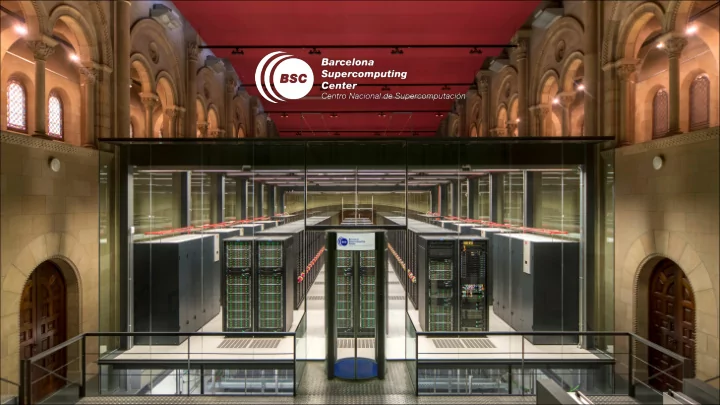
The Barcelona Supercomputing Center Sergi Girona Operations - - PowerPoint PPT Presentation
The Barcelona Supercomputing Center Sergi Girona Operations Director 04/12/2019 e-IRG workshop Dec 2019 Barcelona Supercomputing Center Centro Nacional de Supercomputacin BSC-CNS objectives Supercomputing services R&D in Computer,
04/12/2019 e-IRG workshop Dec 2019
10% Catalan Government 30% Spanish Government 60%
BSC-CNS is a consortium that includes
BSC-CNS objectives
Supercomputing services to Spanish and EU researchers R&D in Computer, Life, Earth and Engineering Sciences PhD programme, technology transfer, public engagement
2018 executed budget June 30, 2019
65 114 164 229 279 302 310 321 358 433 447 475 529 605
200 400 600 800 2005 2006 2007 2008 2009 2010 2011 2012 2013 2014 2015 2016 2017 2018
BSC Staff 2005 - 2018
BSC Staff
To influence the way machines are built, programmed and used: programming models, performance tools, Big Data, Artificial Intelligence , computer architecture, energy efficiency To develop and implement global and regional state-of-the-art models for short- term air quality forecast and long-term climate applications To understand living organisms by means of theoretical and computational methods (molecular modeling, genomics, proteomics) To develop scientific and engineering software to efficiently exploit super-computing capabilities (biomedical, geophysics, atmospheric, energy, social and economic simulations)
Total peak performance: 13,7 Pflops
Ge General P Purpose Cl Cluster: 11. 11.15 15 Pflops (1 (1.07.2017) CT CTE1-P9 P9+Vol
1. 1.57 57 Pflops (1 (1.03.2018) CT CTE2-Ar Arm V8: 0. 0.65 65 Pf Pflops (12. 12.2019 2019) CT CTE3-AM AMD Ro Rome+MI500: : 0. 0.52 52 Pflops (1 (12.2 .2019)
MareNostrum 1
2004 – 42,3 Tflops
1st Europe / 4th World New technologies
MareNostrum 2
2006 – 94,2 Tflops
1st Europe / 5th World New technologies
MareNostrum 3
2012 – 1,1 Pflops
12th Europe / 36th World
MareNostrum 4
2017 – 11,1 Pflops 2nd Europe / 13th World New technologies
Access: prace-ri.eu Access: bsc.es/res-intranet
Ho Hosting ng Cons nsortium: um: 200 Petaflops peak performance (200 x 1015) Experimental platform to create supercomputing technologies “made in Europe”
Spain Portugal Turkey Croatia
223 M€ of investment
The acquisition and operation of the EuroHPC supercomputer is funded jointly by the EuroHPC Joint Undertaking, through the European Union’s Connecting Europe Facility and the Horizon 2020 research and innovation programme, as well as the Participating States Spain, Portugal, Croatia, and Turkey
will explore hardware/software co-designs for Exascale Supercomputers and other hardware targets, based
1. An evaluation platform of pre-silicon IP and ideas, at speed and scale 2. A software development and experimentation platform to enable software readiness for new hardware.
software simulation.
RISC-V-based IP development, especially hardware/software co-design.
European IP.
enable application development and porting.
HPC/DA Applications HPC/DA Runtimes Virtualization OS FPGA Emulated HW HW/SW Tools: LLVM, GDB, Profiling, Performance Monitors FPGA Shell:
External Interfaces: I/O, DRAM, etc.
Emulation Region:
Cores, Accelerators, & Caches
HBM HBM HBM
Emulation Region
FPGA Shell
LINUX
Acquisition [€] Operation[€] TOTAL TCO [€] MareNostrum 5 - overall budget 151.410.000 55.806.000 207.216.000 EuroHPC - contribution 75.705.000 25.700.000 101.405.000
Login Nodes
EuroHPC User EuroHPC Sysadmin
Head Nodes Virtual Server VM VM Service Nodes
BSC LAN
Fabric
Managers
Scheduling Monitoring
Geant
General Purpose Compute partition
Accelerated Compute partition
Ethernet / Infiniband 200 PB Storage
Public Services Administrative Services
To Backup and Archive Storage
EuroHPC User support
Data Pre-Post processing nodes
Applications:
researchers with MPI, OpenMP codes, standard HPC codes. Scalable machine to run codes with high scalability, thousands of nodes.
ready to scale to thousands of GPUs
Purpose and GPU, e.g. Earth science, Life science, Engineering, AI and AI driven executions.
Ho Hosting Consortium:
Spain Portugal Turkey
The acquisition and operation of the EuroHPC supercomputer is funded jointly by the EuroHPC Joint Undertaking, through the European Union’s Connecting Europe Facility and the Horizon 2020 research and innovation programme, as well as the Participating States Spain, Portugal, Croatia, and Turkey