9/25/19 1
Debate for Civic Learning Institute
Assessment & Research Panel Dena Pastor, Ph.D. Associate Director of Assessment Operations, JMU
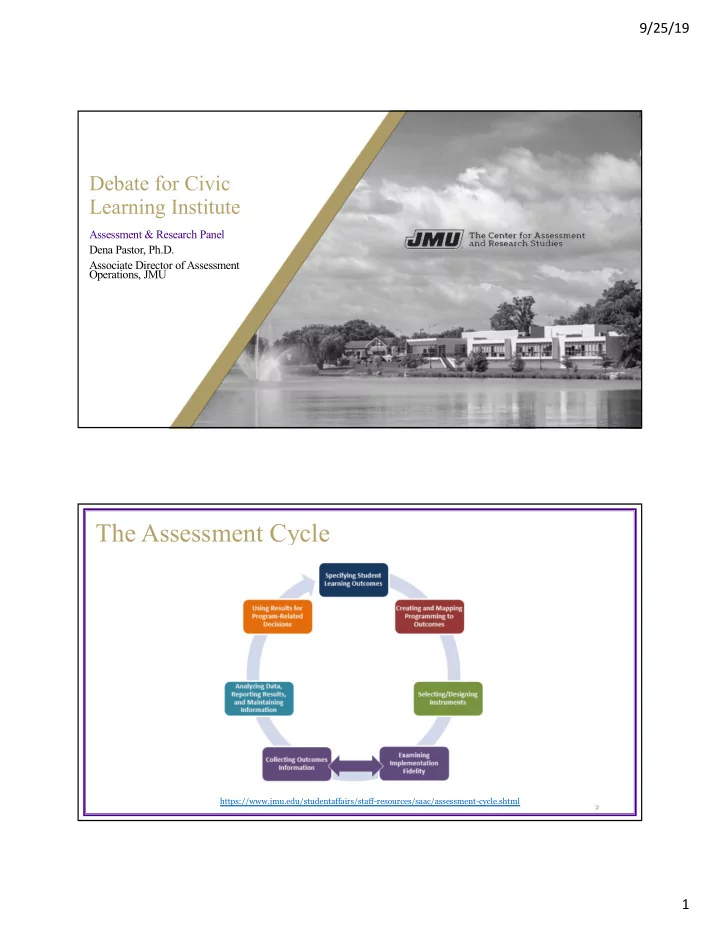
The Assessment Cycle
2
https://www.jmu.edu/studentaffairs/staff-resources/saac/assessment-cycle.shtml
The Assessment Cycle - - PDF document
9/25/19 Debate for Civic Learning Institute Assessment & Research Panel Dena Pastor, Ph.D. Associate Director of Assessment Operations, JMU The Assessment Cycle
Assessment & Research Panel Dena Pastor, Ph.D. Associate Director of Assessment Operations, JMU
2
https://www.jmu.edu/studentaffairs/staff-resources/saac/assessment-cycle.shtml
3
4
Initiative Program A Program B Program C Program D Program E Program F
5
As a result of this course, the student will:
complexity of public problems and why there is conflict, and what factors influenced their own view of the public problem.
understand their reasoning.
for all persons.
6
7
Civic Competency & Engagement Framework (Torney-Purta et al., 2015) Civic Competency Civic Knowledge Civic Skill Civic Engagement Civic Efficacy Democratic Norms and Values Civic Participation
https://www.ets.org/research/policy_research_reports/publications/report/2015/jvdz
8 Area Subscale Description Political Skills General skills of teamwork and collaboration Reach a compromise, help diverse groups work together, deal with conflict, talk about social barriers (e.g., race) General leadership & communication skills Articulate one’s own idea and beliefs to
meeting, assume leadership of a group Skills of political analysis and judgment Recognize competing political interests, write well about political topics, weigh pros/cons of different political positions Skills of political influence and action Know whom to contact to get something done about a social or political problem, develop strategies for political action,
Action & Involvement Expectation for future electoral action Likelihood of engaging in electoral activities (e.g., voting, supporting political campaigns/causes) in the future Expectation for political voice Likelihood of using one’s political voice (e.g., contacting representatives, news
demonstrating, boycotting) in the future Interest & Motivation Motivated by Passion and Perceived Political Impact Extent to which participation in political and social action is motivated by passion and perceived political impact Motivated by Personal Goals and Satisfaction Extent to which participation in political and social action is motivated by personal goals and satisfaction
9 Area Subscale Description Interest & Motivation Attention to government & public affairs “Some people seem to follow what's going on in government and public affairs most of the time, whether there's an election going on or
would you say you follow what’s going on in government and public affairs?” Knowledge & Understanding Current Events Knowledge Self-report of the level of one’s knowledge about current local, state, national, and international issues, political leaders and their roles, and current economic issues. Foundational Knowledge Self-report of the level of one’s knowledge about
political/democratic theories, and political institutions.
External Political Efficacy: Perception of Effective Political Strategies
Public & Institutional Attention
Perceptions of the effectiveness of political strategies used to bring public or institutional attention to issues Informing & Collaborating Perceptions of the effectiveness of political strategies used to inform others or collaborate with
Internal Political Efficacy Internal Efficacy Confidence in ability to comprehend and influence
have a role to play in the political process.”, “I consider myself well qualified to participate in the political process”, “I feel that I have a pretty good understanding of the political issues facing our country.”
Beaumont, E., Colby, A., Ehrlich, T., & Torney-Purta, J. (2006). Promoting political competence and engagement in college students: An empirical
10.1080/15512160600840467. Colby, A., Beaumont, E., Ehrlich, T., & Corngold, J., (2007). Educating for democracy: Preparing undergraduates for responsible political
Section VII here: http://archive.carnegiefoundation.org/ educating_for_democracy/docs/index. html
10
Outcome 4: As a result of completing this course, the student will feel more confident in their ability to have conversations about public problems with others. When discussing public problems, I feel confident in my ability to:
11
Collect Data
Course Design 1:Posttest Only Course Design 2:Pretest and Posttest
Collect Data Collect Data
Design 3:Pretest and Posttest With a Control Group Course
Collect Data Collect Data
No Course
If we see a high average score, how do we know that the course caused the high score? Perhaps students had high scores coming into the course . If we add a pretest, then we can examine if average scores were high prior to the course. We are hoping that posttest scores will be higher than pretest scores. If we do see an increase, how do we know that the course caused the increase? Perhaps the increase resulted from something else happening in the students’ lives during the same time they were taking the course. If we add control group of students who have not completed the course to our design, then we can assess whether gains are being made for students receiving the treatment (our course) and those that are not (our control group). We are hoping to see an increase in scores for students who have taken the course and no increase in scores for students who have not taken the course.