The Assembly of Disk Galaxies: From Keck to JWST Susan Kassin - - PowerPoint PPT Presentation

the assembly of disk galaxies from keck to jwst
SMART_READER_LITE
LIVE PREVIEW

The Assembly of Disk Galaxies: From Keck to JWST Susan Kassin - - PowerPoint PPT Presentation

The Assembly of Disk Galaxies: From Keck to JWST Susan Kassin Space Telescope Science Institute Raymond Simons (Johns Hopkins), Ben Weiner (MMT), Greg Snyder (STScI), DEEP2 & SIGMA Survey teams, VELA simulation team NGC 6984, credit:


slide-1
SLIDE 1

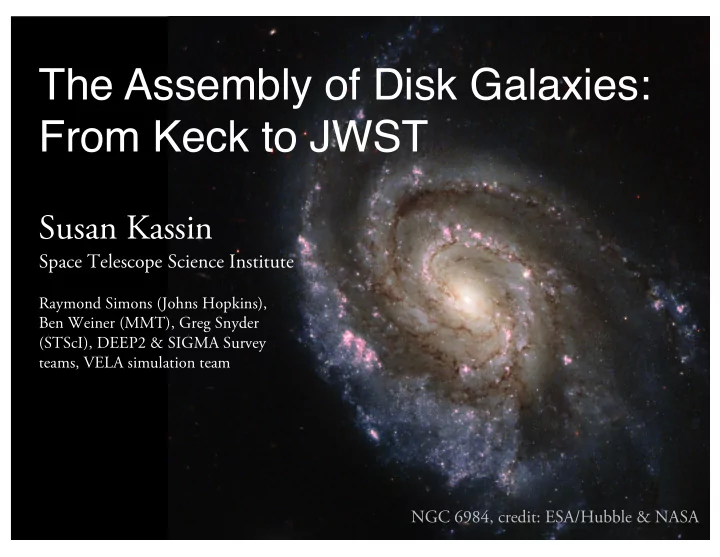
The Assembly of Disk Galaxies: From Keck to JWST

Susan Kassin

Space Telescope Science Institute

NGC 6984, credit: ESA/Hubble & NASA

Raymond Simons (Johns Hopkins), Ben Weiner (MMT), Greg Snyder (STScI), DEEP2 & SIGMA Survey teams, VELA simulation team

slide-2
SLIDE 2

6th year graduate student at Johns Hopkins University

Raymond Simons

  • SIGMA survey of galaxy

kinematics at z=2

  • Mock observations of galaxy

simulations

slide-3
SLIDE 3

When/how are disks assembled? When/how do disks settle into their current well-

  • rdered state?

M63, credit: HubbleSite.org

slide-4
SLIDE 4

It is important to take into account the effects of seeing and beam smearing when measuring galaxy kinematics.

ACS + WFC3 Hα: MOSFIRE

Vrot σ

Vrot and σ are measured from emission lines in Keck spectra

Weiner et al. 2006a,b; Kassin et al. 2007,12; Covington, Kassin et al. 2010; Simons, Kassin et al. 2016

Measurements of the kinematics of high z galaxies

slide-5
SLIDE 5

σ is a gas velocity dispersion

  • integrates over all velocity gradients beneath the seeing
  • quantifies the amount of disordered motions in galaxies (Weiner et al.

06, Kassin et al. 2007, Covington, Kassin et al. 2010, Kassin et al. 14)

  • Does not indicate a “thick disk” (i.e., a disk that is simply puffier)

Measurements of the kinematics of high z galaxies tell us about their physical state

Vrot sini = 208 km/s sgas = 40 km/s 75 km/s 55 km/s 29 km/s 59 km/s

Vrot dominated s dominated mixed

z~1 HST

slide-6
SLIDE 6

Kassin et al. 2007,12

S0.5 = 0.5Vrot

2 +σ gas 2

S0.5 takes into account all the motions, not just rotation. S0.52 ~ total mass (see also Covington et

  • al. 2010)

coincident with Faber-Jackson

Stellar Mass Tully-Fisher Relation to z=1.2

slide-7
SLIDE 7

Ordered disks lie on ridge-line, Disturbed galaxies lie off

slide-8
SLIDE 8

disk will form disk may not form

"Local" Tully-Fisher (z~0.2)

Simons, Kassin et al. 2015 et al.; see also Bloom et al. 2017

“Mass of Disk Formation”

slide-9
SLIDE 9

High-z Galaxies are Mostly Peculiars Still, more Ordered disks lie on ridge-line & more Disturbed galaxies lie off

slide-10
SLIDE 10

Does the relative importance of Vrot and σ evolve with time?

slide-11
SLIDE 11

"Disk Settling"

Kassin et al.12 Simons, Kassin et al. 2016 & 17 σ trend see also Wisnioski et al. 15, Turner et al. 2017

Vrot

(km/s)

Redshift 1010 – 1011 M¤ 109 – 1010 M¤ σ

(km/s)

Redshift

log σ = -0.84 (1+ z)-1 + 2.04

slide-12
SLIDE 12

1010.7 – 1011.7 M¤ 1010 – 1010.7 M¤ 109 – 1010 M¤

Linking galaxy populations in time with "abundance matching"

(our best shot, but far from perfect)

slide-13
SLIDE 13

Abundance matched galaxy populations (Moster et al. 2013) Kassin et al. 2012 Simons, Kassin et al. 2017

Redshift σ

(km/s)

"Disk Settling"

Vrot

(km/s)

Redshift

1010.7 – 1011.7 M¤ 1010.0 – 1010.7 M¤ 109.0 – 1010.0 M¤

slide-14
SLIDE 14

How does the fraction of disk galaxies evolve?

  • Vrot/σ > 3

analog of local low mass disks

  • Vrot/σ > 1

rotation supported

  • Vrot/σ ~ 10

local massive disks like the one shown

NGC 4388, credit: ESA/Hubble & NASA

slide-15
SLIDE 15

Kassin et al.12; Simons, Kassin et al. 2016 & 17

1010 – 1011 M¤ 109.5 – 1010.5 M¤ 109 – 1010 M¤ fraction

  • f

galaxies with V/σ>1 Redshift

Fraction of galaxies with Vrot/σ>1 increases with time

“Disk Settling”

slide-16
SLIDE 16

z~3:

  • AMAZE/LSD: Gnerucci et
  • al. 2011
  • KDS: Turner et al. 2017

z~2:

  • KMOS3D: e.g., Wisnioski et
  • al. 2015
  • SINS: e.g., Förster-Schreiber

et al. 2006,9,11 z~1:

  • MASSIV: e.g., Epinat et al.

2012

  • KROSS: e.g., Madgis et al.

2016, Harrison et al. 2017

  • KMOS3D: e.g., Wisnioski et
  • al. 2015

z<1

  • IMAGES: e.g., Flores et al.

2006, Yang et al. 2008, Puech et al. 2008

Large IFU surveys

  • f galaxy kinematics

stellar mass (M¤) SFR (M¤/yr)

slide-17
SLIDE 17

Quantitatively, surveys agree that disks become more

  • rdered with

time

Kassin et al.12; Simons, Kassin et al. 2016 & 17

Redshift fraction

  • f

galaxies with V/σ>1 1010 – 1011 M¤ 109.5 – 1010.5 M¤ 109 – 1010 M¤

slide-18
SLIDE 18

Only ~30% of high mass galaxies at z=2 have V/σ > 3!

Disk Settling Disk Assembly

1010 – 1011 M¤ 109.5 – 1010.5 M¤ 109 – 1010 M¤ fraction

  • f

galaxies with V/σ>3

Kassin et al.12; Simons, Kassin et al. 2016 & 17

Redshift

slide-19
SLIDE 19

Simons, Kassin, Snyder, Ceverino+ in prep

VELA simulation (Ceverino et al. 2014, 16)

Mock

  • bservations of

a simulated merger galaxy

Vrot can be confused with orbital rotation of mergers in ground- based observations => Fraction of disks at z~2 defined using V/s is likely even lower

slide-20
SLIDE 20

Disk Assembly

1010 – 1011 M¤ 109.5 – 1010.5 M¤ 109 – 1010 M¤ fraction

  • f

galaxies with V/σ>3 Redshift

Conclusions:

  • the vast majority of galaxies at

high redshift are not disks

  • galaxies increase in ordered

rotation (Vrot) and decrease in disordered motions (σ) with time

  • the average fraction of disk

galaxies increases significantly with time

  • higher mass galaxies arrive at

an ordered state first ("kinematic downsizing")

  • conclusions from high-z

kinematic surveys depend on sample selections for mass and morphology

Disk Settling