The Art, Science and Algorithms into our workshop on Thursday using - - PDF document

the art science and algorithms
SMART_READER_LITE
LIVE PREVIEW

The Art, Science and Algorithms into our workshop on Thursday using - - PDF document

Today : Light, composition so we can lead The Art, Science and Algorithms into our workshop on Thursday using DIY Light finders ! of Photography ! Focus today : Lighting angles & composition same principle for both natural


slide-1
SLIDE 1

The Art, Science and Algorithms

  • f Photography!

(Natural) Light! Direction of Light! CSCI 4900/6900! Maria Hybinette!

1!

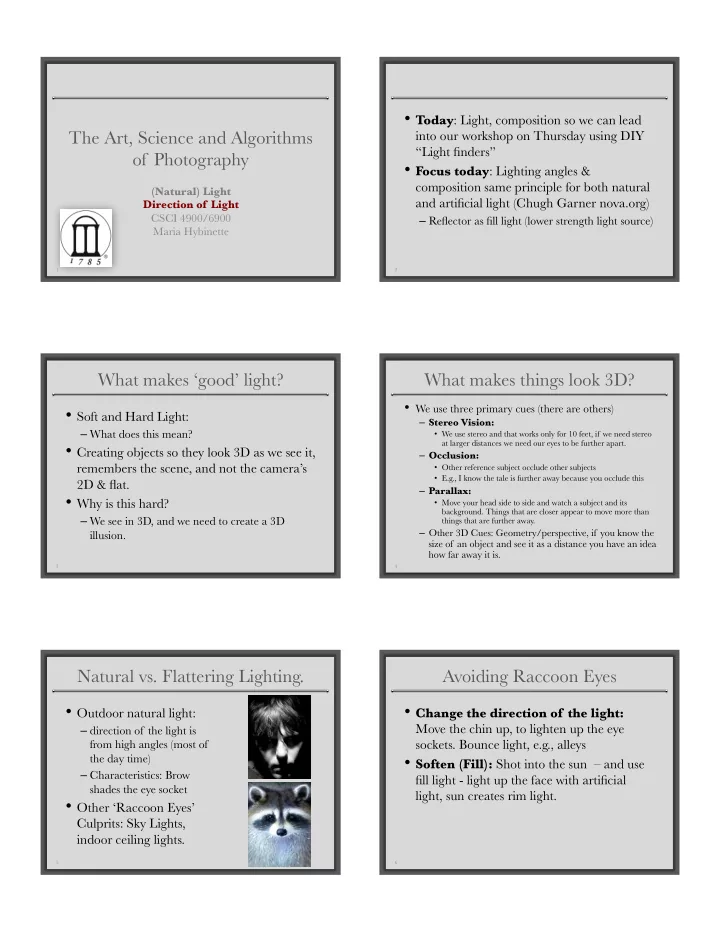
  • Today: Light, composition so we can lead

into our workshop on Thursday using DIY “Light finders”!

  • Focus today: Lighting angles &

composition same principle for both natural and artificial light (Chugh Garner nova.org)!

– Reflector as fill light (lower strength light source)!

2!

What makes ‘good’ light?!

  • Soft and Hard Light:!

– What does this mean?!

  • Creating objects so they look 3D as we see it,

remembers the scene, and not the camera’s 2D & flat. !

  • Why is this hard?!

– We see in 3D, and we need to create a 3D illusion.!

3!

What makes things look 3D?!

  • We use three primary cues (there are others)!

– Stereo Vision: !

  • We use stereo and that works only for 10 feet, if we need stereo

at larger distances we need our eyes to be further apart.!

– Occlusion: !

  • Other reference subject occlude other subjects!
  • E.g., I know the tale is further away because you occlude this!

– Parallax: !

  • Move your head side to side and watch a subject and its
  • background. Things that are closer appear to move more than

things that are further away.!

– Other 3D Cues: Geometry/perspective, if you know the size of an object and see it as a distance you have an idea how far away it is.!

4!

Natural vs. Flattering Lighting.!

  • Outdoor natural light:!

– direction of the light is from high angles (most of the day time) ! – Characteristics: Brow shades the eye socket!

  • Other ‘Raccoon Eyes’

Culprits: Sky Lights, indoor ceiling lights.!

5!

Avoiding Raccoon Eyes!

  • Change the direction of the light:

Move the chin up, to lighten up the eye

  • sockets. Bounce light, e.g., alleys!
  • Soften (Fill): Shot into the sun – and use

fill light - light up the face with artificial light, sun creates rim light.!

6!

slide-2
SLIDE 2

Making the 3D Illusion!

  • Angles of the light source(s)!

– E.g., you may see something like10 AM to 2 PM, “the sun hits object at about a 45o downward angle and this is ‘normal’!

  • Caveat: Angle depends on the latitude and season.!
  • Contrast patterns on the subject, shadows, midtones, and

highlights:! – Light hardness (stark shadows) versus softness (wrapped, feathered lighting)! – Control: !

  • distance of the source, !
  • size of the source, weather, !
  • Angle, and !
  • fill light to soften (secondary light source, reflector

another light).!

7! !"#$%%&'()*+*#&,*-(./0%)*+*%1.2345&6

Cheapest & Simplest Setup!

  • North facing

window facing away from the direct rays

  • f the sun.!

– Reflector at shadow side reflecting window light into the dark shadow on subject as filler.!

8!

  • The BIG SECRET about lighting is revealed: !

– It's not the light, but rather contrast and relative brightness of areas in the photo which triggers the brain to react and move the eye in a photo. !

  • http://super.nova.org/DPR/COIforTHOU/!

9!

Classic Lighting!

  • Some terms to describe light patterns: !

– Short, Broad, Butterfly, Loop and Rembrandt!

  • We will use Chuck Gardner’s approach to

lighting:!

– Light up the eye and mouth areas.!

  • Tool: Main light (key light)!

– Hide the nose (make it non-distracting)!

  • Tool: Main light and fill light.!

– Find the most flattering camera angle!

10!

Visualization: Light Rod!

  • Envision rod at bridge of nose with a key light

at the end (nose as the compass rose, ground zero)!

  • Watch/visualize the shadows of eye sockets

and the nose shadow as the rod angles/arcs

  • r moves.!

– Goal: Light in both eyes, and non distracting nose shadow.! – Rules of thumb: !

  • Vertical: Too high brows shade the eyes, !
  • Horizontal: More than 45 degrees on either side eye on
  • pposite side will disappear.!
  • Brighter areas enlarge!

11!

Reference Point!

  • Classic: light relative to camera axis: !

– E.g., Place the key light relative to the nose.! – Flattering position (Maintain 45R/40V relative to the nose) !

  • 45 degrees to the right of the (base) nose, and !
  • 40 degrees higher than the eye line.!
  • Gardner “Compass Rose”: light relative to the

subject face, the spot between the eyes.!

– 2 coordinates:!

  • (1) Place the light!
  • (2) Place the camera (e.g., 10 degrees above the eye line,

looking down at the nostrils instead of into the nostrils)!

12!

slide-3
SLIDE 3

Example!

  • L: 45° R40°V !
  • C: 40° L10°V!
  • Key Light: 45 degrees to the right of the nose

and 40 degrees above the eye line!

  • Camera: 40 degrees to the left of the nose and

10 degrees higher than the eye line !

– Camera faces shadow.!

  • Classic description: Short lighting!

13!

  • K45R+40V / C40L

+10V key light placed 45° to the right of the nose and 40° above the eye- line, with the camera viewing it from 45° to the left of the nose and 10° above the eye line.!

14!

  • Position the light (key)

then the camera!

– Once the face is

  • riented to the light

in a flattering pattern illuminating the eyes, mouth and front of the face! – Then make the face look different by changing the position

  • f the camera

relative to the face.!

15! 16!

  • Symmetrical faces !
  • Non Symmetrical (oblique angels C/L are

more flattering)!

17! 18!

slide-4
SLIDE 4

L 45 R 45V / C45°R+15°V!

19! 20!

L 45°L,+45°V / C 0°H+15°V .!

21!

Classic Names!

  • Short Lighting!
  • Broad Lighting!
  • Split Lightin!
  • Butterfly Lighting!
  • Loop Lighting!
  • Rembrandt Lighting!

22!

Short Lighting!

  • L 45H/+40-45 !
  • C oblique/profile!

23!

Broad!

  • Key Light greater than 45H, half the face is

shaded!

  • Camera at bright side!

24!

slide-5
SLIDE 5

Split!

  • Face cut in half, full face (similar to broad,

but camera angle defines it)!

25!

Butter fly!

  • Shadow directly below nose, 0H, 45-60V!

26!

Loop Light!

  • L 5-15 / > 45 V!
  • Noose shadow, down and to the side over

the upper lip.!

27!

Rembrandt!

  • Key light 50/60H/+45V all but a very small

patch of highlight and a glint of catch light

  • n the shaded side.!

28!

Fill Light (Wednesday)!

  • Key light creates the 3D effect!
  • Fill light lifts the shadows and softens the

light (and enables/eases the camera too see the full contrast range).!

29!