The Arctic Sea Ice Monitoring and Climate Variation Hiroyuki Enomoto - - PowerPoint PPT Presentation

the arctic sea ice monitoring and climate variation
SMART_READER_LITE
LIVE PREVIEW

The Arctic Sea Ice Monitoring and Climate Variation Hiroyuki Enomoto - - PowerPoint PPT Presentation

Monitoring Climate Change from Space COP21 Japan Pavilion, Dec. 4, 2015 The Arctic Sea Ice Monitoring and Climate Variation Hiroyuki Enomoto National Institute of Polar Research Background Arctic warming rate is twice faster than other


slide-1
SLIDE 1

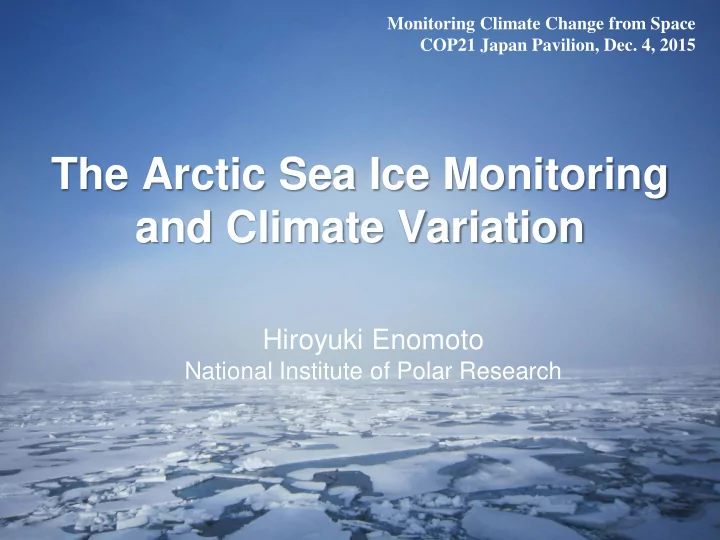
Hiroyuki Enomoto

National Institute of Polar Research

The Arctic Sea Ice Monitoring and Climate Variation

Monitoring Climate Change from Space COP21 Japan Pavilion, Dec. 4, 2015
slide-2
SLIDE 2

Background

  • Arctic warming rate is twice faster than other regions.
  • The enhanced change in the Arctic is called

“Polar Amplification” of warming.

Sea ice area in September 2012 was nearly half of that in 1980s (JAXA-ADS). Observed surface air temperature anomalies from the 1880-1890 mean, for each latitude bands, 9 year moving average (Shindell and Faluvegi, 2009).

North of 60N

2012 1980s

slide-3
SLIDE 3

“Polar Amplification” and “Feedbacks” in climate system

  • Arctic sea ice declining became drastic in 2000’s with the

summer minimum record in 2012 (“Early Indicator”).

  • Arctic sea ice change is an results of warming, and at

same time, sea ice is the cause of accelerating warming by “Ice albedo feedback”.

Summer sea ice sea ice area Year

atmosphere

Insolation reflection Snow/ice

Data: JMA

terrestrial radiation

slide-4
SLIDE 4

Sea ice

slide-5
SLIDE 5

Questions arise from Arctic and sea ice

Why Arctic warming is so rapid? How sea ice is changing? What is the influence to various fielded of Arctic? How we can monitor, understand, respond to change?

Atmosphere Ocean Terrestrial condition Cryosphere/hydrosphere change and Society

slide-6
SLIDE 6

AMSR-2 data products and visualization for Arctic study through ADS/GRENE Arctic Project, NIPR, JAXA Snow cover Soil moisture https://ads.nipr.ac.jp/vishop/vishop-monitor.html

slide-7
SLIDE 7

Seasonal cycle of sea ice

Large fluctuation Spring Autumn

slide-8
SLIDE 8

Winter temperature is increasing Summer Sea ice melting is strong air conditioner Warming is not apparent on this figure, however change is occurring in the other style.

Data:NCEP

Temperature at North Pole

Month-year Air Temperature (C)

Summer temperature is very stable and homogeneous on sea ice

slide-9
SLIDE 9

Sea ice: reflection of solar radiation Forming melt pond over sea ice Heat: ice melt, stored in open water…

Microwave suganal of melt water

slide-10
SLIDE 10

Contribution of each processes to Arctic warming amplification

Arctic amplification and feedback

Arctic amplification index (AAI) CO2 Water vapor Albedo Cloud Surface evap. Large-scale condense. Cumulus

  • Sens. heat + turbulent

Advection Ocean heat content Month

  • Warming is small in

Jun.-Aug., when solar radiation is reflected by ice. Heat is absorbed in

  • cean.
  • The heat is released

in Oct.-Dec.

  • Amplified warming

is maintained with cloud feedback.

Expanding open water=Ocean: heat storage Ice : Albedo Heat & vapor release from Ocean+Cloud formation

Summer Autumn

Yoshimori et al. (2014)

Positive Negative

slide-11
SLIDE 11

summer winter spring autumn

Decay: melting Opening Lead River dicharge Freezing, Growth Snow cover Mid-latitude weather,

Ice conditions

Open water, melt pond,

Sea ice seasonal cycle and satellite monitoring

ice thickness

Weather, Transport, Ocean environment Heat and water vapor, cloud

slide-12
SLIDE 12

AMSR-E/AMSR2 thickness : every September 10

Purple-pink: melt pond concentration

2002 2003 2004 2005 2006 2007 2008 2009 2010 2012

2013 Krishfield et al, 2014 Data: Tateyama Kitami Inst. Tech。

Thinning of sea ice

slide-13
SLIDE 13

Fragile ice : Thin ice and violent weather

Reduction of sea ice in 2012.8.1-18

Reduction of sea ice in 2012.8.1-18

slide-14
SLIDE 14

New Arctic weather condition: Great Arctic Cyclone (GAC) Wind, wave: Coastal and navigation safety, mixing (ocean), erosion(coast)

slide-15
SLIDE 15

summer winter spring autumn

Decay: melting Opening Lead River dicharge Freezing, Growth Snow cover Mid-latitude weather,

Ice conditions

Open water, melt pond,

Sea ice seasonal cycle and satellite monitoring

ice thickness

Weather, Transport, Ocean environment Heat and water vapor, cloud

slide-16
SLIDE 16

Winter ice growth by dynamic condition, and forecast

  • f summer sea ice Data: GCOM-W AMSR2

Yamaguchi lab. Univ of Tokyo

http://www.1.k.u-tokyo.ac.jp/YKWP/2015arctic.html

In situ freezing/sea ice dynamics

Thin / thick ice Dynamic conditions Winter ice motion for forecasting summer retreat GRENE Arctic project

  • Univ. of Tokyo Group
  • N. Kimura and H. Yamahguchi
slide-17
SLIDE 17

2013.03.04 & 02.18NOAA

Changing winter sea ice conditions Data: GCOM-W AMSR2

Winter sea ice coverage, thickness, movement

Frequent opening/ridging Water vapor and heat releases Summer ice prediction

slide-18
SLIDE 18

1979 2014

Cold and snow in the Mid-latitudes

Sea I ce Decrease in winter Snow and cold air to mid-latitudes as extreme weather .

slide-19
SLIDE 19

Concluding remarks

Satellite observation and advance of analyzing technology provide new understanding of Arctic: Arctic warming Polar Amplification, Ice albedo feed back Ice reduction: more open water, heat + water cycle snow

  • cean, cloud, cyclone, atmospheric circulation, snow

Application to Society Weather, Mid-latitude connection, Environment, Coastal safety, Transport and industry From observation and understanding, Japanese new project ArCS (2015-20) aims to provide scientific information for Arctic environment and sustainable development ,and global role

2015-2020 (MEXT, Japan) 2011-2015 (MEXT, Japan)