The approach Share features across objects, automatically - - PDF document

the approach
SMART_READER_LITE
LIVE PREVIEW

The approach Share features across objects, automatically - - PDF document

Sharing features: Efficient Booting Multi-class object Desired detector outputs: detection: Procedures for Multi-class Object Detection Bookshelf Classifier Screen no person One patch P(person | v p ) Classifier Local no car P( car | v


slide-1
SLIDE 1

Sharing features: Efficient Booting Procedures for Multi-class Object Detection

Antonio Torralba, Kevin Murphy and Bill Freeman

(Presented by Xu, Changhai) Most of the slides are copied from the authors’ presentation

Multi-class object detection:

Local features

no car Classifier P( car | vp ) Vp no cow Classifier P( cow | vp ) no person Classifier P(person | vp )

… Bookshelf Desk Screen

Desired detector outputs: One patch

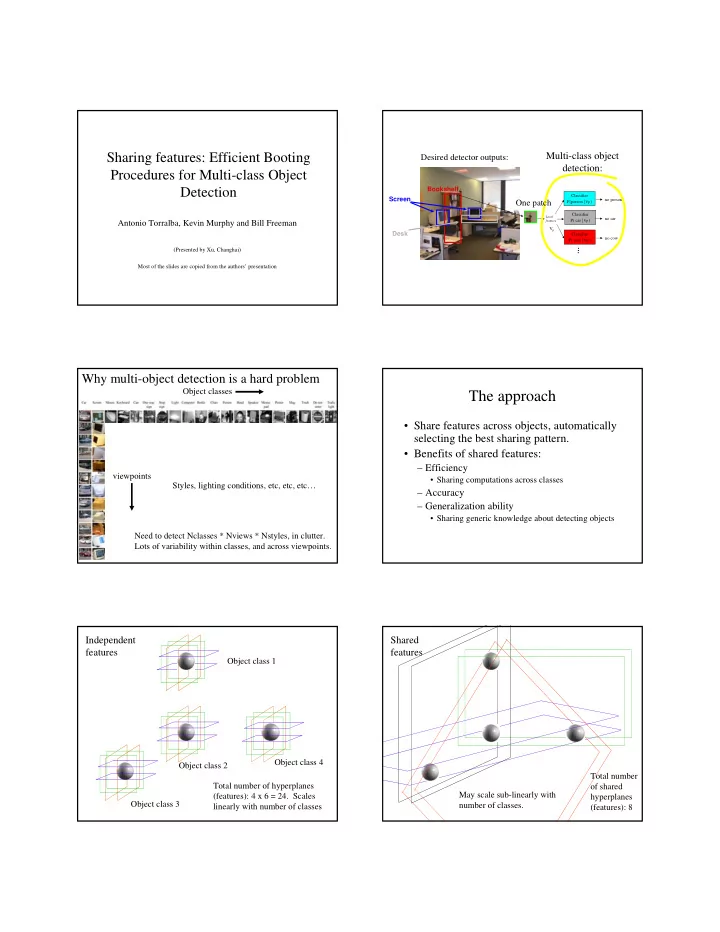
Why multi-object detection is a hard problem

viewpoints Need to detect Nclasses * Nviews * Nstyles, in clutter. Lots of variability within classes, and across viewpoints. Object classes Styles, lighting conditions, etc, etc, etc…

The approach

  • Share features across objects, automatically

selecting the best sharing pattern.

  • Benefits of shared features:

– Efficiency

  • Sharing computations across classes

– Accuracy – Generalization ability

  • Sharing generic knowledge about detecting objects

Object class 1 Total number of hyperplanes (features): 4 x 6 = 24. Scales linearly with number of classes

Independent features

Object class 2 Object class 3 Object class 4 Total number

  • f shared

hyperplanes (features): 8 May scale sub-linearly with number of classes.

Shared features

slide-2
SLIDE 2

Additive models for classification

+1/-1 classification classes feature responses

Feature sharing in additive models Multi-classBoosting

We use the exponential multi-class cost function classes classifier

  • utput for

class c membership in class c, +1/-1 cost function

Weak learners are shared

At each boosting round, we add a perturbation

  • r “weak learner” which is shared across

some classes:

Multi-class Boosting

weight squared error Weight squared error over training data θ a+b b vf

Feature output, v

Specialize weak learners to decision stumps

hm (v,c)

slide-3
SLIDE 3

θ a+b b vf Given a sharing pattern, the decision stump parameters are obtained analytically

Feature output, v

Find weak learner parameters analytically

hm (v,c)

Joint Boosting: select sharing pattern and weak learner to minimize cost.

Conceptually, for all features: for all class sharing patterns: find the optimal decision stump, hm(v,c) end end select the hm(v,c) and sharing pattern that minimizes the weighted squared error Jwse for this boosting round.

Approximate best sharing

To avoid exploring all 2C –1 possible sharing patterns, use best-first search: S = [] % Grow a list of candidate sharing patterns, S. while length S < Nc for each object class, ci, not in S % consider adding ci to the list of shared classes, S for all features, hm evaluate the cost J of hm shared over [S, ci] end end S = [S, cmin_cost] end Pick the sharing pattern S and feature hm which gave the minimum multi-class cost J.

Effect of pattern of feature sharing on number of features required (synthetic example) Effect of pattern of feature sharing on number of features required (synthetic example)

(best first search heuristic)

Now, apply this to images.

Image features (weak learners)

32x32 training image of an object 12x12 patch Location of that patch within the 32x32 object gf(x) Mean = 0 Energy = 1 wf(x) Binary mask Feature output

slide-4
SLIDE 4

The candidate features

template position

The candidate features

Dictionary of 2000 candidate patches and position masks, randomly sampled from the training images template position

Example shared feature (weak classifier)

At each round of running joint boosting on training set we get a feature and a sharing pattern.

Response histograms for background (blue) and class members (red)

How the features were shared across objects

(features sorted left-to-right from generic to specific)

Performance evaluation

Area under ROC (shown is .9)

False alarm rate Correct detection rate

Performance improvement over training

Significant benefit to sharing features using joint boosting.

slide-5
SLIDE 5

70 features, 20 training examples (left)

Shared features Non-shared features

15 features, 20 training examples (mid)

70 features, 20 training examples (left) Shared features Non-shared features

15 features, 2 training examples (right)

15 features, 20 training examples (middle) 70 features, 20 training examples (left) Shared features Non-shared features

Scaling

Joint Boosting shows sub-linear scaling of features with objects (for area under ROC = 0.9).

Results averaged

  • ver 8 training sets,

and different combinations of

  • bjects. Error bars

show variability.

Generic vs. specific features

Parts derived from training a binary classifier. In both cases ~100% detection rate with 0 false alarms Parts derived from training a joint classifier with 20 more

  • bjects.

Multi-view object detection

train for object and orientation

View invariant features View specific features Sharing features is a natural approach to view-invariant object detection.

slide-6
SLIDE 6

Multi-view object detection Summary

  • Feature sharing essential for scaling up object

detection to many objects and viewpoints.

  • Joint boosting generalizes boosting.
  • The shared features

– generalize better, – allow learning from fewer examples, – with fewer features.

  • A novel class will lead to re-training of previous

classes