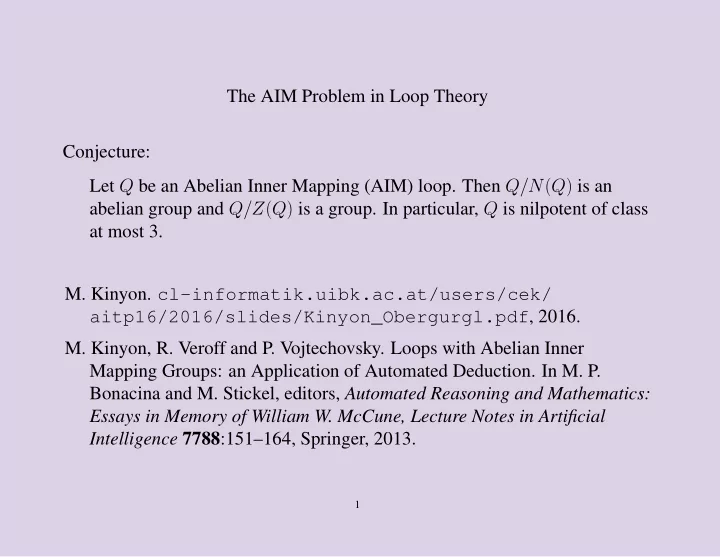
SLIDE 1 The AIM Problem in Loop Theory Conjecture: Let Q be an Abelian Inner Mapping (AIM) loop. Then Q/N(Q) is an abelian group and Q/Z(Q) is a group. In particular, Q is nilpotent of class at most 3.
- M. Kinyon. cl-informatik.uibk.ac.at/users/cek/
aitp16/2016/slides/Kinyon_Obergurgl.pdf, 2016.
- M. Kinyon, R. Veroff and P. Vojtechovsky. Loops with Abelian Inner
Mapping Groups: an Application of Automated Deduction. In M. P. Bonacina and M. Stickel, editors, Automated Reasoning and Mathematics: Essays in Memory of William W. McCune, Lecture Notes in Artificial Intelligence 7788:151–164, Springer, 2013.
1
SLIDE 2
AIM Loops (Clauses) % loop axioms 1 * x = x. x * 1 = x. x \ (x * y) = y. x * (x \ y) = y. (x * y) / y = x. (x / y) * y = x. % inner mappings (y * x) \ (y * (x * u)) = L(u,x,y). ((u * x) * y) / (x * y) = R(u,x,y). x \ (u * x) = T(u,x). % abelian inner mapping group T(T(u,x),y) = T(T(u,y),x). L(L(u,x,y),z,w) = L(L(u,z,w),x,y). R(R(u,x,y),z,w) = R(R(u,z,w),x,y). T(L(u,x,y),z) = L(T(u,z),x,y). T(R(u,x,y),z) = R(T(u,z),x,y). L(R(u,x,y),z,w) = R(L(u,z,w),x,y).
2
SLIDE 3
AIM Conjecture (Clauses) % associator (x * (y * z)) \ ((x * y) * z) = a(x,y,z). % commutator (x * y) \ (y * x) = K(y,x). % goals a(K(x,y),z,u) = 1 # label("aK1"). a(x,K(y,z),u) = 1 # label("aK2"). a(x,y,K(z,u)) = 1 # label("aK3"). K(a(x,y,z),u) = 1 # label("Ka"). a(a(x,y,z),u,w) = 1 # label("aa1"). a(x,a(y,z,u),w) = 1 # label("aa2"). a(x,y,a(z,u,w)) = 1 # label("aa3").
3
SLIDE 4
AIM Theory Hierarchy
Loop Theory AIM LC LCC SAIP left Bol C CC Moufang left Bruck Steiner
4
SLIDE 5 The Challenges How far up the loop hierarchy can we prove the conjecture? Although general AIM is the ultimate goal, results in several of the extensions
- f the theory are new and of significant interest.
We also are interested in discovering other, previously unspecified, properties
5
SLIDE 6 The Process We boot-strapped the project (for initial sets of hints) by proving the conjecture in strong extensions of the theory for which the result was known (e.g., Moufang loops) On success: move farther up the hierarchy On failure:
- Prover9 parameters (but not a lot)
- additional and/or different extra assumptions
- intermediate lemmas (e.g., suggested by the mathematicians)
- looser or different characterization of related theorem
- iterative methods (e.g., varying lex order of terms)
As the library of proofs grows, it becomes increasingly important to manage hints (selection and prioritization) effectively.
6
SLIDE 7 Notable Results (Mathematics)
- Original goals in extensions of the theory (working up the hierarchy)
- Goal equivalences
aK1, aK2, aK3 and Ka are equivalent (in AIM) aa1, aa2, aa3 are equivalent (in AIM) Proving aK2 implies the others was extremely difficult
- Previously unknown properties of AIM loops, for example,
K(K(x,y),z) = K(x,K(y,z)). a(x,y,z) * K(u,w) = K(u,w) * a(x,y,z). See www.cs.unm.edu/˜veroff/AIM/.
7
SLIDE 8
AIM Proof Lengths 2011: 2015: 2017: 2019: 24,356 73,625 242,134 242,134 18,862 69,489 141,589 193,847 17,075 54,742 112,135 141,589 16,400 45,131 89,716 124,938 15,785 40,708 87,534 112,135 Proof levels: Several over 500, one at 841
8
SLIDE 9
Other Measures of Progress Before hint prioritization: 549 proofs in 117 output files, 167K distinct hint clauses, 47K appearing in more than one output file As of November 2018: 641 proofs in 149 output files, 2.3 million distinct hints, 90K appearing in more than two output files As of January 2019: 660 proofs in 158 output files, 2.6 million distinct hint clauses, 114K appearing in more than two output files
9
SLIDE 10
Other Projects Lattices, groups, loops, classical and nonclassical logics ... Publications in respected math journals: Algebra Universalis, Journal of Algebra, Transactions of the AMS, Notre Dame Journal of Formal Logic, Studia Logica ...
10