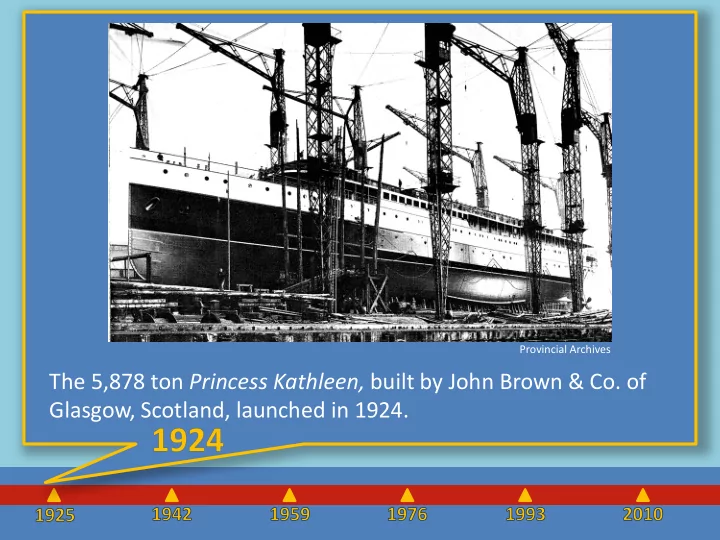
SLIDE 1
The 5,878 ton Princess Kathleen, built by John Brown & Co. of Glasgow, Scotland, launched in 1924.
Provincial Archives
SLIDE 2
The maiden voyage was from Glasgow, Scotland to Vancouver, Canada via the Panama Canal.
SLIDE 3
The Princess Kathleen was built to operate along the company’s busy Vancouver-Victoria-Seattle Triangle Route.
SLIDE 4
The elegant dining room onboard the Princess Kathleen sat 168 people.
Provincial Archives
SLIDE 5
Princess Kathleen was taken over by the Royal Navy on September 1, 1941 for use as troop transport in the Mediterranean.
The Pacific Princesses: An Illustrated History of Canadian Pacific Railway’s Princess Fleet
SLIDE 6
“In the some 250,000 miles of wartime service, she was untouched by the Axis forces.” –Robert D. Turner
Canadian Pacific Railroad
SLIDE 7
Returned by the Navy to the Canadian Pacific Railroad, Princess Kathleen was refitted and put back in service on the Vancouver- Victoria-Seattle Triangle Route beginning June 22, 1947.
Joe D. Williamson
SLIDE 8
Two years after returning to service, Princess Kathleen was transferred to Canadian Pacific Railroad’s Vancouver-Alaska route.
SLIDE 9
On September 7, 1952, the final Alaska cruise of the season, Princess Kathleen encountered heavy squalls and poor visibility while traveling between Juneau and Skagway.
SLIDE 10 The Chief Officer ordered a simple course change to move the vessel to the middle of the channel after seeing the Shelter Island light.
Point Lena
SLIDE 11 Princess Kathleen should have moved to mid channel then returned to course.
Point Lena
SLIDE 12 However, instead of giving the correct order to steer starboard then return to course, the Chief Officer mistakenly gave a command to just steer starboard.
Point Lena
SLIDE 13 Eventually, the error was discovered. The Chief Officer saw land ahead he ordered the vessel hard-a-starboard, but it was too late.
Point Lena
SLIDE 14
The Princess Kathleen grounded at Point Lena at 2:58 AM on September 7, 1952.
Alaska State Library – Historical Collections
SLIDE 15
After assessing damage to the bow, the Captain attempted to back the ship off the rocks, but was unable to move the Princess Kathleen.
Alaska State Library – Historical Collections
SLIDE 16 Passengers and lifeboats were readied for the possible evacuation
Alaska State Library – Historical Collections Alaska State Library – Historical Collections
SLIDE 17
As the tide fell, the vessel took on a list and the wind increased driving the stern against the rocks. By 5:30 AM the list was 19 degrees and the captain evacuated the passengers. By 9:00 AM all 307 passengers had safely disembarked.
Alaska State Library – Historical Collections
SLIDE 18
The stern of the Princess Kathleen started to flood with the incoming tide. With the bow still on the rocks the vessel flooded further until, at 11:30 AM, the captain and crew abandoned ship.
Alaska State Library – Historical Collections
SLIDE 19
Alaska State Library – Historical Collections
At 12:30 PM, almost 10 hours after the grounding, Princess Kathleen slid from Point Lena.
SLIDE 20
Alaska State Library – Historical Collections
SLIDE 21
Alaska State Library – Historical Collections
SLIDE 22
Alaska State Library – Historical Collections
SLIDE 23
Alaska State Library – Historical Collections
SLIDE 24
Alaska State Library – Historical Collections
SLIDE 25
Alaska State Library – Historical Collections
SLIDE 26
Alaska State Library – Historical Collections
SLIDE 27
Alaska State Library – Historical Collections
SLIDE 28
Alaska State Library – Historical Collections
SLIDE 29
The stern now rests in approximately 140 feet of water, the bow in 40 feet. The depth of water, location of the wreck and age of Princess Kathleen made salvage too difficult and costly. Public perception at the time was fuel didn’t represent a serious risk to the environment. No fuel recovery or cleanup operations were mounted.
SLIDE 30
“Diver Magnus Hansen of Juneau, Alaska, displays some silverware he recovered from the sunken CPR Steamer Princess Kathleen…”
The Lethbridge Herald
SLIDE 31
“The Canadian Pacific Lines flagship Princess Kathleen … may soon be brought to the surface and used as a tourist attraction…” “Miss DarVelle said she hopes to pull the vessel up on the beach in the Auke Bay area…”
SLIDE 32 Recreational divers note and document small quantities
- f oil leaking from Princess Kathleen. Oil discharge is
limited to a single location.
Scale
Lou Barr
Marble sized collections
from a threaded pipe.
SLIDE 33
Reports to Department of Environmental Conservation and Coast Guard of non-recoverable oil discharges and rainbow sheens increase. There are occasional reports of small “tar balls” on beaches around Point Lena.
ADEC- Moore
SLIDE 34
The Coast Guard contracted with Global Offshore Divers to conduct an assessment on Princess Kathleen using Remotely Operated Vehicles (ROVs).
Both photos taken by USCG – Sector Juneau
SLIDE 35
The Remote Operated Vehicles (ROVs) assessed the starboard side of Princess Kathleen, the port side is laying against the seafloor prohibiting ROV access.
Princess Kathleen Unified Command
Click image to play video
SLIDE 36
The assessment documents a largely intact starboard hull though most portholes are now open. The wooden upper decks and structures are completely gone; the existing structure begins on the promenade deck.
Promenade Deck
SLIDE 37
The Remote Operated Vehicles (ROVs) were unable to enter Princess Kathleen, but the mini-ROV was able to record video while looking inside the open portholes and open doorways.
USCG- Sector Juneau
SLIDE 38
The initial Remote Operated Vehicle (ROV) assessment documented oil escaping from the interior of the vessel via broken port holes during certain tide cycles.
USCG- Sector Juneau
SLIDE 39
Princess Kathleen Unified Command
Click image to play video
SLIDE 40
The oil present within the structure of the vessel prompted ADEC and the USCG to form a Unified Command. The Unified Command is pursuing a Phase II assessment of the vessel, which will be completed with divers.
USCG- Sector Juneau
Lena Point
SLIDE 41 Weather permitting, the dive assessment will begin Sunday, March 7. The assessment seeks to answer the following questions:
- What is the structural integrity of the vessel and the fuel tanks?
- How much fuel remains in the tanks and within the
superstructure of the vessel?
Kodiak dive operations. Global Offshore Divers
SLIDE 42
Princess Kathleen Unified Command - 2010