Th The Impacts of Temperature on I t f T t Wentletraps and - - PowerPoint PPT Presentation

th the impacts of temperature on i t f t t wentletraps
SMART_READER_LITE
LIVE PREVIEW

Th The Impacts of Temperature on I t f T t Wentletraps and - - PowerPoint PPT Presentation

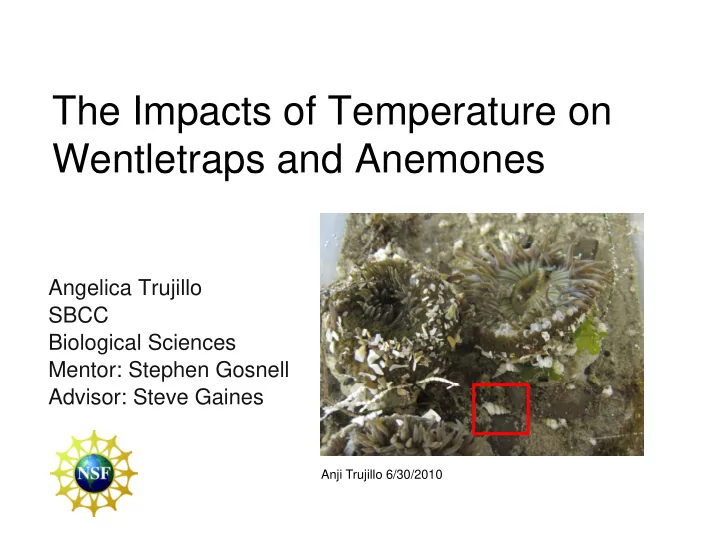
Th The Impacts of Temperature on I t f T t Wentletraps and Anemones e t et aps a d e o es Angelica Trujillo SBCC SBCC Biological Sciences Mentor: Stephen Gosnell Advisor: Steve Gaines Anji Trujillo 6/30/2010 Impacts of Interactions

slide-1
SLIDE 1

Th I t f T t The Impacts of Temperature on Wentletraps and Anemones e t et aps a d e

  • es

Angelica Trujillo SBCC SBCC Biological Sciences Mentor: Stephen Gosnell Advisor: Steve Gaines

Anji Trujillo 6/30/2010

slide-2
SLIDE 2

Impacts of Interactions on Communities

  • Species interaction

influence community influence community dynamics

  • Species interactions

change with the change with the environment

  • Intertidal as Model

S t

Stephen Gosnell 11/19/2009

System

slide-3
SLIDE 3

Research Focus

How will the interaction between sea anemones and a wentletraps change with temperature?

Goals

L t fi ld i

  • Locate field specimen

and determine abundance abundance

  • Determine impact of

Anthopleura sp

  • Determine impact of

temperature on species and interaction

Epitonium tinctum Anthopleura sp.

3

and interaction

p

Anji Trujillo 7/3/10

slide-4
SLIDE 4
slide-5
SLIDE 5

Experimental Methods in the Field Experimental Methods in the Field

  • Collecting of specimens
  • Field Experiments
  • Developing search
  • Developing search

protocol S

  • Surveys
  • Determine wentletrap

population size and density

  • Mark and recapture

4

  • Mark and recapture
slide-6
SLIDE 6

9

slide-7
SLIDE 7

10

slide-8
SLIDE 8

Experimental Methods in the Lab

Factorial Experiment

  • Explore the combined impacts of temperature food

Explore the combined impacts of temperature, food availability, and predation on anemones.

5

slide-9
SLIDE 9

Factorial Table Factorial Table

Multiple Stressors Temperature Presence of predator F d il bilit Food availability

Food/No Food

Low Temp 12˚C High Temp 20˚C

Predator

12˚C, Predator 20˚C, Predator

6

No Predator

12˚C, No Predator 20˚C, No Predator

slide-10
SLIDE 10

Assessing the Impact

  • n Anemones
  • Morphological measures
  • n Anemones

p g

  • mass, color, death rate
  • Molecular methods
  • protein degradation

Assessing the Impact on Assessing the Impact on Wentletraps

  • Acute temperature response

7

  • Acute temperature response
slide-11
SLIDE 11

11

slide-12
SLIDE 12

Ubiquitun Dot Blot Quantifying protein

Standard

y g p degradation

  • Extract protein from sea

anemone tentacles

  • W,-T, +F
  • Expose protein to anti-body

Results: Not clear

12

slide-13
SLIDE 13

Heat Block Experiment Heat Block Experiment

Acute Temperature p Response

  • 90 minutes exposure

from 12.1˚C - 31.5˚C R lt ll i d Result: all survived

  • Local water temp. does

not exceed 20˚C

13

slide-14
SLIDE 14

14

slide-15
SLIDE 15

Project Summary Project Summary

Establish the impacts of temperature

  • n wentletrap and sea anemone
  • Offer insight community

dynamics

  • Similar anthozoan-

t d l ti hi gastropods relationships found in coral reefs

11

around the world.

slide-16
SLIDE 16

Future Plans

  • Finish a second trial of the factorial

experiment

  • Reassess the impact

p

  • Go out into the field and re-evaluate

population size and densities. population size and densities.

  • Take a look at larger number of protein

extraction samples extraction samples

  • Assess wentletrap movement and feeding

f preferences

slide-17
SLIDE 17

Acknowledgments

INSET staff INSET staff Mentor: Stephen Gosnell p Elizabeth Hoaglund Friends and Family

17