Texture What is texture? Easy to recognize, hard to define - - PDF document

texture
SMART_READER_LITE
LIVE PREVIEW

Texture What is texture? Easy to recognize, hard to define - - PDF document

Texture What is texture? Easy to recognize, hard to define Deterministic textures (thing-like) Stochastic textures (stuff-like) Tasks Discrimination / Segmentation Classification Texture synthesis


slide-1
SLIDE 1

1

Texture

  • What is texture?

– Easy to recognize, hard to define – Deterministic textures (“thing-like”) – Stochastic textures (“stuff-like”)

  • Tasks

– Discrimination / Segmentation – Classification – Texture synthesis – Shape from texture – Texture transfer – Video textures

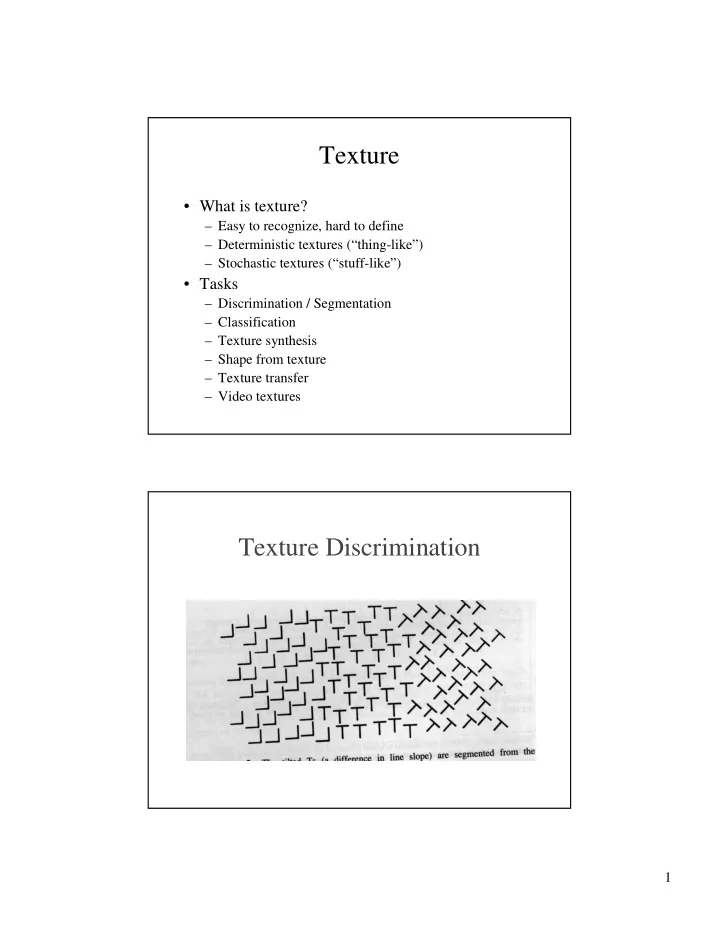
Texture Discrimination

slide-2
SLIDE 2

2

Shape from Texture

Modeling Texture

  • What is texture?

– An image obeying some statistical properties – Similar structures repeated over and over again – Often has some degree of randomness

slide-3
SLIDE 3

3

slide-4
SLIDE 4

4

Steerable (i.e., Oriented) Pyramids

slide-5
SLIDE 5

5

Texture Synthesis [Efros & Leung, ICCV 99]

Synthesizing One Pixel

– What is ? – Find all the windows in the image that match the neighborhood

  • consider only pixels in the neighborhood that are already filled in

– To synthesize x

  • pick one matching window at random
  • assign x to be the center pixel of that window

sample image Generated image

SAMPLE x

slide-6
SLIDE 6

6

Markov Random Field

A Markov random field (MRF)

  • generalization of Markov chains to two or more dimensions

First-order MRF:

  • probability that pixel X takes a certain value given the values
  • f neighbors A, B, C, and D:

D C X A B X ∗ ∗ ∗ ∗ ∗ ∗ ∗ ∗ ∗ ∗ ∗ ∗ ∗ ∗ ∗ ∗ ∗ ∗ ∗ ∗ ∗ ∗ ∗ ∗ ∗ ∗ ∗ ∗ ∗ ∗ ∗ ∗ X ∗ ∗ ∗ ∗ ∗ ∗ ∗ ∗ ∗ ∗ ∗ ∗ ∗ ∗ ∗ ∗ ∗ ∗ ∗ ∗ ∗ ∗ ∗ ∗ ∗ ∗ ∗ ∗ ∗ ∗ ∗ ∗ ∗ ∗ ∗ ∗ ∗ ∗ ∗ ∗ ∗ ∗ ∗ ∗ ∗ ∗ ∗ ∗

  • Higher order MRF’s have larger neighborhoods

Markov Chain

  • Markov Chain

– a sequence of random variables – is the state of the model at time t – Markov assumption: each state is dependent only on the previous one

  • dependency given by a conditional probability:

– The above is actually a first-order Markov chain – An N’th-order Markov chain:
slide-7
SLIDE 7

7

Really Synthesizing One Pixel

sample image

– An exact neighborhood match might not be present – So we find the best matches using SSD error and randomly choose between them, preferring better matches with higher probability SAMPLE

Generated image

x

Growing Texture

– Starting from the initial image, “grow” the texture one pixel at a time

slide-8
SLIDE 8

8

Window Size Controls Regularity

More Synthesis Results

Increasing window size

slide-9
SLIDE 9

9

More Results

aluminum wire reptile skin

Failure Cases

Growing garbage Verbatim copying

slide-10
SLIDE 10

10

Image-Based Text Synthesis

  • Efros & Leung ’99 Extended

Efros & Leung ’99 Extended

  • Observation: neighbor pixels are highly correlated
slide-11
SLIDE 11

11

  • !

"

  • #
  • $

Minimal error boundary Minimal error boundary

" "

  • 2

2

"

slide-12
SLIDE 12

12

Philosophy Philosophy

  • The “Corrupt Professor’s Algorithm:”

– Plagiarize as much of the source image as you can – Then try to cover up the evidence

  • Rationale:

– Texture blocks are by definition correct samples of texture, so the only problem is connecting them together

Texture Transfer

Constraint Texture sample

slide-13
SLIDE 13

13

Texture Transfer Texture Transfer

  • Take the texture from one object

and “paint” it onto another object

– This requires separating texture and shape – That’s HARD, but we can cheat – Assume we can capture shape by boundary and rough shading

%&'( %&'(

  • +

+ = = + + = =

slide-14
SLIDE 14

14

= = + +

slide-15
SLIDE 15

15

slide-16
SLIDE 16

16

slide-17
SLIDE 17

17

slide-18
SLIDE 18

18

slide-19
SLIDE 19

19

slide-20
SLIDE 20

20

slide-21
SLIDE 21

21

slide-22
SLIDE 22

22

slide-23
SLIDE 23

23

slide-24
SLIDE 24

24

slide-25
SLIDE 25

25

slide-26
SLIDE 26

26

slide-27
SLIDE 27

27

slide-28
SLIDE 28

28

slide-29
SLIDE 29

29

slide-30
SLIDE 30

30

slide-31
SLIDE 31

31

slide-32
SLIDE 32

32

slide-33
SLIDE 33

33

slide-34
SLIDE 34

34