Temperatures in Downtown Tempe, AZ on an Extreme Heat Wave Day By - - PowerPoint PPT Presentation

temperatures in downtown tempe az on an
SMART_READER_LITE
LIVE PREVIEW

Temperatures in Downtown Tempe, AZ on an Extreme Heat Wave Day By - - PowerPoint PPT Presentation

Built Environment Contributions to the Radiant Temperatures in Downtown Tempe, AZ on an Extreme Heat Wave Day By Anthony J. Brazel 1 and Ariane Middel 2 Session 11B Biometeorology IV 10 th International Conference on Urban Climate 14 th


slide-1
SLIDE 1

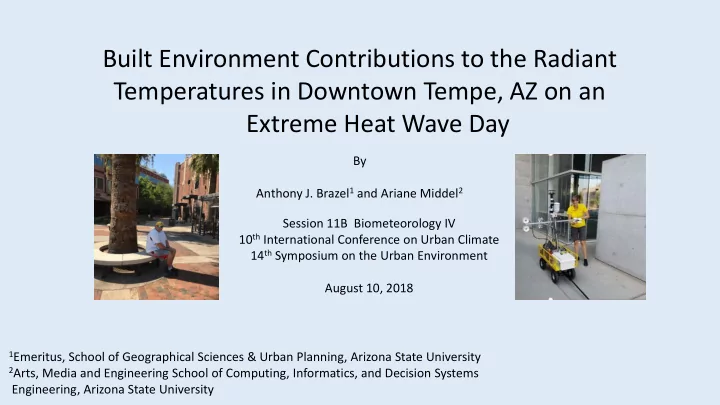
Built Environment Contributions to the Radiant Temperatures in Downtown Tempe, AZ on an Extreme Heat Wave Day

By Anthony J. Brazel1 and Ariane Middel2

1Emeritus, School of Geographical Sciences & Urban Planning, Arizona State University 2Arts, Media and Engineering School of Computing, Informatics, and Decision Systems

Engineering, Arizona State University Session 11B Biometeorology IV 10th International Conference on Urban Climate 14th Symposium on the Urban Environment August 10, 2018

slide-2
SLIDE 2
slide-3
SLIDE 3

*from Tempe.gov *

slide-4
SLIDE 4

٠Given the concern for human comfort and walkability in Tempe, we explore the

variability of a major factor of human comfort – Mean Radiant Temperature or MRT.

٠Under hot, dry, clear-sky conditions with low wind speed, outdoor thermal comfort

is mainly driven by Mean Radiant Temperature.

٠We have previously collected observations using Kestrel global thermometers and used Rayman.

(ICUC9 Poster, 2015, “Mill Avenue, Tempe, AZ Downtown Microclimate – An APA-designated Best Street”,

  • Jour. Urban Design, 2016 “Desert New Urbanism: testing for comfort in downtown Tempe, Arizona”)

٠Here we use more accurate six directional method of radiant fluxes and mobile sampling.

Purpose

slide-5
SLIDE 5

Circles in red are sites with higher SVFs and more open.

slide-6
SLIDE 6

٠CART has been used for a previous study of the ASU campus - Ariane Middel, Scott Krayenhoff,

in preparation, Micrometeorological Factors Determining the Outdoor Thermal Environment During Record-Breaking Extreme Heat in Tempe, Arizona: Design for Optimal Microscale Heat Mitigation, Building and Environment.

slide-7
SLIDE 7
  • MRT
  • Six-directional method applying angular factors for a standing reference person (VDI 1998*):

7

Wi: weighting factors (0.06 up/down, 0.22 lateral) Ki: directional shortwave radiation Li: directional longwave radiation ak: shortwave absorption coefficient (0.70) al: longwave absorption coefficient (0.97)

𝑁𝑆𝑈 =

4 σ𝑗=1

6

𝑋

𝑗 𝑏𝑙𝐿𝑗 + 𝑏𝑚𝑀𝑗

𝑏𝑚 ∙ 𝜏 − 273.15 𝐿

*VDI. (1998). VDI 3787, Part II: Environmental Meteorology: Methods for the Human-biometeorological Evaluation of Climate and Air Quality for the Urban and Regional Planning at Regional Level. Part I: Climate.

slide-8
SLIDE 8

٠Six microclimate transects on June 21, 2017 between 0800 and 2000 LST at 0800, 1000, 1200, 1400,

1700, 2000.

٠Air temperature, relative humidity, shortwave and longwave radiation in six directions, and 2D wind

speed and direction were logged at 2-s intervals 16 transect stops of 45+ seconds to account for sensor lag.

٠Sampled locations include a variety of heterogeneous environments, i.e. fully shaded and partially

shaded sites, artificial and natural shade, sun-exposed sites, and varying ground cover (concrete, asphalt, brick, artificial turf, mulch)

٠Observations were time-detrended to the full hour for cross-site comparison.

slide-9
SLIDE 9

5 10 15 20 25 30 35 40 45 50 2 4 6 8 10 12 14 16 18 20 22 24

Ta, RH, WS June 21, 2017 NWS Sky Harbor Int Airport

Ta oC RH % WS m/s 20 22 24 26 28 30 32 34 36 38 40 42 44 46 48 50 1 2 3 4 5 6 7 8 9 10 11 12 13 14 15 16 17 18 19 20 21 22 23 24 25 26 27 28 29 30

Sky Harbor NWS June, 2017 Ta

  • C

max min

slide-10
SLIDE 10

e.g., Obstructed Sites Photos Top Left to Bottom Right correspond to SVFs Left to Right

slide-11
SLIDE 11

mean 0800 to 1700 2000 MRT MRT MRT ID surface type Orientation shade type SVF

  • C

peak oC time

  • C

11 asphalt parking lot buildings 0.80 est 65.5 70.9 1459 38.3 115 gravel vacant lot buildings 0.80 est 67.1 73.7 1501 36.3 117 wood mulch near vacant lot buildings/trees 0.80 est 65.3 74.7 1502 35.4 9 brick/concrete NS EW sidewalk NW corner 0.75 62.6 72.3 1447 37.0 7 cement Plaza palms/blds 0.70 est 65.5 68.4 1722 39.3 45 brick NS E sidewalk blds/trees 0.60 60.4 69.7 1710 40.9 3 cement EW street blds/trees 0.60 est 62.0 65.5 1415 39.7 8 cement NS walkway canyon/trees/blds 0.52 56.1 69.2 1443 38.9 6 Art Turf Plaza/Trees Tree/Blds 0.50 est 63.9 73.0 1436 39.0 14 concrete NS walkway Canyon/blds 0.27 49.7 69.1 1400 41.2 4 brick EW walkway canyon/Blds/trees 0.25 50.0 72.6 1421 42.1 13 brick EW N sidewalk sidewalk overhang 0.21 49.5 57.9 1257 38.3 5 brick EW walkway Canyon/blds 0.20 45.2 56.5 1433 39.6 10 brick NS W sidewalk tree canopy/blds 0.19 50.0 60.5 1244 39.3 12 brick EW N sidewalk Arcade Walk 0.05 39.5 44.3 1504 38.5 1 concrete EW walkway Tunnel 0.03 37.6 44.7 1700 41.2

slide-12
SLIDE 12

30.0 35.0 40.0 45.0 50.0 55.0 60.0 65.0 70.0 0.00 0.10 0.20 0.30 0.40 0.50 0.60 0.70 0.80 0.90

SVF vs MRT oC Mean 0800-1700)

slide-13
SLIDE 13

60oC, peaks >70oC Open Plazas and lots South-facing protected sites Narrow N-S Narrow E-W 10-20oC reduction 10oC reduction

High peaks noon

15oC reduction Sidewalk trees Arbor walkway “tunnel” through building 10oC reduction 23oC reduction South protection, narrowing walkways, use of trees, and tunneling walkways MRT mean 0800-1700 values

slide-14
SLIDE 14
  • 1. Further investigate role of material variability and corresponding Ɛ and µ values as they

influence Ts

  • 2. Investigate K↓ variations from stations available in the PMA and relate to local factors.
  • 3. Use CART information to aid in ongoing model evaluation of built environment microclimates

using e.g., Rayman and ENVI met. Ongoing study - An Evaluation of Mean Radiant Temperature Estimations in an Arid Urban Climate, Peter J. Crank, Melissa Wagner, Ariane Middel, Anthony Brazel, Dani Hoots ASU, Martin Smith, Univ. Minnesota Twin Cities, Abstract submitted to AGU 2018.

Additional Analyses