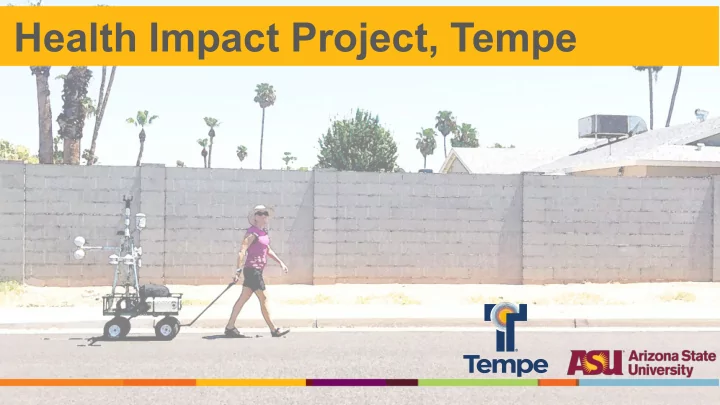
Health Impact Project, Tempe Climate Ac e Action + + Ex Extrem - - PowerPoint PPT Presentation

health impact project tempe climate ac e action ex extrem
SMART_READER_LITE
LIVE PREVIEW

Health Impact Project, Tempe Climate Ac e Action + + Ex Extrem - - PowerPoint PPT Presentation

Health Impact Project, Tempe Climate Ac e Action + + Ex Extrem eme e Hea eat Pew H Health I Impac act P Proj oject, T Tempe What urban infrastructure is associated with thermal comfort and discomfort? Four Activities: 1. citywide


slide-1
SLIDE 1

Health Impact Project, Tempe

slide-2
SLIDE 2

Climate Ac e Action + + Ex Extrem eme e Hea eat

slide-3
SLIDE 3

Pew H Health I Impac act P Proj

  • ject, T

Tempe

Four Activities:

  • 1. citywide survey (heat and health)
  • 2. neighborhood microclimate assessment
  • playground and public space assessments,
  • 3. participatory heat assessments
  • (heat walk event), and integrate that data to inform a
  • 4. climate action co-design workshop
  • (park design), which aims to co-produce solutions with residents.

Kiwanis/ The Lakes Character Area Only

What urban infrastructure is associated with thermal comfort and discomfort?

slide-4
SLIDE 4

Stra rategy

  • 1. Survey
  • 2. Microclimate assessment
  • 3. Participatory assessment

4. Workshops

  • Guidelines/

guidelines

  • Standards
  • Codes
  • All hazards

mitigation plans

  • Emergency

manager Informal public conversation Increase dialog on heat

slide-5
SLIDE 5

Per erfor

  • rman

ance M Measure T Targets

1) In each of the city’s character areas, less than 20% of residents report experiencing heat-related illness in the past 12 months. 2) In each of the city’s character areas, less than 15% of residents report experiencing significant negative impacts due to high temperature in their homes in the past 12 months.

slide-6
SLIDE 6

Infrastruc uctur ure

  • Parks and Play Spaces
  • Multiuse Paths
  • Arterial Walls
  • Parking Lots
slide-7
SLIDE 7

Microcl climate A Asse ssess ssments ts

  • 1. Arable Weather Stations, sun/shade
  • 2. MaRTy Transect Assessment
slide-8
SLIDE 8

Field W Wor

  • rk,

k, August – October, 2019

slide-9
SLIDE 9

MaRTy Ty Tran anse sect cts

slide-10
SLIDE 10

Hea Heat W Walk - “Informed and hot!”

slide-11
SLIDE 11

Field W Wor

  • rk L

k Loc

  • cations
slide-12
SLIDE 12

Pa Park & & Pl Playspac paces, Kiwanis Park

slide-13
SLIDE 13

Mean an Ra Radi diant T Tem emperature ( (MRT), 8 8am

slide-14
SLIDE 14

12PM

slide-15
SLIDE 15

12PM

slide-16
SLIDE 16

Kiwanis Park, Tempe

August 25, 2019 during 7-8pm thermal comfort transect

Parks & s & Pl Playspac paces

Key points:

  • Tension between accessibility and

surface temperature hazards

  • Trees and shade structures can

reduce MRT by 30-50∘F at noon

  • Focus on creating more usable

playspaces for more hours each day and longer season - shade

  • Data collection can be an

engagement activity –

  • Informal questions from public
  • Formal Heat Walk
slide-17
SLIDE 17

Multi-Use P e Paths hs

Kiwanis Park

8AM

slide-18
SLIDE 18

Mu Multi-Use Pa Paths

Key points:

  • At 8am commute time, shaded parts
  • f North-South Western Canal path

were up to 60∘F cooler (MRT) than sun soaked All American Way

  • East-West El Paso Path MRT was 10-

40∘F cooler than adjacent College Ave

  • Heat walks help align thermal

experience, MRT, and surface temperature data and promote learning

“Wow, it’s 93 in the shade but 120 something over there” - Heat Walker

slide-19
SLIDE 19

Arterial W l Walls lls

Mostly Central and Northern Tempe

slide-20
SLIDE 20

Surface T e Temper eratures es

slide-21
SLIDE 21

Arterial W l Walls lls

Key points:

  • Shade, thermal capacity, and
  • rientation impact on surface

temperatures

  • Thermal performance varied

depending on hour of day

  • Structural concrete columns and

ground beams showed highest night time temperatures

  • The effect of wall surface roughness,

as in smooth versus rough masonry, was not thermally visible.

#9, East Facing Wall on west side of Rural, north of Broadway

slide-22
SLIDE 22

Parking L g Lot

  • ts

Lot 11, ASU Tempe Campus

slide-23
SLIDE 23

85 90 95 100 105 110 80 90 100 110 120 130 140 150 160 6:00 AM 9:00 AM 12:00 PM 3:00 PM 6:00 PM 9:00 PM Air temperature (°F) Surface Temperature (°F) Time of Day

Surface temperature 06/09/2018 - Parking Lot 11

Surface Temperature - PV canopy Surface Temperature - sun-exposed Air Temperature - PV canopy Air temperature - sun-exposed Details of the data Day: June 9, 2018 Sky Harbor daytime high air temp: 108F Sky Harbor morning low air temp: 79F Sunrise: 5:18 am Sunset: 7:37 pm

Surface T e Temper eratures es

slide-24
SLIDE 24

85 90 95 100 105 110 90 100 110 120 130 140 150 160 170 6:00 AM 9:00 AM 12:00 PM 3:00 PM 6:00 PM 9:00 PM Air temperature (°F) MRT (°F) Time of Day

MRT 06/09/2018 - Parking Lot 11

MRT - PV canopy MRT - sun-exposed Air Temperature - PV canopy Air temperature - sun-exposed Details of the data Day: June 9, 2018 Sky Harbor daytime high air temp: 108F Sky Harbor morning low air temp: 79F Sunrise: 5:18 am Sunset: 7:37 pm

Mean an Ra Radi diant T Tem emperatures

slide-25
SLIDE 25

Parking L g Lot

  • ts

Key points:

  • Lot 11 has strong differences

between sun-exposed and PV shaded areas for mean radiant temperature (MRT) of up to 40F.

  • Lot 11 shows also strong differences

in the surrounding surface temperature underneath the instrument (up to 30F).

  • Lot 11 – differences for surface

temperature and MRT are much slower or non-existent during the night hours

slide-26
SLIDE 26

Con

  • nclusions
  • Aligning research with City challenges and priorities requires common

understanding of the challenge between city and academic partners including intention in how findings will be used to guide policy

  • Data can be integrated into existing City GIS database to map thermal

performance of infrastructure at different times of days and seasons

  • Extreme heat’s subjective nature is different from other hazards (e.g. flooding)

and thus thermal comfort and experience is a critical piece to integrate into any policy to improve resilience to extreme heat