Team 21: Autonomous RoboSub Final Presentation Fall 2012 Team - - PowerPoint PPT Presentation

team 21 autonomous robosub
SMART_READER_LITE
LIVE PREVIEW

Team 21: Autonomous RoboSub Final Presentation Fall 2012 Team - - PowerPoint PPT Presentation

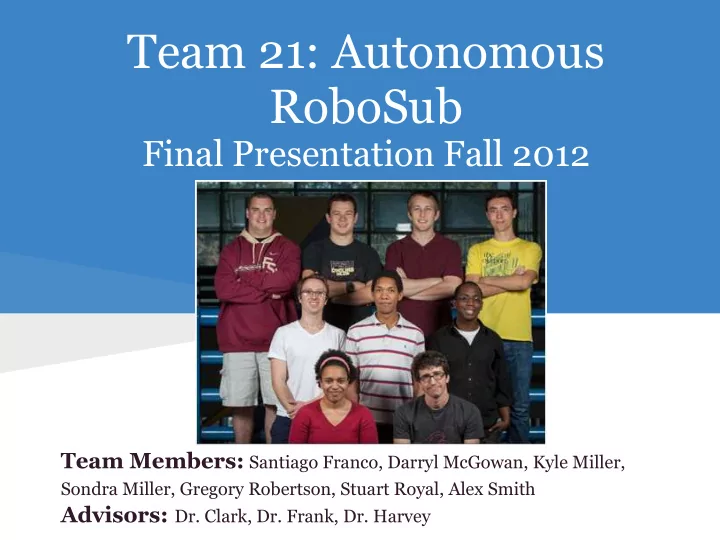
Team 21: Autonomous RoboSub Final Presentation Fall 2012 Team Members: Santiago Franco, Darryl McGowan, Kyle Miller, Sondra Miller, Gregory Robertson, Stuart Royal, Alex Smith Advisors: Dr. Clark, Dr. Frank, Dr. Harvey Competition 15th

slide-1
SLIDE 1

Team 21: Autonomous RoboSub

Final Presentation Fall 2012

Team Members: Santiago Franco, Darryl McGowan, Kyle Miller,

Sondra Miller, Gregory Robertson, Stuart Royal, Alex Smith

Advisors: Dr. Clark, Dr. Frank, Dr. Harvey

slide-2
SLIDE 2

Competition

  • 15th Annual AUVSI RoboSub Competition
  • Held in San Diego July 22-28, 2013
  • 7 tasks making use of camera, depth sensor

torpedoes, claw, marker dropper, and hydrophones

  • Current rules have not yet been released

1

slide-3
SLIDE 3

Competition Tasks

  • Maneuvering through a gate
  • Line following on ground
  • Buoy ramming
  • Maneuvering around
  • bstacles
  • Dropping markers in

specific location

  • Shooting a target
  • Picking up specified objects
  • Moving towards a pinger

and surfacing

2

slide-4
SLIDE 4

Current Design

CAD drawing of Assembly 3

slide-5
SLIDE 5

Hull and Frame

  • New Hull

design

○ Simpler ○ More accessible ○ Better!

4

slide-6
SLIDE 6

Thrusters

SeaBotix SBT150

  • —Max Amp.: 5.8A(30 sec duration)
  • —Max Cont. Amp.: 4.25A
  • —Max Power: 150W(each motor)
  • Total of 4 thrusters

Thruster 5

slide-7
SLIDE 7

Claw and Torpedo Launcher

  • Both custom made by last year's team
  • Both powered by pneumatic actuators fed by

an air tank

claw mechanism Torpedoes and torpedo launcher 6

slide-8
SLIDE 8

Beacon Dropper

  • Servo motor used to rotate

arm to allow beacon to drop

  • ut

Bottom view of the beacon dropper 7

slide-9
SLIDE 9

Power System

  • 2x 14.8V Polymer Li-Ion batteries

○ Only powering thrusters ○ Only using 1 at a time ○ 30A Max Discharge rate

  • 1x 19v 4Ah Li-Ion External Laptop Battery

○ Powers main CPU unit ○ Lasts roughly 2-3 hours ○ Essentially powers all USB devices as well

  • 1x 12v Li-Ion 18650 Box Battery

○ Regulated to power all other electronics ■ Arduino ■ Actuators ○ 4A Max Discharge Rate

8

slide-10
SLIDE 10

Power Subsystems Outline

9

slide-11
SLIDE 11

Processing System

  • Main System Controller

○ Intel i3 2330M, 8GB Ram, Wifi, 6 USB Ports ○ Controls all subsystems ○ Contains top level controller

  • Subsystem Controllers

○ Arduino UNO ○ Arduino MEGA ■ Controls all 4 thrusters ■ Directly connected to IMU

  • Stabilizes sub movement
  • Inertial Measurement Unit

○ Razor 9DOF IMU ○ Acceleration along 3 axes ○ rotation about all 3 axes

10

slide-12
SLIDE 12

Sensors

  • Depth sensor

○ IMCL submersible pressure transducer ○ feeds voltages to Arduino

  • Hydrophones

○ Sensortech SQ26 hydrophones ○ Passive locating ○ 4 used for 3-dimensional localization

11

slide-13
SLIDE 13

Cameras

Logitech C615 Webcam

  • Using two: one for frontal view, one for

ground view

  • Will send video for running vision processing

12

slide-14
SLIDE 14

Vision Program

  • Running OpenCV software

using C++

  • Ability to recognize colors and

shapes

  • Used for location of, direction

to, and identification of

  • bjectives

13

slide-15
SLIDE 15

Communication Subsystem

14

slide-16
SLIDE 16

Safety

  • Safety of AUVSI divers is a primary concern

○ Low-impact torpedo system ○ Non-toxic sealants ○ Safety shrouds covering blades on all thrusters ○ Exterior kill switch for entire system

  • Safety of components

○ Rigid exterior frame ○ Watertight o-ring ○ Separated power systems

15

slide-17
SLIDE 17

Environmental Concerns

  • Toxicity of components, sealants,

and adhesives

○ standard aluminum ○ non-toxic sealants

  • Disposal and recyclability of components

○ Proper disposal of batteries in future

years

○ Aluminum hull and frame can be

reused or recycled

16

slide-18
SLIDE 18

Future Plans

  • Complete the fabrication

and testing of the physical design

  • Interface with all

sensors

  • Recognize objects and

colors underwater

  • Perform trial runs

designed to resemble actual competition conditions

  • Go To Competition!

17

slide-19
SLIDE 19

Questions

slide-20
SLIDE 20

Sources

[1] OpenCV Shape Recognition. Image. http://www.emgu. com/wiki/images/thumb/ShapeDetectionExample.png/300px- ShapeDetectionExample.png [2] Recycling. Image. http://www.sunsetscavenger. com/green_cart/images/recycling_logo_earth_300x300.gif [3] Question Mark. Image. http://upload.wikimedia.

  • rg/wikipedia/en/a/af/Question_mark.png

[4] IMCL Submersible Pressure Transducer. Image. http://www.sensorsone. com/wp-content/uploads/2012/02/IML-500px.jpg [5] Razor 9DOF IMU. Image. http://static3.watterott.com/09510-02-Working. jpg