Tax Considerations in Structuring Private Investment Funds Balancing - - PowerPoint PPT Presentation

tax considerations in structuring private investment funds
SMART_READER_LITE
LIVE PREVIEW

Tax Considerations in Structuring Private Investment Funds Balancing - - PowerPoint PPT Presentation

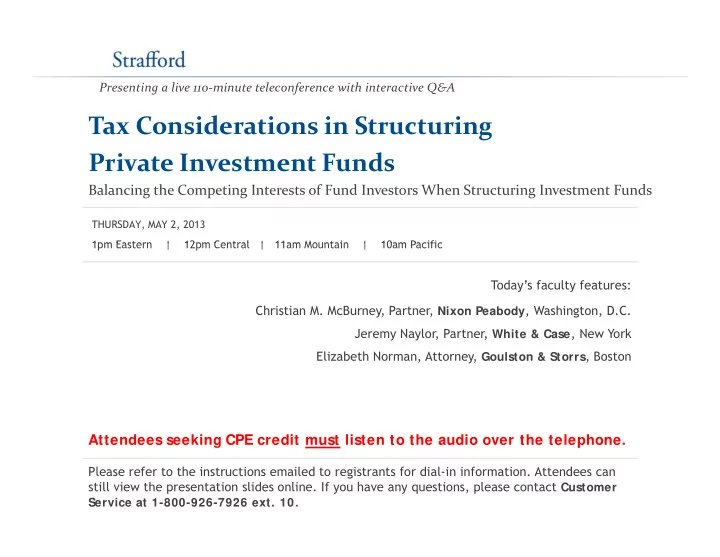
Presenting a live 110 minute teleconference with interactive Q&A Tax Considerations in Structuring Private Investment Funds Balancing the Competing Interests of Fund Investors When Structuring Investment Funds THURSDAY, MAY 2, 2013 1pm


slide-1
SLIDE 1

Presenting a live 110‐minute teleconference with interactive Q&A

Tax Considerations in Structuring Private Investment Funds

Balancing the Competing Interests of Fund Investors When Structuring Investment Funds

1pm Eastern | 12pm Central | 11am Mountain | 10am Pacific THURSDAY, MAY 2, 2013

Today’s faculty features:

1pm Eastern | 12pm Central | 11am Mountain | 10am Pacific

Christian M McBurney Partner Nixon Peabody Washington D C Christian M. McBurney, Partner, Nixon Peabody, Washington, D.C. Jeremy Naylor, Partner, White & Case, New York Elizabeth Norman, Attorney, Goulston & Storrs, Boston

Attendees seeking CPE credit must listen to the audio over the telephone.

Please refer to the instructions emailed to registrants for dial-in information. Attendees can still view the presentation slides online. If you have any questions, please contact Customer

Service at 1-800-926-7926 ext. 10.

slide-2
SLIDE 2

Tips for Optimal Quality

S d Q lit S

  • und Qualit y

For this program, you must listen via the telephone by dialing 1-866-570-7602 and entering your PIN when prompted. There will be no sound over the web connection. If you dialed in and have any difficulties during the call, press *0 for assistance. You may also send us a chat or e-mail sound@

straffordpub.com immediately so

we can address the problem we can address the problem.

Viewing Qualit y

To maximize your screen, press the F11 key on your keyboard. To exit full screen, press the F11 key again.

slide-3
SLIDE 3

Continuing Education Credits

FOR LIVE EVENT ONLY

For CLE credits, please let us know how many people are listening online by completing each of the following steps:

  • Close the notification box
  • In the chat box, type (1) your company name and (2) the number of

attendees at your location

  • Click the SEND button beside the box

For CPE credits, attendees must listen to the audio over the telephone. Attendees can still view the presentation slides online. Please refer to the instructions emailed to registrants for additional information. If you have any questions, please contact Customer Service at 1-800-926-

7926 ext. 10.

slide-4
SLIDE 4

Program Materials

If you have not printed the conference materials for this program, please complete the following steps:

  • Click on the + sign next to “Conference Materials” in the middle of the left-

hand column on your screen hand column on your screen.

  • Click on the tab labeled “Handouts” that appears, and there you will see a

PDF of the slides for today's program.

  • Double click on the PDF and a separate page will open.

Double click on the PDF and a separate page will open.

  • Print the slides by clicking on the printer icon.
slide-5
SLIDE 5

May 2, 2013

Tax Considerations in Structurin in Structuring Private Equity Funds q y

Balancing the Competing Interests of Fund Investors Balancing the Competing Interests of Fund Investors When Structuring Investment Funds

Christian McBurney, Nixon Peabody LLP, Washington, D.C. office Jeremy Naylor, White & Case LLP, New York office Eli b th N G l t & St B t ffi

5

Elizabeth Norman, Goulston & Storrs, Boston office

slide-6
SLIDE 6

Fund Characteristics

  • Types of Funds

P i E i — Private Equity — Venture Capital Hedge — Hedge — Distressed Debt — Real Estate — LBO — Fund of funds

6

slide-7
SLIDE 7

Fund Characteristics (cont’d)

  • Other important fund characteristics

U S b d b d id U S ? — U.S.-based or based outside U.S.? — Focus investing in U.S. or outside U.S., or both? Is fund an investor or conducting a trade or business? — Is fund an investor or conducting a trade or business?

› Investor: possible disallowance of fund manager fees for U.S. investors under Section 212 › Trade or business: fees deductible under Section 162; but UBTI, ECI and CAI concerns

7

slide-8
SLIDE 8

Type of Fund Investors

  • U.S. Taxable Individual or Corporation

S S d l G

  • U.S. State and Local Government

— Pension Funds

U S Tax Exempt Investors

  • U.S. Tax-Exempt Investors

— Corporate Pension Plans — University and College Endowment Funds University and College Endowment Funds — Private Foundations — Charity Endowment Funds y — Individual Retirement Accounts (IRAs)

8

slide-9
SLIDE 9

Type of Fund Investors (cont’d)

  • Non-U.S. Investors

I di id l — Individuals — Non-U.S. entities treated as corporations for U.S. income tax purposes p p — Pension Funds (not taxed in home country)

  • Non-U.S. Government Investors (Section 892)

— Sovereign Wealth Funds — Pension Funds

9

slide-10
SLIDE 10
  • U. S. Taxable Individuals and Corporations

U.S. Taxable U.S. Taxable Individual C Corp.

35% c.g. and o.i.

  • 20% c.g.
  • 39.6% o.i.
  • 3.8% nii

Fund L.P .

  • Gain on interest sale
  • Gain on asset sale
  • Interest
  • Gain on stock sale
  • Dividends
  • Interest

Portfolio Corp Portfolio LLC

  • Gain on debt sale
  • Gain on debt sale

Corp.

N F d Bl k d i d

10

No Fund Blocker desired Unblocked investor can also claim tax credits and treaty benefits

slide-11
SLIDE 11
  • U. S. State and Local Government
  • U. S. State and

L l G t Local Government

0% U.S. tax rate

Fund L.P .

Gain/income Gain/income

Portfolio Corp Portfolio LLC

Gain/income Gain/income

Corp.

N F d Bl k d i d

11

No Fund Blocker desired Unblocked can also claim treaty benefits

slide-12
SLIDE 12
  • U. S. Tax‐Exempt Investors

U.S. Tax-Exempt

0% U.S. tax rate

Fund L.P .

  • Gain on interest sale (c.g.)
  • Interest
  • Gain on debt sale (c.g.)
  • Gain on stock sale
  • Dividends
  • Interest
  • Gain on debt sale

Portfolio Corp. Portfolio LLC

  • Gain on debt sale

p

N F d Bl k d i d

  • Gain on sale of

noninventory property

12

No Fund Blocker desired Unblocked investor can also claim treaty benefits

slide-13
SLIDE 13
  • U. S. Tax‐Exempt Investors (cont’d)

U.S. Tax-Exempt

35% U.S. tax rate

Fund L.P . Fund L.P .

Fees earned by L.P .

Portfolio LLC

  • Operating income

F d Bl k ft d i d

p g

  • Gain on sale of inventory

13

Fund Blocker often desired Unrelated business taxable income (UBTI)

slide-14
SLIDE 14
  • U. S. Tax‐Exempt Investors (cont’d)

U.S. Tax-Exempt

35% U.S. tax rate

Fund L.P .

Debt-Financed:

  • Gain on interest sale
  • Interest
  • Gain on debt sale

Debt-Financed:

  • Gain on stock sale
  • Dividends
  • Interest

Portfolio Corp. Portfolio LLC

  • Gain on debt sale

Debt-Financed:

  • Gain on sale

Corp.

D bt fi d i i UBTI

Gain on sale

  • f any property
  • Operating Income

14

Debt-financed income is UBTI Fund Blocker often desired

slide-15
SLIDE 15
  • U. S. Tax‐Exempt Investors (cont’d)

Parallel Fund Structure

U.S. Tax-Exempt

Parallel Fund Structure

p Non-U.S. or U.S. Feeder Fund

Non-U.S. Investments (N UBTI) U.S. Investments (N UBTI)

U.S.

  • Corp. Blocker

(No UBTI) (No UBTI) Investments (UBTI)

15

(UBTI)

slide-16
SLIDE 16

Non‐U.S. Investors

  • U.S. tax goals

A id h i fil U S i — Avoid having to file a U.S. income tax return — Limit U.S. tax on “Effectively Connected Income” (ECI). If ECI: — If ECI:

› Must file U.S. federal, state, and local returns › Must pay income tax at regular, federal, state and local rates

  • Non-U.S. corp must also pay U.S. 30% “branch profits” tax

— Limit U.S. tax on FDAP income

› 30% U.S. withholding tax rate unless U.S. tax treaty applies › Claim U.S. treaty benefits where possible

16

slide-17
SLIDE 17

Non‐U.S. Investors (cont’d)

  • Effectively Connected Income (ECI) is income recognized

by a non U S person that is effectively connected with a by a non-U.S. person that is effectively connected with a business carried on in the U.S.

— Does fund have a loan origination business? g — “Securities trading safe harbor” protects offshore funds

  • ECI includes share of operating income from a pass-

through entity conducting business in the U.S.

— Non-U.S. partners are deemed engaged in a U.S. business S l f hi i i hi h — Sale of partnership interest in partnership that generates ECI: IRS takes the position that gain is ECI

  • FIRPTA income treated like ECI

17

FIRPTA income treated like ECI

slide-18
SLIDE 18

Non‐U. S. Investors (cont’d)

Non-U.S. Investor

0% U.S. tax rate

d

U S S

Fund L.P .

U.S. Source:

  • Portfolio interest
  • Gain on debt sale

Non-U.S. U.S. Source:

  • Gain on stock sale

Portfolio Corp Portfolio LLC Portfolio

Source:

  • Gain/income

Corp. Portfolio Corp.

18

No Fund Blocker desired

slide-19
SLIDE 19

Non‐U. S. Investors (cont’d)

Non-U.S. Investor

30% U.S. tax rate (unless treaty applies)

Fund L.P . Fund L.P .

U.S. Source:

  • Dividends

Portfolio Corp

  • Non-portfolio interest

Treaty benefits can be claimed

Corp.

19

y Non-U.S. pension fund from a treaty country – 0% U.S. tax rate No Fund Blocker desired

slide-20
SLIDE 20

Non‐U. S. Investors (cont’d)

Non-U.S. Investor

35%/39.6% U.S. tax rate

Fund L P Fund L.P .

Gain on interest sale (ECI)

Portfolio LLC

U.S. Source:

  • Gain on sale of operating assests (ECI)
  • Operating income (ECI)

20

Fund Blocker usually desired

slide-21
SLIDE 21

Non‐U. S. Investors (cont’d) Parallel Fund Structure

Non-U.S. Investor

Parallel Fund Structure

Non-U.S. or U.S. Feeder Fund

Non-U.S. Investments (N ECI) U.S. Investments (N ECI)

U.S.

  • Corp. Blocker

(No ECI) (No ECI)

  • U. S.

Investments

21

Investments (ECI)

slide-22
SLIDE 22

U.S. Tax‐Exempt Investor (cont’d) Parallel Fund Structure

  • Why use non-U.S. Feeder?

N h U S i — Not have to report non-U.S. investments — Can avoid "controlled foreign corporation" (CFC) treatment where substantial investors are non-U.S. investors and fund owns 50% or more of the non-U.S. portfolio company

  • Why use U.S. Feeder?

— Easier to claim U.S. treaty benefits—only need to issue W-8BEN to U.S. Feeder — Will relevant non-U S tax treaties "flow-through" a non- — Will relevant non-U.S. tax treaties flow-through a non- U.S. Feeder? See also Section 894(c).

22

slide-23
SLIDE 23

UBTI and ECI—Not Exactly the Same

  • Some investments may generate UBTI, but not ECI

D b fi d i (i l di k l di id d — Debt-financed income (including stock sales, dividends, and interest)

  • Some investments may generate ECI, but not UBTI

Some investments may generate ECI, but not UBTI

— Sale of partnership interests where partnership conducts a U.S. trade or business — Investments in U.S. real property holding corporations (holding 50% or more of gross assets in U.S. real property) — Loan commitment fees not UBTI but may be ECI — Loan commitment fees not UBTI, but may be ECI

  • Accordingly, a blocker that avoids all ECI may be too

broad for a U.S. tax-exempt investor; and a blocker that

23

avoids all UBTI may be too broad for a non-U.S. Investor

slide-24
SLIDE 24

Non‐U.S. Governmental Investors

  • Non-U.S. Governments (including their controlled

entities) are generally exempt from U S tax under IRC entities) are generally exempt from U.S. tax under IRC Section 892 on income from investments from securities, except income from the conduct of a "commercial activity" (CAI)

  • If a controlled entity has CAI (either US or non-US), it

could lose its Section 892 exemption (but recent relief in could lose its Section 892 exemption (but recent relief in proposed regulations—“inadvertent” and “de minimis” standards; interest in non-controlled LP)

  • Investments in operating partnerships generate CAI
  • Non-US Government owning U.S. real property or 50% or

24

more of the stock of a United States Real Property Holding Corporation (USRPHC) can generate CAI

slide-25
SLIDE 25

Non‐U. S. Governmental Investors (cont’d)

Non-U.S. Government

0% U.S. tax rate

d Fund L.P .

U.S. Source:

  • Interest
  • Gain on debt sale

Non-U.S. U.S. Source:

  • Gain on stock sale
  • Interest
  • Dividends

Portfolio Corp Portfolio LLC Portfolio

Source:

  • Gain/income

Corp. Portfolio Corp.

25

No Fund Blocker desired

slide-26
SLIDE 26

Non‐U. S. Governmental Investors (cont’d)

Non-U.S. Government

35% U.S. tax rate

Fund L P Fund L.P .

Gain on interest sale (CAI)

Portfolio LLC

U.S. Source:

  • Operating income (CAI)
  • Gain on sale of operating assets (CAI)

26

Fund Blocker desired

slide-27
SLIDE 27

Non‐U. S. Governmental Investors (cont’d)

Non-U.S. Government Non-U.S. or U.S. Feeder Fund

Non-U.S. Investments (N CAI) U.S. Investments (N CAI)

U.S.

  • Corp. Blocker

(No CAI) (No CAI)

  • U. S.

Investments

27

Investments (CAI)

slide-28
SLIDE 28

ECI, FDAP and CAI—Not Exactly the Same

  • Some investments may generate ECI but not CAI

I i U S l h ldi i — Investments in U.S. real property holding corporations (USRPHC) (holding 50% or more of gross assets in U.S. real property)

› Only CAI if Non-U.S. Government holds 50% of more

  • f USRPHC
  • Some investments may generate CAI but not ECI

Some investments may generate CAI but not ECI

— Sale at gain of non-U.S. corporate entity controlled by Non-U.S. Government, which would be a USRPHC if formed in the U.S., is taxable CAI, but would not be ECI

  • Some investments may generate FDAP withholding

for non-U S Investors but not for Non-U S

28

for non U.S. Investors, but not for Non U.S. Governmental Investors

slide-29
SLIDE 29

Parallel Fund Structure

  • Most tax efficient fund structure generally is to use

separate parallel funds for each type of investor separate parallel funds for each type of investor

— Administrative costs

  • Should each investment have a newly-formed

Should each investment have a newly formed separate blocker?

— This can avoid U.S. dividend withholding tax on exit — But if a single blocker is used for multiple investments, income and gain from one investment can be offset by losses from another losses from another

  • Risk of aggregation of different fund entities used in

parallel/AIV structure due to applying carried interest across ll f d

29

all funds

slide-30
SLIDE 30

Simplified Parallel Fund

Other Investors Electing U.S. Tax‐Exempt, Non‐U.S. and Non‐U.S. Governmental Investors

Parallel Fund GP Blocker Corp.

Carry Carry

Main Fund Intermediate Partnership Portfolio LLC

30

Portfolio Corp.

slide-31
SLIDE 31

Alternative Investment Fund

Other Investors All Investors Electing U.S. Tax‐Exempt, Non‐U.S. and Non‐U.S. Governmental Investors

AIF “B” GP

Carry

AIF “A” AIF B Main Fund Blocker Corp. Intermediate Partnership

Carry

Portfolio LLC Portfolio Corp.

31

slide-32
SLIDE 32

Feeder Fund – No Flexibility

Other Electing U.S. Tax‐Exempt, Non‐U.S. and Non‐U.S. Governmental Investors Other Investors

GP Feeder Fund (Offshore) Main Fund L.P . Portfolio LLC Portfolio Corp. LLC

32

slide-33
SLIDE 33

Qualified Small Business (“QSB”) Stock

U.S. Individuals U.S. Tax-Exempt Investors Non-U.S. Investors

Fund L.P .

QSB St k

US Portfolio Corp.

QSB Stock

  • Section 1202: 0% tax rate for noncorporate taxpayers
  • n sale of QSB stock held for more than five years
  • Some businesses excluded
  • Corporation’s total gross assets may not exceed $50m

at issuance; Fund must acquire stock at original issue

33

  • Exclusion limited to greater of $10m or 10x aggregate

tax basis of QSB stock

slide-34
SLIDE 34

Subsidiary Blocker Structures

Non-U.S./U.S. Tax-Exempt Investors Taxable Investors Investors Fund

Sensitive investor capital

U.S.

  • Corp. Blocker

Taxable investor capital

Portfolio LLC

p

34

slide-35
SLIDE 35

Subsidiary Blocker Structures

  • Some funds use subsidiary “blocker” corporations for ECI

and UBTI investments and UBTI investments

— Capital of tax sensitive investors channeled through blockers

› Special allocations at the Fund level – substantiality concerns? › Risk to Non-U.S. Investors of U.S. tax return filing obligation

GP Carry pre or post tax? Take out GP carry below the — GP Carry pre- or post-tax? Take out GP carry below the blocker

  • Exit from investment

— Sale of assets and liquidation of blocker — Sale of blocker shares?

35

› Allocation of discount?

slide-36
SLIDE 36

Other Types of US Funds

  • Hedge Funds

d b

  • Distressed Debt
  • Real Estate (including oil and gas)

36

slide-37
SLIDE 37

Other Types of US Funds – Hedge Funds

  • Onshore/offshore structure

T i ll C “ f d” d hi — Typically Cayman “master fund” – taxed as a partnership — Onshore feeder – Delaware LP or LLC

› Taxable investors invest here › Taxable investors invest here › Simplifies reporting for U.S. taxable investors

— Offshore feeder – Cayman company (or LP that box checks t b t t d ) to be treated as a corp)

› Tax-Exempts and Non-U.S. investors invest here › Offshore feeder may make sense for taxable investors given y g Section 212 limitations on deductibility of management and

  • ther fees and NII Medicare tax

37

slide-38
SLIDE 38

Other Types of US Funds – Hedge Funds (cont’d)

  • Issues for taxable investors

I h f d “ d ” f ? — Is the fund a “trader” for tax purposes?

› deductibility of management fees and expenses

— GP’s performance compensation structured as a G s pe o a ce co pe sat o st uctu ed as a partnership allocation of profits

› If paid as fee and fund is not trader – Section 212 deductibility limitations deductibility limitations

— Management fees and other expenses should be paid at the master fund level

› Risk that under logic of Rev. Rul. 2008-39, if paid at the feeder level may not be deductible.

— Investment in offshore feeder may offer tax advantages

38

y g

› Deferral if 3.8% Medicare tax on NII until distribution › Effective deduction of management fees in non-trader fund

slide-39
SLIDE 39

Other Types of US Funds – Hedge Funds (cont’d)

  • Issues for Non-U.S./U.S. Tax-Exempt investors

T di i k d i i f h b f f d — Trading in stocks and securities safe harbor for feeder — Offshore feeder is effective “blocker” for UBTI and ECI

› But corporate income tax and branch profits tax on any ECI › But corporate income tax and branch profits tax on any ECI

— Non-U.S. government investors cannot access 892 benefits through offshore feeder — Allocation of FATCA risk — Stop Tax Haven Abuse Act?

39

slide-40
SLIDE 40

Other Types of US Funds – Hedge Funds (cont’d)

  • Issues for Investment Manager

T f i i i — Treatment of incentive compensation

› Allocation allows for potential for capital gains › Generally not a large portion of hedge fund’s revenues y g p g › Not available for funds that mark-to-market

— Incentive fees

S i 457A/409A i if id b ff h f d › Section 457A/409A issues if paid by offshore feeder › Potentially avoid self-employment tax and new 3.8% Medicare tax on NII

40

slide-41
SLIDE 41

Other Types of US Funds – Distressed Debt

  • Typically structured similar to hedge funds with same

general issues general issues

  • Distressed debt-specific issues

— Portfolio Interest

  • t ol o

te est — Market Discount; OID — Recovery of basis treatment for deeply discounted debt? — Loan origination activities

› Workouts/loan modifications resulting in reissuances/deemed new originations g › “Season and Sell” – other strategies to avoid being considered in loan origination/active financing business › Impact of 2009 GLAM (Chief Counsel Mem AM2009010)

41

› Impact of 2009 GLAM (Chief Counsel Mem. AM2009010)

slide-42
SLIDE 42

Foreign Investment in Real Property Tax Act (FIRPTA)

  • In general, non-US persons generally do not pay U.S. tax
  • n disposals of stock or securities of U S issuers
  • n disposals of stock or securities of U.S. issuers
  • FIRPTA is an exception to this general treatment
  • FIRPTA imposes a tax on gains realized from the
  • FIRPTA imposes a tax on gains realized from the

disposition of a U.S. real property interest, which includes direct real estate holdings and:

— Partnership/flow-throughs that hold U.S. real estate — Interests in a “U.S. real property holding corporation” (USRPHCs) (USRPHCs) — Direct or indirect rights to share in proceeds, appreciation

  • r profit of U.S. real estate

42

slide-43
SLIDE 43

FIRPTA (cont’d)

  • USRPHCs

FIRPTA l li i h l h lf f — FIRPTA also applies to companies where at least half of the fair market value of the company’s trade or business assets is attributable to U.S. real property assets

› Five-year lookback

— Carve-out for investments in publicly traded stocks where the investor does not hold more than 5% of the class of the investor does not hold more than 5% of the class of stock being traded — FIRPTA Traps

› Distressed companies › Publicly traded stock de-listed

43

slide-44
SLIDE 44

FIRPTA (cont’d)

  • Tax imposed at U.S. tax rates

C ll d ll h h hh ld

  • Collected partially through withholding
  • Gains treated as ECI

N U S ith FIRPTA i l i U S

  • Non-U.S. person with FIRPTA gain also incurs a U.S.

federal income tax filing obligation

  • Branch profits tax may also apply

Branch profits tax may also apply

44

slide-45
SLIDE 45

FIRPTA (cont’d)

  • U.S. blockers frequently used to hold U.S. real

estate assets which blocks application of FIRPTA tax estate assets, which blocks application of FIRPTA tax and filing obligations

  • Note, however, that the U.S. blocker itself may be

, , y a “USRPHC” which would trigger FIRPTA gain if sold (unlikely exit)

  • Trap for unwary: Section 1445(e) withholding on non-

dividend distributions from a USRPHC

45

slide-46
SLIDE 46

FIRPTA (cont’d)

Non-U.S. Fund

Non-U.S. Investments (No FIRPTA) U.S. Non-Real Estate

U.S.

  • Corp. Blocker

Investments (No FIRPTA)

  • U. S. Real

Estate I t t

46

Investments

slide-47
SLIDE 47

FIRPTA (cont’d)

Financing the U.S. Blocker: Potential

Non-U.S. Fund

Complications (Withholding Tax, Earnings Stripping, AHYDO, Section 267)

Offshore Blocker

Non-U.S. Investments (No FIRPTA) U.S. Non-Real Estate

U.S.

  • Corp. Blocker

Loan Interest (No FIRPTA) Estate Investments (No FIRPTA)

  • U. S. Real

Estate

47

Investments

slide-48
SLIDE 48
  • U. S. Tax‐Exempt Investors: 514(c)(9)
  • Certain tax-exempt investors (“Qualified Organizations”,
  • r QOs) are eligible for an exception to debt financed
  • r QOs) are eligible for an exception to debt-financed

UBTI in certain circumstances

— Most common QOs are pension funds and educational p

  • rganizations
  • Provided certain requirements are met, Section

514( )(9) id th t d bt i d t i 514(c)(9) provides that debt incurred to acquire or improve “real property” won’t give rise to UBTI for QOs

— Definition of “real property” unclear Definition of real property unclear

  • Compliance with 514(c)(9) poses challenges, particularly

for funds

48

slide-49
SLIDE 49
  • U. S. Tax‐Exempt Investors (cont’d): 514(c)(9)
  • Section 514(c)(9): General Requirements for Debt-

Financed Acquisition of Real Estate Financed Acquisition of Real Estate

— Purchase Agreements — Borrowing Agreements Borrowing Agreements

› General rule › Eligible lenders › Multi-property loans

— Leasing Agreements

49

slide-50
SLIDE 50
  • U. S. Tax‐Exempt Investors (cont’d) : 514(c)(9)
  • Requirements for a 514(c)(9)-Compliant Fund

F d l i h l i — Fund must comply with general requirements — AND

› All of the partners must be QOs or › All of the partners must be QOs, or › Each allocation to a QO Partner must be a “Qualified Allocation”, or The partnership’s allocation provisions for tax purposes: › The partnership’s allocation provisions for tax purposes:

  • Satisfy the “Fractions Rule”, and
  • Have “Substantial Economic Effect”

P t ti l L l d E i C f

  • Potential Legal and Economic Consequences of

complying with the Fractions Rule and the Substantial Economic Effect Rules

50

slide-51
SLIDE 51

Non‐U.S. Funds with U.S. Investments

  • Same general structural considerations as above

N U S I ill b f d ECI — Non-U.S. Investors will be focused on ECI — If fund holds real estate assets, FIRPTA may also apply Special structuring requirements for non-U S investors — Special structuring requirements for non-U.S. investors — Treaty planning and additional documentation requirements — Non-U.S. corporation in structure (including offshore blocker entity)? Potential branch profits tax

U S i FATCA i li ti f f d d

  • U.S. source income = FATCA implications for fund and

its investors

51

slide-52
SLIDE 52

Non‐U.S. Funds with U.S. Investors: Investing Overseas

  • Some considerations:

PFIC/CFC i ( U S f d b h h) — PFIC/CFC issues (want non-U.S. fund to be pass-through) — Tax filing obligations in non-U.S. jurisdictions Non-U S withholding tax — Non-U.S. withholding tax — Treaty analysis — U.S. tax-exempt investors will still be concerned about p UBTI, and may wish to invest through a blocker if there will be debt-financing or investments in operating pass-throughs pass throughs — Certain countries (India, China) have begun imposing tax

  • n indirect gains, which has led to an increase in the use

f “fili bl k ”

52

  • f “filing blockers”
slide-53
SLIDE 53

US Funds Investing Overseas

  • Same general structural considerations as have been

illustrated with some additions illustrated, with some additions

— UBTI on debt-financed investments/pass-through income — Treaty benefits Treaty benefits — PFIC/CFC — Foreign tax credit flow-through — Commercial activities income still a concern for controlled commercial entities (but 892 benefits generally irrelevant)

S f h i ibl

  • Some of these are incompatible

— E.g., flow-through structures for taxable investors, but UBTI issues for tax-exempts

53

UBTI issues for tax exempts

slide-54
SLIDE 54

US Funds Investing Overseas Parallel Funds

U S T bl /U S S / S

– Parallel Funds

U.S. Taxable/U.S. Government Investors Non-U.S./U.S. Tax-Exempt Investors Fund (taxed as partnership) Fund (taxed as corporation) partnership) ( p ) Non-U.S. Investments

54

Investments

slide-55
SLIDE 55

US Funds Investing Overseas Master/Feeder

U S Taxable/U S Non U S /U S

– Master/Feeder

U.S. Taxable/U.S. Government Investors Non-U.S./U.S. Tax-Exempt Investors Feeder Fund (taxed as corporation) Master Fund (taxed as (taxed as partnership) Non-U.S.

55

Non U.S. Investments

slide-56
SLIDE 56

US Funds Investing Overseas (cont’d)

  • PFIC/CFC issues for US taxable investors

A i d f l i — Anti-deferral regimes

  • PFIC - ≥ 50% passive assets or ≥ 75% passive income

Look through 25% owned subsidiaries — Look-through 25% owned subsidiaries

  • Recharacterization of distributions, gain as ordinary

income + penalty interest charge p y g

— No chance for qualified dividend income

56

slide-57
SLIDE 57

US Funds Investing Overseas (cont’d)

  • Make “check the box election” to treat as a pass-through

C b diffi l d l l k US — Can be difficult to persuade local owners to make US tax election

  • QEF Election – modified look-through

QEF Election modified look through

— Losses and FTCs generally don’t flow through — Often covenants to make election and obtain information to make US tax filings — Can be burdensome for funds to gather required information including from 25% owned subsidiaries information, including from 25% owned subsidiaries

57

slide-58
SLIDE 58

US Funds Investing Overseas (cont’d)

  • CFC – more than 50% of a foreign corporation owned by

“U S Shareholders” U.S. Shareholders

— U.S. persons with 10% or more voting power

› U.S. partnership = 1 U.S. person p p p

— Structure Fund and management entities as Cayman vehicles to apply 10% voting power test on look-through basis look-through basis — Or elect to treat foreign portfolio corporation as a pass- through

58

slide-59
SLIDE 59

Luxembourg Investment Structure into Europe

  • Luxco set up with
  • Luxco set up with

minimal capital

  • PECs yield 8% per year

U.S. Main U.S. Investors

PECs yield 8% per year

  • CPECs can be redeemed for

FMV of shares into which

U.S. Main Fund LP

Cash PECs CPECs

CPECs are convertible

  • PECs and CPECs

Luxco

CTB to be Taxed as a i d d Cash

  • Debt for Luxemburg

tax purposes E i f U S German Portfolio Company

Disregarded Entity

German Portfolio Company

59

  • Equity for U.S. tax

purposes (99/1 debt

  • equity ratio)

Company Company

slide-60
SLIDE 60

Luxembourg Investment Structure into Europe (cont’d)

Littl L

  • Little or no Lux

withholding tax

  • Luxco benefits from EU

U.S. Investors

  • Luxco benefits from EU

tax treaties

  • Luxco disregarded for

U.S. Fund LP

Dividends Capital Gains

g U.S. tax purposes

  • Some US tax issues: debt-

Luxco

CTB to be Taxed as a Disregarded Dividends Capital Gains

equity (including debt maturity); Section 305

German Portfolio Company

g Entity p

60

Company

slide-61
SLIDE 61

Issue for Canadian Investors in U.S. Fund

US Canadian Canadian

Distribution

US Investors Canadian Corporation (Taxable) Canadian Pension Fund (Non‐Taxable)

Distribution

U.S. Fund Main LP U.S. Blocker LP

CTB to be Taxed as a

C d U S Bl k LP hi

U.S. Portfolio

Distribution Corporation

  • Canada treats U.S. Blocker LP as a partnership
  • Under U.S.-Canada tax treaty, U.S. 30% withholding tax applies

(hybrid entity)

61

( y y)

  • Avoided if U.S. Portfolio LP is instead an LLC
slide-62
SLIDE 62

Another Issue for Canadian Investors

US Canadian Corporation Canadian Pension Fund US Investors Corporation (Taxable) Pension Fund (Non‐Taxable) U.S. Main Fund LP Fund LP U.S. Portfolio U.S. Portfolio LLC

Di id d CTB to be Taxed as a Corporation

C d t t LLC ti

Dividends

U.S. Corporation

  • Canada treats LLC as a corporation
  • Under U.S.-Canada tax treaty, U.S. 30% withholding tax applies

(hybrid entity)

62

  • Avoided if U.S. Portfolio LLC is instead U.S. Portfolio LP
slide-63
SLIDE 63

Structuring Fund Manager Entities

  • Funds generally have separate General Partners and

Investment Managers Investment Managers

— GP (or special LP owned by principals) receives carried interest

› Generally special purpose entity for each fund

— Investment Manager receives management fees

G ll i l M C ll f d › Generally single Management Company across all funds › Employees, contracts › Franchise value

63

slide-64
SLIDE 64

Structuring Fund Manager Entities (cont’d)

  • Reasons for separation?

E f i — Ensure proper tax treatment of separate income streams

› Carried interest – capital gains › Management fees – ordinary income g y

— State/local tax reasons

› NYC unincorporated business tax

Of hi k — Often separate ownership stakes

› Carried interest more widely distributed than ownership of Management Company › Deal-by-deal; fund-by-fund

64

slide-65
SLIDE 65

Structuring Fund Management Entities (cont’d)

Li it d P t P i i l

(cont d)

Limited Partners Principals General Partner Management Company

Carried interest

Fund

interest Management Fees

Investments

65

Investments

slide-66
SLIDE 66

Structuring Fund Manager Entities (cont’d)

  • Considerations?

M C Ch i f E i — Management Company – Choice of Entity

› S corp – limited flexibility; state tax issues; perhaps avoid self-employment taxes on dividends › LLC – flexibility; self-employment taxes on distributive share

  • f fee income?

› LP – flexibility; requires separate GP entity; avoid self- y; q p y; employment taxes on distributive share of fee income

  • Statutory exception from SECA for distributive share of a

limited partner

  • Impact of Renkemeyer?

66

slide-67
SLIDE 67

Structuring Fund Manager Entities (cont’d)

  • Considerations?

G l P Ch i f E i — General Partner – Choice of Entity

› Less of an issue than Management Company as all distributions should avoid self-employment taxes › Use of LP arguably avoids new Medicare tax on NII

— General Partner – Issuances of Interests; Vesting

Issuance of profits interest; no interest in current value › Issuance of profits interest; no interest in current value › 83(b) election › Catch-up allocations › Vesting/forfeiture/allocations to other partners

67

slide-68
SLIDE 68

Foreign Account Tax Compliance Act (FATCA)

  • “Foreign Account Tax Compliance Act” or FATCA, is

generally effective as of January 28 2013 generally effective as of January 28, 2013

  • Intended to ensure that U.S. persons holding assets

through offshore entities and accounts pay U.S. taxes on g p y related income

  • Compels non-U.S. financial entities to either (1)

document and report information about their U.S. accountholders/investors or (2) face a withholding tax of 30% on most U.S. source gross income or gross proceeds g g p

68

slide-69
SLIDE 69

FATCA (cont’d)

  • FATCA does not replace the current withholding and

reporting regime for non U S persons reporting regime for non-U.S. persons

— FATCA is intended to be coordinated with the current regime in order to prevent double withholding

  • While FATCA is generally effective as of January 28,

2013, a phased implementation timeline applies

  • FATCA has a global reach

— It imposes new documentation, withholding and reporting requirements not only on non-U S entities but also on requirements not only on non-U.S. entities, but also on certain U.S. financial entities

69

slide-70
SLIDE 70

FATCA (cont’d)

  • Categories Under Regulations

S hh ld A

  • U.S. Withholding Agents

— U.S. hedge and private equity funds may be required to act as withholding agents under FATCA act as withholding agents under FATCA

  • Foreign Financial Institutions (FFIs)

— Non-U.S. funds likely FFIs y — Multiple categories: Participating FFI, Deemed Compliant FFI, and Non-Participating FFI

  • Non-Financial Foreign Entities (NFFEs)
  • Exempt Beneficial Owners

G ll bj FATCA i hh ldi l

70

— Generally not subject to FATCA withholding as long as necessary documentation is provided to withholding agent

slide-71
SLIDE 71

FATCA (cont’d)

  • Withholding Under FATCA

30% f “ hh ld bl ” d

  • FFIs: 30% of any “withholdable payment” paid to non-

participating FFIs and recalcitrant account holders

— Tiered implementation of withholdable payments Tiered implementation of withholdable payments

› 2014: U.S. source FDAP income › 2017: U.S. source gross proceeds on sale of stock or securities › 2017: “foreign pass-through payments”

  • Other withholding agents: Non-FFI withholding agents

must withhold 30% of any withholdable payment paid to must withhold 30% of any withholdable payment paid to non-participating FFIs and passive NFFEs that fail to report on their significant U.S. owners

71

  • “Withholding agent” broadly construed under FATCA
slide-72
SLIDE 72

FATCA (cont’d)

  • Two-pronged approach to FATCA compliance

IRS R l i — IRS Regulations — Intergovernmental Agreements (IGAs)

  • Important Guidance to Come
  • Important Guidance to Come
  • FFI Model Agreement, Registration Portal, Tax Certificates,

FATCA Reporting Form, Withholding Reports

  • Coordinating guidance, plus guidance on “foreign

pass-through payments” IGA

  • IGAs

72

slide-73
SLIDE 73

FATCA (cont’d)

U.S. Funds: U.S. Withholding Agents

i hh ldi b S d f

f l d

  • Wit hholding by U.S

. Fund: If an investor fails to provide

necessary information to U.S. Fund, 30% FATCA withholding may be deducted from investor’s share of g y withholdable payments

  • Tax wit hheld under F

ATCA is paid by U.S . Fund t o IRS

73

slide-74
SLIDE 74

FATCA (cont’d)

  • Non-U.S. Funds (and non-US blockers): Are they FFIs?

D fi i i f FFI i h fi l l i i l d ( — Definition of FFI in the final regulations includes (among

  • thers) foreign “investment entities”

› Broad definition of “investment entities”

— Most non-U.S. funds will be FFIs, with the exception of certain real estate funds N dit f d f 30% ithh ldi t if f d — No credit or refund of 30% withholding tax—if fund or blocker is treated as corporation for U.S. tax purposes and treaty does not change result

  • Does every FFI need to comply with FATCA?

— Material U.S. source income?

74

— Legal and practical considerations — Various classifications for compliant FFIs

slide-75
SLIDE 75

FATCA (cont’d)

  • Special Considerations for Funds Organized as

Partnerships for U S Tax Purposes Partnerships for U.S. Tax Purposes

— FATCA withholding applies not just to withholdable payments, but also to allocations of income — Timing of FATCA withholding on a partnership’s receipt of gross proceeds is unclear R l ti d ’t dd h th l f t hi — Regulations don’t address how the sale of a partnership interest will be treated under FATCA

75

slide-76
SLIDE 76

FATCA (cont’d)

  • FATCA and Fund Documentation

F d i i l d i l d — Fund organizational and operational documents

› Operating agreements › Investor subscription documents and account applications p pp › Fund offering documents › Side letters

Service provider agreements (transfer agent custodian — Service provider agreements (transfer agent, custodian, administrator, withholding agent, adviser, etc) — Credit agreements/ISDAs/repo & securities lending agreements

76

slide-77
SLIDE 77

New 3.8% Medicare Contribution Tax

  • Imposed on U.S. individuals taxpayers, and estates

and trusts and trusts

  • Not imposed on corporations or pass-through entities—

but “net investment income” passes through to U.S. p g individuals, and estates and trusts

  • Not imposed on non-resident individuals
  • Effective date: January 1, 2013

77

slide-78
SLIDE 78

New 3.8% Medicare Contribution Tax (cont’d)

  • The Medicare contribution tax is 3.8% on the lesser of:

“N i i ” — “Net investment income” or — The excess of modified adjusted gross income (MAGI) over the applicable “threshold amount” pp

  • The threshold amounts are:

— Married individuals filing jointly - $250,000 — Married individuals filing separately - $125,000 — Qualifying widow(er) with dependent child - $250,000 — Trust and estates - $11,950 for 2013

78

slide-79
SLIDE 79

New 3.8% Medicare Contribution Tax (cont’d)

  • Three Buckets of Net Investment Income:

G i f i di id d i i — Gross income from interest, dividends, annuities, royalties, and rents — Gross income derived from a business constituting a g passive activity to the taxpayer under IRC Section 469 (and gross income derived from a trade or business comprised

  • f trading in financial instruments or commodities)
  • f trading in financial instruments or commodities)

— Net gains from the disposition of property, such as the sale

  • f stocks, partnership interests, bonds, and real estate
  • Under proposed regs, the first two buckets can be

negative and offset other buckets, but the third bucket cannot

79

bucket cannot

slide-80
SLIDE 80

New 3.8% Medicare Contribution Tax (cont’d)

U.S. Taxable Individual Other Investors (and certain Trust and Estate) Investors

3.8% nii

Fund L.P .

  • Gain on interest sale
  • Gain on stock sale
  • Gain on asset sale
  • Interest
  • Gain on debt sale
  • Dividends
  • Interest
  • Gain on debt sale

Portfolio Corp. Portfolio LLC

80

slide-81
SLIDE 81

New 3.8% Medicare Tax

  • Impact on Fund Managers and Planning

C i d I — Carried Interest

› Passive investment income subject to new tax › Additional 3.8% tax on top of 20% LTCG (or 39.6% for interest, p ( , STCG and nonqualified dividend income)

— Incentive compensation in hedge fund?

If paid as fee may be subject to 3 8% self employment tax › If paid as fee, may be subject to 3.8% self-employment tax unless qualifying for LP exception or perhaps flowing through as S corp dividends (but see next slide) If paid as allocation subject to new Medicare tax › If paid as allocation, subject to new Medicare tax

  • Even if fund is a “trader” hedge fund

81

slide-82
SLIDE 82

New 3.8% Medicare Tax (cont’d)

  • Impact on Fund Managers and Planning

C i d I — Carried Interest

› Passive investment income subject to new tax › Additional 3.8% tax on top of 20% LTCG (or 39.6% for interest, p ( , STCG and nonqualified dividend income)

— Incentive compensation in hedge fund?

If paid as fee may be subject to 3 8% self employment tax › If paid as fee, may be subject to 3.8% self-employment tax (but see next slide) › If paid as allocation, subject to new Medicare tax

E if f d i “t d ” h d f d

  • Even if fund is a “trader” hedge fund

82

slide-83
SLIDE 83

New 3.8% Medicare Tax (cont’d)

  • Planning Opportunities

M i i f d f l i — More incentive for deferral transactions — 1031s – gain not picked up under NII rules until recognized Restructure carried interests as incentive fees — Restructure carried interests as incentive fees

› If majority of income is already ordinary (STCG, interest, rent, royalties) › If carried interest is taxed as OI, further incentive to convert fees (even if self-employment taxes would apply as the new Medicare tax is nondeductible against recipient’s income) › Potential bad result for taxable investors in fund due to 212 limitation on deductibility of incentive fee

83

slide-84
SLIDE 84

New 3.8% Medicare Tax (cont’d)

  • Planning Opportunities

C LLC S C LP — Convert LLCs to S Corps or LPs

› Trade or business income paid as dividends by an S corp to its shareholders that “materially participate” is not subject to the tax › Member in LLC on same facts arguably subject to self- employment taxes on same income › Meaning of “Materially participating” going to be very important

84

slide-85
SLIDE 85

New 3.8% Medicare Tax (cont’d)

  • Planning Opportunities

U i i — Using corporations

› Corporations pay low tax rates on income up to $50,000. › Incentive fees up to such amounts could be paid to a p p corporation owned by Fund manager › Dividend out of corporation subject to 20% top federal tax + 3.8% NII tax

  • Effective federal tax rate of 35.8% as compared with 43.4%

› State and local taxes to be considered

  • Potential double state tax

Potential double state tax

85

slide-86
SLIDE 86

What is a Carried Interest?

  • Private equity and hedge fund managers structure funds

with a 2 & 20 compensation structure with a 2 & 20 compensation structure

— Fixed percentage of gains over losses

› Typically 20% yp y

— Often, most income/gain allocated to the 20% carry is taxed at favorable capital gain rates N l i l i ld l h 20% — New legislation would apply to the 20% carry

86

slide-87
SLIDE 87

Carried Interest Tax Proposals

  • In President Obama’s 2014 budget

d l l dd C

  • Proposed legislation to add new IRC section 710
  • Proposal would tax as ordinary income a fund manager’s

share of income from an “investment services share of income from an investment services partnership interest” in an investment partnership

  • Or a portion, i.e,. 50% if the investment is held for five

years or more

  • Applies to old and new partnerships (no grandfathering)

87

slide-88
SLIDE 88

Carried Interest Tax Proposals (cont’d)

  • Applies to persons (or related persons) who:

Di l i di l id f h f ll i i — Directly or indirectly provide any of the following services with respect to assets held (directly or indirectly) by the partnership:

› Advising on investing in, purchasing, or selling a “specified asset” › Managing, acquiring, or disposing of a specified asset g g, q g, p g p › Arranging financing with respect to a specified asset; or › Any activity in support of any of the previously described activities described activities

88

slide-89
SLIDE 89

Definition of Specified Assets

  • The term “specified asset” means:

S i i ( i 475( )(2)) — Securities (section 475(c)(2)) — Real estate held for rental or investment Partnership interests — Partnership interests — Commodities (section 475(e)(2)) — Options or derivative contracts with respect to p p these assets

89

slide-90
SLIDE 90

Some Partnerships Covered Include:

  • Private equity funds

d f d

  • Hedge funds
  • Venture capital funds

LBO f d

  • LBO funds
  • Real estate funds and partnerships

M k t bl iti f d d t hi

  • Marketable securities funds and partnerships
  • Oil and gas funds and partnerships???

90

slide-91
SLIDE 91

Some Partnerships Not Covered:

  • Partnership operates an active business

E fi i i d i id b — E.g., profits interests are issued to service providers by an LLC that operates a manufacturing business

  • Obama budget: proposal is not intended to affect

Obama budget: proposal is not intended to affect qualification of a REIT owning a carried interest in a real estate partnership

91

slide-92
SLIDE 92

Tax Acceleration

  • Tax on Carried Interest is accelerated if:

C i d I h ld f C i d I ( — Carried Interest holder transfers Carried Interest (even transfers to family partnerships or REIT operating partnerships) — Carried Interest holder receives property distributions from the partnership Partnership merges into another partnership — Partnership merges into another partnership

  • In limited cases the Carried Interest holder can elect to

avoid the gain if the Carried Interest taint is carried over g to the new partnership (e.g., a partnership merger, division or termination under section 708(b)(1)(B))

92

slide-93
SLIDE 93

Other Consequences

  • Where an individual is engaged in the trade or business
  • f providing specified services income taken into
  • f providing specified services, income taken into

account as ordinary income would become subject to self-employment tax

— This is regardless of whether the partner is a limited partner and regardless of whether the underlying partnership income would be exempt from self- partnership income would be exempt from self employment tax (e.g., dividends, interest, capital gain)

  • Net income and net loss generally is treated as ordinary

— The idea is that Carried Interest is compensation income and should not receive tax losses like an investment

93

slide-94
SLIDE 94

Qualified Capital Exception

  • Carried Interest holder can exclude “Qualified Capital”

that is acquired for invested capital and intended to be that is acquired for invested capital and intended to be the “side-by-side” capital such holder puts in with the investors

  • To apply the rule, there must be an unrelated investor

who contributes cash in exchange for a capital interest

  • n the same basis as the Carried Interest holder
  • n the same basis as the Carried Interest holder
  • One exception: Carried Interest rule does not apply if

all allocations, distributions and capital contributions , p have been pro rata

94

slide-95
SLIDE 95

Qualified Capital Exception ‐ Loans

  • Carried Interest holder will not be treated as having a

Qualified Capital Interest to the extent that contributed Qualified Capital Interest to the extent that contributed capital is attributable to a loan made or guaranteed, directly or indirectly, by any other partner or the partnership (or a person related to such partner or the partnership)

  • Other loans to Carried Interest holder are not
  • Other loans to Carried Interest holder are not

disqualified

95

95

95

slide-96
SLIDE 96

Sale of Interests in Fund Manager Entity

B A C

LLC

A, B and C Sell LLC Interests XYZ Fund Managers GP Goodwill

LLC

20 GP 20 GP 20 % GP 20 % Investors Investors

LP LP

  • Obama budget: “committed to working with Congress to

develop mechanisms to assure the proper amount of income recharacterization where the business has goodwill or other

96

recharacterization where the business has goodwill or other assets unrelated” to services

slide-97
SLIDE 97

Fund Documents – Key Tax Provisions

  • Offering Memorandum

d h A

  • Limited Partnership Agreement
  • Subscription Documents

Sid L tt

  • Side Letters
  • Tax Opinions

97

slide-98
SLIDE 98

Fund Documents – Key Tax Provisions

  • Private Placement

Memorandum

  • Summary of key tax provisions
  • Limited Partnership Agreement

(Operating Agreement)

Examples of key t ax-relat ed provisions:

  • General overview of tax

treatment

  • ECI and UBTI Covenants
  • GP Clawback
  • Management fee waivers
  • Management fee offsets
  • Withholding
  • Allocations
  • Tax Distributions
  • Non-U.S. Taxes and Returns
  • Tax information reporting

98

  • Tax matters partner
slide-99
SLIDE 99

Fund Documents – Key Tax Provisions (cont’d)

  • Subscription Documents
  • Investor tax

representations

  • Tax Opinions
  • Partnership Tax Opinion
  • 514(c)(9) Opinion
  • PTP representations
  • Transfer restrictions
  • Electronic K-1 consent

( )( ) Electronic K 1 consent

  • Side Letters
  • PFIC/QEF election and

CFCs

  • Prohibited transactions

CFCs

  • Foundation issues
  • ERISA issues

d

  • 892 Non-U.S.

Governmental Investors

  • Non-U.S. investor-specific

i

99

  • Tax reporting, and

much more issues

slide-100
SLIDE 100

Today’s Speakers

  • Christian McBurney, Partner, Nixon Peabody LLP

, Washington D C Office (202) 585 8358 Washington, D.C. Office, (202) 585-8358, cmcburney@nixonpeabody.com

  • Jeremy Naylor, Partner, White & Case, New York City

Office, (212) 819-8760, jnaylor@whitecase.com

  • Elizabeth Norman, Associate, Goulston & Storrs, Boston

Offi (617) 574 3568 l Office, (617) 574-3568, enorman@goulstonstorrs.com

100