Tax Issues for Real Estate Investment Trusts Structuring REIT - - PowerPoint PPT Presentation

tax issues for real estate investment trusts
SMART_READER_LITE
LIVE PREVIEW

Tax Issues for Real Estate Investment Trusts Structuring REIT - - PowerPoint PPT Presentation

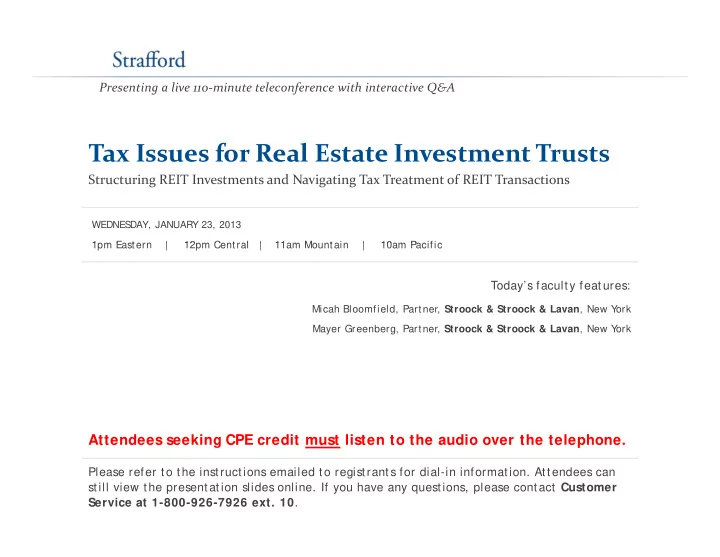
Presenting a live 110 minute teleconference with interactive Q&A Tax Issues for Real Estate Investment Trusts Structuring REIT Investments and Navigating Tax Treatment of REIT Transactions WEDNES DAY, JANUARY 23, 2013 1pm Eastern |


slide-1
SLIDE 1

Presenting a live 110‐minute teleconference with interactive Q&A

Tax Issues for Real Estate Investment Trusts

Structuring REIT Investments and Navigating Tax Treatment of REIT Transactions

1pm Eastern | 12pm Central | 11am Mountain | 10am Pacific WEDNES DAY, JANUARY 23, 2013

Today’s faculty features:

1pm Eastern | 12pm Central | 11am Mountain | 10am Pacific Micah Bloomfield, Partner, Stroock & Stroock & Lavan, New Y

  • rk

, , , Mayer Greenberg, Partner, Stroock & Stroock & Lavan, New Y

  • rk

Attendees seeking CPE credit must listen to the audio over the telephone.

Please refer to the instructions emailed to registrants for dial-in information. Attendees can still view the presentation slides online. If you have any questions, please contact Customer Service at 1-800-926-7926 ext. 10.

slide-2
SLIDE 2

Tips for Optimal Quality

S d Q lit S

  • und Quality

For this program, you must listen via the telephone by dialing 1-866-873-1442 and entering your PIN when prompted. There will be no sound over the web connection. If you dialed in and have any difficulties during the call, press *0 for assistance. Y

  • u may also send us a chat or e-mail sound@

straffordpub.com immediately so we can address the problem we can address the problem.

Viewing Qualit y

To maximize your screen, press the F11 key on your keyboard. To exit full screen, press the F11 key again.

slide-3
SLIDE 3

Continuing Education Credits

FOR LIVE EVENT ONLY

For CLE credits, please let us know how many people are listening online by completing each of the following steps:

  • Close the notification box
  • In the chat box, type (1) your company name and (2) the number of

attendees at your location

  • Click the S

END button beside the box For CPE credits, attendees must listen to the audio over the telephone. Attendees can still view the presentation slides online. Please refer to the instructions emailed to registrants for additional information. If you have any questions, please contact Customer Service at 1-800-926- 7926 ext. 10.

slide-4
SLIDE 4

Program Materials

If you have not printed the conference materials for this program, please complete the following steps:

  • Click on the + sign next to “ Conference Materials” in the middle of the left-

hand column on your screen hand column on your screen.

  • Click on the tab labeled “ Handouts” that appears, and there you will see a

PDF of the slides for today's program.

  • Double click on the PDF and a separate page will open.

Double click on the PDF and a separate page will open.

  • Print the slides by clicking on the printer icon.
slide-5
SLIDE 5

Tax Issues for Real Estate Investment Estate Investment Trusts

January, 23 2013 y

Micah Bloomfield Mayer Greenberg Mayer Greenberg

slide-6
SLIDE 6

The Basic REIT Framework The Basic REIT Framework

  • Organizational Requirements

Organizational Requirements

– Principal requirement is broad ownership

Th B i O ti l R i t

  • Three Basic Operational Requirements

– Assets: Must primarily hold real estate assets – Income: Must primarily earn passive income from real estate Di ib i M di ib f i i – Distribution: Must distribute most of its income to shareholders

6

slide-7
SLIDE 7

Basic REIT Benefits Basic REIT Benefits

  • No entity level tax provided organizational and

No entity level tax provided organizational and

  • perational requirements are met and all income

distributed

  • Access to Capital: May be publicly traded

– Other Master Limited Partnerships and Regulated I t t C i th l t h bli Investment Companies, the only way to have public status and be free from entity-level tax

  • Flexibility: May be any type of U S entity

Flexibility: May be any type of U.S. entity

– Usually organized as corporations or trusts, but may also be LLCs

7

slide-8
SLIDE 8

Some Overlooked REIT Benefits Some Overlooked REIT Benefits

  • Useful vehicle for many international investors to invest in U.S. real

t t hil idi FIRPTA d b h fit t estate while avoiding FIRPTA and branch profits tax

– Domestically controlled REIT not treated as a U.S. real property holding company under FIRPTA – Dividend attributable to sale of U S real estate may be subject to Dividend attributable to sale of U.S. real estate may be subject to branch profits tax

  • Pension-held REITs: Provide a 5% cushion for UBTI-sensitive

taxpayers

– UBTI generally more strict that REIT income rules

  • Especially the case on parking

– Smaller tax-exempt ownership stakes avoid many UBTI issues entirely

  • Not necessaril limited to “traditional” real estate b sinesses
  • Not necessarily limited to “traditional” real estate businesses

– Could include energy, storage, communications, retail, casinos

8

slide-9
SLIDE 9

Organizational Requirements Organizational Requirements

  • Managed by trustees or directors

Managed by trustees or directors

  • Not beneficially owned by five or fewer

persons persons

  • Beneficially owned by 100 or more persons

– Look-through to underlying shareholders for Look through to underlying shareholders for REITs owned by public company

  • Have transferable shares or certificates

ve s e b e s es o ce c es

  • Not a bank or insurance company
  • Taxable as a U S corporation

Taxable as a U.S. corporation

9

slide-10
SLIDE 10

Potential Issues & Structuring Opportunities Potential Issues & Structuring Opportunities

  • Five or fewer provisions as takeover defenses

p

– “Excess share” provisions in articles of incorporation generally restrict number of shares of any single shareholder to 9.9% or less – Not impenetrable: some REITs still implement shareholder rights plans (“poison pills”)

  • Less case law on excess share provisions
  • Finding Shareholders needed to satisfy 100 shareholder

requirement

– Private REITs often engage facilitators to find these Private REITs often engage facilitators to find these investors – Often use special class of stock with aggregate liquidation preference of $100,000 with fixed return in 9-12% range p e e e ce o $ 00,000 w t ed etu 9 % a ge

10

slide-11
SLIDE 11

Asset Tests Asset Tests

  • 75% of value: real estate assets, cash, cash items

– Rev. Rul. 2012-17 money market accounts are now confirmed as cash items

  • No more than 25% of value represented by securities

– No definition of “securities” in REIT rules – RIC rules refer to the SEC Act of 1940 definition

  • The value of any one issuer’s securities may not exceed 5%

y y %

  • f the REIT’s total assets

– In absence of REIT definition, reliance on definition of issuer under § 2(a) of the SEC act of 1940

  • Ownership of any issuer may not exceed 10%
  • No more than 25% of value may be made up of one or more

TRS TRS

11

slide-12
SLIDE 12

Special Asset REITs Special Asset REITs

  • Hotel REITs

– Enabled by TRS related party rent exception – Hotel must be managed by independent contractor. § 856(l)(3).

  • Healthcare REITs

– Recent developments in senior care facilities

  • PLR 201104023: “age in place” senior assisted living facility was

healthcare facility; qualified for TRS related party rent exception

  • But see PLR 2008130015: certain independent living facilities may not

be healthcare facilities

  • Timber REITs

S l f ti b lifi l f l t t t – Sale of timber qualifies as sale of real estate asset – The Service has recently blessed income from sale of carbon credits as “good” income

  • PLR 201123005; PLR 20113005
  • PLR 201123005; PLR 20113005

12

slide-13
SLIDE 13

New Developments in Classifying Real Estate Assets

  • Generally more liberal attitude regarding the classification of

t t l t t t structures as real estate assets

– PLR 201204006: signage structures real estate assets due to inherent permanence – New ruling in the pipeline regarding solar power generating structures New ruling in the pipeline regarding solar power generating structures

  • Facts and circumstances test distinguishing real property from

“assets accessory to the operation of business” under Treas. Reg. 1.856-3(d).

– Context important: solar structures may qualify if used to generate power for REIT owned property, but not in a commercial production facility

  • Uncertain: status of freestanding billboard structures
  • Uncertain: status of freestanding billboard structures
  • PLR 201234006: excess mortgage servicing spreads have been

approved as good real estate assets

13

slide-14
SLIDE 14
  • 75% of gross income must be

real-estate related

Income Tests

  • 95% of gross income must be

passive

  • QRS income is treated as having
  • QRS income is treated as having

been earned directly

  • No more than 1% of gross

i f t income from a property attributable to impermissible tenant services

Satisfy Both Tests: * Rents from Real Property

– Based on single property, not entire REIT

  • Certain hedging income & most

* Real Property Gains (unless prohibited transaction) *Dividends from other REITs *Interest on Real Estate *Foreclosure Property Income *T I I

g g foreign currency gains are excluded from REIT income test calculations

*Temporary Investment Income

14

slide-15
SLIDE 15

The Nebulous Boundary Between Impermissible Tenant Services, Ordinary Bad Impermissible Tenant Services, Ordinary Bad Income, and Good Rent

  • To avoid impermissible tenant services income, must be

p “customary” and not primarily for convenience of tenant

– § 856(d)(7)(C)(i): specifically lists only maid service as § ( )( )( )( ) p y y impermissible tenant service – Comparatively little guidance exists on services provided in more modern buildings and situations g

  • Concierge, technology services, construction management
  • Marketing funds
  • Little guidance on what constitutes a “tenant service”

e gu d ce o w co s u es e se v ce

– PLR 9646027: charges for “courtesy services” not impermissible tenant services income, but bad income

  • Limited to “infrequent, limited, insubstantial” services

ted to eque t, ted, substa t a se v ces

15

slide-16
SLIDE 16

Related Party Rents: Selected Issues Related Party Rents: Selected Issues

  • General exception for TRS: rent paid will qualify if

p p q y 90% of space leased to persons other than TRS or related parties

– Special exceptions for lodging and healthcare facilities p p g g – Calculation is made using leased; not leasable space

  • Attribution rules may create unanticipated related party

rents for multiple partnerships with overlapping rents for multiple partnerships with overlapping

  • wnership

– Under § 318 attribution rules, partner deemed to own what its partners owned its partners owned – § 856(d)(5) substantially relaxes rule: provides only 25%+

  • wnership results in attribution

16

slide-17
SLIDE 17

Parking Problems Parking Problems

  • Rev. Rul. 2004-24 alleviated significant problems, but some issues

i remain

– Now clear that income paid parking, both reserved and unreserved generates good income when connected to leased property – Nebulous standard for valet: unclear when it may be impermissible Nebulous standard for valet: unclear when it may be impermissible services income

  • Requires some safety or capacity justification
  • JV with Tax Exempt

– Tax exempt not covered by Rev. Rul. 2004-24, cannot accept income from paid parking – Related Party Rent problem: the tax-exempt can use a taxable affiliate as a JV partner, but the REIT cannot use a TRS as a JV partner, but the REIT cannot use a TRS

  • Tax exempt related party rent rule requires more than 50%. § 512(b)(13).

17

slide-18
SLIDE 18

Distribution Requirements Distribution Requirements

  • Undistributed income subject to tax at regular corporate tax

rates

  • To retain REIT status, REIT must distribute dividends equal

to at least the sum of:

– 90% of REIT taxable income – 90% of after-tax net income from foreclosure property – Less excess of the sum of certain items of non-cash income over 5% of REIT taxable income

  • 4% additional excise tax if REIT fails to distribute 85% of
  • rdinary income and 95% of capital gain

– Dividends declared by December, but paid in January are credited to the prior tax year. § 857(b)(9)

  • Distribution may not constitute a “preferential dividend”

y p

18

slide-19
SLIDE 19

Planning for the Distribution Requirements d Fi i F il and Fixing Failures

  • “Foot Faults” – inadvertent disproportionate

p p distributions could cause loss of REIT status

– May happen through accidental timing mismatch or miscalculation of the amount due to a shareholder – There are various foot fault relief provisions – Previously, Rev. Proc. 2010-12 provided some relief

  • Allowed certain non-cash transfers to avoid preferential dividend

Allowed certain non cash transfers to avoid preferential dividend treatment

– Only applied to dividends paid prior to the end of 2012

  • Disproportionate distributions and conversions: PLR

p p 20127004: exchange of new class of stock for old class based on value over two-year period in preparation for REIT conversion not preferential dividend p

19

slide-20
SLIDE 20

Use of REIT Subsidiaries Use of REIT Subsidiaries

  • QRS primarily exists to provide limited liability

– May be useful in M&A context

  • PLR 9512020 (one of two active business acquired in spin off transaction

acquired)

  • PLR 9717036 (target qualified as QRS after reverse cash merger)

( g q g )

– Less useful in light of the availability of UPREIT/DOWENREIT structures and LLCs

  • REIT deemed to own proportionate share of partnership or LLC

assets assets

– Issue: partnership or LLC could undertake an action that would cause REIT to fail income or asset tests

  • TRS can generally provide any type of service

TRS can generally provide any type of service

– But see: hotel and healthcare REITs – But see: 100% penalty tax for bad TRS fees

  • Factual examination required

20

slide-21
SLIDE 21

Structuring Considerations Structuring Considerations

  • Use of UPREITs

– Tax deferral: allows REIT sponsors to avoid tax liability if properties sold for cash or swapped with REIT shares M id d f t i iti – May provide edge for property acquisitions – May create conflict between sponsor and shareholders

  • Use of DOWNREITs

Use of DOWNREITs

– Each acquisition results in formation of new partnership – Provides many UPREIT advantages to traditionally t t d REIT structured REITs – Eliminates potential conflict of interest present in UPREITs

21

slide-22
SLIDE 22

Investors Owning Partnerships A B Cash REIT Shares Partnership REIT REIT Shares Cash Interests Real Estate UPREIT

(Umbrella Partnership)

General Partnership Interest

The UPREIT Structure

Assets are held through umbrella partnership rather than directly by REIT.

22

slide-23
SLIDE 23

The Unique Concerns of Pension-Held REITs The Unique Concerns of Pension Held REITs

  • Pension-held REIT if single qualified trust holds 25%

g q

  • f REIT (by value), or qualified trusts (each owning at

least 10%) hold more than 50%. § 856(h)(3).

– Subject to unrelated business transaction income (“UBTI”) j ( ) rules as well as REIT income rules

  • UBTI rules generally less generous than REIT income test rules
  • Maximum of 5% UBTI
  • Non-pension held REIT use may provide alternative to

relying on fractions rule under § 514(c)(9)(E)

– Argument that even pension-held REIT is not a QO and Argument that even pension held REIT is not a QO, and therefore not subject to fractions rule compliance

  • Issue: may be subject to ERISA fiduciary requirements

23

slide-24
SLIDE 24

Selected International Issues Selected International Issues

  • Receipt of capital gains dividend from a REIT may be taxed as

i ff ti l t d t U S t d b i income effectively connected to a U.S. trade or business

– May subject foreign shareholder to U.S. filing requirement – § 897(h) amended in 2004 to treat distribution as ordinary dividends if foreign shareholder has less than 5% interest in a class of stock of a foreign shareholder has less than 5% interest in a class of stock of a publicly traded REIT

  • Sovereign wealth and § 892

– Notice 2007-55: distribution from a lower-tier to upper-tier REIT subject to FIRPTA

  • Notice states that IRS will challenge assertion that 897(h) does not apply to

complete liquidations, or that § 892 exempts a sovereign entity from taxation under FIRPTA

– Proposed regulations relax and clarify rules

  • Interest in a REIT will be subject to tax, but will not cause sovereign wealth

fund to be deemed to engage in “commercial activity” and lose tax status

24

slide-25
SLIDE 25

REIT Mergers and Acquisitions REIT Mergers and Acquisitions

  • The tax-free reorganizations provisions under §

g p § 368 generally apply to REITs along with ordinary C-corporations

REIT merger into non REIT investment company will – REIT merger into non-REIT investment company will not qualify for tax free treatment unless meets definition of “diversified investment company”

  • § 368(a)(2)(F)
  • § 368(a)(2)(F)
  • Most common forms

– Merger of target into acquirer g g q – Merger of target into wholly-owned subsidiary – Merger of subsidiary of acquirer into target

25

slide-26
SLIDE 26

Selected Merger Issues

Target Parent

Selected Merger Issues

  • Availability of the reverse triangular merger (§ 368(a)(2)(E))

Transitory

Sub

– Ex 5 of Treas. Reg. 1.368-2(b) interpreted as limiting reverse triangular merger if both target and acquiring are REITs – Concern: reverse triangular could be used as divisive “A” reorganization with the supposed possibility of earnings and profits reorganization with the supposed possibility of earnings and profits bailout

  • NAREIT comment: No actual danger- earnings and profits would need to be

distributed in the transaction. To the extent danger exists, same issues apply to forward triangular. g

  • Merger of two UPREITs: consolidation of assets into single
  • perating partnership

– Drop down of assets was thought to cause remote continuity of interest bl problem – No longer creates issue due to revised remote continuity of interest

  • regulations. See Treas. Reg. 1.368-1(d)(4)(iii); Rev. Rul. 2002-85 (as

applied to D reorganizations)

26

slide-27
SLIDE 27

REIT Conversions REIT Conversions

  • Several public companies not operating traditional real

estate businesses have recently announced REIT conversions

– Dillard’s Department Stores – Iron Mountain (document storage) – American Tower (communications) – Lamar Advertising (outdoor signage)

  • Two potential types of candidates:

– Non-real estate businesses that can spin off real estate

  • More viable if little accumulated earnings and profits or built-in gain

g p g

– Non-traditional real estate business that may be able to satisfy the REIT income and asset tests

  • Iron Mountain, Lamar Advertising

27

slide-28
SLIDE 28

Pros and Cons of REIT Conversions Pros and Cons of REIT Conversions

Pros: Cons:

  • Potential for substantial entity-

level tax savings k h d

  • Conversion requiring spinoff

may not qualify for tax-free treatment under § 355

Holding of real estate for own

  • Markets have reacted

favorably to conversion announcements

  • Potential management

– Holding of real estate for own use generally will not fulfill “active business” requirement – May be possible to satisfy if

  • ther services are being
  • Potential management

advantages from splitting real- estate and operational aspects

  • f businesses
  • ther services are being

provided

  • See Rev. Rul. 2001-29
  • May cause business to forgo

i i REIT revenue to maintain REIT status

  • Compliance and legal costs

may be high may be high

28

slide-29
SLIDE 29

Case Study: Can Iron Mountain Satisfy h I T ? the Income Test?

  • The company operates differently from

p y p y a traditional storage REITs

– Significant additional services: shipping, doc ment destr ction electronic records document destruction, electronic records, escrow, consulting

  • May need to rely heavily on TRS

y y y

– 25% TRS value limitation may become an issue May reduce TRS valuation through adding – May reduce TRS valuation through adding debt to its TRS

  • Debt from REIT parent may suffice

29

slide-30
SLIDE 30

Some Fixes for Common Problems Some Fixes for Common Problems

  • Failure of 100 shareholder test

– Note: does not need to be satisfied in first year of operation – If failed in subsequent years, can avoid loss of REIT status with $50,000 penalty and reasonable cause

  • Failure of distribution requirement
  • Failure of distribution requirement

– May be able to make a deficiency dividend – Rev. Proc. 2012-12 relief no longer available as of beginning of this year y

  • Failure of 75% asset test

– Pitfall only triggered if failure is caused by acquisition and is not cured within 30 days of end of quarter

  • Failure of 95% or 75% income tests

– Reasonable cause exception can be claimed on line 2f of schedule J of the REIT’s return

30

slide-31
SLIDE 31

Changes on the Horizon Changes on the Horizon

  • Elimination of preferential dividend rule for

p publicly traded REITs.

– Has appeared in the President’s budget in recent years W ld b i t t t f f ti l di id d i li – Would bring treatment of preferential dividends in line with the RIC rules – Political Argument: preferential dividend rule is d d SEC d bl k l i redundant to SEC and blue sky laws protecting shareholders

  • Repeal of Notice 2007-55

p

– NAREIT has requested addition to the IRS’s priority guidance plan

31

slide-32
SLIDE 32

Micah Bloomfield 212 806 6007 212.806.6007 mbloomfield@stroock.com Mayer Greenberg Mayer Greenberg 212.806.6286 mgreenberg@stroock.com www.stroock.com