TASTE LANGUEDOC, TASTE ADVENTURE Leurs Vins Pour Notre Temps - - PowerPoint PPT Presentation

taste languedoc
SMART_READER_LITE
LIVE PREVIEW

TASTE LANGUEDOC, TASTE ADVENTURE Leurs Vins Pour Notre Temps - - PowerPoint PPT Presentation

TASTE LANGUEDOC, TASTE ADVENTURE Leurs Vins Pour Notre Temps Training Presentation Visit us at LanguedocAdventure.com Languedoc Visit us at LanguedocAdventure.com Why Languedoc? History: Oldest Wine Culture in France


slide-1
SLIDE 1

Visit us at LanguedocAdventure.com

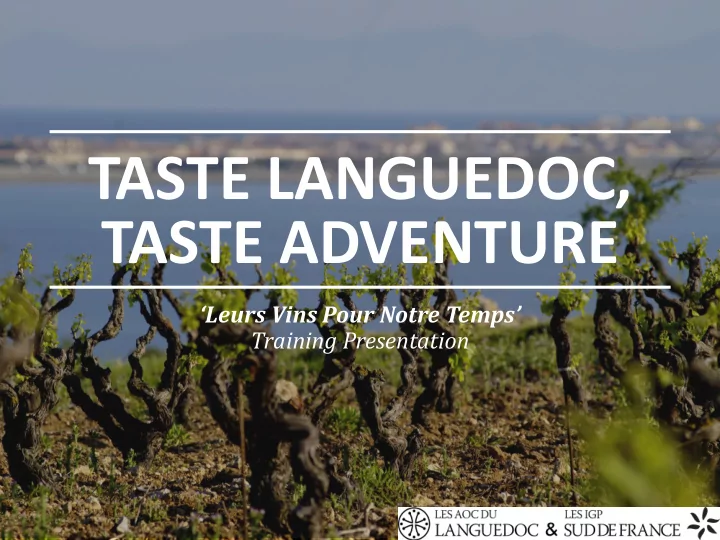
TASTE LANGUEDOC, TASTE ADVENTURE

‘Leurs Vins Pour Notre Temps’ Training Presentation
slide-2
SLIDE 2

Visit us at LanguedocAdventure.com

Languedoc

slide-3
SLIDE 3

Visit us at LanguedocAdventure.com

Why Languedoc?

  • History: Oldest Wine Culture in France
  • Diversity: Soil, Varieties, Traditions
  • Consistency and Quality: no, seriously!
  • Trend Leaders: Rosé and Organic
slide-4
SLIDE 4

Visit us at LanguedocAdventure.com

Languedoc: Key Points

  • Some of the oldest wine regions in Europe
  • Sète – Ancient fishing village, vineyards have been in the area for thousands of years
  • Source of Innovation and Progressive Thought
  • Sparkling Wine – Limoux, 1544 (sorry Dom Pérignon)
  • Gosset, oldest Champagne house founded 1584
  • Mutage developed in 12th century in Montpellier
  • Arnaud de Villeneuve
  • Many wine techniques were “invented” in Languedoc; home to one of the oldest

universities in Europe

  • University of Toulouse 1229 AD
  • Techniques to manage: hydric stress, fermentation temperature control, resistant

varieties and rootstocks…

  • Social Responsibility and equality
  • Cathars - didn’t eat meat, didn’t believe in church buildings, regarded men and

women as equals… 12th – 14th century!

slide-5
SLIDE 5

Visit us at LanguedocAdventure.com

Languedoc: Key Points

  • Largest Quality Wine Region in the world
  • Approximately 1.4 million hectoliters produced in 2018 (of AOC wines)
  • Roughly 15.5 million 9L cases
  • 1/3 of all French wine is from Languedoc-Roussillon
  • Climate is consistent and relatively stable
  • Low rainfall, cooling winds, and long growing season from proximity to the Mediterranean
  • 320 days of sunshine per year, average temperature 15°C/59°F
  • Rosé Takes Center Stage
  • +25% in rosé winemaking in the past two years - Languedoc is the leading producer of rosé

in France

  • Accounts for 30% of total French rosés and 11% of the world’s production.
  • Greatest Number of French Organic Vineyards
  • 29% of all French Organic Vineyards, 6% of global
slide-6
SLIDE 6

Visit us at LanguedocAdventure.com

Languedoc: Key Points

  • The Rise of Languedoc Rosé
  • An increase in production of +68% in two years time
  • Languedoc is the new first name is rosé!

62% = Production share of the regional AOC Languedoc appellation

Rosé production (in hL) from the AOCs of Languedoc

slide-7
SLIDE 7

Visit us at LanguedocAdventure.com

Languedoc: Key Points

  • Organic Leaders
  • Currently the largest organic vineyard area in France, over 22k hectares
  • Thinking long term, planning for the future

29% of all French

  • rganic

viticulture 6% of global

  • rganic

viticulture Largest amount

  • f French

vineyard area currently in conversion (5,829 ha) Double the amount of

  • rganic

vineyard area

The 10 Year Plan

40% of producers with some form of high value certification, such as Terra Vitis 60% of surfaces committed to the process of sustainable development

Now

slide-8
SLIDE 8

Visit us at LanguedocAdventure.com

Languedoc: Location, Influences

Pyrenees Mtns Mediterranean Sea Cevennes Mtns ‘Tramontane’ Wind ‘Marin’ Wind Sunshine, Winds, Little Rainfall and Geological Diversity

slide-9
SLIDE 9

Visit us at LanguedocAdventure.com

Languedoc: Diversity Within

5 Main Zones: Elemental Languedoc

  • Mountain – more continental climates, the

north of the region, often resembles Rhône in profile and structure

  • Coastal – strong Mediterranean influence,

abundant sunshine, more lush, riper styles of wine

  • South – closest to Roussillon AOCs, larger

amounts of Carignan

  • Center – heart of the region, flatter land, more

volume production

  • West – mix of continental and Atlantic

influences, most sparkling wines found here, higher elevation and more diverse meso- and microclimates

Center South Coastal Mountain West

slide-10
SLIDE 10

Visit us at LanguedocAdventure.com

Languedoc: Production and Styles

  • 93% of wines are still
  • 5% sparkling: Mauzac,

Chardonnay, Chenin Blanc, Pinot Noir

  • 2% fortified: Muscats
  • 74% of still wines are red
  • Grenache, Syrah, Mourvèdre,

Carignane, Cinsault, Cinsault…

  • 16% of still wines are rosé
  • 10% of still wines are white
  • Piquepoul, Grenache Blanc,

Bourboulenc, Marsanne, Roussanne, Viognier…

10% 16% 74% Blanc Rosé Rouge

Production breakdown of the Languedoc AOP wines

slide-11
SLIDE 11

Visit us at LanguedocAdventure.com

Languedoc: Regional Breakdown

  • Designations:
  • AOP: Appellation d’Origine Protegée =

about 14% of region’s total production (many still use AOC)

  • IGP: Indication Geographique Protegée

= about 60% of production

  • The Conseil Interprofessionnel des Vins

du Languedoc (CIVL) represents the AOPs and IGPs - But NOT IGP Pays d’Oc

  • Within the AOP segment, Languedoc is

seeing an ongoing evolution of appellations and designations

IGP 60%

26%

AOP 14%

Vins SANS Indication Geographique (ex-Vins de Table) = Vin de France

slide-12
SLIDE 12

Visit us at LanguedocAdventure.com

Languedoc: Prevailing Terroirs

Calcaires / limestones Galets roulés / rolled pebbles Grès / sandstone Schistes/shales Molasses Sandy-clay and clay- limestone soils Generally poor soils, well drained, allows for strong and deep root systems. In general, the darker the soil, the more dense and structured the wine will be.

slide-13
SLIDE 13

Visit us at LanguedocAdventure.com

Languedoc: Misunderstandings

  • “Languedoc is the Wine Lake”
  • Previously known for producing large quantities of wine, new AOC/IGP/Crus help to

promote quality image

  • “Affordable = Cheaply Made”
  • Majority of Languedoc AOC wines are made in styles and using techniques that are

celebrated in more “traditional quality” regions

  • “Wines Are Not Specific to Region They Come From”
  • Garrigue: Mix of herbs that grow wild in the region: rosemary, thyme, sage, lavender,

juniper

  • Soils are diverse and revealed in the quality wines
  • “Nobody Cares About Vineyards in the South”
  • ~30% of France’s organic wine comes from Languedoc
slide-14
SLIDE 14

Visit us at LanguedocAdventure.com

Languedoc: Misunderstandings

  • Evolution – the number of scores for Languedoc AOC wines given by the Wine Advocate
  • 25 fold increase in 5 years
  • Publication now dedicated to reviewing the wines annually
slide-15
SLIDE 15

Visit us at LanguedocAdventure.com

Languedoc: Selling Points

Why should you and your customers choose Languedoc Wines?

  • Features and Benefits
  • Fast growing category → strong interest

in the category, consumers are seeking these out as the new ‘discoveries’

  • Mediterranean influence → Consistency

from year to year

  • Great QPR → consumers will find quality

in each bottle

  • Innovative, dynamic region → exciting,

authentic wine choices (discoveries) that integrate tradition and modernity

slide-16
SLIDE 16

Visit us at LanguedocAdventure.com

Languedoc: Selling points

More reasons to choose Languedoc

  • Blanquette and Crémant de Limoux are

traditional method, sparkling wines (Champagne quality) at much more approachable prices

  • Languedoc’s rosé wines offer Provence style

for more approachable prices.

  • Discovery - Whites and reds offer new grapes

and blends for consumers to enjoy

  • ~30% of all of France’s organic viticulture

comes from Languedoc

slide-17
SLIDE 17

Visit us at LanguedocAdventure.com

Languedoc: The Pitch

What to focus on if you have - 30 seconds with a customer:

  • Languedoc, South of France produces wines of all styles and colors: reds, whites, rosés, sparkling and

sweet wines

  • Proximity to the Mediterranean Sea means vintage consistency, lush flavor profiles, and an

abundance of organic production

  • Key grapes from the region are ones you might already know like Grenache, Syrah and Mourvèdre
  • AOC segment represents top quality
slide-18
SLIDE 18

Visit us at LanguedocAdventure.com

Languedoc: The Pitch

What to focus on if you have - 2 minutes with a customer:

  • Languedoc, South of France produces wines of all styles and colors: reds, whites, rosés, sparkling and

sweet wines

  • Majority of production is red blends
  • Languedoc is also largest producer of French rosé, similar in style to rosés from Provence
  • Mediterranean climate allows for greater vintage consistency than other areas of France
  • Also means an abundance of organic production
  • Key grapes from the region are ones you might already know like Grenache, Syrah and Mourvèdre.
  • Plus new grapes like Piquepoul – a white wine
  • And some of the first sparkling wines in France
  • AOC segment represents top quality
  • Wines showcase notes of garrique (blend of wild herbs: rosemary, thyme, sage), which you cook with,

making these wines great food partners

slide-19
SLIDE 19

Visit us at LanguedocAdventure.com

Languedoc: Key Appellations

slide-20
SLIDE 20

Visit us at LanguedocAdventure.com

Languedoc: Keys Appellations

What are some of the AOCs (AOPs) most commonly seen in the US market?

  • AOC Languedoc (long-dock)
  • Corbières (cor-bee-air) and Corbières Boutenac
  • Faugères (fowj-air)
  • Fitou (fee-too)
  • La Clape (la clap)
  • Limoux (lee-moo) – Blanquette (blonk-ette) or Crémant (cray-mont)
  • Minervois (min-er-vwah) and Minervois la Livinière
  • Muscat de Saint Jean de Minervois
  • Picpoul de Pinet (peek-pool duh pee-nay)
  • Pic Saint Loup (peek-san-loo)
  • Saint-Chinian (san shin-ee-an), Roquebrun and Berlou
  • Terrasses du Larzac (tear-ahs doo lar-zak)
slide-21
SLIDE 21

Visit us at LanguedocAdventure.com

AOC Languedoc

  • AOC Languedoc (established in 2007) – “The Base”
  • What geographical area does this cover: Encompasses all AOC areas within Languedoc-

Roussillon

  • What other name might you see on the label: AOC Coteaux du Languedoc
  • What grapes can be included:
  • Must be a blend of at least 2 approved varieties
  • Reds/Rosés: Grenache Noir (Lledoner Pelut), Syrah, Mourvedre, Cinsault, Carignan
  • Whites: Bourboulenc, Grenache Blanc, Roussanne, Marsanne, Vermentino, Clairette,

Piquepoul

  • Other requirements:
  • All grapes must be grown in AOP delimited areas
  • Can only include approved varieties (this list is smaller than that for IGP wines)
slide-22
SLIDE 22

Visit us at LanguedocAdventure.com

Pic Saint Loup

  • Pic Saint Loup – “Closest to Rhone” – recently elevated to stand alone AOC (2017)
  • Zone: Mountain
  • Only approved for Red (90%) and Rosé (10%) wines. Whites can be AOC Languedoc
  • Rainfall is higher here than other areas, garrigue very noticeable and prevalent
  • Dominated by limestone soils and two particularly large escarpments
  • Key grapes:
  • Reds/Rosés: Grenache, Syrah, Mourvèdre (no more than 80% of any one variety)
  • Notable producers:
  • Chateau de Lascaux
  • Chateau La Roque
  • Chateau de Lancyre
  • Ermitage du Pic St Loup
  • Mas Foulaquier
  • Mas Bruguière
slide-23
SLIDE 23

Visit us at LanguedocAdventure.com

Terrasses du Larzac

  • Terrasses du Larzac – “High quality up and comer”
  • Zone: Mountain
  • Only approved for Red wines. Whites and Rosés can be AOC Languedoc
  • Marked by larger diurnal range, more continental climate
  • Varied soils. Producers regularly harvest at yields lower than permitted maximum = high

quality, much critical acclaim.

  • Key grapes:
  • Reds: Grenache, Syrah, Mourvèdre (min 60%), Carignan, Cinsault (max 30%)
  • Notable producers:
  • La Peira
  • Domaine du Pas de l’Escalette
  • Mas Julien
  • Mas de l’Écriture
slide-24
SLIDE 24

Visit us at LanguedocAdventure.com

Picpoul de Pinet

  • Picpoul de Pinet – “Picpoul, pick moules (mussels)!”
  • Zone: Coastal, Dominated by influence of nearby water, Bassin de Thau and

Mediterranean

  • Only approved for White wines
  • Perfect partners for all seafood
  • Alluvial soils, warm temperate climate
  • Key grapes:
  • White: Piquepoul
  • Notable producers:
  • Les Costières de Pomerols
  • Domaine Félines Jourdan
  • Cave l’Ormarine
  • Chateau Saint Martin de la Garrigue
slide-25
SLIDE 25

Visit us at LanguedocAdventure.com

La Clape

  • La Clape – “Lush reds, unique whites”
  • Zone: Coastal
  • Only approved for Red and White wines. Rosés can be AOC Languedoc. *Home to the

most planting of Bourboulenc anywhere

  • One of the hottest and driest parts of France. Limestone and sand soils
  • Key grapes:
  • Reds: Grenache, Syrah, Mourvèdre (min 70%), Carignan and Cinsault
  • Whites: Bourboulenc*(min 40%), Clairette, Grenache Blanc, Marsanne, Roussanne,

Piquepoul, Rolle

  • Notable producers:
  • Gerard Bertrand
  • Mas du Soleilla
  • Chateau des Karantes
slide-26
SLIDE 26

Visit us at LanguedocAdventure.com

Corbières

  • Corbières – “Heartland of Carignan”
  • Zone: South, AOC Corbières-Boutenac is located within larger Corbières area
  • Approved for Reds (95%), Whites and Rosés
  • Largest appellation in Languedoc – in terms of area and volume of wine produced

(4th largest in France)

  • Windy, hot. Emphasis on Carignan in reds
  • Key grapes:
  • Reds/Rosés: Carignan (max 50%), Grenache, Mourvèdre, Syrah, Lledoner Pelut,

Cinsault (max 20% for reds, max 70% for rosés)

  • Whites: Grenache Blanc, Bourboulenc, Marsanne, Roussanne, Vermentino,

Clairette, Terret, Muscat (max 10%)

  • Notable producers:
  • Ollieux Romanis
  • Domaine de Fontsainte
slide-27
SLIDE 27

Visit us at LanguedocAdventure.com

Fitou

  • Fitou – “Big, hearty reds from the South”
  • Zone: South
  • One of the oldest appellations in Languedoc, only approved for Red wines, others can be

AOC Languedoc or IGP

  • Divided into 2 subzones:
  • Maritime - Soils are clay/limestone near the water
  • Haut - limestone/sandstone more inland
  • All Fitou must undergo a minimum aging period. Cannot be released until May following

vintage and if oak aged, spend a minimum of 12 months in wood

  • Key grapes:
  • Reds: Carignan, Grenache (min 60%), Syrah, Mourvèdre
  • Notable producers:
  • Mont Tauch
slide-28
SLIDE 28

Visit us at LanguedocAdventure.com

Minervois

  • Minervois (Reds (94%), Whites, Rosés) – “Marvelous Minervois”
  • Zone: Center, AOC Minervois la Livinière is located within greater Minervois
  • Varied soils, though predominantly clay/limestone. All vineyards are south facing
  • More emphasis on Syrah compared to neighbor Corbières
  • Key grapes:
  • Reds/Rosés: Syrah, Grenache, Mourvèdre (min 60%), Carignan, Cinsault, Terret,

Aspiran, Piquepoul (max 40%)

  • Whites: Marsanne, Roussanne, Macabeu, Bourboulenc, Clairette, Grenache Blanc,

Vermentino, Muscat à Petits Grains

  • Notable producers:
  • Chateau d’Oupia
  • Chateau Maris
  • Chateau Sainte Eulalie
  • L’Ostal Blanc
slide-29
SLIDE 29

Visit us at LanguedocAdventure.com

Saint-Chinian

  • Saint-Chinian (Reds/Rosés, Whites) – “Naturally intense”
  • Zone: Center
  • Schist soil in the north, clay/limestone to the south. Mediterranean climate
  • Carignan features less than in either Corbières or Minervois
  • Key grapes:
  • Reds/Rosés: Grenache, Syrah, Mourvèdre, Lledoner Pelut (min 70%), Carignan,

Cinsault

  • Whites: Grenache Blanc, Marsanne, Roussanne, Vermentino (90%)
  • Notable producers:
  • Caves de Roquebrun
  • Domaine Rimbert
  • Chateau Viranel
  • Laurent Miquel
slide-30
SLIDE 30

Visit us at LanguedocAdventure.com

Faugères

  • Faugères (Reds/Rosés, Whites) – “Mineral Reds”
  • Zone: Center
  • Schist soils dominate the area, altitude is noticeable compared to nearby areas
  • Combination of wind and soils temper the warm climate’s influence on wines; lots of

minerality

  • Key grapes:
  • Reds/Rosés: Syrah, Grenache, Mourvèdre, Carignan, Cinsault
  • Whites: Grenache Blanc, Roussanne, Marsanne, Vermentino
  • Notable producers:
  • Leon Barral
  • Abbaye Sylva Plana
  • Chateau la Liquière
  • Les Crus Faugères – Mas Olivier
slide-31
SLIDE 31

Visit us at LanguedocAdventure.com

Limoux

  • Limoux (Blanquette, Crémant, still White, still Red) – “The original sparklers”
  • Zone: West
  • More continental climate (cool), soils are limestone with sandstone, quartz and clay
  • Sparkling wines are made in the traditional method, written evidence dating to 1544 (pre-

dates Champagne!)

  • Key grapes:
  • Blanquette: at least 90% Mauzac, up to 10% Chenin Blanc and Chardonnay
  • Crémant: min 40% Chardonnay, balance of Chenin Blanc, Mauzac and/or Pinot Noir
  • Notable producers:
  • Saint Hilaire
  • J. Laurens
  • Antech
  • Gerard Bertrand
  • Domaine Martinolles
slide-32
SLIDE 32

Visit us at LanguedocAdventure.com

Muscats

  • Muscats – “Sweet indulgences”
  • Zone: Central (Muscat Saint Jean de Minervois) and Coastal (others)
  • 4 separate AOCs for production, one single grape permitted: Muscat à petits grains
  • Vins Doux Naturel, must is fortified with grape spirit
  • Finished wines: 11% residual sugar, 15-18% alcohol by volume
  • All grapes must be harvested by hand, no irrigation is allowed

AOCs:

  • Muscat de Saint Jean de Minervois (smallest)
  • Muscat de Frontignan (largest and oldest)
  • Muscat de Lunel
  • Muscat de Mireval
  • Notable producers:
  • Les Vignerons de la Mediterreanée
slide-33
SLIDE 33

Visit us at LanguedocAdventure.com

Today’s Wines

  • Wine 1
  • Wine 2
  • Wine 3 etc.
slide-34
SLIDE 34

Visit us at LanguedocAdventure.com

Today’s Wines

Wine Name with vintage AOC Zone Grapes/Blend SRP Vinification/ Viticulture details Notes on Producer Tasting Notes

slide-35
SLIDE 35

Visit us at LanguedocAdventure.com

Thank you!

For more information on Languedoc Wines, please visit www.languedocadventure.com Follow us: Facebook.com/LanguedocWines Instagram.com/languedocwinesusa