(Tao Te Ching) Victor Frankl: "He who has a Why can bear - - PowerPoint PPT Presentation
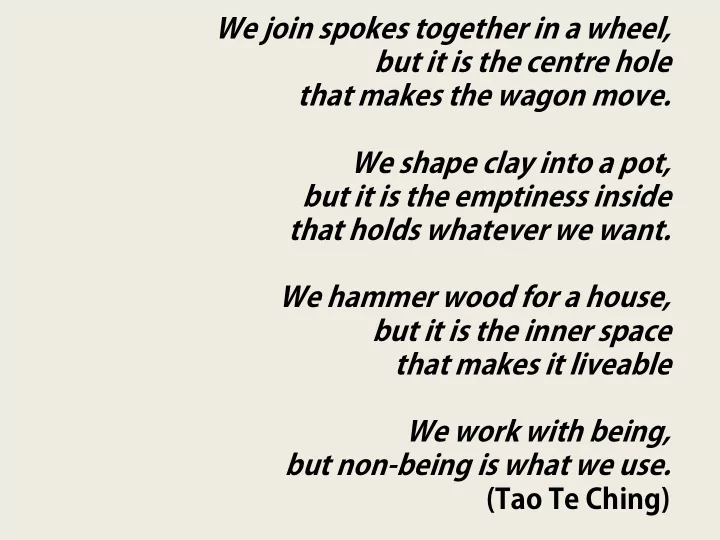
We join spokes together in a wheel, but non-being is what we use. We work with being, that makes it liveable but it is the inner space We hammer wood for a house, that holds whatever we want. but it is the emptiness inside We shape clay into
Victor Frankl: "He who has a Why can bear almost any How"
Outline
- Background & Rationale
- My Study
- Methods
- Results
- Conclusion
First things first: What is spirituality?
- Spirituality is a multi-dimensional and complex concept. In
addition, there appears to be little consensus on the definition of this term (Ho, 2010; Moberg, 2008). Therefore, this dissertation will adopt a broad definition of spirituality which consists of four main themes emphasising a) the essence of being b) the meaning of life c) existential values d) the connection with a higher power/God, with others and with the universe.
Religion and Spirituality are different concepts for different people
- ‘Religiosity’ is related
to the institution of religion, referring to the knowledge, feelings, practices and beliefs of people.
Is it really that important to study spirituality in older men?
- Lack of research
- As one ages, “being” may become more
significant that “doing”.
- A man, who has spent his life working to provide
for a family, being the handyman around the house, and going from task to task, may find this particularly difficult.
- The retirement effect
- Masculine Identity
Global Statistics by Age and Gender World Health Organisation (2000)
Suicide in Later Life by Gender
Why am I studying spirituality through health science?
If suicide stats aren’t enough to convince you...
- Amendment of the WHO definition of health
- Whole person/patient centred care.
“Physical disease may cause difficulty breathing, which is exacerbated by social circumstances as well as feelings of anxiety; but the difficult experience will also be affected by the individual’s sense of hope or awareness of support….how much worse difficulty in breathing will feel if there is no hope of treatment..” (White, 2006, p.26).
How do older men view spirituality and do they see this interacting with their health and well-being? General Literature Review Systematic Review 6 one-on-one semi-structured interviews
My Research
Methodology
- Qualitative, phenomenological research
- Constructivist position: describes and interprets patterns of
meaning in their natural contexts.
- Design and method centred upon individual interviews, with
narrative providing the framework for data collection
- Employs a general inductive approach (Thomas, 2006), for data
analysis
- The importance of considering my role as the researcher
Interviews
- WHO: Older men, aged over 65 years. Living in independent
living of an aged care facility (Selwyn Foundation).
- WHERE: Two large aged care residential villages in
Auckland
- RECRUITMENT: Purposive sampling, then random selection.
Selwyn Foundation staff made first contact.
- HOW: in the men’s homes or in a meeting room at the
village; approximately 1-1.5 hrs. long
i). The Meaning of Spirituality
- definition
- spiritual experiences
- interpretations of spirituality
ii). The Meaning and Significance of Spirituality
- within their family
- as an individual
- in relationships
- in everyday life
- significant moments
iii). The Effect of Spirituality
- on health and well-being?
iv). Views on Spirituality
- have these views changed or changing
- influencing factors on these views
- reasons for change
v). Inadequate spirituality
- anything missing from spiritual life
- what has been lost spiritually
- could anything be improved in life
spiritually vi). Spiritual Challenges
- what challenges your spirituality?
- have there been any particular
experiences, relationships or times in life that your spiritual life was challenged? vii). Spirituality and Religion
- what do you regard as the
relationship between spirituality and religion?
- is there a difference between the
two for you?
- in what instances would you feel
spiritual but not religious, or vice versa?
Results: preliminary findings
- Large variation in defining
spirituality between men
- ‘spirituality’ being a new
age concept that wasn’t about in ‘their day’
- Spirituality became more
important once retired
- While, some men didn’t
agree with the Church, went to services anyway for personal reflection (or because their wife made them)
- All considered spirituality to
play a vital role in their health and saw it as having a positive effect
- Spirituality and religion
were often considered as the same concept. Mutually exclusive.
- Occupation, and connection
with the environment played a role in defining spirituality
Strengths and Limitations
- Strengths:
- systematic review had not been conducted
before.
- first study on healthy, older men
- NZ’s growing interest in the topic
- Limitations:
- researcher bias
- small sample size
- setting
- generalisability of results
Where to next?
- Currently conducting
data analysis
- Aim to publish results
- A new website: