T-08 Acid-Base Indicators and pH Determination & T-09 - - PowerPoint PPT Presentation

t 08 acid base indicators and ph determination amp t 09
SMART_READER_LITE
LIVE PREVIEW

T-08 Acid-Base Indicators and pH Determination & T-09 - - PowerPoint PPT Presentation

T-08 Acid-Base Indicators and pH Determination & T-09 Solubility Rules Place pre-lab report on table for the TA to sign Hand in final lab report Collect lab equipment: One piece of transparency and blank paper per group Even


slide-1
SLIDE 1

1

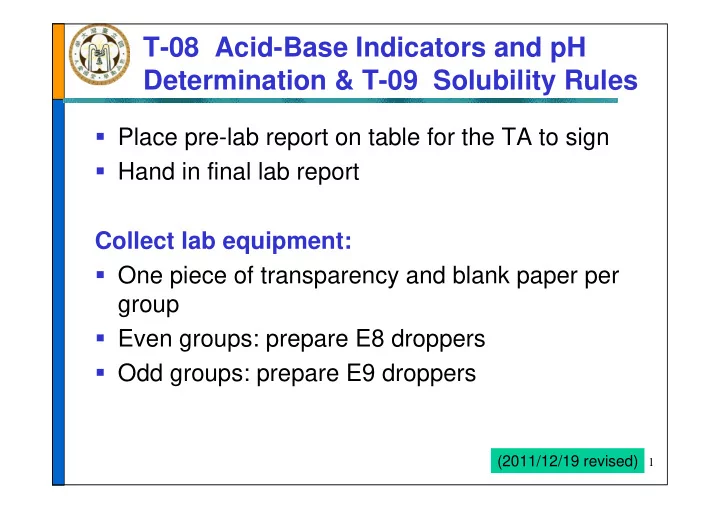
T-08 Acid-Base Indicators and pH Determination & T-09 Solubility Rules

  • Place pre-lab report on table for the TA to sign
  • Hand in final lab report

Collect lab equipment:

  • One piece of transparency and blank paper per

group

  • Even groups: prepare E8 droppers
  • Odd groups: prepare E9 droppers

(2011/12/19 revised)

slide-2
SLIDE 2

2

T-08 Acid-Base Indicators and pH Determination

Objective:

  • To test the pH range of various acid-base indicators.
  • To determine the pH values of salt solutions

Introduction:

  • Acid-base indicators is a weak organic acid (HIn) or
  • rganic base (In)

3 a 3 a

[H O ][In ] K [HIn] [HIn] [H O ] [In ] K [HIn] 10 color of acid form [In ] [HIn] 1 color of base form [In ] 10

     

   

  • +

2 3

Color of acid form Color of base form

HIn + H O In + H O 

slide-3
SLIDE 3

3

Color of Acid-base Indicator Depends on pH of Solution

  • [HIn]≧10[In-]: reveal HIn color
  • [In-]≧10[HIn]: reveal In- color
  • [H3O+] ≧ 10Ka, pH < pKa - 1: HIn color
  • [H3O+] ≦ Ka/10, pH > pKa + 1: In- color

pKa - 1 pKa + 1

Color of acid form

HIn

Color of base form

In

Color-change range Increasing pH

pH = pKa ± 1

slide-4
SLIDE 4

4

pH of Salt Solutions

  • Cation (Na+) of a strong base (NaOH): neutral
  • Anion (Cl-) of a strong acid (HCl): neutral
  • Conjugate base (F-) of a weak acid: basic
  • Conjugate acid (NH4+) of a weak base: acidic
  • Cation (Fe3+) of transitional metals: acidic

Basic anion: F-

(aq) + H2O(l)

HF(aq) + OH-

(aq)

Acidic cation: NH4

+ (aq) + H2O(l)

NH3(aq) + H3O+

(aq)

slide-5
SLIDE 5

5

Procedure 1: Prepare Plastic Droppers

  • Two groups share one set of

plastic droppers

  • Labels each dropper to

indicate the reagents

  • Draw about 1 mL of each

chemicals, invert droppers

  • If the reagent in the dropper

displays unusual coloring:

– Discard the reagents from dropper – Draw clean distilled water from cup – Rinse and discard several times – Fill with fresh reagent

slide-6
SLIDE 6

6

Cleaning Plastic Droppers Correctly

  • Plastic droppers

containing testing reagents should be properly categorized.

  • If a dropper is

contaminated during the experiment, discard the reagent and rinse the dropper several times with distilled water.

Draw Discard

slide-7
SLIDE 7

7

Procedure 2. Add Buffer/Salt Solution onto Transparency

  • Take a piece of

transparency and blank paper per group

  • Add colorless pH and salt

solutions row by row first.

  • Then add the indicators

column by column

  • Keep every drop the same

size

  • Do not touch the solution

drops on the transparency to avoid contamination

slide-8
SLIDE 8

8

Procedure 3: Add Indicators

Do not touch the solution drops on the transparency to avoid contamination

1 2 3

slide-9
SLIDE 9

9

Procedure 4: Record or Take Picture

  • f Color Change
  • Record the color changes
  • Circle the range of color

change for each indicator

  • According to the color change,

determine the pH value of each salt solution

  • Phenolphthalein (alcoholic

solution) has smaller surface tension and tends to spread

  • ut; it can be added last.

pH = 2~4

Record the color changes and determine the pH of the unknown test solution

slide-10
SLIDE 10

10

Procedure 5: Clean & Recycle

  • Using the wash bottle to

rinse the transparency and discard into sink

  • Wipe dry transparency with

paper towel and hand it in along with blank paper

  • Categorize the plastic

droppers that containing testing reagents

  • Invert the plastic droppers

with the opening on top on test tube rack for the next class to use

slide-11
SLIDE 11

11

T-09 Solubility Rules

  • Objective: To verify solubility rules by using this experiment
  • Introduction:

Solubility rules:

NO3

  • : All nitrate salts are soluble

CH3COO-:All acetate salts are soluble Cl-、Br-、I- : All soluble, except for Ag+ , Hg2

2+ , Pb2+

SO4

2-: All soluble, except for Ca2+, Sr2+, Ba2+, Pb2+, Hg2 2+, Ag+

S2-: All sulfides are insoluble, except for group IA, IIA cations and NH4

+

OH-: All hydroxides are insoluble, except for group IA cations and Ca2+, Sr2+, Ba2+ CO3

2-:All carbonate salts are insoluble, except those of group IA cations and NH4 +

PO4

3-: All phosphate salts are insoluble, except those of group IA cations and NH4 +

slide-12
SLIDE 12

12

Procedure 1: Prepare plastic droppers

  • Two groups share one set of

plastic droppers

  • Label the droppers to indicate the

reagents

  • Draw about 1 mL of each

chemicals, invert droppers

  • If the reagent in the dropper

displays unusual coloring or precipitation – Discard the reagents from dropper – Draw clean distilled water from cup – Rinse and discard several times – Fill with fresh reagent

slide-13
SLIDE 13

13

  • Take a piece of transparency

and blank paper per group

  • Add cationic reagents row

by row first

  • Then add the anionic

reagents column by column

  • Keep every drop the same

size

  • Do not touch the solution

drops on the transparency to avoid contamination

Add cationic solutions row by row

Procedure 2: Add the solution

slide-14
SLIDE 14

14

Blank paper as background Black table top as background

Record: (1) any precipitation and color of the precipitate (2) any color change of the solution

Procedure 3: Observe and Record the Precipitation and/or Color Change

slide-15
SLIDE 15

15

  • Rinse the transparency with wash

bottle and collect waste into beaker

  • Discard into waste container

for heavy metals

  • Wipe dry the transparency with

paper towel and hand it in along with blank paper

  • Categorize plastic droppers,

place on table for the next class to use

Procedure 4: Clean & Recycle

slide-16
SLIDE 16

16

Notice

  • Liquid waste that contains heavy waste

must be recycled

  • Hand in transparency after cleaning and

drying

  • Separate and categorize the droppers of

the two experiments.

  • The last class that does the experiment

must empty and categorize the droppers, then tie with rubber band. Hand into the paper box.