1 20.2 20.2 Structure and Reactivity Structure and Reactivity - - PDF document

1
SMART_READER_LITE
LIVE PREVIEW

1 20.2 20.2 Structure and Reactivity Structure and Reactivity - - PDF document

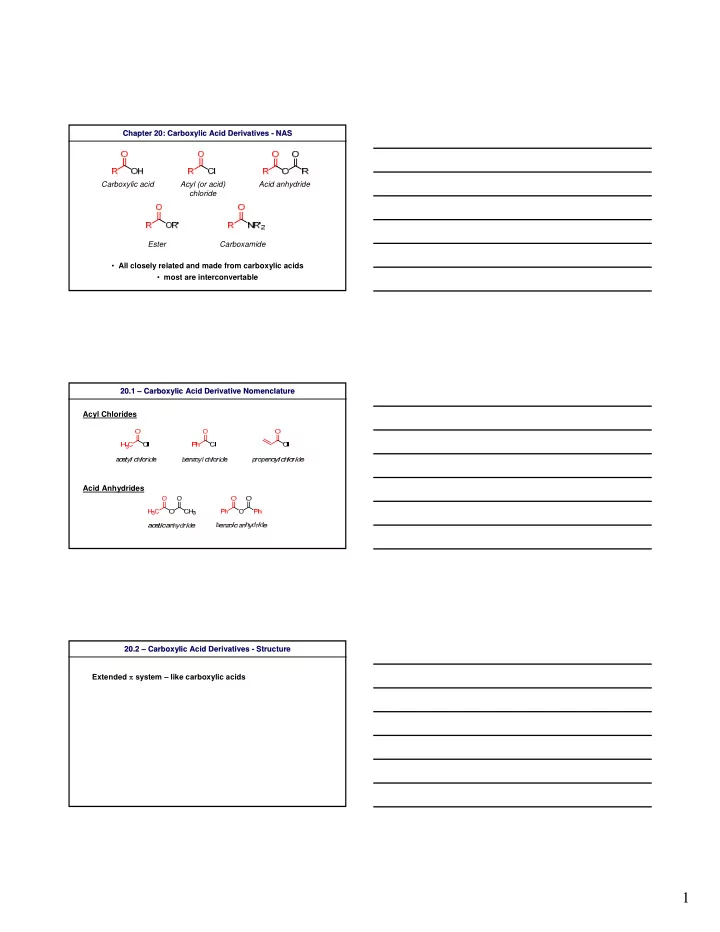
Chapter 20: Carboxylic Acid Derivatives Chapter 20: Carboxylic Acid Derivatives - - NAS NAS Carboxylic acid Acyl (or acid) Acid anhydride chloride Ester Carboxamide All closely related and made from carboxylic acids most are


slide-1
SLIDE 1

1

Chapter 20: Carboxylic Acid Derivatives Chapter 20: Carboxylic Acid Derivatives -

  • NAS

NAS Carboxylic acid Acyl (or acid) chloride Acid anhydride Ester Carboxamide

  • All closely related and made from carboxylic acids
  • most are interconvertable

20.1 20.1 – – Carboxylic Acid Derivative Nomenclature Carboxylic Acid Derivative Nomenclature Acyl Chlorides Acid Anhydrides 20.2 20.2 – – Carboxylic Acid Derivatives Carboxylic Acid Derivatives -

  • Structure

Structure Extended π system – like carboxylic acids

slide-2
SLIDE 2

2

20.2 20.2 – – Structure and Reactivity Structure and Reactivity

  • Fig. 20.2

20.2 20.2 – – Structure and Reactivity Structure and Reactivity Resonance possibilities - acid chlorides and anhydrides

Acid chlorides and acid anhydrides are not stabilized significantly by resonance – quite reactive towards nucleophiles

Resonance possibilities – esters, amides, carboxylates

Increasing delocalization leads to increasing stability and decreasing reactivity

20.2 20.2 – – Structure and Reactivity Structure and Reactivity

slide-3
SLIDE 3

3

20.3 20.3 – – General Mechanism for General Mechanism for Nucleophilic Nucleophilic Acyl Acyl Substitution Substitution

Tetrahedral intermediate

20.4 20.4 – – NAS Using Acid Chlorides NAS Using Acid Chlorides

Tetrahedral intermediate

20.4 20.4 – – NAS Using Acid Chlorides, e.g. Amide Synthesis NAS Using Acid Chlorides, e.g. Amide Synthesis

slide-4
SLIDE 4

4

20.5 20.5 – – Acyl Acyl Substitution in Carboxylic Acid Anhydrides Substitution in Carboxylic Acid Anhydrides

Acetic anhydride Maleic anhydride Synthesis of anhydrides

20.5 20.5 – – Acyl Acyl Substitution in Carboxylic Acid Anhydrides Substitution in Carboxylic Acid Anhydrides

Lab experiment

20.6 20.6 – – Sources of Esters Sources of Esters

slide-5
SLIDE 5

5

20.7 20.7 – – Physical Properties of Esters Physical Properties of Esters 20.10 20.10 – – Reactions of Esters Reactions of Esters

Acid-catalyzed hydrolysis Basic hydrolysis – saponification

20.11 Reactions of Esters with Ammonia and Amines 20.11 Reactions of Esters with Ammonia and Amines

slide-6
SLIDE 6

6

20.12 20.12 – – Thioesters Thioesters

Acetyl coenzyme A

20.13 20.13 – – Amides Amides

Hydrogen bonding

20.13 20.13 – – Amides Amides – – Structure and Synthesis Structure and Synthesis

slide-7
SLIDE 7

7

20.14 20.14 – – Intramolecular Intramolecular Amide Formation Amide Formation – – Lactams Lactams 20.15 20.15 – – Hydrolysis of Amides Hydrolysis of Amides – – not covering not covering 20.16 20.16 – – 20.17 20.17 – – Preparation and Hydrolysis of Preparation and Hydrolysis of Nitriles Nitriles

  • Protonate nitrogen, attack C with water
  • Proton transfer to nitrogen followed by enolization
  • Rest of mechanism the same as the amide hydrolysis
slide-8
SLIDE 8

8

20.18 20.18 – – Addition of Addition of RMgX RMgX to to Nitriles Nitriles – – Not Covering Not Covering