System Dynamics Delays Definition characteristics types & - - PDF document

system dynamics delays
SMART_READER_LITE
LIVE PREVIEW

System Dynamics Delays Definition characteristics types & - - PDF document

1 System Dynamics Delays Definition characteristics types & examples Material Delays pipeline first-order third-order n th -order Information Delays first-order third-order n th -order 2 System


slide-1
SLIDE 1

UniOS-FB9-IMU-BWL/MSWI-Rieger-SS06-WiKyb-05: System Dynamics Basics (Delays) (1 / 8)
1

System Dynamics Delays

Definition

— characteristics — types & examples

Material Delays

— pipeline — first-order — third-order … nth-order

Information Delays

— first-order — third-order … nth-order

2

System Dynamics: Delays

Definition

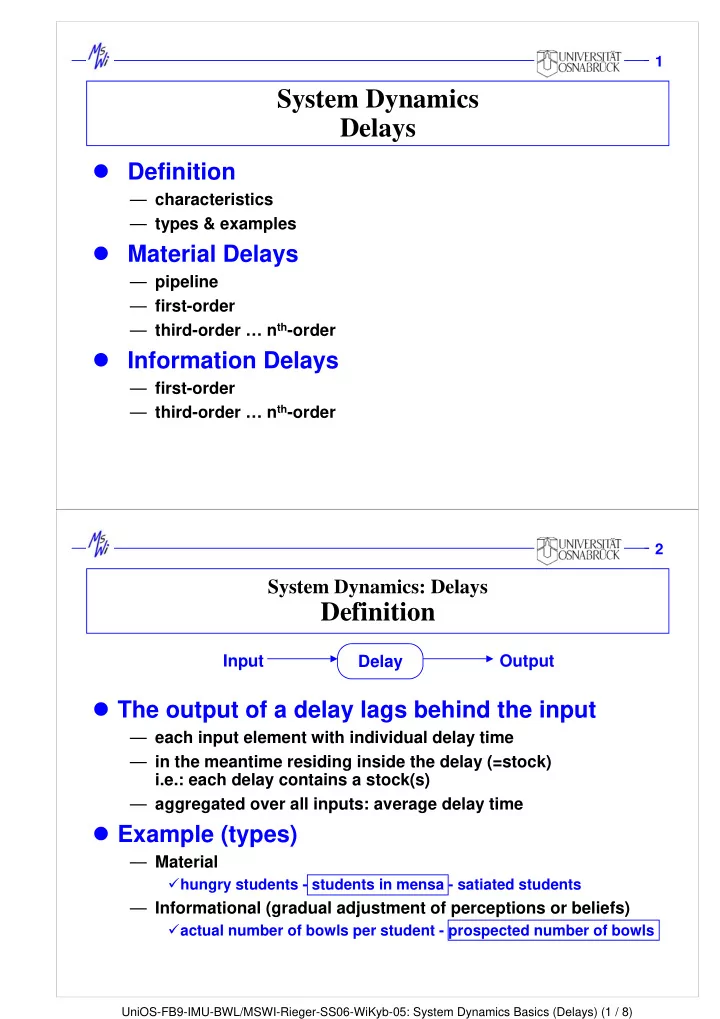
The output of a delay lags behind the input

— each input element with individual delay time — in the meantime residing inside the delay (=stock) i.e.: each delay contains a stock(s) — aggregated over all inputs: average delay time

Example (types)

— Material

hungry students - students in mensa - satiated students

— Informational (gradual adjustment of perceptions or beliefs)

actual number of bowls per student - prospected number of bowls

Input Output Delay

slide-2
SLIDE 2

UniOS-FB9-IMU-BWL/MSWI-Rieger-SS06-WiKyb-05: System Dynamics Basics (Delays) (2 / 8)

3

System Dynamics: Delays

Excursion: PULSE-function

Define non-recurring event (0/1) at <start> (time) for time period <duration>: y = PULSE(start,duration) Example:

  • all students (100%) get hungry at 12°clock

Model equations:

hungry students=PULSE (12,0.1) hungry students

1 0.75 0.5 0.25 2 4 6 8 10 12 14 16 18 20 22 24 Time (Hour) hungry students : Current

4

System Dynamics: Delays

Pipeline Delay (DELAY_FIXED)

  • same delay time for each input

and: each input served FIFO (at once) eating hungry satiated average eating time pipeline delay

2 1.5 1 0.5 11 12 13 14 15 16 Time (Hour) hungry : Current % satiated : Current % eating : Current %

Model equations: average eating time=1 eating= INTEG (hungry-satiated,0) hungry=PULSE(12, 0.01)/0.01 satiated=DELAY FIXED(hungry, average eating time, 0) TIME STEP=0.01

slide-3
SLIDE 3

UniOS-FB9-IMU-BWL/MSWI-Rieger-SS06-WiKyb-05: System Dynamics Basics (Delays) (3 / 8)

5 1st-order material delay

2 1.5 1 0.5 11 12 13 14 15 16 Time (Hour) hungry : Current % satiated : Current % wait and eat : Current %

System Dynamics: Delays

1st-order material delay (DELAY1I)

  • average delay time for all inputs

and: inputs served randomly !

Model equations: average eating time=1 hungry=PULSE(12, 0.01)/0.01 wait and eat= INTEG (hungry-satiated,0) satiated=wait and eat/average eating time

  • der:

satiated=DELAY1I(hungry, average eating time, 0) TIME STEP=0.01

wait and eat hungry satiated average eating time 6

System Dynamics: Delays

higher-order material delays (2nd-order)

  • simply cascading

1st-order delays (assuming cascaded queues)

Model equations: average eating time=1 hungry=PULSE(12, 0.01)/0.01 waiting= INTEG (hungry-served,0) served=waiting/(average eating time/2) eating= INTEG (served-satiated,0) satiated=eating/(average eating time/2) TIME STEP=0.01

waiting hungry average eating time eating served satiated 2nd-order material delay

2 1.5 1 0.5 11 12 13 14 15 16 Time (Hour)

hungry : Current % satiated : Current % waiting : Current % eating : Current %

slide-4
SLIDE 4

UniOS-FB9-IMU-BWL/MSWI-Rieger-SS06-WiKyb-05: System Dynamics Basics (Delays) (4 / 8)

7

System Dynamics: Delays

3rd-order material delay (DELAY3I)

Model equations: average eating time=1 hungry=PULSE(12, 0.01)/0.01 waiting= INTEG (hungry-served,0) served=waiting/(average eating time/3) paying= INTEG (served-paid,0) paid=paying/(average eating time/3) eating= INTEG (paid-satiated,0) satiated=eating/(average eating time/3)

  • der:

satiated=DELAY3I(hungry, average eating time, 0) TIME STEP=0.01

waiting hungry average eating time paying served eating paid satiated 3rd-order material delay

2 1.5 1 0.5 11 12 13 14 15 16 Time (Hour)

hungry : Current % satiated : Current % waiting : Current % paying : Current % eating : Current %

8

System Dynamics: Delays

9th-order material delay

9th-order material delay

2 1.5 1 0.5 11 12 13 14 15 16 Time (Hour)

hungry : Current % satiated : Current % waiting : Current % paying : Current % eating : Current %

waiting hungry average eating time paying served eating paid satiated

  • 3 cascaded

3rd-order delays

Model equations: average eating time=1 hungry=PULSE(12, 0.01)/0.01 waiting= INTEG (hungry-served,0) served=DELAY3I(hungry, average eating time/3, 0) paying= INTEG (served-paid,0) paid=DELAY3I(served, average eating time/3, 0) eating= INTEG (paid-satiated,0) satiated=DELAY3I(paid, average eating time/3, 0) TIME STEP=0.01

nth order with n→∞ ⇒ pipeline

slide-5
SLIDE 5

UniOS-FB9-IMU-BWL/MSWI-Rieger-SS06-WiKyb-05: System Dynamics Basics (Delays) (5 / 8)

9

System Dynamics: Delays

Alternative Delay Distributions (orders of delays)

Alternative Delay Distributions (orders of delay)

2 1.5 1 0.5 11 12 13 14 15 16 Time (Hour)

hungry : Current % satiated0 : Current % satiated1 : Current % satiated3 : Current % satiated9 : Current %

nth order with n→∞ ⇒ pipeline 10

System Dynamics: Delays

VenSim-PLE-Delay Macros

VenSimPLE-Delay-Macros:

— DELAY FIXED pipeline delay (manual initialization) — DELAY1I 1st-order material delay (manual initiatization) — DELAY3I 3rd-order material delay (manual initialization) — DELAY3 3rd-order material delay (with integrated equilibrium initialization)

Delay Equilibrium (Initialization)

— Input = Output — Delay Stock = Input * Average Delay Time — Initializing Delay in Equilibrium:

  • utput

= DELAY3I(input, avg_delay_time, input*avg_delay_time) = DELAY3(input, avg_delay_time)

slide-6
SLIDE 6

UniOS-FB9-IMU-BWL/MSWI-Rieger-SS06-WiKyb-05: System Dynamics Basics (Delays) (6 / 8)

11

System Dynamics: Delays

Example Delay Equilibrium/Initialization

Model Equations: additional beginners=0 avg time of studies=9 beginners=500+STEP(additional beginners, 10) graduates=DELAY3(beginners, avg time of studies) … (s.left below) …

students beginners graduates avg time of studies additional beginners Example Delay equilibrium/initialization

1,000 6,000 500 3,000 10 20 30 40 50 60 70 80 90 100 Time (Month)

beginners : add100 graduates : add100 students : add100 students : init0

Correct Equilibrium Initialization:

students= INTEG (+beginners-graduates, beginners*avg time of studies)

Wrong Equilibrium Initialization:

students= INTEG (+beginners-graduates, 0)

12

System Dynamics: Delays

Information Delay (Exponential Smoothing)

gradual adjustment of perceptions or beliefs perception/belief = delay stock!

Perception Actual Value Gap Adjustment Time Adjust ment +

  • +
  • Exponential Smooth

200 170 140 110 80 5 10 15 20 25 30 35 40 45 50 Time (Month) Actual Value : Current Perception : Current

Model equations: Actual Value=100+STEP(50, 5) Adjustment=Gap/Adjustment Time Adjustment Time=6 Gap=Actual Value-Perception Perception= INTEG (Adjustment,Actual Value)

  • der:

Perception=SMOOTH(Actual Value, Adjustment Time)

slide-7
SLIDE 7

UniOS-FB9-IMU-BWL/MSWI-Rieger-SS06-WiKyb-05: System Dynamics Basics (Delays) (7 / 8)

13

System Dynamics: Delays

VenSim-PLE-SMOOTH Macros

VenSimPLE-SMOOTH-Macros:

— SMOOTH 1st-order exponential smoothing (with integrated initialization) — SMOOTHI 1st-order exponential smoothing (manual initialization) — SMOOTH3I 3rd-order exponential smoothing (manual initialization)

Exponential Smoothing Analogy

— Outputt = Outputt-1 + (Inputt-Outputt-1)/AdjustmentTime = Outputt-1 + (Inputt-Outputt-1)*(1/AdjustmentTime) — mit SmoothFactor = 1/AdjustmentTime: — Outputt = SmoothFactor * Inputt + (1-SmoothFactor) * Outputt-1

14

System Dynamics: Delays

Delay Behaviour

Delay Comparison

200 170 140 110 80 2 4 6 8 10 12 14 16 18 20 22 24 26 28 30 Time (Month) Actual Value : Current smooth1 : Current smoth3 : Current

delay time =6 delay time =6 delay time =6

63% 86% 95%

smooth1(t>=5) = a + bt * ( 1 - exp(-(t-5)/delaytime) ) a b

slide-8
SLIDE 8

UniOS-FB9-IMU-BWL/MSWI-Rieger-SS06-WiKyb-05: System Dynamics Basics (Delays) (8 / 8)

15

System Dynamics: Delays

Material Delays Summary

Vergleich Delay1 und Delay3

200 175 150 125 100 3 6 9 12 15 18 Time (Month) Zuflußrate - BASIS Abflußrate Delay1 - BASIS Abflußrate Delay3 - BASIS Pipe line Abfluß rate Delay3 RT2 Delay 3 RT1 Delay 3 LV3 Delay3 LV2 Delay3 LV1 Delay3 Abfluß rate3 Abfluß rate1 Verzögerungszeit Abfluß rate Delay1 Zufluß rate LV Delay1

16

SMOOTH3: Die Glättung 1. bis 3. Ordnung

200 175 150 125 100 3 6 9 12 15 18 Time (Month)

Input - BASIS LV1S3 - BASIS LV2S3 - BASIS LV3S3 - BASIS Output Smooth3 - BASIS

System Dynamics: Delays

Information Delays Summary

RT2 S3 RT1 S3 Input RT3 S3 Glättungs faktor LV3S3 LV2S3 LV1S3 Output Smooth 3 Output Smooth Delta Smooth LV Smooth Verzögerungszeit