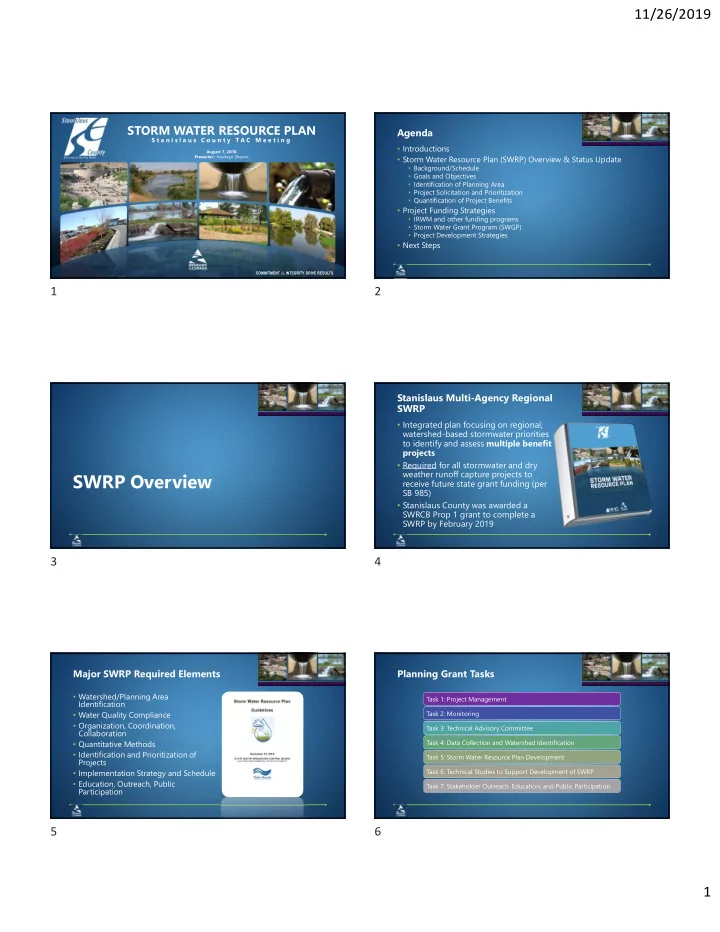
SWRP Overview receive future state grant funding (per SB 985) - - PDF document

swrp overview
SMART_READER_LITE
LIVE PREVIEW

SWRP Overview receive future state grant funding (per SB 985) - - PDF document

11/26/2019 STORM WATER RESOURCE PLAN Agenda S t a n i s l a u s C o u n t y T A C M e e t i n g Introductions August 7, 2018 Presenter: Hawkeye Sheene Storm Water Resource Plan (SWRP) Overview & Status Update


slide-1
SLIDE 1

11/26/2019 1

STORM WATER RESOURCE PLAN

August 7, 2018 Presenter: Hawkeye Sheene

S t a n i s l a u s C o u n t y T A C M e e t i n g

COMMITMENT & INTEGRITY DRIVE RESULTS

Agenda

  • Introductions
  • Storm Water Resource Plan (SWRP) Overview & Status Update
  • Background/Schedule
  • Goals and Objectives
  • Identification of Planning Area
  • Project Solicitation and Prioritization
  • Quantification of Project Benefits
  • Project Funding Strategies
  • IRWM and other funding programs
  • Storm Water Grant Program (SWGP)
  • Project Development Strategies
  • Next Steps

SWRP Overview

Stanislaus Multi-Agency Regional SWRP

  • Integrated plan focusing on regional,

watershed-based stormwater priorities to identify and assess multiple benefit projects

  • Required for all stormwater and dry

weather runoff capture projects to receive future state grant funding (per SB 985)

  • Stanislaus County was awarded a

SWRCB Prop 1 grant to complete a SWRP by February 2019

Major SWRP Required Elements

  • Watershed/Planning Area

Identification

  • Water Quality Compliance
  • Organization, Coordination,

Collaboration

  • Quantitative Methods
  • Identification and Prioritization of

Projects

  • Implementation Strategy and Schedule
  • Education, Outreach, Public

Participation

Planning Grant Tasks

Task 1: Project Management Task 2: Monitoring Task 3: Technical Advisory Committee Task 4: Data Collection and Watershed Identification Task 5: Storm Water Resource Plan Development Task 6: Technical Studies to Support Development of SWRP Task 7: Stakeholder Outreach, Education, and Public Participation

1 2 3 4 5 6

slide-2
SLIDE 2

11/26/2019 2

Project Timeline

Establish TAC Develop SWRP Components and Protocols Solicit and Prioritize Projects Draft Storm Water Resources Plan Address Comments on Plan Final Storm Water Resources Plan

JAN-FEB OCT-DEC APR- SEPT AUG-NOV AUG OCT-JAN 2018

Anticipated funding solicitation

2017 2019

SWRP Goals/Objectives

Stanislaus SWRP Goals and Objectives

  • Provide regional watershed-based planning to address

challenges and opportunities for managing stormwater and dry weather runoff

  • Identify and prioritize stormwater and dry weather runoff

projects that provide multiple benefits to help achieve watershed and regional planning goals

Environment Community Flood Management Water Quality Water Supply

Identification of Planning Area & Priorities

SWRP Planning Area & Water Resource Priorities

  • Implement water quality

improvements to support TMDL goals

  • Reduce pollutant discharges

into 303(d) listed impaired water bodies

  • Augment water supply by

capturing stormwater or dry weather runoff for recharge into a groundwater basin (where feasible)

  • Provide SWRP benefits to

disadvantaged communities and economically distressed areas

Project Solicitation and Prioritization

7 8 9 10 11 12

slide-3
SLIDE 3

11/26/2019 3

Project Solicitation Process

  • Solicitation period October

through December 2017 using Opti

  • Projects were prioritized
  • Benefits were summarized
  • Prioritized Project List

submitted to SWRCB January 2018

www.eaststanirwm.org/projects

Projects Submitted

  • 58 projects eligible for SWRP
  • 17 projects were considered “Ready to Proceed”
  • 41 projects were conceptual

Project Benefits

SWRP Project

Water Quality Water Supply Flood Management Environment Community

SWRP Main Benefits

Benefit Category Main Benefit Water Quality Increased filtration and/or treatment of water Water Supply Water supply reliability Conjunctive Use Flood Management Decreased flood risk by reducing runoff rate and/or volume Environmental Environmental habitat protection and/or improvement, including:

  • Wetland enhancement/creation;
  • Riparian enhancement; and/or

Instream flow improvement Increased urban green space Community Employment opportunities provided Public education

SWRP Additional Benefits

Benefit Category Additional Benefit Water Quality Nonpoint source pollution control Reestablished natural water drainage and treatment Water Supply Water conservation Flood Management Reduced sanitary sewer overflows Environmental Reduced energy use, greenhouse gas emissions, or provides a carbon sink Reestablishment of natural hydrograph Water temperature improvements Community Community involvement Enhance and/or create recreational and public use areas

Project Prioritization Approach

  • Eligible Projects receive credit for:
  • Providing SWRP Main Benefits and Additional Benefits
  • Addressing regional watershed priorities
  • Progress towards project implementation
  • Projects are prioritized based on points awarded to each project
  • Project scores are intended as a tool for the Project Proponents
  • Scores do not dictate which projects receive future funding

13 14 15 16 17 18

slide-4
SLIDE 4

11/26/2019 4

Quantified Project Benefits

  • Summarized using maps and tables
  • Broken down by benefit category (see handouts)

Project Funding Strategies

IRWM Funding Opportunities

  • IRWM Implementation Funding
  • Draft PSP – September 2018
  • Final PSP – late 2018
  • Pre-application workshops – February-July 2019
  • Applications due – ~8 weeks after pre-application workshop
  • At least 10% of overall IRWM implementation funding

set aside for DAC IRWM Round 2 Funding Process

Fall 2018 Spring 2019 Summer 2019

IRWM DAC Funding Opportunities

  • IRWM DAC Involvement
  • $3.1 to the San Joaquin River Funding Area – 7 IRWM

regions

  • Submitted and contract is expected in September
  • Work is expected to start in October
  • IRWM DAC Implementation Funding
  • At least 10% of overall IRWM implementation funding

set aside for DAC Other Funding Opportunities

Multiple benefit projects = funding opportunities

  • utside of usual stormwater suspects
  • Examples:
  • California Natural Resources Agency
  • $7.0 million for the acquisition, restoration, protection and

development of river parkways – due 9/27

  • Hazard Mitigation Assistance Programs
  • Transportation funds
  • Upcoming parks bonds measure

19 20 21 22 23 24

slide-5
SLIDE 5

11/26/2019 5

Prop 1 Storm Water Grant Program

Prop 1 Storm Water Program

  • Overview/Review of Prop 1 Storm Water Program
  • Overall Program Requirements & Priorities
  • Multiple Benefits Requirements
  • SWRP Requirements
  • Development Strategies for Potential Grant

Projects

  • Projects Identification
  • Project Development
  • Storm Water Resource Plan
  • Scheduling
  • Questions/Proposed Projects Discussion

26 27

Prop 1 Storm Water Program Project Funding Breakdown

Project Type Minimum Grant Amount Maximum Grant Amount Implementation $250,000 $10,000,000

Round 2 Funding Availability – Projected to be up to $86 million

Match Requirement

  • Minimum local funding match of 50% of the total project cost. (Reduced for DACs)
  • Matching costs can be included for project activities after 11/04/2014.
  • State funds cannot be included as match.

Prop 1 Storm Water Program Anticipated Timeline

Date Board Adoption of Guidelines 12/15/2015 Round 2 Solicitation Opens for Implementation Projects1 Early 2019 Solicitation Closes for Implementation Projects To be announced Implementation Project Funding Lists Available To be announced Storm Water Resource Plan Requirement Due2 90 days after funding list

Based on Round 1 Process: 1. Pre-application process -SWRCB may review all completed short applications and give feedback to help applicant craft a stronger project. 2. The SWRCB is giving applicants 90 days after Implementation Funding List for application to submit the self-certified required SWRP (or functional equivalent) with proposed project incorporated. 28

Prop 1 Storm Water Program Grant Eligibility

Eligible Applicants*

  • Public Agencies
  • 501(c)(3) Nonprofits
  • Public Utilities
  • Indian Tribes
  • Mutual Water Companies

Other groups could potentially be involved as project partners

Source: Prop 1 Storm Water Grant Program Final Guidelines by SWRCB

29 *Must show capacity to manage grant

Prop 1 Storm Water Program Implementation Project Requirements

Source: Summarized from Prop 1 Storm Water Grant Program Final Guidelines by SWRCB

30

  • Be included and implemented in an adopted IRWMP
  • Be included in a SWRP consistent with the Water Code requirements

and SWRP Guidelines

  • Be consistent with the applicable water quality control plan (Basin

Plan) adopted by the SWRCB and/or Regional Water Board

  • Demonstrate the capability of contributing to sustained, long-term

water benefits for a minimum period of 20 years

  • Be operated and maintained for the project’s useful life
  • Demonstrate adequate rights of way for the useful life (i.e., 20-years)
  • f the project
  • Be multi-benefit project containing a minimum of two benefits listed

in Section G – Storm Water Management Benefits

25 26 27 28 29 30

slide-6
SLIDE 6

11/26/2019 6

Prop 1 Storm Water Program Priorities and Preferences

  • Preference will be given to projects that capture and “re-purpose” storm water for a variety of

potential benefits, including (but not limited to) water supply, flood control, habitat enhancement/ restoration, and creating green spaces.

  • Preference will also be given to projects that include partnerships between the organizations that

are responsible for or have a role in realizing the multiple benefits identified in the project application.

  • Applicants should look for new and innovative technologies or practices to meet the

aforementioned goals.

MEANING

In addition to stormwater requirements, successful projects will likely also include

  • Watershed or large/regional-level partnerships
  • Stormwater capture and reuse
  • New/innovative methods

Prop 1 Storm Water Program Implementation Project Types

Source: Prop 1 Storm Water Grant Program Draft Guidelines by SWRCB

32

Specific types of eligible projects include:

  • Green Infrastructure
  • Rainwater and stormwater capture
  • Stormwater treatment facilities
  • Demonstration or pilot projects

designed to lead to widespread implementation of the practice throughout the watershed

  • And more!

Prop 1 Storm Water Program Storm Water Management Benefits

  • Project must address two to three storm

water management benefits

  • Primary (Main) Benefit
  • Must be quantifiable
  • Secondary Benefits
  • One to Two Benefits
  • Quantifiable or Non-Quantifiable
  • Application:
  • Estimate annual quantifiable benefits
  • Reference backup documentation
  • Calculate cost effectiveness
  • Narrative description of any non-quantifiable benefit

claimed.

Source: Prop 1 Storm Water Grant Program Final Guidelines by SWRCB

33 SWRP Project

Water Quality Water Supply Flood Managem ent Environ- ment Com- munity

Prop 1 Storm Water Program Storm Water Resource Plan Requirement

  • Implementation projects must be listed

in the SWRP or equivalent plan

  • A project must be specifically listed or

included as a programmatic element of a SWRP .

  • Programmatic element projects must be

designed to achieve specific quantified performance goals identified in the SWRP (or functionally equivalent plan).

  • The only exceptions are: (1) a small DAC

<20,000 people, and (2) for projects that are in an ASBS and are covered under an approved ASBS Compliance Plan.

34

Prop 1 Storm Water Grant Program Project Development Strategies

Prop 1 Storm Water Program Project Development

Does the proposed project follow the intent of Prop 1 and comply with SWRCB requirements and preferences?

Be designed to infiltrate, filter, store, evaporate, treat, or retain stormwater

  • r dry weather runoff

Respond to climate change Contribute to regional water security Contain a minimum of two Stormwater Management Benefits Capture and “re-purpose” stormwater for a variety of potential benefits, including (but not limited to) water supply, flood control, habitat enhancement/restoration, and creating green spaces Include partnerships between the organizations that are responsible for or have a role in realizing the multiple benefits identified in the project application Include new and innovative technologies or practices to meet the aforementioned goals

36

31 32 33 34 35 36

slide-7
SLIDE 7

11/26/2019 7

Prop 1 Storm Water Program Project Development

Identify other potential project partners and/or projects that can strengthen project

  • Projects/Partners may add/strengthen multiple benefits
  • Projects/Partners may broaden geographic scope to

watershed/region

  • Projects/Partners may help applicant develop matching funds with

funds or in-kind assistance

  • Projects/Partners may improve potential DAC consideration
  • If not partnering, are there agencies or groups that may offer this

project a letter of support?

37

Prop 1 Storm Water Program Project Development – DACs & EDAs

Disadvantaged Communities (DAC) and Economically Distressed Areas (EDA) Projects that DIRECTLY benefit DACs or EDAs receive special consideration in funding

  • Matching Requirement (50%) reduced for projects that directly benefit

a DAC or EDA – as little as 10%

  • Calculated via community size, MHI, and how much of the project is in the DAC
  • Project scores higher (15 of 100 points for DACs)
  • For other funding programs, percentage of funding set aside for DACs
  • DAC Mapping Tool - https://gis.water.ca.gov/app/dacs/

38

Prop 1 Storm Water Program Project Development – Matching Costs

Matching Costs = 50% project funding

  • Can you leverage some of required matching

costs:

  • Applicable costs that are being/have been tracked

since November 2014 or can be tracked moving forward

  • Non-state funding sources (EPA, DOT, etc.)
  • Partnerships or leveraged projects

Note that a $2 million project requires $1 million in matching, so if the scope is broadened, additional work can be included as match, but the new project must meet all requirements and be in SWRP .

39

Prop 1 Storm Water Program Project Development

Project Timeline

  • Is the proposed project far enough in development/ design for

Round 2?

  • Can project scope, cost, timeline, quantifiable benefits, and accompanying

plans/graphics be included in the pre-application (if offered) and clarified in the full application?

  • Can the project be constructed within approximately 4 years?
  • If not, can project be phased?

Round Award Construction Complete Final Report Work Completion Final Invoice Implementation Round 1 Fall 2016 July 2020 September 2020 October 2020 November 2020 Implementation Round 2 ESTIMATED 2019 ESTIMATED 2023 ESTIMATED 2023 ESTIMATED 2023 ESTIMATED 2023

40

Next Steps

  • Complete Administrative Draft, Public Draft and Final Draft
  • Complete SWRP website
  • Assess stormwater capture/groundwater recharge sites
  • Developing scope of work, assessment this summer/fall
  • Conduct stormwater monitoring
  • Monitoring will occur early rainy season (October 2018-January 2019)

The SWRP will be completed so that included projects will be eligible for SWGP and IRWM Implementation Funding in late 2018/early 2019

Questions/Comments?

Hawkeye Sheene 415.321.3427 hsheene@woodardcurran.com Woodard & Curran

37 38 39 40 41 42

slide-8
SLIDE 8

11/26/2019 8

SWRP Planning Area: Stanislaus County

  • Main Watersheds:
  • 1. Middle San Joaquin – Lower

Merced – Lower Stanislaus

  • 2. Panoche – San Luis Reservoir
  • Other Watersheds
  • Upper Tuolumne, Upper

Stanislaus, Upper Merced, Lower Calaveras – Mormon Slough

SWRP Planning Area: Stanislaus County

  • East Stanislaus and Westside San

Joaquin IRWMP areas

  • Stanislaus and Tuolumne Rivers

Groundwater Basin Association, Turlock Groundwater Basin Association, and San Luis & Delta-Mendota Water Authority groundwater management plan area

SWRP Planning Area: Stanislaus County Coordination between concurrent water resource planning areas facilitates effective regional water planning SWRP Planning Area: Water Quality Priorities

  • Total Suspended Solids
  • Mercury / Methylmercury
  • Diazinon
  • Chlorpyrifos
  • Diuron
  • Total Nitrogen

Project Prioritization

  • [A Storm Water Resource Plan] shall use measurable factors to

identify, quantify, and prioritize potential stormwater and dry weather runoff capture projects. (Wat. Code, § 10562, subd. (e).)

  • Project Eligibility (Fatal Flaw Analysis)
  • Each Project must meet all of the following:

Can the project be sponsored by an eligible applicant? Yes/No Is the project a stormwater or dry weather runoff project? Yes/No Does the project provide two or more SWRP Main Benefits? Yes/No Does the project provide at least one SWRP Additional Benefit? Yes/No

Water Quality Benefits

  • 13 Ready to proceed projects
  • 29 Concept projects

SWRP Benefit Conceptual Ready to Proceed Total Reduction in TSS loading (lbs/yr) 204,100 750 204,850 Trash removed (lbs/yr) 5,100 100 5,200 Volume of water treated (mgd) 510 10 520 Volume of runoff infiltrated (AFY) 2,582 3,042 5,624

43 44 45 46 47 48

slide-9
SLIDE 9

11/26/2019 9

Map: Projects with Water Quality Benefits Water Supply Benefits

  • 14 Ready to proceed projects
  • 28 Concept projects

SWRP Benefit Conceptual Ready to Proceed Total

Increase in water supply through direct groundwater recharge (AFY) 19,332 19,542 38,874 Increase in water supply through direct use (AFY) 2,572 101,000 103,572 Increase in water supply through in lieu recharge/conjunctive use (AFY) 15,000 10,000 25,000 Reduction in water use (AFY)

  • 240

240

Map: Projects with Water Supply Benefits Flood Management Benefits

  • 11 Ready to proceed projects
  • 27 Concept projects

SWRP Benefit Conceptual Ready to Proceed Total

Reduction in peak flow discharge (cfs) 145 2,685 2,830 Reduction in volume of potential flood water (AFY) 2,662 25,052 27,714 Reduction in sewer overflow volumes (AFY) 7

  • 7

Map: Projects with Flood Management Benefits Environmental Benefits

  • 9 Ready to proceed projects
  • 14 Concept projects

SWRP Benefit Conceptual Ready to Proceed Total

Habitat protected or improved (acres) 50 3,513 3,563 Instream flow rate improvement (cfs) 65 15 80 Energy consumption reduced (KWH/year) 525,000 997,500 1,522,500 GHG emissions reduced (tons/year) 391 743 1,134

49 50 51 52 53 54

slide-10
SLIDE 10

11/26/2019 10

Map: Projects with Environmental Benefits Community Benefits

  • 6 Ready to proceed projects
  • 13 Concept projects

SWRP Benefit Conceptual Ready to Proceed Total

Number of employment opportunities provided

  • 4

4 Participants per year 62 200 262 Number of outreach materials provided or events conducted

  • 27

27 Estimated visits per year 20,250 10,200 30,450

Map: Projects with Community Benefits Projects with TMDL and 303(d) List Benefits Stormwater Capture and Recharge Projects Multi-Benefit Projects

55 56 57 58 59 60