Sustainable M&E Through PDD- Based Capacity Building Hillary - - PowerPoint PPT Presentation

sustainable m e through pdd based capacity building
SMART_READER_LITE
LIVE PREVIEW

Sustainable M&E Through PDD- Based Capacity Building Hillary - - PowerPoint PPT Presentation

Sustainable M&E Through PDD- Based Capacity Building Hillary Eason Knowledge, Innovation, and Technology Team October 23, 2018 Local partner M&E technology needs dont always Local Local You partner partner end with your

slide-1
SLIDE 1

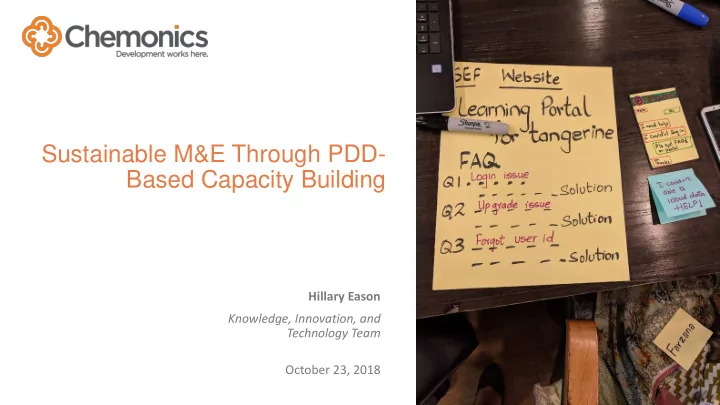
Sustainable M&E Through PDD- Based Capacity Building

Hillary Eason Knowledge, Innovation, and Technology Team October 23, 2018

slide-2
SLIDE 2

M&E technology needs don’t always end with your project.

You

Local partner Local partner Local partner Local partner

slide-3
SLIDE 3

But just handing over the platforms you use may not be enough.

Project scope changes Project context changes Technology itself changes

slide-4
SLIDE 4

And your counterparts may or may not be comfortable working with technology.

Your M&E tech Your counterpart

slide-5
SLIDE 5

So how do you ensure that appropriate and responsible M&E technology continues to be used in the future?

slide-6
SLIDE 6

Focus on local capacity-building

  • Partners should be able to not only

use whatever tech you give them, but also choose MEL technology

  • n their own in the future.
  • There’s a framework available that

can help you do just that.

slide-7
SLIDE 7

Why use the PDD for this?

  • Widely accepted
  • Applicable across a broad cross-section of projects
  • Easy to understand (even for people with limited tech experience)
slide-8
SLIDE 8

What does this look like in practice?

Short: session/briefing

  • “Here’s how we made these

decisions, keep these Principles in mind”

Medium: training

  • “Here are some of the

Principles that might come up in future”

Long: full workshop

  • “Here’s how you can use

the PDD from start to finish in choosing technology”

slide-9
SLIDE 9

Case Study: “Choosing and Using Technology” workshop

  • Context
  • Done in conjunction with USAID’s Sindh Reading Project
  • Training was given to a partner NGO, Sindh Education Foundation, as part of a

handover process for a custom version of Tangerine (tablet-based assessment tool)

  • Workshop provided for MEL staff, training team, assessment team, and IT
slide-10
SLIDE 10

Case Study: “Choosing and Using Technology” workshop

GOAL: Partners have the capacity to make decisions about MEL technology in the future. PDD Guidelines for appropriate technology selection Human-centered design Framework and tools for designing with the user

slide-11
SLIDE 11

Case Study: “Choosing and Using Technology” workshop

Day 1

  • Introduction to the Principles
  • Context Analysis

Day 2

  • Defining Problem, User,

and Design Criteria

Day 3

  • Ideating, Prototyping, Piloting
  • Planning for Sustainability
slide-12
SLIDE 12

Case Study: “Choosing and Using Technology” workshop

  • Each session was driven by specific relevant Principles.

Key PDD Concepts: Context Analysis

  • Design with the user. By understanding the basics of

your user groups, you can design something that meets their needs.

  • Understand the existing ecosystem. A good context

analysis will give you information about the local ecosystem you can use in selecting a solution.

  • Be data driven. All of the information in a context

analysis is data you can use to verify your assumptions.

  • Reuse and improve. By looking at past work in this

area, you can identify tools and programs you can build

  • n rather than starting from scratch.
slide-13
SLIDE 13

Case Study: “Choosing and Using Technology” workshop

  • Successes
  • By the third day, all participants were able to identify the Principles and how they

could be used in specific ways to choose new assessment tools

  • Workshop generated usable ideas and prototypes
  • Challenges and lessons learned
  • For a MEL-specific audience, dive deeper into particular relevant principles (e.g.

“Address privacy and security”)

slide-14
SLIDE 14

FAQ

  • Can this type of training be used for both MEL and non-MEL partner staff?
  • Yes! But you may wish to have some MEL-only trainings that focus more on specific

Principles, depending on the context.

  • How much past experience do participants need with technology?
  • Not much. If they can use a phone, they can learn the Principles.
slide-15
SLIDE 15

Thank you! Further questions: heason@chemonics.com knowledgeinnovationtech@chemonics.com