
SLIDE 1
Sustainable Development Goals (SDGs)
Localizing and Mainstreaming Sustainable Development Goals: An Inclusive Implementation Process
Sustainable Development Goals (SDGs) Localizing and Mainstreaming - - PowerPoint PPT Presentation
Sustainable Development Goals (SDGs) Localizing and Mainstreaming Sustainable Development Goals: An Inclusive Implementation Process BACKGROUND FRAMEWORK APPROACH DOMESTICATION ROADMAP GLOBAL SDG BACKGROUND 25 September 2015, a set of 17
Localizing and Mainstreaming Sustainable Development Goals: An Inclusive Implementation Process
Weak institutional framework – no monitoring, accountability and legitimacy (addressing targets not achieved) Implementation and reporting framework – reporting should not be a frame for implementation Disconnection between government and civil society – limited constructive debate and meaningful policy influence Translating technical to tangible – translating goals into action at the lowest levels Data gaps – geographically disaggregated data and quality assured data Goals achieved / Goals deferred - politics of data turning real successes into reported failures and real failures into reported successes MDG lessons learned
SDGs main aim is to end poverty + integrate the 3 dimensions of sustainable development
Protect our ecosystems for all societies and our children
To grow a strong, inclusive and transformative economy
Each goal should be analysed and pursued with regard to the three dimensions
To end poverty, inequality
Protect our ecosystems for all societies and our children
To end poverty, inequality To grow a strong, inclusive and transformative economy Ensure healthy lives, knowledge and the inclusion of woman and children Promote safe and peaceful societies and strong institutions
To grow a strong, inclusive and transformative economy Promote safe and peaceful societies and strong institutions Ensure healthy lives, knowledge and the inclusion of woman and children Protect our ecosystems for all societies and our children
To end poverty, inequality
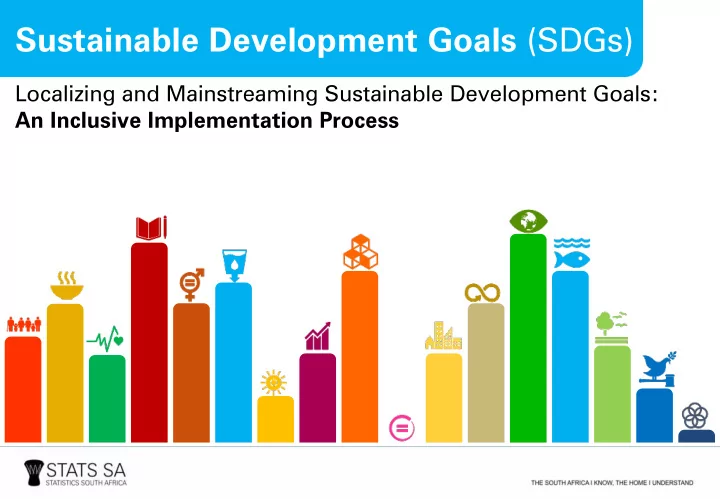
Goal 1
End poverty
Goal 2
End hunger, achieve food security
Goal 3
Ensure healthy lives
Goal 6
Ensure available & sustainable water
Goal 4
Ensure equitable quality education
Goal 10
Reduce inequality
Goal 5
Achieve gender equality
Goal 6
Promote peaceful & inclusive societies
Goal 8
Promote inclusive economic growth
Goal 7
Ensure affordable & sustainable energy
Goal 9
Build resilient infrastructure
Goal 12
Ensure sustainable consumption and production
Goal 14
Conserve and sustainably use the oceans
Goal 13
Strengthen implementation
Goal 15
Protect, restore and promote terrestrial ecosystems
Goal 11
Make cities inclusive, safe, resilient and sustainable
Goal 13
Urgent action to combat climate change
Apply to every nation, every sector, every organization Are inter-connected in a system for inclusiveness and coherence Are about changing how we do things
The approach of the SDGs agenda is a departure from the MDG process in 3 important ways
Apply to every nation, every sector, every organization Are inter-connected in a system for inclusiveness and coherence Are about changing how we do things
Significant changes: zero goals, universal goals, comprehensive goals, but also …
Are based on better data: timely, disaggregated, reliable information systems monitoring, evaluation and accountability
The “data revolution” refers to opportunity to improve the data for decision-making, accountability and solving development challenges.
Enable data to play its full role in the realisation of sustainable development by closing key gaps
refers to the incorporation
development targets in national and local strategies, plans, and budgets, and data systems
GOAL
INCLUSIVE ECONOMIC GROWTH
GOAL
HUMAN AND COMMUNITY DEVELOPMENT
GOAL
ENVIRONMENTAL SUSTAINABILITY
GOAL
STRATEGIC INFRASTRUCTURE
GOAL
HUMAN RESOURCE DEVELOPMENT
STRATEGIC GOALS
KwaZulu-Natal will be a prosperous Province with a healthy, secure and skilled population, living in dignity and harmony, acting as a gateway to Africa and the World
GOAL
GOVERNANCE AND POLICY
GOAL
SPATIAL EQUITY
GOAL
STRATEGIC GOALS
3.2 Enhance health of communities and citizens 3.1 Poverty eradication and social welfare 3.3 Enhance sustainable household food security 3.4 Sustainable human settlements 3.5 Safety and security 3.6 Advance youth, gender and disabled 3.6 Advance social capital
HUMAN AND COMMUNITY DEVELOPMENT
Domestication
3
Multi- stakeholder
2
Monitoring Reporting
6
Policy coherence
Public awareness
1
Budgeting
Risk Adaptability
SHORT TERM LONG TERM
MAINSTREAMING
tailoring SDGs to national, sub-national and local contexts
Stats SA is the national coordinator of the SDG reporting process, culminating in the production of the country report
we cannot talk about
Localizing and Mainstreaming Sustainable Development Goals: An Inclusive Implementation Process
Legislature
Parliament
Monitor, Communicate
review system that promotes systemic understanding
Align, Localise
a process of domestication to contextualise
Data, reporting
a system for advocacy capacity building
Legislature
Parliament
Monitor, Communicate
review system that promotes systemic understanding
Align, Localise
a process of domestication to contextualise
Data, reporting
a system for advocacy capacity building What existing structure / fora can be used?? Define roles of provincial role and respons players…. Define priorities What is the ideal structure for KZN?? Engage continuously
Stats SA Responsibility Shared Responsibility
generate sustained public awareness, involvement, support, ownership and accountability engage national, provincial and local government, civil society, businesses, community based groups, academia translate global to local: relevant, applicable and attainable at national, provincial and local levels / Public awareness
1
Multi- stakeholder
2
Domestication
3
A report FOR the countries stakeholders, developed BY the countries stakeholders Emphasising the principle
no one behind”
Satisfying SA/KZN Developmental Needs
Domestication
3
Multi- stakeholder
2
Public awareness
1
Align, Localise
a process of domestication to contextualise and adjusted to meet local peculiarities
Public awareness
1
generate sustained public awareness, involvement, support, ownership and accountability Multi- stakeholder
2
engage national, provincial and local government, civil society, businesses, community based groups, academia
KZN SDG Process
SDG advocacy and promotion provincially and regionally - Various stakeholders involved in process
Technical and regional workshops attended by various stakeholders from Gov, CSOs, Academia, Parastatals, Business, Development Partners
75 additional domesticated indicators emanated from the Technical and regional workshops translate global to local: relevant, applicable and attainable at national, provincial and local levels /
Domestication
3
Key issues emanating
participation., legislature civil society engagement
to engage meaningfully, especially as the goals should not be viewed in isolation
processes
structures to define a provincial governance structure for the SDG process
Monitoring Reporting
6
Data, reporting
a system for advocacy capacity building = platform to serve implementation
Without high-quality data providing right information on the right things at the right time; designing, monitoring and evaluating effective policies becomes almost impossible
Monitoring Reporting
6
a „data ecosystem‟ to provide timely, disaggregated data and reliable information systems for accountability
230 indicators divided into 3 Tiers to be monitored: Tier 1: Clear standards and methods developed and data available on the indicators Tier 2: Clear standards and methods developed, but not all countries have data
Tier 3: No standards and methods exist or methods are in process of being developed
KZN SDG Process
SDG
National Coordinating Committee (NCC) National Sectoral working groups (SWG)
Roles and responsibilities:
Staffed with technical people, representatives from:
Data and Reporting framework
The implementation and refinement of the PGDP has been institutionalised through the system or structure of Action Work Groups (AWGs),
17 set up to take responsibility for
the implementation and reporting of the various Strategic Objectives of the PGDP , as well as to provide input to the annual refinement of the PGDP . The SDG process to be aligned to this institutional framework
PGDP and Action working groups
Data and Reporting framework (Proposal) - Provincial
Theme AWG PGDP Goal SDG Goal People 8 & 17 3 & 6 5, 10, 16 Poverty, Food Security and Inequality 8 3 1 & 2 Health 10 3 3 Education 6 & 7 2 4 Labour 1 - 5 1 1 Economy 1 – 5, 12 & 13 1 & 4 3 & 9 Households 9, 11 & 18 3 & 7 11 Water & Sanitation 14 4 6 Energy 15 4 & 5 7 Environment 16 4 & 5 12 - 14 Governance 17 6 15 & 16
domesticated and supplementary indicators were proposed for all the 17 goals
National on 16 November 2016
Domesticated indicators and Supplementary and proxy indicators
Goal 1 4.0% Goal 2 10.7% Goal 3 9.3% Goal 4 17.3% Goal 5 1.3% Goal 6 8.0% Goal 7 9.3% Goal 8: 9.3% Goal 9 10.7% Goal 10 4.0% Goal 11 4.0% Goal 12 2.7% Goal 13 2.7% Goal 15 5.3% Goal 16 1.3%
Key issues emanating - Planning alignment and the SDG as a process
clear, there seem to be fragmentation in terms of the strategy.
review of IDPs presents an opportunity to determine how we can use the goals for purposes of reporting at a local level
Key issues emanating - Indicators and domestication
the local situation
a local level
require narrowing down
international partnerships (making global talk to local)
and demands for a provincial data ecosystem to report
Key issues emanating - data sources
Policy coherence
Budgeting
Risk Adaptability 7
Legislature
Parliament
Policy coherence
Budgeting
Risk Adaptability 7
Alignment of SDG structures to provincial policy and institutionalising collaboration with existing provincial government structures to define a provincial governance structure for the SDG process
Budgetary items to be identified during SDG process in terms of CSO involvement, data collection for Tier III indicators, amongst
Identifying risks and emerging issues, and adapting to them: reflection of lessons and what the data says in relation to progress
Key issues emanating
SDGs to form part of performance agreements
Sustainable Development Goals African Union Agenda 2063 National Development Plan Medium T erm Strategic Framework Provincial Growth and Development Plan District Development Plans Integrated Development plans
Provincial National Global Continental 20 Year 20 Year 20 Year 20 Year 20 Year 20 Year 5 Year Local
WARD BASED PLANS
Planning alignment for integrated implementation
The PGDS represents the establishment of a clear line-of-site to the national (NDP), continental (AU), and global (SDG) frameworks
Working Together For A Secure and Prosperous Future
GOAL
HUMAN AND COMMUNITY DEVELOPMENT
3.2 Enhance health of communities and citizens 3.1 Poverty eradication and social welfare 3.3 Enhance sustainable household food security 3.4 Sustainable human settlements 3.5 Safety and security 3.6 Advance youth, gender and disabled 3.6 Advance social capital
#3: Ensure healthy lives and promote well-being #1: End poverty in all its forms everywhere #11 Make cities inclusive, safe, resilient and sustainable #2: End hunger, achieve food security #16: Promote just, peaceful and inclusive societies #10: Reduce inequality within and among countries #5: Achieve gender equality and empower women and girls
Insert Text Here Insert Text Here Insert Text Here
Public awareness
Consultation, Regional information workshops 28 October, 2 November, 4 November
Domestication
Provincial Technical workshop 24-25 October, National workshop 1 – 2 December
Finalise indicators
Consolidation of inputs 3 October 2016
ROADMAP TO SDG REPORTING
Align indicators
Tier system inputs 30 September
Finalise SWGs
Appointment of the SWG members and ToR
Baseline report
Draft baseline report finalised 31 March 2017 Final set of indicators for baseline report identified 31 January 2017
Baseline Indicators
IAG meeting Provincial report 1 8 November 2016
Provincial indicators
WORLD DATA FORUM
1 2 3
PGDP indicator alignment with the SDGs
SDG Indicator alignment
towards alignment of SWGs and Provincial sector’s AWG as a focal point
Provincial Governance Structures
provincial commitment on the SDG report
Provincial Capacity Building Continue the dialogue at a provincial level
1 2 3
Global set of indicators agreed to as a starting point at the 47th session
March 2016
International: SDG Indicators
1st 10 years of Agenda 2063
document to Finance and Planning Ministers, Adis Ababa, March 2016
consists of 80 indicators to track flagship projects
Continental: Agenda 2063
reviewed
reviewed
started at provincial level
National SDG indicator Domestication Workshop
National: Governance Structures/Reporting
National Consultative Workshop: 1 - 2 December 2016
DIRCO presented on the SDG process in South Africa and discussed some of the following:
based multilateral institutions
for their economic recovery
challenges
Development Negotiating the 2030 Agenda For Sustainable Development
National Consultative Workshop: 1 - 2 December 2016
DIRCO presented on the SDG process in South Africa and discussed some of the following: Key elements of the 2030 agenda
social and environment
build peaceful and just societies iv) empower v) lasting protection
Addis Ababa Action Agenda on financing for development
capabilities
forward
National Consultative Workshop: 1 - 2 December 2016
DIRCO presented on the SDG process in South Africa and discussed some of the following:
Financing
SDGs require substantial amount of financial and non financial resources
National Consultative Workshop: 1 - 2 December 2016
DIRCO presented on the SDG process in South Africa and discussed some of the following:
Challenges
Development
climate change by development partners
consultation with the target beneficiaries and not aligning their programming with the requirements of developing countries
National Consultative Workshop: 1 - 2 December 2016
DIRCO presented on the SDG process in South Africa and discussed some of the following:
Opportunities
human rights principles and standards.
implementing SDGs
sustainable industrial development
1 2 3
indicators to be finalised – IAEG – SDG members
indicators at the 48th session of the UNSC in March 2017 International: SDG Indicators
(CoDGs) and presented at Heads of State Summit for Adoption 2017 Continental: Agenda 2063
TWG ToRs
indicators
nomination by sector departments
National: Governance Structures/Reporting
AT THE FIRST-EVER UNITED NATIONS WORLD DATA FORUM, DATA AND STATISTICS EXPERTS FROM AROUND THE WORLD
29 October – 04 November 2017 Cape Town International Convention Centre Cape Town, South Africa